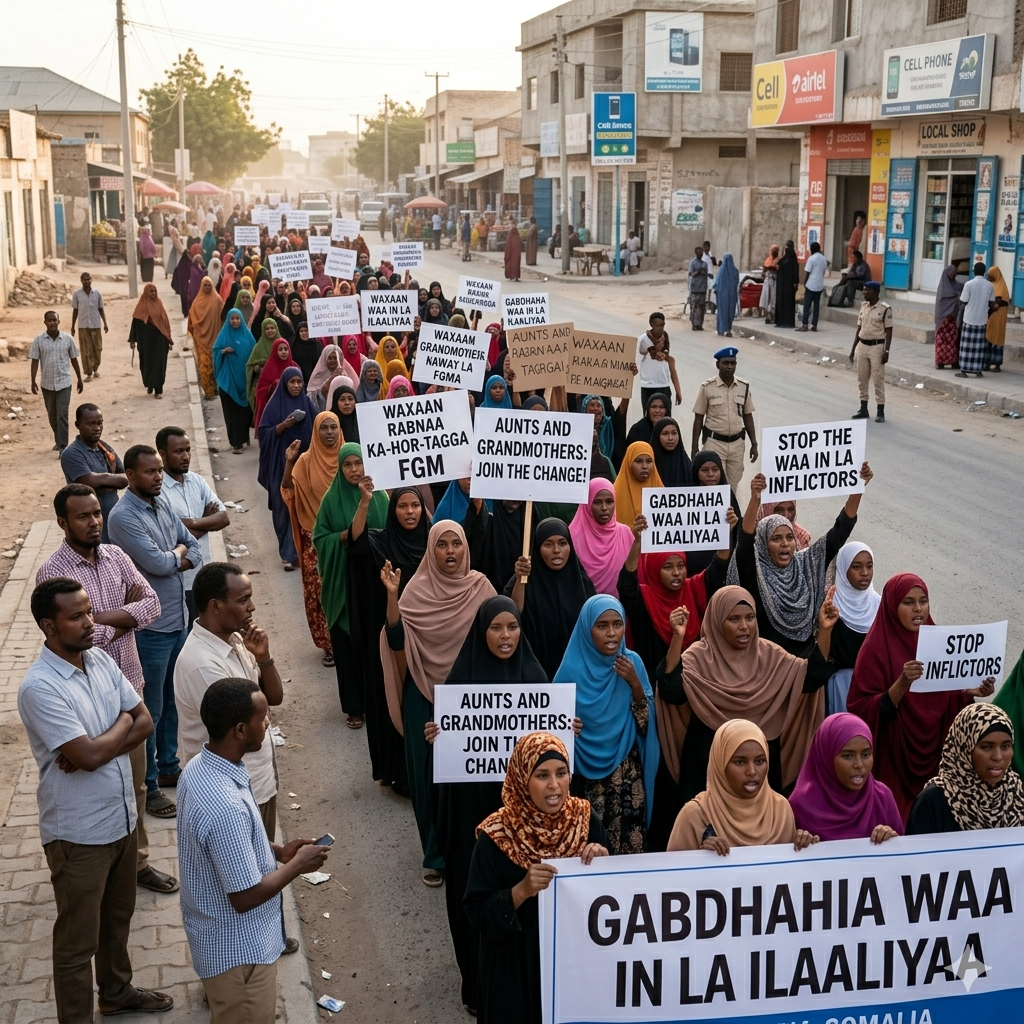

It may take a village to raise a child, yet it takes the whole world to protect them. So, what happens when the child’s family are the ones inflicting harm? Grandmothers, aunts, and mothers restrain their granddaughters, nieces, and daughters all while the elder woman in the community cut into the most intimate part of the child’s body. Edna Adan Ismail, at only eight-years-old, did not have the whole world protecting her. Edna recalls falling into a state of confusion and fear as she was restrained by those who were supposed to protect her, who instead held her down to commit the most gruesome violation against her innocence and her human rights. Edna experienced a reality for millions of young girls and adult women worldwide who undergo Female Genital Mutilation (FGM). UNICEF estimated in 2024 that ninety-nine percent of Somalia’s female population from the ages of fifteen to forty-nine have undergone FGM.1 The prevalence of FGM suggests that the practice remains grounded in societal, cultural, and religious traditions, which is often argued as a form of protection during decades of conflict that maintained FGM and even amplified this practice. How can we understand a violation of human rights so anchored inside of families and communities that deeply affects almost all women in Somali society? This article explores how culture, religion, and political instability all increase the practice of FGM while at the same time denying negative health implications and even mortality.
No Safe Cut: Terminology, Practitioners, and Immediate Health Risks
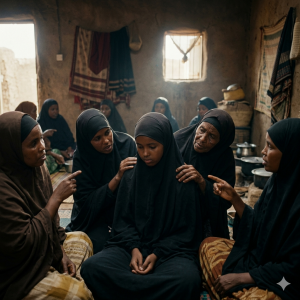
I clarify in this section the terminology and I present the physical consequences to explain the severity and health complications that accompany FGM. The United Nations (UN) has defined Female Genital Mutilation (FGM) as opposed to Female Genital Cutting.2 By referring to FGM rather than Female Genital Cutting which reduces to just “cutting” of the female genitalia and diminishes the methods, techniques, and untrained practitioners who inflict the mutilation. However, survivors and some medical professionals of FGM prefer the term “cutting” as it respects the agency of the women who underwent the practice and does not devalue them as “mutilated bodies.” FGM comprises of four forms of altering female genitalia that lead to health complications for the women and girls. In Somalia, Type III (Infibulation) is the most common and the most severe form of FGM which consists of “narrowing of the vaginal orifice” that is then covered by the “labia minora and/or the labia majora” while the clitoral glans can either be left in place or removed.3
There are no safe options for performing FGM, whether it is done by a medical professional in a hospital with antibiotics and pain medications or whether in a backroom with razor blades by a traditional practitioner. Usually traditional elder women practitioner come to the villages and complete several FGM in the same day without any medical assistance which further heightens the risk of infection, fistula, infertility, still births, or even death. Traditional practitioners consist of non-medical professionals such as elder women of a family or community performing the procedure who were taught to perform FGM by women of the older generations. Although it is unknown why traditional practitioners are the ones primarily performing FGM, it is suggested that FGM is a “strictly ritualized” practice followed by a ceremony that is celebrated “during times of harvest.”4 In Edna’s experience, the procedure was performed in her own home by a traditional practitioner. The method used on Edna included stitching her wounds with “acacia thorns” and later rubbing “a mixture of herbs, sugar and raw egg yolk all intended to heal, but in fact all introducing a much higher probability of infections.”5 Such ritualistic methods highlight how the practice ties in religious and cultural justification in Somali society. The World Health Organization (WHO) emphasizes the risks of the FGM practice for the women and girls. Women and girls who undergo FGM experience a surge of health complications such as “severe infections, heavy blood loss… extreme pain and emotional trauma” immediately following the mutilation and often for decades to come.6
Not in the Name of Islam: Religious Misinterpretations and Patriarchal Control.7
Although FGM is not mandated by Islam, misconceptions and patriarchal norms of FGM have combined the practice with notions of chastity and marriageability dating back to Ancient Egypt. The origins of FGM remain unclear; however, scholars propose two theories on why FGM was performed: (1) FGM was performed on female slaves during the Arab traders to prevent “coitus and pregnancy,” and (2) perpetuated inequality between of hierarchical groups.8 The primary drivers of maintaining FGM alive in Somalia are societal expectations rooted in misconceptions and misinterpretations of religious texts. In Somalia, the total population is over 19 million and it is estimated that over ninety-nine percent of the population is Muslim.9 Disagreement among the various schools of Islamic jurisprudence about whether FGM is a religious requirement stem from the “weak and unauthentic Hadith” of Prophet Muhammad.10
SOme prefer to speak of “circumcision” and then often reference parallel it as ‘sort of equivalent’ to male circumcision; however, both forms are unrelated to one another even though both involve transforming genitalia. FGM would be more attuned to the castration of males not the circumcision. Prophet Muhammad instructed all Muslims to “follow the milat (religion) of Ibrahim,” who is recognized as a Prophet that was circumcised when he was eighty years old.11 Prophet Muhammad had several children who were held to the same high regard of following Islamic laws. If his children committed a violation of Islamic law, they too, would be punished for their crimes. If FGM was a requirement of Islamic law, his daughters, too, would be expected to undergo the procedure. However, there is no Qur’anic or Hadith justifications or mentions of FGM as a requirement nor are there any mentions of Prophet Muhammad’s daughters undergoing FGM.12 The real drivers, then, lie in societal expectations of chastity and marriageability. Therefore, the challenge to curb the practice based on the misinterpretations by the various schools of jurisprudence of Islam where all religious leaders have different perspectives for advocating FGM as an Islamic requirement.
Chastity and marriage, on the other hand, are requirements of Islamic law. Therefore, to certify that women and girls remain pure and eligible for marriage, families force FGM on their daughters even when no religious texts requires the procedure itself. This is to ensure a semi-permanent chastity to control women’s and girls’ sexual desires, and those who oppose the procedure are “outcasted socially…including being unable to marry.”13 Edna, a Muslim herself, recalls knowing of families who are often shamed if they do not subject their granddaughters, nieces, or daughters into the practice. When Edna’s father, who advocated against FGM, discovered that FGM was performed against his wishes, he was outraged. The outrage Edna’s father felt is uncommon for most families in Somalia. In fact, it is a societal expectation for woman and girls to undergo FGM or they risk exclusion and isolation from society. These same societal pressures operated within a political vacuum that allowed FGM to flourish unchecked for decades. Her FGM experience ignited a fighting spirit within Edna, and she began advocating for women’s rights against the practice once she reached a political position within the Somalian government.
Politics, Militia Groups, and the Shielding of Tradition
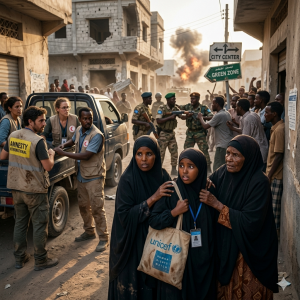
The political climate of Somalia had been unstable under the dictatorship of Siad Barre during the 1960s to the early 1990s. Contrary to the initial response in reforming Somalia’s legislative policies, Dictator Siad Barre’s promises to the people of Somalia, in turn, had furthered the suppression of human rights. During the 1970s, Edna became the first woman to advocate against FGM during a medical conference in Sudan when she was appointed as Director in Ministry of Health. Edna recalls requesting permission from Dictator Siad Barre to present her argument that FGM is not an Islamic requirement, therefore, it should be “viewed as a problem to be addressed and brought to an end.”14 Once granted permission, Edna would publicly advocate against FGM; however, she began receiving death threats from those who opposed her campaign. After Dictator Siad Barre had invaded Ethiopia, he intensified his political oppression of the Somali people, to the extent that Somalians were “jailed, tortured, and executed” if they opposed his authority.15 In 1991, Dictator Siad Barre had been forced to flee the country and regions of Somalia were in control of militia groups that initiated the Somali Civil War. Any efforts to eradicate these militia groups, now known as the al-Shabaab have been unsuccessful throughout the years. Nowhere is this entanglement of politics and tradition more dangerous than in areas still dominated by al-shabaab.
How is al-Shabaab tied to the efforts of outlawing of FGM? In al-Shabaab-controlled regions, the group’s strict interpretation of Sharia Law further entrenches FGM, turning it into both a traditional rite of passage and as a tool for protection. With millions of displaced Somali people, they are left having to seek refuge in refugee camps in Kenya which borders the southern regions of Somalia where al-Shabaab is primarily active. As of 2024, the UN Security Council acknowledged that women and girls in Somalia are most vulnerable to gender-based violence due to “multiple displacements, difficult living conditions, and overcrowded IDP camps.”16 Families traveling through al-Shabaab-controlled areas are either forced into recruitment or voluntarily join through support of “payment” and “family support.”17 Women and girls in al-Shabaab-controlled areas are expected to uphold FGM as both a traditional rite of passage and an expression of the group’s interpretation of Sharia Law. Women and girls are also prohibited from the influence of external sources, that deviate from their interpretation of Islam which includes humanitarian aid that may be confused with enemy forces. Edna’s refuses to allow the feeble Somalian government or the ideologies of al-Shabaab silence the efforts of her anti-FGM campaign.
Unfortunately, the exact data gathered about the attitudes towards FGM in these al-Shabaab-controlled areas is unclear. Any efforts by humanitarian organizations to aid displaced families in Somalia are targeted by al-Shabaab.18 Against this backdrop of governmental collapse and extremist resistance, Edna Adan Ismail’s personal and professional excursion offers the roadmap for change. Meanwhile, the collapse of the government plays a major role in the set-back of moving away from patriarchal control of women and the misinterpretation of Islamic principles. Edna worked tirelessly in Djibouti while employed as a Regional Technical Officer for the World Health Organization (WHO).19 However, she decided to return to Somalia in 2002 to open the Edna Adan Maternity Hospital where she recruited volunteer medical professionals in treating women and girls, many of whom had undergone FGM. By 2010, Edna had opened the Edna Adan University that serves as a blueprint of Somalia’s progress of ending FGM where thousands of medical students would provide services and advocate against FGM throughout East Africa.
Education First: Edna’s Blueprint for Everlasting Change
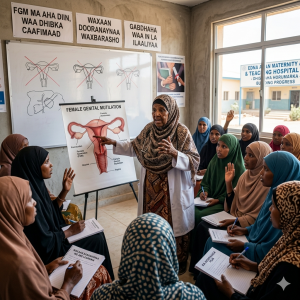
Edna’s efforts in eradicating FGM provides the guiding principle, “education is more important than legislation alone,” which directly confronts the cultural, religious, and political forces that have sustained FGM for centuries.”20 FGM is a deep-rooted practice within Somalian society and approaching the topic can lead to resistance. In fact, Galmudug was the first federal member state of Somalia to outlaw FGM in 2024; however, enforcement of the law has been unsuccessful as people continue to practice FGM under the scopes of the law.21 That is not to say that legislation is not a requirement for eradicating FGM. It means, that with all things considered that contributed to the collapse of the Somali government by the actions of Dictator Siad Barre, there is a strong distrust of government.
Edna Adan Ismail’s life-long mission in ending the FGM practice reflects on the challenges: only education can help eradicate FGM, not merely focused on outlawing the practice. In providing education to medical professionals and acquiring the support of religious leaders, society can begin to dismantle the FGM practice that is deeply entrenched within societies worldwide. After the launch of the Edna Adan Maternity Hospital, more than 4,000 medical professionals use their expertise to advocate against FGM throughout various regions of Somalia.22 Just like Edna’s initial stance and anti-FGM argument have began to slowly shift attitudes within society scarred by dictatorship, civil war, and al-Shabaab extremism. However, to change the attitudes of all people about FGM still remains a constant battle. Without sufficient investment in education, community opposition to FGM remains elusive. Nationwide enforcement has also been out of reach. Future generations of girls will endure the barbaric and harmful practice just as Edna did when she was a little girl. The world must call for actions that would foster the safety and wellbeing of girls as so many millions still risk FGM and its consequences.
- Tannistha Datta and Deeqa Nur, “Breaking the Silence: Somalia’s Legislative Journey to End Female Genital Mutilation,” UNICEF | For Every Child, June 2025. ↵
- UNFPA, “Female Genital Mutilation (FGM) Frequently Asked Questions,” UNFPA, February 2026. ↵
- UNFPA, “Female Genital Mutilation (FGM) Frequently Asked Questions,” UNFPA, February 2026. ↵
- Anne M. Gibeau, “Female Genital Mutilation: When a Cultural Practice Generates Clinical and Ethical Dilemmas,” Journal of Obstetric, Gynecologic & Neonatal Nursing, 27, 85-91. ↵
- Edna Adan Ismail, “A Woman of Firsts: The Midwife Who Built a Hospital and Changed the World,” HarperCollins Publishers Ltd, July 2019, 40-41. ↵
- WHO, “New Study Highlights Multiple Long-Term Health Complications from Female Genital Mutilation,” World Health Organization, April 14, 2025. ↵
- Celine Jacquemin (April 2010) “Female Genital Cutting: shattering the debate yet still violating human rights,” Revista Espaco Academico, #107. ↵
- UNFPA Somalia, “Understanding FGM In Somalia: A Study of Practice, Progress & Pathways in Selected Districts,” UNFPA, January 8, 2026, 9. ↵
- The ARDA, “National/Religion Profiles: Somalia,” The Association of Religion Data Archives, 2025. ↵
- Navida Sayed, “FGM- Not in the Name of Islam,” The Review of Religions, January 5, 2015. ↵
- Lethome Asmani, Ibrahim, and Maryam Sheikh Abdi, “Delinking female genital mutilation/cutting from Islam,” Nairobi: Population Council, 2008, 3. ↵
- Navida Sayed, “FGM- Not in the Name of Islam,” The Review of Religions, January 5, 2015. ↵
- Actionaid, “The Problems with FGM Explained,” Actionaid, February 4, 2026. ↵
- Edna Adan Ismail, “A Discussion with Edna Adan Ismail, Director and Founder of the Edna Adan Maternity Hospital in Hargeisa, Somaliland,” Berkley Center for Religion, Peace & World Affairs, July 8, 2013. ↵
- Jerome L. Neapolitan, “Muhammad Siad Barre,” EBSCO Knowledge Advantage, 2023. ↵
- EUAA, “COI Report – Somalia: Country Focus, May 2025, 30. ↵
- EUAA, “1.1.1. Recruitment of Men, Women, and Children by Al-Shabaab,” COI Report – Somalia: Country Focus, May 2025. ↵
- NCTC, “Al-Shabaab,” National Counterterrorism Center: Counter Terrorism Guide, 2026. ↵
- Benjamin Carlson, Thomas Burnett, “Dr. Edna Adan Ismail Receives 2023 Templeton Prize,” Templeton Prize, May 16, 2023. ↵
- Benjamin Carlson, Thomas Burnett, “Dr. Edna Adan Ismail Receives 2023 Templeton Prize,” Templeton Prize, May 16, 2023. ↵
- Tannistha Datta and Deeqa Nur, “Breaking the Silence: Somalia’s Legislative Journey to End Female Genital Mutilation,” UNICEF | For Every Child, June 2025. ↵
- Kathryn Post, “Nurse-Midwife Edna Adan Ismail, Opponent of Female Genital Mutilation, Wins Templeton Price,” National Catholic Reporter, May 17, 2023. ↵
16 comments
Valentín García
It is go good to read your article again, Cielo. I appreciate how your piece approaches the FGM practice in a practical and informative tone, while maintaining a call-to-action framing. You do exceptionally well in balancing between acknowledging the sociocultural impetus of faith (per its subjective interpretation, of Islamic teachings), and presenting a productive argument against the practice in spite of potential culturally-relative justifications (ie ritualism and tradition). Your writing is gripping yet grounded, and your narrative delivery via Edna’s story drives the subject home intuitively and decisively. Your article deserves all of its accolades and more!
Rosa Inocencio
Hi Cielo, I truly enjoyed reading your article! I have never heard of anything like this before, especially of Somalia so this was definitely something new, sad and shocking. The fact that FGM was pushed for as if it was religious/the law was very crazy to read because some of the individuals undergoing this were literal children, so to think that their families did not protect them from this was very shocking. I liked that you told us a bit of Ednas story and I liked how she was very determined to put an end to FGM. Great article!
Silvia Benavides
Hello Cielo,
Congratulations on writing an amazing article and showing your audiecne a extremly dynamic topic and still having it very informative. I learned so much while reading it. Amazing job!
Mía Perez
I really enjoyed reading your article, it shed light to so many unspoken topics. Seeing that Female Genital Mutilation is not even done by strangers, but by their family who thought they were keeping their daughters safe. That tension between care and abuse/harm makes the practice especially difficult to confront. I also thought the discussion of political instability and groups like al-Shabaab to be crucial in this because it shows how violence and weak governance creates harmful traditions to continue without protest.
Elizabeth Vazquez
Hello Cielo,
I appreciate the introductory sentence and the way the article transitions into a compelling narrative from which one might hope to protect girls int he future. Considering the various health complications involved with FGM, emotional trauma adds a most challenging aspect. Your mention of the link between this practice and inequality among hierarchical groups leads me to believe that it may be an issue extremely hard to fully erradicate.
I was previously unaware of the civil war in Somalia; I appreciate your brief overview of that history. We share a common theme in our articles—here, you discuss the displacement of people from Somalia to Kenya, which parallels the topic I explore regarding Ukrainians displaced into Poland.
Finally, I commend Edna Adan Ismail for her efforts in establishing an organization and a hospital, as we recognize that education is a vital form of empowerment.
Martin Gonzalez
I love your piece, the last section that goes into education and how valuable it is, especially in this case with FGM and how it can help women. As someone who views education as extremely valuable it was great to read how it can provide women who have to go through these acts. My article also focuses on women, though more into the social aspects of change but still both of our pieces have considerations of how societal aspects reflect thoughts on marriage.
Layla Rangel
Cielo, you did an amazing job with this article. The fact that reading it made me feel uncomfortable and disturbed is the biggest indicator that you successfully illustrated the cruel reality that these women face in Somalia. I was especially surprised to read that the origins of FGM aren’t even completely known. The fact that FGM is so commonly practiced based on “theories” and social expectations is shocking. I’m glad to learn that Edna is working against this to bring change. A link I between Somalia and Venezuela I found is how political instability and weak governments can create long-term social problems that affect everyday life.
Christian Molina
Hey, Cielo! Female genital mutilation is a new concept to me, so this whole article has been eye-opening. The social-pressuring of it both surprises me but also makes sense. Traditions, even ones like this, are just upheld social practices. But I would think that in a tradition this harmful, over the generations people would learn the consequences and begin to abstain or find alternatives to maintain tradition without harming people. Especially since you pointed out that Islam doesn’t actually require FGM.
Tina
Hello, Cielo! Your work is incredible. I really, really like your introduction. I think that by providing more detail and using relatable language that you really created an introduction that makes an impact for readers leaving a very strong impression of the issue as well as you as the writer. This topic is completely separate from mine but I believe there is the same denial of the root of an intense issue that causes the normalization of a complex problem as it further entrenches itself in a nations history. For Mozambique and Somalia, I believe there is a lack of proactive action that stunts how quickly progress towards a solution can occur which is only clouded by the several other factors which could make it challenging to see the true root of the problem.
Emilio Orona
I like how you explain that FGM is not a medical issue rather it concerns to religion practices. It was a compelling move to include a personal experience (Edna Adan Ismail), so we can relate to it more. The whole article portrays the prolonged trauma reinforced by family and community structures. Cielo you also emphasize the difference in the power of language. FGM is a more traditional connotation while cutting would-be a more violent connotation. What stood out the most was the argument that religion is often misinterpreted rather than being the true source of the practice, and that social expectations around chastity and marriage are actually driving enforcement. The article also connects how FGM is intertwined with politics in a way. It mentions the instability from groups like Al- Shabab. In connection to my own article, which focuses on how institutions and social systems shape human rights outcomes, this piece reinforces the idea that laws alone are not enough to change behavior