
References
College Board. (2025). Trends in student aid. https://research.collegeboard.org/trends/student-aid
National Center for Education Statistics. (2026). U.S. college enrollment statistics (Table 303.70). https://nces.ed.gov/programs/digest/d24/tables/dt24_303.70.asp
National Center for Education Statistics. (2026). U.S. college tuition, fees, room, and board rates for full-time students (Table 330.10). https://nces.ed.gov/programs/digest/d23/tables/dt23_330.10.asp

11 comments
Rosa Inocencio
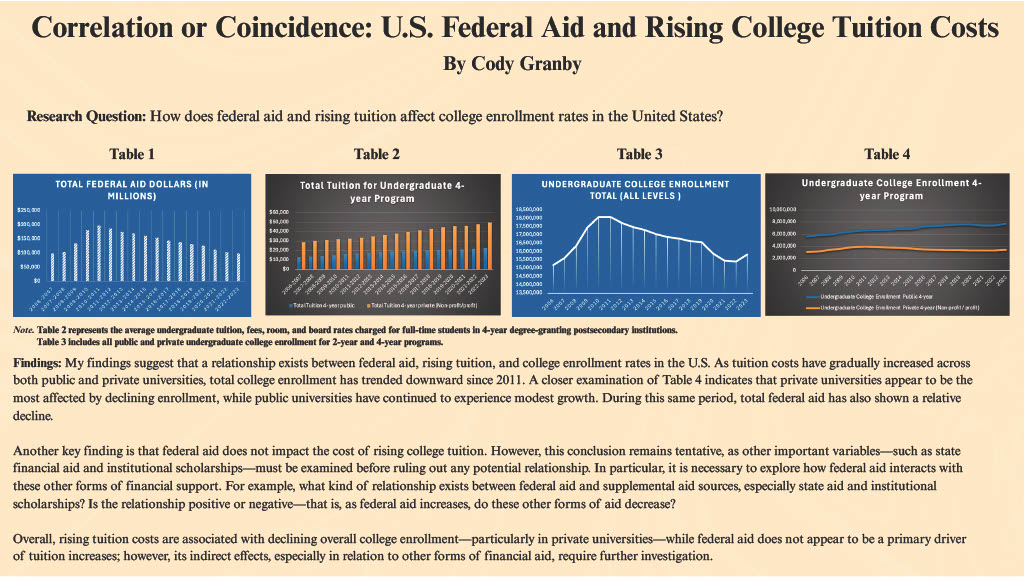
Hi Cody, great infographic! Your infographic does a great job at informing us about the connections between financial aid, the rise of college tuition, and college enrollment. I liked how you included graphs because with them we are able to see how the cost of schooling has increased and how enrollment has decreased possibly do to it since higher tuition cost can discourage individuals from attending college.
Christian Molina
Hi, Cody! As a college student, I was instantly drawn to your infographic. I feel as though all of us, as college students, are incredibly concerned with the price tag that comes with it. Your work exploring the relationship between federal aid and rising costs is really important! I know you said your findings were still tentative, so I hope to see you continue this work!
Tina
Hi Cody! This is a great analyzation of what the cost of tuition is as well as how that correlates with the amount of students who are currently enrolling in private university. Federal and institutional aid play a clear role, education is an important thing to have in any society but important differences like these can also lead to questions about accessibility whether that’s in the United States or other parts of the world that should have access to education in order to understand the actions of their nation.
Martin Gonzalez
It’s extremely interesting how the connection between the ever growing tuition rate and undergrad growth has especially affected the amount of people applying to private universities. Especially since this article is on a private university’s website which also is known for having very high tuition with lower enrollment (at least in comparison to UTSA and Texas A&M). I also find it interesting because in my article on Vietnam higher education is connected with social progress which has occurred from the major economic reforms from the latter half of the 1980s.
Yosany
Cody,
I think you picked an interesting topic that clearly affects us all. College having a financial barrier is clearly a worsening issue, with no relief in sight. While it is something that i have known for a while, your infographic really shows how bad the gap has gotten. As a low income student, i saw how many students chose to forgo an education past high school due to the large price tag. Financial aid does provide some help, but as your graphs show for some it may not be enough. While i was deciding on which university to go to for undergrad, i had managed to secure a 100k scholarship for a private uni. While fantastic, it resulted to about 25k per year for a school that charged 75k annually. Which was simply not enough. The decline of enrollment aligning with the decline in aid really drives home how the interest for higher education is there but isnt being encouraged. I think your inclusion of potential research are excellent and show how there is still so much more to be understood from this topic.
Shaikha Alodssary
Cody
This infographic is great in that you have explored the issue of the correlation between the increase in federal financial assistance and the rise in college tuition costs. What I particularly liked about this infographic was that you have used several data sources in order to demonstrate several dimensions of the issue. From what one can see from the charts included in your infographic, the correlation is definitely complicated. Your interpretation demonstrates strong critical thinking skills as you have taken into consideration other possible reasons for that.
Valentina Gaona
Hi Cody,
I think you explained this topic really well. It addresses how the rise in tuition has been affecting university enrollment, and it is interesting that, even with financial aid, it is not enough help and tends not to be a factor in people staying enrolled. Your infographic provides a really good insight into this topic, and it is well-written.
Paul Jones
Cody
This is an interesting and unique IPE topic and infographic. Very well done. Your data clearly shows that since 2011, college tuition has increased and federal aid has decreased. At the same time, enrollment at private colleges has been declining while public college enrollment has continuously been increasing. My hypothesis would be that private colleges cost more money to attend, and without sufficient federal aid to assist students in paying tuition, they simply cannot afford this more expensive option. Comparatively, public colleges cost less than private schools, thus minimizing the financial burdens on students and making this a more favorable path to choose. I believe your data shows this to be true.
You provide some interesting ideas for further research. Somewhat in the same vein, should you choose to research why exactly federal aid has been decreasing in recent years, another factor which might be worthwhile to consider is employment data. My hypothesis is that if the economy is doing poorly, and college graduates are unable to find meaningful work, then federal aid might naturally be cut as the U.S. government concludes that there is a poor return on their investment. In the spirit of being fiscally responsible, if using tax-payer dollars to assist others to receive an education to eventually get a job is not actually a successful model that ultimately boosts the economy, then elected officials may very well choose to invest those same dollars in other competing initiatives.
Another suggestion to strengthen the infographic might be to show the rising tuition costs compared to inflation over the years. This could be informative and provide some insight into the concerns with the rising cost of education, in relation to the rising cost of everything else, just to add some perspective and highlight significant discrepancies found in the data.
Overall, this is clearly a thought-provoking study and I appreciate you taking the time to do this research and share your findings. I realize my comments begin to deviate from your initial research question, but I believe this shows just how much of a wonderful topic you have chosen to study. Strong work!
No AI was used.
talsaif
*Disregard my previous comment.
Hi Cody,
Reading your infographic feels like uncovering a quiet tension in higher education almost like two forces moving in opposite directions. On one side, tuition keeps rising, making college increasingly expensive. On the other, enrollment begins to fall, especially after 2011, suggesting that more students are being priced out of the system.
What really stood out to me is your central question: is federal aid helping, or is it just coincidentally moving alongside these trends? Your findings challenge a common assumption. Many people believe that federal aid directly drives tuition increases, but your analysis suggests the relationship isn’t that simple. Instead, the decline in enrollment, particularly in private universities, points to affordability as a growing barrier, even with aid in place.
I also found your point about the hidden layers of financial aid really compelling. By bringing in the role of state aid and institutional scholarships, you highlight that federal aid doesn’t operate in isolation, it’s part of a much larger financial ecosystem. That raises an important question: are we looking at the full picture when we talk about college affordability?
Overall, your work tells a deeper story, not just about rising costs, but about access, inequality, and the limits of current policy tools in keeping higher education within reach.
bhouston2
Cody,
Your infographic addresses a very pertinent issue in today’s society. As low-skilled labor jobs have continued to be either off-shored or automated, the need for education to be competitive in today’s labor market is at an all time high. Your findings help contribute to the effort of finding out why college has gotten so expensive, and enrollment rates have not matched the need for high-skilled labor.