I was born and raised on the border of Texas in the city of Brownsville. Upon graduating in the Spring of 2026, I will receive a bachelor's degree in forensic science biology. After graduation, I plan to pursue a medical degree to specialize in cardiology or pediatrics. While at St. Mary's University, I have assisted in the planning committee for the Women in STEM dinner, an event empowering and encouraging all people to support and appreciate the work done in the science community by women. I have also participated in the TRiO Student Support Services Program, where I serve as a peer coach and tutor for the students within the program to assist with students who are first-generation, low-income, or have a documented disability. Additionally, I participated as an undergraduate research student under the direction of Dr. Enslow and Dr. McLeod, where I have extended my curiosity in immunology and forensics research.
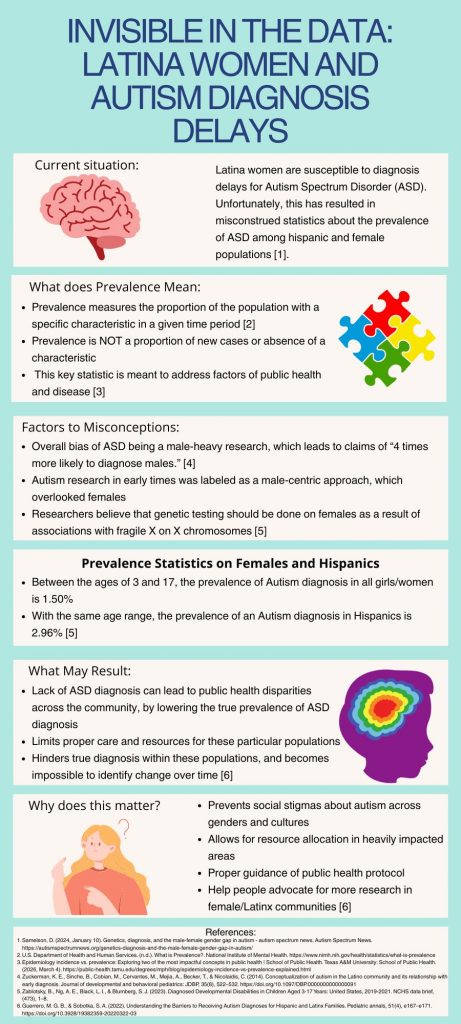
Hi Abigail! I have to be honest that as a member of the Hispanic community whenever I think of ASD I do not think of us, this is really bad because of course Hispanics can have ASD too. As your infographic highlights there is a history of ASD being diagnosed from a male centric view leaving women being underdiagnosed, of course this affects Hispanic women even more given we are a minority. Thank you for reminding us that Hispanic women can also have ASD.
Hello Abigail! I found your infographic very insightful, especially regarding delayed diagnoses for Latinx women. Your research reinforces the fact that women’s health has historically been neglected in medical studies. I also appreciated how you addressed the role of cultural stigmatization, which often makes it even more difficult to pursue necessary medical research. Great job on highlighting these critical issues and their impact on the community!
Hi Abigail,
The stigmas that surround any neurological and developmental disorder, especially pertaining to women and girls, that hinder the ability of getting the adequate services. Recently, there have been more people receiving this diagnosis in adulthood because they were unaware of the disorder when they were younger. This could be either because of denial from caregivers or inadequate information on the characteristics. Typically, women demonstrate different characteristics that do not align with the collected data on ASD; however, these characteristics are more so gathered from males. Overall, this is a topic I would like to explore further. With that said, great job on your infographic!




3 comments
Maurissio Gonzalez
Hi Abigail! I have to be honest that as a member of the Hispanic community whenever I think of ASD I do not think of us, this is really bad because of course Hispanics can have ASD too. As your infographic highlights there is a history of ASD being diagnosed from a male centric view leaving women being underdiagnosed, of course this affects Hispanic women even more given we are a minority. Thank you for reminding us that Hispanic women can also have ASD.
Samantha Garcia Mora
Hello Abigail! I found your infographic very insightful, especially regarding delayed diagnoses for Latinx women. Your research reinforces the fact that women’s health has historically been neglected in medical studies. I also appreciated how you addressed the role of cultural stigmatization, which often makes it even more difficult to pursue necessary medical research. Great job on highlighting these critical issues and their impact on the community!
Cielo Jerusalem Vargas
Hi Abigail,
The stigmas that surround any neurological and developmental disorder, especially pertaining to women and girls, that hinder the ability of getting the adequate services. Recently, there have been more people receiving this diagnosis in adulthood because they were unaware of the disorder when they were younger. This could be either because of denial from caregivers or inadequate information on the characteristics. Typically, women demonstrate different characteristics that do not align with the collected data on ASD; however, these characteristics are more so gathered from males. Overall, this is a topic I would like to explore further. With that said, great job on your infographic!