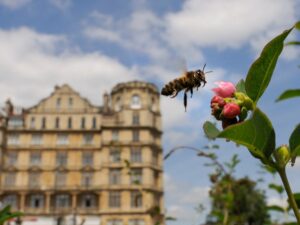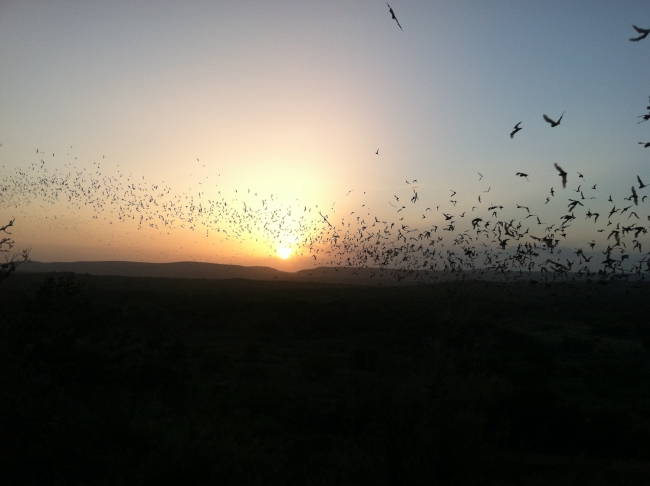

Maybe you’ve heard them when walking late at night or passing under a bridge at dusk, but bats are more than a Halloween decoration. They are responsible for some things as nutritious as the fruits in your home to as recreational as the tequila that goes into your favorite margarita– for those of age. 1 They are an intrinsic part of the worlds’ economic and ecological systems and under a grand umbrella of earth stewardship, their conservation is beneficial not just for them, but for us as well.
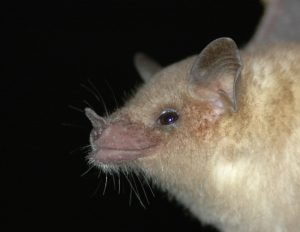
During the annual migration of Mexican long-nosed bats (See Fig.1) from Central Mexico to the southwestern US, pregnant females chase a “nectar corridor” from agave plants, the key ingredient in tequila. The corridor extends northward during the spring growing season as temperatures warm and the agave blooms further and further north. Once done migrating, they will roost in Texas and New Mexico, ween their young until they fly back south, and begin the process again. 5 Although bats benefit mankind through pollination, they are also contributors to pest control and seed dispersal as well.6While study results differ and the estimates vary for the total ecological value of bats, it is known that many species are insectivorous and feed on agricultural pests, helping farmers improve crop yield and decreasing the need (and cost) for pesticides. Furthermore, bats that are frugivorous, which means they eat fruit, disperse the seeds of their forage while eating.7
But beyond ecological value, there is monetary value in their preservation. Nightly bat flights can generate tourism dollars. In recent years, the maternity colony of Mexican free-tailed bats that roosts under Ann W. Richards Congress Avenue Bridge in Austin, Texas attracts approximately 140,000 tourists and generates $10 million a year in economic activity. 8 These wide-ranging benefits are just some examples of how important a healthy bat population can be.
As humans, we are responsible for the spark of the Anthropocene, or the “Human Epoch”. Some organisms have readily adapted to the human-built environment, but that is not the case for all species, and bats are no exception. 9 Bats are an important part of mammalian diversity, constituting nearly a fifth of the world’s biodiversity in mammals. Unfortunately, they are extremely underrepresented in research and about a third of bat species are classified as “threatened” or “data deficiency” by the International Union of Conservation of Nature (IUCN). This lack of a broad research base means bat conservation is a complicated topic, and a challenging one at the least.10
Agriculture is identified as a threat for over 50 % of bat species that are considered threatened by IUCN. Nearly 40% of land cover is now under agricultural use, and the resulting direct loss and modification of habitat reduces bat populations. Agricultural practices tend to reduce foraging and resources for roosting species in the area. Also, what usually comes with managing large areas of land are pests, which usually means the use of pesticides. The application of pesticides can poison insectivorous bats directly through their food source, and lead to a lack of insect prey abundance. For bats that feed on fruit crops, there can be direct conflicts between them and the farmers. But the physical interactions between bats and humans can be even more grim. Roughly 13%, or one hundred and sixty seven bat species are still hunted for medicinal or food purposes. In Southeast Asia, and Central Africa, bushmeat hunting is recognized as a conservation threat for the species that live there. The desired targets for bushmeat are the larger species, usually greater than 100 grams, and bat roosting behavior in accessible places like caves and trees make them more predictable to hunt. The growing interest in bats as souvenirs or household decor is also something of concern.13
Furthermore, urban development results in mass alteration of the landscape and environment, and more than one aspect of urban decor imposes a threat to our nighttime gardeners. The transition to a more urban society has only gone up in the last century, with an estimated increase in the global urban population from 2.53 to 6.97 billion people in the past 50 years.14 This urban expansion usually happens at a rate far too fast for organisms to assess and adapt. Recent studies suggest that bat activity and species richness goes down as urban influences increase. Like the bats in Austin, some species are capable of adapting and benefiting from an urban environment. These studies, however, are focused on cities with forested areas nearby — a reduced amount of tree coverage may lead to more negative impacts on bat populations from urban development.15 The bigger picture is approximately 98% of bat species are losing their homes 16
Homes and cities come with pollution, noise and light pollution, increase in waste, and also urban heat islands.17 Due to their small size, and with the extra surface area from their wings and webbed tail membrane, bats are susceptible to drought from changes in the climate. 18 Specifically in North America, drought and increasing temperatures are the largest threat from climate change. Without water, bats may fail to reproduce, and 82% of species are predicted to be at risk over the next 15 years because of climate change. Extreme weather conditions in the form of heat waves and severe winter storms are two sides of a coin that have taken many of these flying critters.19
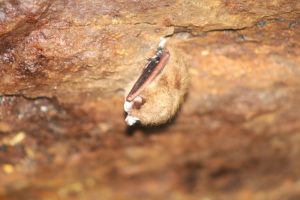
Even while some human practices negatively impact bats directly and indirectly, there are ways that humans can protect these valuable nighttime gardeners. This is what earth stewardship calls on us to do. By educating, spreading the word, and taking action to mitigate known threats to bats, we can protect the ecological and economic services they provide. By preserving these “behind the scene” pollinators, we can in turn protect our way of life by protecting theirs. 27
- Harper R. 2022. Bat Conservation International; (accessed 2025 Oct 20). https://www.batcon.org/not-just-the-birds-and-bees-6-fast-facts-about-pollinating-bats/ ↵
- Bat with visible white-nose syndrome during Vermont surveying, Sydney Giuliano, Public Domain, https://www.fws.gov/media/bat-visible-white-nose-syndrome-during-vermont-surveying ↵
- Harper R. 2022. Bat Conservation International; (accessed 2025 Oct 20). https://www.batcon.org/not-just-the-birds-and-bees-6-fast-facts-about-pollinating-bats/ ↵
- Nocturnal pollinators | U.S. Fish & Wildlife Service. 2025. FWSgov. (accessed 2025 Nov 5). https://www.fws.gov/initiative/pollinators/nocturnal-pollinators. ↵
- Lear KM et al. 2024. Agave distribution and floral display influence foraging rates of an endangered pollinating bat and implications for conservation. Ecology and Evolution. 14(3):e11125 (accessed 2025 Oct 10). https://onlinelibrary.wiley.com/doi/abs/10.1002/ece3.11125. https://doi.org/10.1002/ece3.11125 ↵
- de Wit LA et al. 2025. Co-Benefits From Species-Level Conservation Contribute to Multilateral Environmental Agreement Targets. Conservation Letters. 18(1):e13072 (accessed 2025 Oct 10). https://onlinelibrary.wiley.com/doi/abs/10.1111/conl.13072. https://doi.org/10.1111/conl.13072 ↵
- 2023 State of the Bats Report. 2023. Bat Conservation; (accessed 2025 Oct 15). https://digital.batcon.org/state-of-the-bats-report/2023-report/ ↵
- Congress Avenue Bridge – Bat-Watching Sites of Texas. (accessed 2025 Nov 24). https://tpwd.texas.gov/huntwild/wild/species/bats/bat-watching-sites/congress-avenue-bridge.phtml ↵
- Voigt CC, Kingston T. 2016. Bats in the Anthropocene. In: Voigt CC, Kingston T, editors. Bats in the Anthropocene: Conservation of Bats in a Changing World. Springer International Publishing; p 1–9 (accessed 2025 Oct 15). https://doi.org/10.1007/978-3-319-25220-9_1. https://doi.org/10.1007/978-3-319-25220-9_1. ↵
- Frick WF, Kingston T, Flanders J. 2020. A review of the major threats and challenges to global bat conservation. Annals of the New York Academy of Sciences. 1469(1):5–25 (accessed 2025 Oct 10). https://onlinelibrary.wiley.com/doi/abs/10.1111/nyas.14045. https://doi.org/10.1111/nyas.14045 ↵
- Roosting Mexican long-nosed bats, Loren Ammerman/Angelo State University, Public Domain, https://www.fws.gov/media/roosting-mexican-long-nosed-bats ↵
- Frick WF, Kingston T, Flanders J. 2020. A review of the major threats and challenges to global bat conservation. Annals of the New York Academy of Sciences. 1469(1):5–25 (accessed 2025 Oct 10). https://onlinelibrary.wiley.com/doi/abs/10.1111/nyas.14045. https://doi.org/10.1111/nyas.14045 ↵
- Frick WF, Kingston T, Flanders J. 2020. A review of the major threats and challenges to global bat conservation. Annals of the New York Academy of Sciences. 1469(1):5–25 (accessed 2025 Oct 10). https://onlinelibrary.wiley.com/doi/abs/10.1111/nyas.14045. https://doi.org/10.1111/nyas.14045 ↵
- Voigt CC, Kingston T. 2016. Bats in the Anthropocene. In: Voigt CC, Kingston T, editors. Bats in the Anthropocene: Conservation of Bats in a Changing World. Springer International Publishing; p 1–9 (accessed 2025 Oct 15). https://doi.org/10.1007/978-3-319-25220-9_1. https://doi.org/10.1007/978-3-319-25220-9_1 ↵
- Voigt CC, Kingston T. 2016. Bats in the Anthropocene. In: Voigt CC, Kingston T, editors. Bats in the Anthropocene: Conservation of Bats in a Changing World. Springer International Publishing; p 1–9 (accessed 2025 Oct 15). https://doi.org/10.1007/978-3-319-25220-9_1. https://doi.org/10.1007/978-3-319-25220-9_1 ↵
- 2023 State of the Bats Report. 2023. Bat Conservation; (accessed 2025 Oct 15). https://digital.batcon.org/state-of-the-bats-report/2023-report/ ↵
- Voigt CC, Kingston T. 2016. Bats in the Anthropocene. In: Voigt CC, Kingston T, editors. Bats in the Anthropocene: Conservation of Bats in a Changing World. Springer International Publishing; p 1–9 (accessed 2025 Oct 15). https://doi.org/10.1007/978-3-319-25220-9_1. https://doi.org/10.1007/978-3-319-25220-9_1 ↵
- Festa F et al. 2023. Bat responses to climate change: a systematic review. Biological Reviews. 98(1):19–33 (accessed 2025 Oct 10). https://onlinelibrary.wiley.com/doi/abs/10.1111/brv.12893. https://doi.org/10.1111/brv.12893 ↵
- 2023 State of the Bats Report. 2023. Bat Conservation; (accessed 2025 Oct 15). https://digital.batcon.org/state-of-the-bats-report/2023-report/ ↵
- Bat with visible white-nose syndrome during Vermont surveying | FWS.gov. (accessed 2025 Oct 15). https://www.fws.gov/media/bat-visible-white-nose-syndrome-during-vermont-surveying ↵
- Frick, Winifred. 2025. The Invisible Mammal: Protecting Bats for People and the Planet (Zoom). Aldo Leopard Foundation ↵
- admin. 2017. (accessed 2025 Nov 26). https://cwhl.vet.cornell.edu/disease/white-nose-syndrome ↵
- 2023 State of the Bats Report. 2023. Bat Conservation; (accessed 2025 Oct 15). https://digital.batcon.org/state-of-the-bats-report/2023-report/ ↵
- admin. 2017. (accessed 2025 Nov 26). https://cwhl.vet.cornell.edu/disease/white-nose-syndrome ↵
- Frick, Winifred. 2025. The Invisible Mammal: Protecting Bats for People and the Planet (Zoom). Aldo Leopard Foundation ↵
- Harper R. 2023. Bat Conservation International; (accessed 2025 Nov 26). https://www.batcon.org/a-grub-hub-for-fat-bats/ ↵
- Earth Stewardship – Ecological Society of America. (accessed 2025 Nov 26). https://esa.org/programs/science-engagement/earth-stewardship/ ↵