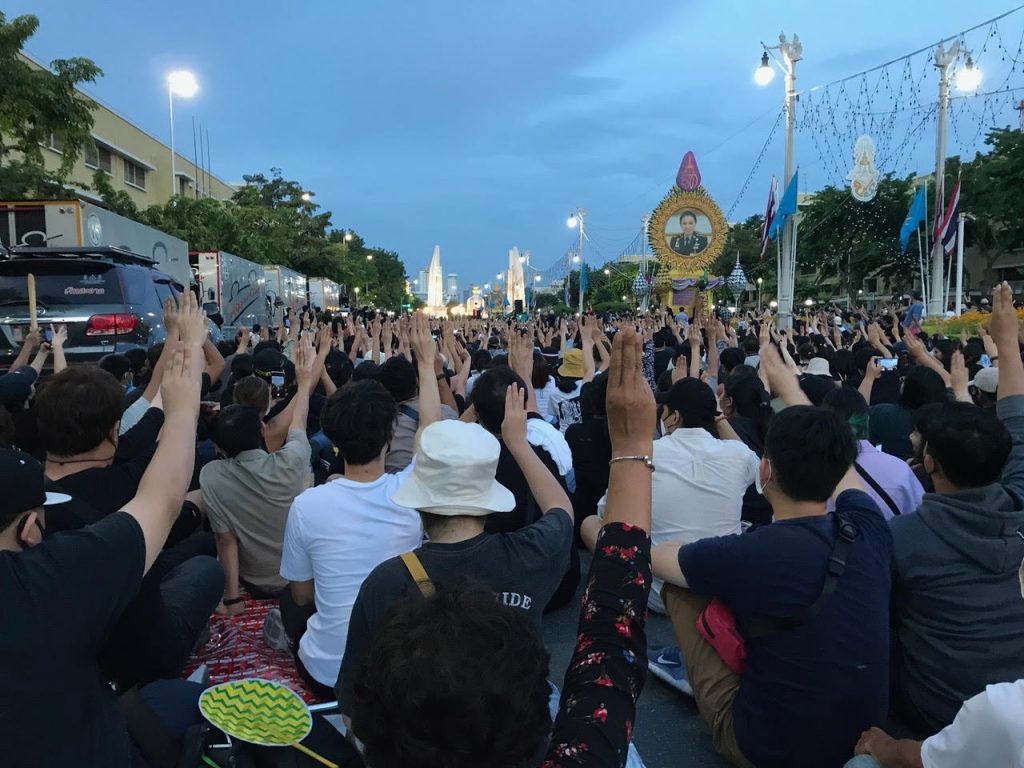

Young activists in the country of Thailand face multiple criminal charges for raising their voices to call out human rights violations.1 Enraged by the lack of jobs, the suppression of their voices, and the facade of a fake democracy, these young activists risked their lives to stand up for what they believe.2 Thailand’s youth envision a government accountable for providing economic stability, protecting the right to free speech, and upholding the principles of a sterling democratic state. However, systemic corruption thwarts these aspirations, as high levels of voter fraud in the last election explain why Thailand seems “stuck” in this political transition.3 Restoring political stability is the only way to reverse the tide of youth losing faith in their future.4 Chronic political uncertainty, frequent insurgencies, and strained human rights have left Thailand in a state of transition, clouding its pathway to reform.5 Does the youth population foresee a solution to reshape Thailand’s future?
Resilient Echoes of the Silenced
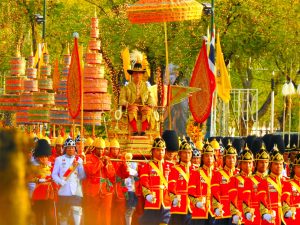
Thailand, formerly an absolute monarchy, established its parliamentary system in 1932. The new constitution appointed the king as head of state and the prime minister as head of government.6 However, Thai citizens question the existence of genuine democracy due to frequent military coups, lèse-majesté prosecutions, and the repeated dissolution of political parties.7 Lèse-majesté laws designate any perceived insult, threat, or defamation toward the head of state as a criminal offense, carrying severe prison sentences ranging from 3 to 15 years. In addition, the recurring putsches have consistently reshaped the nation’s political climate, most notably in 2014, when Prayut Chan-o-cha seized power in a military coup.8 To solidify this power, the regime used the legal framework to dismantle new political movements pushing for reform. Subsequently, the government’s dissolution of the Future Forward (FFP) opposition party in early 2020 ultimately pushed young activists to the streets. FFP, which widely shared pro-democracy and anti-military views using encrypted social media platforms, quickly captured the attention of young and first-time voters. They inspired a vision of change that mirrored the public’s demands for equality and freedom. Nonetheless, that hope vanished when Thailand’s Constitutional Court dissolved FFP.9
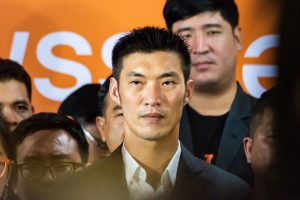
The court ruled that a $6 million contribution from its leader, Thanathorn Juangroongruangkit, violated election laws regarding donation limits.10 Despite Thanathorn’s defense that the funds represented a loan rather than a gift, the ruling stood. As a result, the ruling barred him and 16 other party executives from politics for ten years.11 Many young citizens supporting FFP viewed the ruling as a tactic to silence the opposition. This did not stop them from protesting against the government, and soon the Move Forward Party (MFP) emerged. MFP served as the successor to FFP and articulated its commitment to democratic reforms. Those reforms centered on abolishing Thailand’s lèse-majesté laws. MFP soon succumbed to charges under these statutes, which further heightened resentment between citizens and the government.12 Following the dissolution of the MFP, its successor, the People’s Party, arose as the new opposition. The People’s Party’s mission remained aligned with the ideologies of its predecessors, only condensing the rhetoric of lèse-majesté abolishment to avoid dissolution. Under the leadership of Natthaphong Ruengpanyawut, the People’s Party won 120 seats in the 2026 general election and constitutional referendum, cementing its position as the nation’s second-largest political party and the leader of the opposition.13 As the party settles into its role, the central question remains whether this tactical shift in rhetoric represents a pragmatic survival strategy of complying with the status quo to remain a viable opposition. The Thai electorate now waits to see if these concessions will be enough to protect the People’s Party or if it is destined to follow its predecessors down the path of judicial dissolution.
Young Hands Reforming an Ancient Crown

The 2020 dissolution of the FFP sparked a wave of youth activism aimed at ousting Prime Minister Prayut Chan-o-cha, drafting a progressive constitution, and reforming the monarchy. Among those activists, leaders Parit Chiwarak, known as “Penguin,” and Panusaya “Rung” Sithijirawattanakul catalyzed the reformation movement in Thailand.14 Both activists argue for human dignity and equality across all, reinforcing the idea that no one is born superior to others.15 Their three-finger salute has leaped from the fiction of The Hunger Games into the streets of Thailand, evolving from a silent cinematic gesture into a defiant emblem of resistance against state oppression.16 Penguin strives to dismantle the state’s traditional definition of “Thainess,” which is rooted in the three pillars of Nation, Religion, and Monarchy.17 He argues that this conservative ideology suppresses individual identity and undermines human dignity. In contrast, Penguin envisioned a democratic triad of Freedom, Equality, and Unity.18 Penguin never expected to be the face of a political movement, but today he carries 25 separate lèse-majesté charges under Article 112.19 Early into his activism, Penguin endured 100 days in a detention center, maintaining a hunger strike for 57 days.20 Rung followed Penguin’s lead by completing a 39-day hunger strike during her 59-day incarceration.21 Their endurance only continued to galvanize young activists and strengthened their perseverance to challenge the government. While Penguin and Rung faced repeated bail denials, Thai and international NGOs provided exposure and

legal support for their illegal imprisonment.22 A 2024 ruling handed Penguin a two-year prison sentence, though he had sought safety in self-exile before he could be detained.23 Rung, however, remains in Thailand on bail, facing nine counts of lèse-majesté as she continues her master’s studies while awaiting the court’s verdict.24 The movement has also faced tragic losses. On May 14, 2024, 28-year-old anti-monarchy activist Netiporn ‘Bung’ Sanesangkhom passed away following a month-long hunger strike.25 Reports indicated that Bung suffered a cardiac arrest while at the Central Women’s Correctional Institute Hospital.26 Her death sparked widespread furor, with fellow activists attributing her passing directly to the conditions and treatment she endured during her incarceration. Thai historian Thongchai Winichakul starkly explains this kind of dehumanizing treatment, noting that those accused of lèse-majesté often endure the harshest punishments.27 He argues that in the eyes of the state, these individuals have forfeited their Thainess; therefore, the state effectively strips them of their human dignity.28 This context has further fueled intense inquiries surrounding Bung’s passing, as she remained in custody on those very charges. Bung’s case exemplifies a larger pattern; since the 2014 military coup, at least 285 individuals have faced charges under Article 112.29 The United Nations has repeatedly urged Thailand to drop these charges, citing a routine of illegal detentions and the systematic denial of bail.30
The Southern Conflict as a Shield for Power
Beyond the courtroom battles over free speech, the state reinforces its grip on power through localized yet intense conflict that serves as a blueprint for national suppression. The Southern Thailand insurgency drives a relentless, violent struggle concentrated in the predominantly Malay-Muslim provinces of Pattani, Yala, and Narathiwat.31 Since 2004, this unrest has resulted in approximately 6,000 deaths and more than 10,000 incidents.32 Militants frequently employ drive-by shootings, arson, and vehicle-borne improvised explosive devices to target police, schools, and infrastructure.33 While violence levels fluctuate, the perpetual threat continues to destabilize the region and alarm citizens nationwide. The state’s harsh response to separatist groups like Barisan Revolusi Nasional (BRN) and the Patani United Liberation Organisation (PULO) directly stifles the national youth movement.34 By citing the serial security threat in the south, the government homogenizes martial law and emergency decrees. These legal instruments grant military autonomous power and allow it to circumvent democratic oversight entirely.35 Crucially, the military now turns these southern emergency tactics inward to silence pro-democracy activists.36 By using the southern unrest to validate its interference in governance, the military maintains a state of permanent exception where it suspends human rights in the name of national security.37 This strategy develops power in a way that effectively criminalizes the next generation. Authorities now rebrand youthful dissent as a domestic security threat, allowing them to use the same surveillance and detention methods once reserved for active conflict zones.38 For young activists urging a new constitution, the southern conflict symbolizes more than a distant regional issue; it functions as the legal engine that keeps Thailand’s democracy “stuck.”
Youth Blueprint for a New Democracy
Thai citizens demonstrate their profound love for and devotion to their country by holding their government accountable. The strength of these young activists brings hope and inspiration to those who have lost their voices. Amid endless political instability, young protesters advocate for their fundamental rights within a democracy. They envision a system governed by the people of Thailand, where freedom of expression ensures that their call for improved economic opportunities and political rights echoes throughout the halls of power. Ultimately, young Thai citizens aspire to a kinder future where they can secure stable jobs and enjoy their lives freely. Shattering the barrier between monarchical rule and military enforcement creates the only viable pathway for a true democracy in Thailand. This path to reform now rests in the hands of a generation that refuses to remain trapped in a stagnant political system. By challenging systemic oppression, these activists provide the foundation for a new era. However, as chronic uncertainty and human rights violations diminish their objectives, the question remains whether the state will choose reform or invite further antagonism. Thailand’s regime may currently seize legal power, but the future is being drafted by a generation that refuses to bow its head until Thai identity is synonymous with freedom.
- Paul Chambers, “Thailand in 2021 Angling towards Chaos?” Southeast Asian Affairs, 345–61, 2022. ↵
- Yen Vun Fung and Janice L. H. Nga, “An Investigation of Economic Growth, Youth Unemployment and Inflation in ASEAN Countries,” International Journal of Academic Research in Business and Social Sciences 2022. ↵
- Sebastian Strangio, “Calls Mount for Recount of Thai Election amid Claims of Fraud, Irregularities,” The Diplomat, February 12, 2026. ↵
- World Health Organization, “Thailand Data | World Health Organization,” data.who.int, 2023. ↵
- Nation Thailand, “Deep South Insurgency Marks 22 Years: 10,116 Attacks, 5,999 Deaths,” The Nation, January 4, 2026. ↵
- “Translation Constitution of the Kingdom of Thailand *,” 2017. ↵
- Kay Young, “The Thai People’s Struggle for Democracy amidst Deep State and Coup D’états,” Tricontinental: Institute for Social Research, January 31, 2025. ↵
- Yvette Tan, “Why Young People Are Protesting in Thailand,” BBC News, sec. Asia, August 1, 2020. ↵
- Rebecca Ratcliffe, “Thai Court Dissolves Opposition Party Future Forward,” The Guardian, sec. World news, February 21, 2020. ↵
- Merrit Kennedy, “Thailand’s Constitutional Court Dissolves Major Opposition Party,” NPR, February 21, 2020. ↵
- Merrit Kennedy, “Thailand’s Constitutional Court Dissolves Major Opposition Party,” NPR, February 21, 2020. ↵
- Jonathan Head, “Move Forward: Thai Court Dissolves Reformist Party That Won Election,” BBC News, August 7, 2024. ↵
- Wikipedia Contributors, “2026 Thai General Election,” Wikipedia Wikimedia Foundation, February 18, 2026. ↵
- Giuseppe Bolotta, “Starving for Humanity: Thai Youth’s Hunger Strike Resistance in the Buddhist Kingdom,” UCL Press, 83–108, 2026. ↵
- Giuseppe Bolotta, “Starving for Humanity: Thai Youth’s Hunger Strike Resistance in the Buddhist Kingdom,” UCL Press, 83–108, 2026. ↵
- “Three-Finger Salute (Pro-Democracy),” Wikipedia, November 14, 2022. ↵
- Millie Young, “Getting Closer into the Heart of the Thai Thai-Ness,” Animationstudies.org, 2020. ↵
- Giuseppe Bolotta, “Starving for Humanity: Thai Youth’s Hunger Strike Resistance in the Buddhist Kingdom,” UCL Press, 83–108, 2026. ↵
- Chairith Yonpiam, “‘Penguin’ faces 25th lese majeste charge,” Bangkok Post PCL, 2024. ↵
- Giuseppe Bolotta, “Starving for Humanity: Thai Youth’s Hunger Strike Resistance in the Buddhist Kingdom,” UCL Press, 83–108, 2026. ↵
- Giuseppe Bolotta, “Starving for Humanity: Thai Youth’s Hunger Strike Resistance in the Buddhist Kingdom,” UCL Press, 83–108, 2026. ↵
- Giuseppe Bolotta, “Starving for Humanity: Thai Youth’s Hunger Strike Resistance in the Buddhist Kingdom,” UCL Press, 83–108, 2026. ↵
- The Nation, “Elusive Thai Activist ‘Penguin’ Gets 2 Years in Jail over Lese Majeste,” Asia News Network, 2024. ↵
- Tan Hui Yee, “Exiled, Jailed or Silenced: Thailand’s Youth Protest Leaders Languish under Prosecution Blitz,” The Straits Times, September 14, 2024. ↵
- Giuseppe Bolotta, “Starving for Humanity: Thai Youth’s Hunger Strike Resistance in the Buddhist Kingdom,” UCL Press, 83–108, 2026. ↵
- “Thailand: Tragic Death of Detained Activist Must Be ‘Wake-up Call,’” Amnesty International, May 14, 2024. ↵
- Giuseppe Bolotta, “Starving for Humanity: Thai Youth’s Hunger Strike Resistance in the Buddhist Kingdom,” UCL Press, 83–108, 2026. ↵
- Giuseppe Bolotta, “Starving for Humanity: Thai Youth’s Hunger Strike Resistance in the Buddhist Kingdom,” UCL Press, 83–108, 2026. ↵
- “Thailand: Free Speech Activists Get 32-Month Sentences,” Human Rights Watch, February 23, 2026. ↵
- “UN Experts Urge Thailand to Drop Charges against Pimsiri Petchnamrob and Other Pro-Democracy Rights Defenders,” The Office of the High Commissioner for Human Rights, 2025. ↵
- Nation Thailand, “Deep South Insurgency Marks 22 Years: 10,116 Attacks, 5,999 Deaths,” The Nation, January 4, 2026. ↵
- Nation Thailand, “Deep South Insurgency Marks 22 Years: 10,116 Attacks, 5,999 Deaths,” The Nation, January 4, 2026. ↵
- Nation Thailand, “Deep South Insurgency Marks 22 Years: 10,116 Attacks, 5,999 Deaths,” The Nation, January 4, 2026. ↵
- Akkanut Wantanasombut, “Unheard Voices: The Youth’s Movements toward the Conflict in Thailand’s Southernmost Provinces,” 2016. ↵
- “World Report 2026: Rights Trends in Thailand,” Human Rights Watch, January 9, 2026. ↵
- “‘Change Has Arrived’: Why Thailand Is in Crisis,” BBC News, December 3, 2020. ↵
- “Irregular Warfare Observations from Southern Thailand,” Australian Army Research Centre, December 3, 2021. ↵
- “World Report 2020: Rights Trends in Thailand,” Human Rights Watch, January 14, 2020. ↵


18 comments
Valentín García
Samantha, your exploration of Thai govt operations and directives was a fascinating read, especially as you cover lèse-majesté prosecutions. This compliance mechanism the state employs seems to be central to many glaring and counterproductive measures handicapping Thai democratic pursuits.
Further, your analysis of the young an stalwart opposition is inspiring, and very reminiscent of developments in other states wrestling with similar power struggles. These young people at the tip of the spear are brave and full of conviction, willing to martyr themselves to galvanize the people into action; these party to the opposition, are also remarkable in their grit to endure the onslaughts of state persecution. As these unfolding developments prove perennial, the world stands to question the operational integrity and efficacy of a state that is otherwise fraught with corruption, paranoia, and incompetence.
You lay out an awesome story of Thai resilience amid the unraveling of an out-of-touch, feckless government. Thailand has always been a country of interest for me, and now having read your article, I believe I have a more grounded perspective not simply on the country, but on the wonderful and courageous Thai people. Great article, with a great conclusion!
Mía Perez
I really enjoyed reading your article because it highlighted how Thailand’s youth are risking so much just to fight for basic democratic rights and freedom of speech. I especially found the discussion of the lèse-majesté laws and the repeated dissolutions of opposition parties important because it shows how the government uses legal systems to silence reform movements. The examples of Penguin and Rung also made the article feel very personal and powerful.
Rosa Inocencio
Hi Samantha, great article, it was very informative! I think it’s interesting and inspiring how the youth now are what will hopefully be or make the change for various countries futures. My favorite part about it was the part on FFP, which eventually turned into MFP, then lastly turned into The People Party. I liked it because, although there were many challenges in the way, they did not give up.
Silvia Benavides
Hello Smantha,
This is a very strong article. It took me through a dynamic way of learning, which is something that not everyone can do. I enjoyed your images but wish they were a little bit more dynamic. AMAZING JOB!
Christian Molina
Hey, Sam! Before reading your article, I didn’t know the term “Lèse-Majesté Laws,” so the very subject is brand new to me. The parts of your article that track the change and evolution of political movements and parties since the government cracks down on those who speak against them was interesting. It’s good to see that the people of Thailand are firmly against this and are willing to stand up for their beliefs, similar to Nepal and the Philippines.
Isabel M Gerwig
Samantha! I really love this article, it is so interesting how much the youth really impact society and want to ensure that their future is guaranteed to be fair to them. I love the background you gave, as I don’t know much about Thailand. I do remember seeing in the news about the 2020 dissolution of the Future Forward party, and so learning more context was really enjoyable. While my article is more economically centered, this relates to the fact that there is a dissatisfaction with the government, while Thailand deals with authoritarianism, Argentina deals with economic instability. The youth really are the fire under the government to create change. Great article!
Maurissio Gonzalez
Hi Samantha! Thank you for your article on Thailand! I did not know that Thailand has a monarchy I thought that it was a democracy, I consider it to be a step on the right direction for Thailand that the youth have a less pro-monarchy vision for Thailand and they are actively trying to move transform Thailand into a more democratic country. I did research on Tunisia and in Tunisia there was also a pro-democratic movement called the Arab Spring, which was inspired by the death of Muhamed Bouazizi, just like in Thailand after Bung’s dead.
Tina
Hello, Samantha! Your article is amazing, very informative and packs in a lot of information that reinforces your central idea. The censorship that’s happening in conjunction with voters fraud is met with a legal system that is intended to benefit the head of state, not the youth. This article really made me hopeful that the youth activists are able to make a deep difference in their nation. I didn’t write about the political polarization of Mozambique but it does exist, there’s a deep history between Mozambique and political violence causing displacement. Putting an emphasis on the youth and empowering a new generation through modern means is definitely a step towards finding a nation’s identity after such a long history, your article does a great job of explaining Thailand’s struggle with free speech.
Layla Rangel
Samantha, I found this article very informative on Lèse-majesté laws in Thailand. A connection I found between our articles is the silencing that both Thai and Venezuelan citizens face. In both nations, citizens are not free to question or criticize their head of state. I love how in the section “Youth Blueprint for a New Democracy” you paint the picture that holding the government accountable is not done out of malice or hostility but instead out of love for their country and a desire to improve it.
Emilio Orona
Hi Samantha, this article really connects youth activism to long-standing structural issues like military intervention, judicial suppression, and restrictive lèse-majesté laws. The resilience of the youth is there because there is an itineration of political party dissolutions. You do a great job of using rhetorical devices to hook the author by including hunger strikes, imprisonment, and even Bung’s death. This critically gives the argument moral/ ethical weight while also showing how the state’s legal system becomes a tool of political control. This Thailand article connects to my Bosnia and Herzegovina by how in Thailand the military-judicial structure and recurring coups create a system where political competition is repeatedly reset rather than resolved, pushing young people to seek voice through protest or disengage entirely. In both contexts which are Thailand and Bosnia and Herzegovina, institutional design directly shapes whether youth see a future for themselves within the state or outside of it.