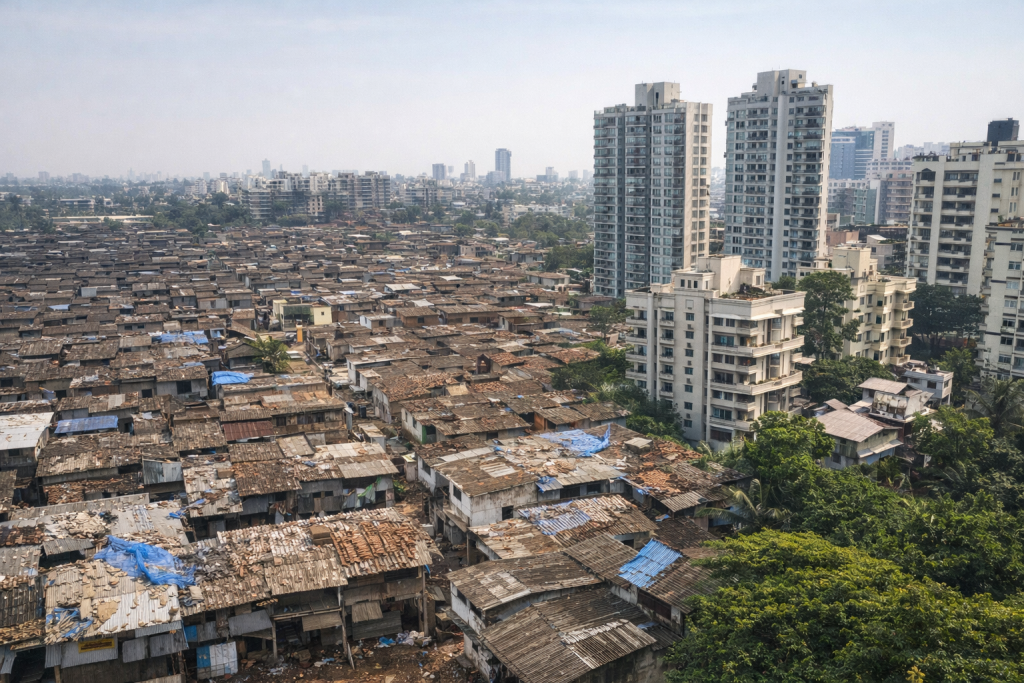

When you step onto the land of India, chaos surrounds you, bright warm colors reveal you have entered another world and sounds overcome you: dogs are barking, people are rushing across the street, an intense smell mix discarded trash and spices draws you in or overwhelms you at times. Behind those vibrant and tumultuous scenes hides a harsh reality: uneven development! On the one hand, highly industrialized urban communities exist alongside rural isolated regions where people survive each day in extreme poverty because of diverse factors such as environmental condition, level of infrastructure and transportation system, and access to education.
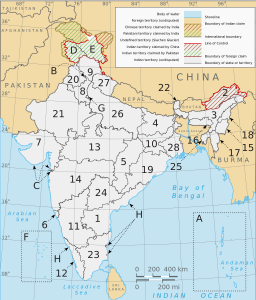
Uneven development in India is not just the whole country, but it differs in the different regions; how does it differ in varying areas of India? Most particularly focusing on two areas in India: one is Udaipur that experienced dramatic development and the other is Araria where so many people still remain in extreme poverty. As India uniquely transformed its economic system from relying on agricultural output to developing its technology and services sector, the fate of its population has varied drastically. The different characteristics in each region developed their infrastructure at different pace, they vary in the number of natural and human or cultural resources, and in the population’s attainment of education. However, in addition to those India features present in large cities, in rural India, many people live in densely populated area. This feature makes government policy focusing on promoting transportation system, including emerging technologies such as electric mobility, be more efficient and effective to implement. If improving infrastructure and education could occur, the lives of millions in rural areas could be better.
Come with me to visit each region to uncover of how Araria, in a flood zone, sees its infrastructure destroyed each year which discourages investments and has left the state of Bihar lagging behind. Then, on the trip to Udaipur, we will examine how Udaipur has been able to capitalize on its resources and its tourism through public private partnerships.
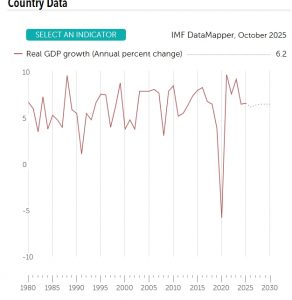
India started its development and industrialization with its policy started in 1991 called New Economic Liberalization. The government implemented this policy to support economic reforms, economic liberalization, privatization, and globalization. Before enforcing this policy, the government called License Raj regulated India under strict restrictions on the economy. As a result of these policy, India’s economy, however, expanded globally, which led to huge growth within the country. In fact, real GDP growth of India in 1992 was +5.5% compared to 1991 and kept over 0 by 2020 when pandemic discouraged economic activity or trade with outside countries.12 Nevertheless, this national growth does not reflect how each region has developed unevenly.
India has developed differently compared to other large countries such as U.S., the U.K., and Japan. Instead of moving from the agricultural sector to the manufacturing sector, India jumped over the manufacturing sector when transforming from the agricultural sector to the service sector. Skipping the manufacturing sector step played some negative roles in development of rural India because the manufacturing sector creates basically large numbers of jobs. In contrast, the service sector requires higher human expertise or skills. 3 Therefore, the technology service sector excludes people living in rural areas who lack access the education. They missed out on opportunities to engage in the service sector, and they remained in the agricultural sector. Furthermore, the service sector tends to concentrate in urban areas, and it also facilitates expanding gap between wealthy living in urban and poor living in rural regions. 4 Conversely, other large counties that went through manufacturing sector also experienced uneven development due to several political, geographical, and economical factors. For example, the Measure of America, founded by Oxfam America, the Conrad Hilton Foundation and the Rockefeller Foundation, reveals huge gaps among some groups in our country to access opportunity and reach their potential.5
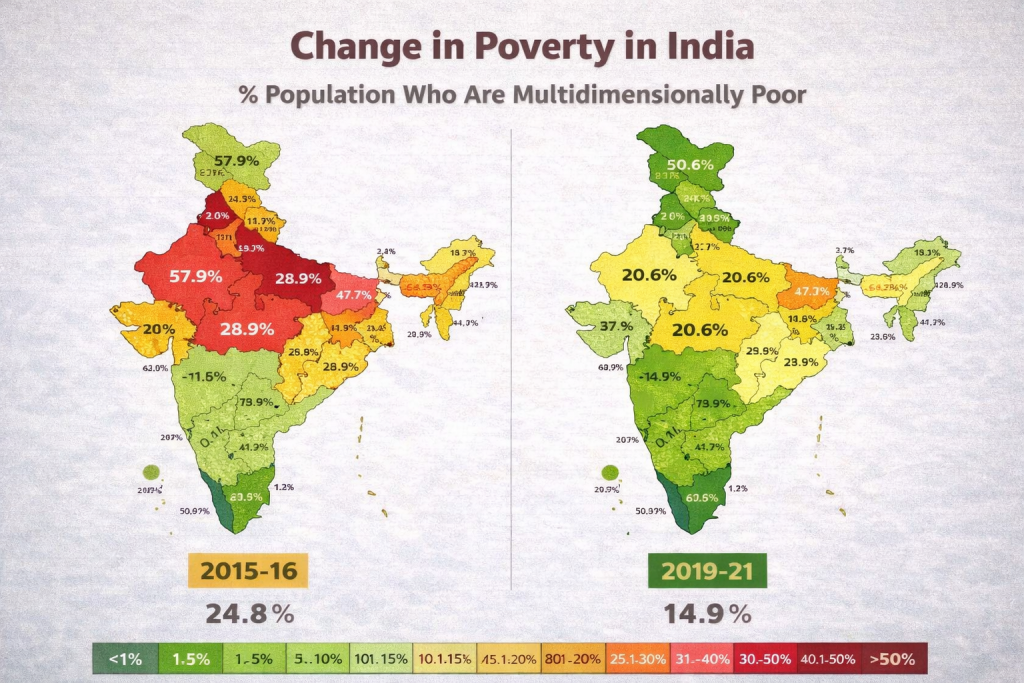
The map compares levels of poverty and development in India demonstrates that development depends on many factors in each area. While we can see the State of Radjastan significantly decreasing from 57.9% in 2015-16 to 20.6% in 2019-21, in the state of Bihar, extreme poverty has remained at the same very high level of over 47.0%.6 Focusing on Araria located in Bihar state at east part nearby Nepal and Udaipur located in Rajasthan state near Pakistan, most data shows Udaipur has developed more successfully than Bihar and many other states in India. For example, although Bihar state reduced percentage of Headcount Ratio, refers to the percentage of the population living below the poverty line, about 18.0% during 2015-16 to 2019-21, the percentage of Araria remains 52.0%. In addition, District-wise percentage point change in the Headcount Ratio between 2015-16 and 2019-21 shows slow growth; 12.58% despite of high percentage in 2015-16. On the other hand, Udaipur located in Rajasthan state near Pakistan reduced percentage of Headcount Ratio about 33.0% representing successful development. Those data represent that within the same country; there are different paths of development.78
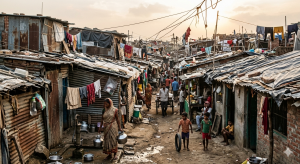
When arriving in Araria in Bihar state, you witness devastated schools overflowing rivers running down the slopes from Nepal as heavy rainfall rushes down into the region. Imagine the disruption to the lives of farmers with each flood in Araria. Floods severally erode farmland and destroy many crops with annual natural disaster. This leads to families unable to produce food to feed their families or make a living. As a result, farmers cannot pay school fees and children stop attending school only made worse each year with longer rainy weather that further disrupts the transportation system. As a consequence, so many families fall into extreme poverty, and they cannot survive increasingly severe situations. Furthermore, this natural disaster discourages the government from investing to improve the infrastructure. This reveals the environmental challenges play a crucial role in the viability of development of certain area. In the case of Araria, natural disasters hinder development by harming people’s living and working conditions as well as discouraging investment from the government or private sector in infrastructure. As a result, Araria suffers from weak infrastructure. Roads remain scarce. Transportation is unreliable as well deserted schools, and lacks health care facilities. The growing lack of infrastructure has compounding impacts by also reducing available jobs, days of economic activities, interrupting education, and cutting essential supplies or services for people. Furthermore, people living in such poor infrastructure tend to struggle repeatedly because the environmental reality makes it harder to organize themselves. So today, the poorest segment of the population in Bihar are experiencing worsening living conditions. With few if any options to escape this poverty, they eventually fall “negative cycle”, with no way of jumping out from this cycle without effective nationally supported solutions. So, how did Udaipur manage to avoid such a fate?
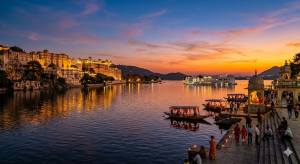
When arriving in Udaipur in Rajasthan state, you find beautiful lakes, where palaces and temples with historic significance attract large number of tourists. Let’s follow a father working as tourism guide in Udaipur. Udaipur historically been abundant in tourism, giving many opportunities to create income in this area. In addition, tourism incentivizes the government to invest in the infrastructure of this city because growing its infrastructure means welcoming even more tourists. More profits provide the tourism industry the power to pressure the government for further improvements. As a result, the guide and his family live better. The children attend high quality school ensuring higher educational achievement, which in turn lead to much more opportunities and jobs. Udaipur’s historically cultural resources help the city develop efficiently attracting tourists and investing. Consequently, Udaipur, “the city of lakes” has experienced growth and development overtime. Tourism benefits go beyond creating more jobs they further provided the impetus to grow and invest in the service sector. Udaipur promotes public private partnership to capitalize on its resources and its tourism such as Rajasthan Industrial Trade Expo (RITEX), organizers say that the three-day Expo will feature over 200 stalls and is expected to attract more than 30,000 visitors. The Organizers project the Expo will generate direct and indirect business opportunities exceeding Rs 1,000 crore.9 Increasing revenue from tourism enables them to organize and keep improving their infrastructure and it also help many people transform from the agricultural sector into the service sector and get access to education and basic needs or services, as a positive cycle. Udaipur, unlike Araria, capitalizes on its cultural treasures to further improve its economy and develop further possibilities.
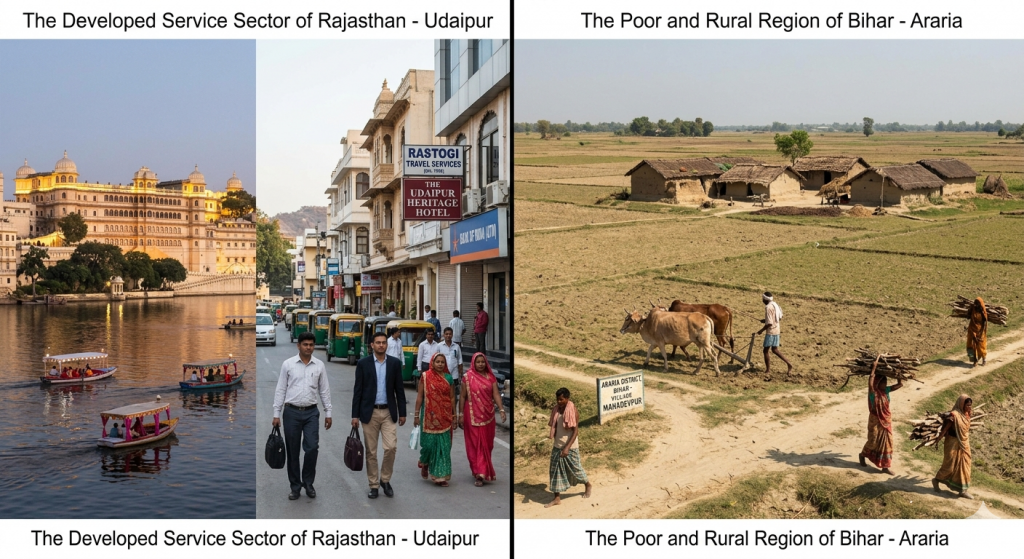
Comparing Araria where an area has failed to develop and Udaipur where an area has succeeded to develop highlights several critical points to develop poor areas. First, the most important thing in an attempt to break out poor conditions or poverty is improving infrastructure including transportation systems, education, basic needs, and social services so that poor people can access those social services. Next, each area has different geological nature and social or cultural characteristics and those play both a positive and negative role in development depending on if those can help people improve infrastructure and their access to such social services. For example, rich natural and cultural resources enable people to establish stable infrastructure and to get access to it from tourism profits, while caste hierarchy discourage some specific persons from getting access to social services. Therefore, the government has to recognize those differences and take policy adapted to each nature. Taking example from Araria and Udaipur, the government should take power establishing organized infrastructure and transportation systems for Araria so as to help residents receive social services because they do not have tools or systems to escape from their poor conditions, on the other side, the government should take power preserving natural and cultural resources for Udaipur in order to help residents continue to use those resources efficiently because they already have tools to improve their infrastructure and social service and accessibility to those services.
In conclusion, India has experienced huge increase in development and further industrialization since 1991 thanks to its New Economic Liberalization policy. India’s path to development did not follow most other countries that transformed their economic system from the agricultural sector to industrial production, instead India expanded its service sector. However, not all state benefited equally. Major urban areas received benefits from the service sector while others were more rural were excluded from development and remained poor without options to grow its own manufacturing. When comparing Araria to Udaipur, Araria’s geography and environmental conditions thwarted its ability to succeed. Araria lacks stable infrastructure and provides little access to social services most crucial to overcome poverty. Therefore, the government needs to devise an economic growth plan for Araria that takes into account its specific needs and challenges. I present recommendations for the stages of such a plan. In the region of Araria they can take advantage of focusing on the global push to reduce transportation sector emissions, and they can accelerate their own shifts to electric mobility (e-mobility). Emerging economies, particularly India and across Africa, must play a critical role in this transition.10 Accelerating this transition could help poor area that do not have tools or resources to break up poverty establish rich transportation systems and access to social service while preserving natural and cultural resources and decreasing harmful emissions. Urbanization tends to benefit from the pull of its attractive cities with more job opportunities and more services, while rural areas tend to push away and send out the younger generation who cannot find sustainable employment.
- International Monetary Fund. “IMF Country Data: Real GDP Growth (Annual Percent Change).” Accessed March 6, 2026, https://www.imf.org/en/search#q=India%20GDP%20growth. ↵
- Hankla, Charles R. “India: Political Change, Multiparty Politics, and Upgrading.” In In Pursuit of Prosperity: Industrial Policy and the Politics of Economic Upgrading. University of Michigan Press, 2025. http://www.jstor.org/stable/10.3998/mpub.12122865.12. ↵
- Chaitanya Talreja, “Service Sector Growth and Inequality in India: An Analysis of Household Consumption Spending,” Sage Journals 72, no. 4 (2024),Accessed on 8 April, 2026.https://journals.sagepub.com/doi/full/10.1177/00194662241238498 ↵
- Charles Hankla, “India: Political Change, Multiparty Politics, and Upgrading,” In Pursuit of Prosperity: Industrial Policy and the Politics of Economic Upgrading, University of Michigan Press, 2025. http://www.jstor.org.stmarytx.idm.oclc.org/stable/10.3998/mpub.12122865.12. ↵
- David Gardner, “Development: US Fails to Measure Up on ‘Human Index’,” The Guardian, July 17, 2008, Development, https://www.theguardian.com/society/2008/jul/17/internationalaidanddevelopment.usa?utm_source=chatgpt.com ↵
- NITI Aayog, National Multidimensional Poverty Index: A Progress Review 2023 (New Delhi: Government of India, 2023) National-Multidimentional-Poverty-Index-2023-Final-17th-July.pdf. ↵
- NITI Aayog, National Multidimensional Poverty Index: A Progress Review 2023 (New Delhi: Government of India, 2023) National-Multidimentional-Poverty-Index-2023-Final-17th-July.pdf ↵
- Prepp,Head Count Ratio-Indian Economy Notes, https://prepp.in/news/e-492-head-count-ratio-indian-economy-notes ↵
- Khan, Sohail, UDAIPURTIMES.COM, Udaipur Prepares for RITEX2026 from March 20-22, Updated January 8, 2026, 11:06 IST. https://udaipurtimes.com/exhibition-around-town/udaipur-prepares-for-ritex-2026/cid18081688.htm. ↵
- Akanksha Golchha, Abhinav Subramaniam, and Akshat Singh, Accelerating the Electric Mobility Transition: Enabling India-Africa Cooperation Through the EMBRACE Platform (Washington, DC: Center for Strategic and International Studies, 2025), https://www.csis.org/analysis/accelerating-electric-mobility-transition-enabling-india-africa-cooperation-through. ↵


17 comments
Valentín García
Yuta, your article does an awesome job at explaining why liberalization help facilitate growth in some areas while other, more rural places like Araria remained stuck in negative cycles of disaster and under-investment. Moreover, I find your conclusion about India skipping the manufacturing step in the industrialization continuity especially fascinating, as it would further explain why so much of India’s working class yet remains in poverty — as they were denied the opportunity to work within this new economic paradigm, and in turn are consequently rejected from the service sector as they will have also been denied the opportunity to gain the skills and means necessary to adequately navigate the new sets of standards in place. India’s meteoric development has come at the expense of its own people; poetic, in a sense, however, as this dichotomy of class and equity is wholly true to the caste system itself, in place within the overarching social structure.
On the whole, Yuta, you masterfully blend descriptive elements with technical and data-focused points to convey a stark tale of two realities within the state of India. You have an exceptional flow of ideas, and you develop your article with brevity and yet comprehensive detail. An outstanding work, Yuta, I enjoyed reading it.
Mía Perez
This article gives a clear and engaging explanation of uneven development in India, especially through your comparison of Araria and Udaipur. The contrast between environmental hardship and tourism-driven growth works well and helps make your argument easy to understand. I also liked how you connected national economic reforms like the 1991 liberalization to regional inequality, since it shows that overall GDP growth does not necessarily reflect local realities. The use of data, maps, and specific examples strengthens your analysis and makes the differences between regions more concrete. Your conclusion effectively ties together infrastructure, education, and policy solutions, especially when you emphasize that development strategies need to be tailored to local conditions rather than applied uniformly across the country.
Rosa Inocencio
Hi Yuta, I thought your article was very interesting! I liked that it showed and talked about how different regions in India can develop in completely different ways. I think you did an amazing job comparing Araria and Udaipur by mentioning the equality/inequality that the region is facing, including the infrastructure, education, and how tourism has a huge impact on them too. Great Article!
Silvia Benavides
Hi Yuta,
This was wonderful to read. I really enjoyed it. Not only was there a great storytelling element to your writing, but it was very engaging and very descriptive. Amazing Job!
Elizabeth Vazquez
Hey Yuta, I recognize that socioeconomic issues in countries like India are complex and interconnected. I appreciate your emphasis on the economic divide—the disparity between urban wealth and rural poverty. It would have been encouraging to see a more optimistic outlook for the future of India’s population in your conclusion, or perhaps some suggestions for actions that could be taken to promote national prosperity and reduce extreme poverty.
Isabel Gerwig
Yuta, I loved reading your Article! This really transported me to India and showed me how divided the country really is. This uneven development really shows how it can affect societies by creating barriers, such as the shift you describe from agriculture to a service-based economy. This article relates to mine as Argentina has an economic segregation between the poor and the rich, with no middle class. I loved this, and I can’t wait to learn more from you!
Christian Molina
Howdy, Yuta! Your article on the inequality of India was really descriptive and did a good job portraying the stark differences. Before read your article, all I knew was North India vs. South India, but now that you’ve actually laid out a map and put city names to it, I’ve definitely learned more. Inequality like this is also a big issues in the Philippines, but there it has more to do with which island you’re on.
Layla Rangel
Hi Yuta! I really loved the imagery you used in your hook. I also really liked the images you used specially the “Change in Poverty in India” which really highlighted the difference over the past few years. You also did a good job clearly showing the contrast between Araria and Udaipur and how uneven development can exist within the same country. A link I found between Venezuela and India is the high poverty rate (especially in Araria) in both nations.
Maurissio Gonzalez
Hi Yuta! It is fascinating how two different regions of India can have vast differences in terms of the economy and social services, it is unfortunate that some people feel like they are not allowed to use social services due to their caste, I knew about India’s traditional caste system, but I was unaware that this was one of its consequences. I did research on Tunisia, and like India the Tunisian economy benefits a lot from tourism.
Tina
Hey, Yuta! This is a fantastic article, not only did you describe India but presented a full picture for the many different areas that differ from the more tourist attracting area like Udaipur opposed to Araria. Your approach to a solution was very similar to my approach when it comes to addressing higher-risk areas, government support and policy is essential! I think the similarity is due to the fact that these are not man made issues but rather the consequences that come with a lack of sustainable plan for a re-occurring issue.