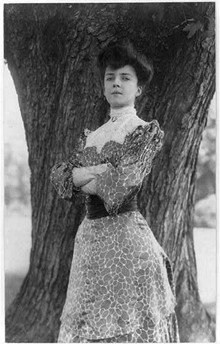

Alice Longworth was a powerhouse figure in politics. Her husband, Nick, was a senator and Speaker of the House. Her lover, and the secret father of her child, William Borah, was also a senator. Her distant cousin was the only president to serve four terms. Alice understood politics. And Alice was driven by a singular goal: to preserve and extend the political legacy, not of her cousin, but of her father. The larger than life, charismatic, bull moose: Theodore Roosevelt. As Theodore’s eldest, and his only child from his first marriage, which ended tragically in the death of his wife and his mother on the same day, Alice felt it was her duty to ensure the name Roosevelt was forever associated with him. Alice Roosevelt Longworth had charm, wit, and intelligence. She lived in elite political circles, aligning herself with men who either embodied her father’s ideals or could be persuaded to adopt them. And she was persuasive. Her influence was informal but potent, rooting itself in social capital, wit, and access to DC’s inner circle.1
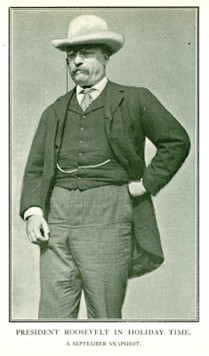
Alice’s work was threatened by the rise of previously mentioned distant cousin, Franklin D. Roosevelt. One could argue that political ambitions simply ran in the family. Why should Alice be threatened? Well, to Alice, FDR did not simply represent just another political opponent, one that she could charm into her ideals. He represented not just a change to her father’s legacy but a threat to erase it. FDR was running under the Democratic Party, a contrast to staunchly Republican Theodore, and his growing popularity indicated a noticeable change in politics, away from the system Alice knew how to navigate and control into her favor. Suddenly Alice saw the possibility of the Roosevelt name and its meaning to Americans, and politics, slipping away.2
Alice was just irritated with FDR for being a Democrat at first, but that irritation soon morphed into a kind of resentment of FDR himself. Alice noticed that FDR was using her father’s political playbook to push his own career forward. Assistant Secretary of the Navy, Governor of New York, and then a presidential candidate. It became clear to Alice that her father’s legacy was not sacred to FDR in the way it was to her, and that he would use her father’s name and legacy to further his own ambitions. The already tense situation became personal through Alice’s brother, Theodore Roosevelt Jr., who, as President Theodore’s eldest son, had been raised as the natural heir to their father’s political legacy. In Alice’s view, FDR was not only stealing from Theodore Roosevelt’s playbook but displacing the rightful heir to his legacy within her family.3
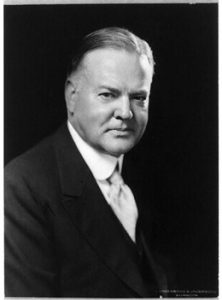
As the 1932 election approached, Alice transitioned from resenting in private to opposing her cousin loudly and publicly. She was not usually one for public campaigning, preferring to use social gatherings and parties as a sort of network among DC politicians, introducing her political friends and allies to possible future allies. The only presidents she officially campaigned for were her father and Warren G. Harding, though her campaigning for Harding was mostly due to a deep dislike of then-president Woodrow Wilson and his policies, rather than a deep respect for Harding. Breaking from her usual method of using charm among the politicians, she actively worked against FDR, joining then First Lady, Lou Hoover, in support of Herbert Hoover. She even feigned some pride in Ohio, the state that bore both Hoover and Alice’s husband, Nick, although those who knew her knew she preferred to spend as little time in the Buckeye State as possible. Alice was known to insist she was “…too shy to speak in public…,” but there was little sign of that shyness now that Alice had an enemy, saying, “I wasn’t so much for Hoover…but I was against Franklin…”4
As Alice realized just how serious Franklin’s commitment to usurping her father’s legacy was, another woman in the family became a parallel and increasingly threatening force: Franklin’s wife, and Alice’s closer cousin, Eleanor Roosevelt. Eleanor and Alice’s fathers were brothers, and both girls spent formative summers during their childhoods in their Auntie Bye’s Manhattan home. They did run parallel to each other in many ways. Both had strained relationships with their maternal figures (Eleanor with her mother, Alice with her stepmother) and both idolized their fathers, even if they were not the best parents (Elliot Roosevelt, Eleanor’s father, struggled with alcoholism and was in and out of sanitoriums and hospitals. Theodore Roosevelt, Alice’s father, was so overwhelmed with grief following the simultaneous loss of his mother and wife that he left Alice in Auntie Bye’s care for the first two years of her life and grieved in North Dakota). But Eleanor was a staunch supporter of her husband’s presidential ambitions and may have even been more popular than him. (Another way in which the women were similar. Alice was notably more popular among people than her senator husband.) Eleanor was a steadfast activist, advocating for the rights of workers, engaging with female journalists and other women in politics, and becoming a public presence. Eleanor appealed to the everyday American. Alice, who had been nicknamed ‘Princess Alice’ by the media during her father’s presidency, couldn’t form the same connection with voters, try as she might. The divide became obvious and maybe even one that’s familiar to modern times: One side supported by the longstanding power players, one side supported by the people.5
This wasn’t good for Alice. The rules of the game, one in which she was a reigning champion, were changing before her eyes. Her hold on political power was slipping and her usual methods of holding on weren’t working. She, and her side of the Roosevelt family, refuse to be defeated quietly. Even her notoriously private stepmother, former First Lady Edith Roosevelt, made an appearance at Madison Square Garden in support of Hoover, nine days before the election. Four days later, Alice made her first national radio address, claiming the Democrats were insulting Americans intelligence in their statements against President Hoover. Alice clearly pulled out every trick she knew. It wasn’t enough.6
FDR became the 32nd president of the United States on March 4, 1933. Hoover had only won six states. Alice’s influence was slipping through her fingers, as was the Roosevelt legacy, which would now be carved out by Franklin and Eleanor, rather than her and her brothers. How could Alice continue?7
Maybe some expected her to leave DC. Her husband had passed in 1931, leaving Alice with a six-year-old daughter. No one would have blamed her if she quietly retired to New York and raised her daughter alongside her family. But Alice didn’t run away. She stayed in DC and even visited Franklin and Eleanor in the White House on occasion. However, the cousins that were once close as children never fully healed their relationships following the election, possibly due, in part, to Alice’s longstanding habit of refusing to keep her opinion to herself. She did notably tell people that she felt FDR running for four consecutive terms was akin to dictatorship. But the three Roosevelt cousins were able to maintain civility with each other, even if things were strained at times.8
Alice’s interaction with political elites was lifelong though. She did adapt, meeting with 17 presidents over the course of her 96 years of life. She was always a social staple and an influential observer, but the average American would always praise publicly engaged figures like Eleanor over Alice. But one thing that Alice Roosevelt Longworth never lost was her voice, even if she did lose her right to define the legacy of the name Roosevelt. She gave many interviews and lent her voice and story to multiple books about her life. While she may not be as well-known as Franklin and Eleanor, no one can ever say that Alice Roosevelt Longworth, or her father, will fade into obscurity. So, maybe, she did get what she wanted in the end.9
- Marc Peyser and Timothy Dwyer, Hissing Cousins: The Untold Story of Eleanor Roosevelt and Alice Roosevelt Longworth (New York: Nan A. Talese/Doubleday, 2015), 154. ↵
- Alice Roosevelt Longworth and Michael Teague, Mrs. L.: Conversations with Alice Roosevelt Longworth (Garden City, NY: Doubleday, 1981), 159. ↵
- Marc Peyser and Timothy Dwyer, Hissing Cousins: The Untold Story of Eleanor Roosevelt and Alice Roosevelt Longworth (New York: Nan A. Talese/Doubleday, 2015), 92. ↵
- Marc Peyser and Timothy Dwyer, Hissing Cousins: The Untold Story of Eleanor Roosevelt and Alice Roosevelt Longworth (New York: Nan A. Talese/Doubleday, 2015), 170-171. ↵
- Marc Peyser and Timothy Dwyer, Hissing Cousins: The Untold Story of Eleanor Roosevelt and Alice Roosevelt Longworth (New York: Nan A. Talese/Doubleday, 2015), 17. ↵
- Marc Peyser and Timothy Dwyer, Hissing Cousins: The Untold Story of Eleanor Roosevelt and Alice Roosevelt Longworth (New York: Nan A. Talese/Doubleday, 2015), 173. ↵
- Alice Roosevelt Longworth and Michael Teague, Mrs. L.: Conversations with Alice Roosevelt Longworth (Garden City, NY: Doubleday, 1981), 160. ↵
- Marc Peyser and Timothy Dwyer, Hissing Cousins: The Untold Story of Eleanor Roosevelt and Alice Roosevelt Longworth (New York: Nan A. Talese/Doubleday, 2015), 196. ↵
- Alice Roosevelt Longworth and Michael Teague, Mrs. L.: Conversations with Alice Roosevelt Longworth (Garden City, NY: Doubleday, 1981), 161. ↵