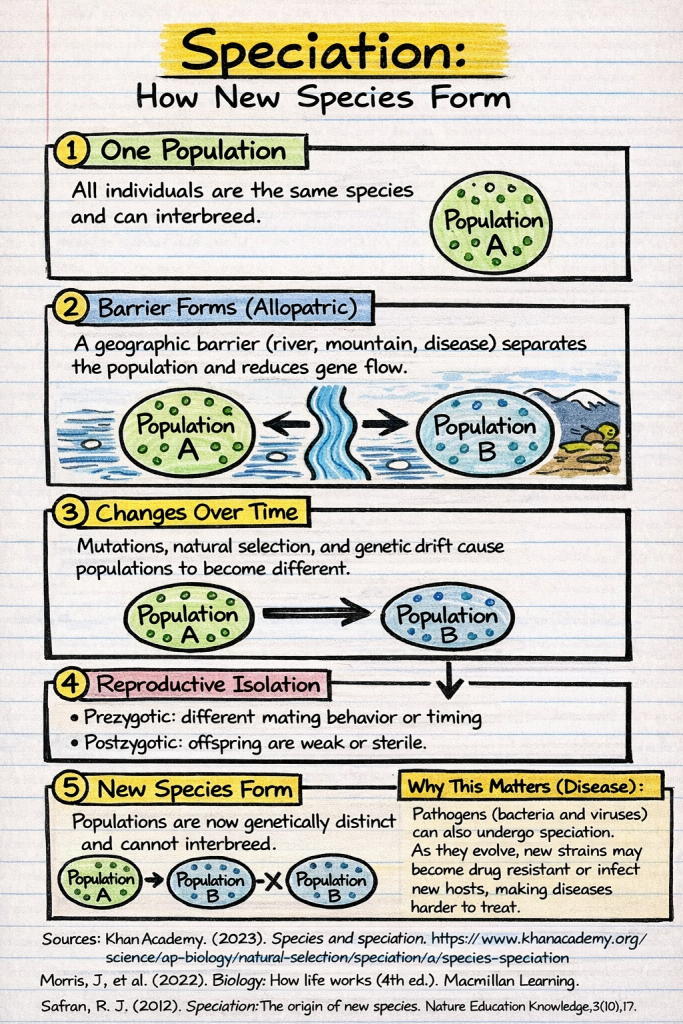
New species arise through speciation, an evolutionary process that splits into two or more genetically distinct species that can no longer interbreed. This process is the source of Earth’s biodiversity, which helps explain how life adapts to challenges, different environments, disease, and climate change. Speciation reduces gene flow between populations, followed by genetic drift through mutations and reproductive isolation. There are two main topics. Allopatric speciation occurs when populations are separated by a geographical barriers. For example, rivers, mountains, or disease outbreaks. Over time, the isolated groups become reproductively incompatible. In contrast to sympatric speciation, when populations divide while in the same geographical location. This can occur from ecological differences like habitat changes or trying different food sources. Understanding speciation matters deeply today because it helps explain pathogen evolution, where bacteria and viruses quickly form new strains that easily become drug-resistant. By knowing how populations change and evolve, speciation research informs us about conservation, agriculture, and how we respond to environmental change.
Tags from the story


3 comments
Maurissio Gonzalez
Hi Emerald! I have meet people who are unable to wrap their heads around the concept of evolution, but the way you have managed to explain how different species are formed is so simple to understand, I will make sure to remember your infographic next time I talk about evolution. I would also like to congratulate you on your graphics; the pencil style is really pretty
Yuta Satake
Your infographic is well organized and easy to follow the process of how new species form through speciation. I had not known that species undergo so many processes when forming new species. In addition, your insightful information provides an implication for my article that new species may cause more easily new diseases in poor and unclean areas. Thank you for sharing informative insights!
Samantha Garcia Mora
Hello Emerald! I really enjoyed the design of your project; the graphics were clean, professional, and very easy to follow. I found your explanation of how specific environments drive the adaptation and eventual differentiation of species to be particularly insightful. It is amazing to consider how every species on Earth is a product of this ongoing evolutionary process. Your project perfectly captures how fascinating and intricate the world of science can be. Well done!