


National Security Memorandum
Executive Summary
The purpose of this National Security Staff Memorandum is to provide national security recommendations to mitigate the risk of the People’s Republic of China from asserting its regional influence in the Indo–Pacific region that threatens the United States vital interest, values, and stability of the international system. This memorandum outlines three policy recommendations aimed at preventing adversary expansion, protecting U.S. national interest, and ensuring long-term stability in the Indo-Pacific and the broader international order. Collectively, these recommendations leverage the diplomatic, informational/intelligence, and military instruments of power to strengthen deterrence, reinforce alliances and partnerships, and enhance U.S. strategic positioning. Their implementation will be critical for maintaining the balance of power and preserving regional security in the region to safeguard U.S. vital interest.
Background/Context
Great powers continue to test the limits of foreign intervention, often triggering cascading effects across the international system. Russia’s invasion of Ukraine illustrates how regional conflicts can escalate into broader geopolitical competition. Simultaneously, sustained U.S. military commitments in the Middle East with the war against Iran have required significant allocation of resources and strategic attention. This environment raises a critical question: which major power may next seek to assert regional dominance. The People’s Republic of China is a leading candidate, particularly as it assesses perceived opportunities created by U.S. global force posture and competing priorities. As U.S. resources and capabilities are distributed across multiple theaters, China may find itself in a favorable position to advance its strategic objectives. These include reinforcing its claims in the South China Sea—a vital corridor for global trade—and increasing pressure on Taiwan to reintegrate with mainland China, in which Beijing considers central to its territorial integrity and national identity, similar in significant to Russia’s claim regarding Ukraine (Dolven et al., 2025). If the People’s Republic of China act on its strategic interest, these actions will significantly erode the global security environment and would likely demand an immediate and coordinated response from the U.S. For this reason, it is imperative that the United States plan for worst-case scenarios by developing a comprehensive strategy to deter aggression and respond effectively if deterrence fails. Failure to do so will have disastrous consequences on the stability of the Indo-Pacific region and the integrity of the international order.
Policy Recommendations
(1) Diplomatic: Strengthen and Institutionalize Allied Coordination in the Indo-Pacific
Diplomatically, the United States must reaffirm, deepen, and institutionalize its alliances and partnerships across the Indo-Pacific. The diplomatic element of national power is foundational to American influence, serving as the primary mechanism through which military, economic, and informational tools are coordinated and projected. As Joseph Nye (2008) argues through the concept of “smart power,” effective strategy requires the integration of both hard and soft power to achieve sustainable outcomes. In the Indo-Pacific, this means leveraging alliances not only as symbolic commitments, but as operational frameworks for collective security.
To achieve this, the U.S. should pursue three key diplomatic initiatives. First, it should expand and formalize multilateral security coordination among core regional partners, particularly through frameworks such as the Quadrilateral Security Dialogue (Quad), strengthening cooperation with Japan, Australia, and India (Smith, 2021). This includes establishing routine joint strategic planning dialogues, crisis response mechanisms, and coordinated messaging to deter unilateral actions by the People’s Republic of China. Second, the U.S. must reinforce bilateral alliances within the first and second island chains—particularly with South Korea and the Philippines—by expanding defense agreements and procurement, increasing high-level diplomatic engagements, and supporting capacity-building initiatives for regional partners (Vorndick, 2018). Lastly, the U.S. should globalize the Indo-Pacific security framework by incorporating transatlantic partners, including NATO, into Indo-Pacific consultations and contingency planning. Although geographically distant, NATO allies have a vested interest in preserving stability in the South China Sea, through which approximately one-third of global trade flows annually (Dolven at al., 2025). A crisis in this region would generate significant economic and security repercussions worldwide. Expanding NATO’s political coordination—through joint statements, naval presence operations, and intelligence-sharing—would signal unified opposition to coercive territorial expansion and reinforce global deterrence.
Given the current geopolitical environment, in which U.S. military and strategic resources are strained by ongoing commitments in the Middle East, the United States cannot unilaterally manage the risks posed by China’s regional ambitions. Instead, it must adopt a coalition-based approach that distributes the burden of deterrence and response. By strengthening diplomatic ties, institutionalizing multilateral coordination, and aligning global partners around shared interests, the U.S. can enhance its strategic position in the Indo-Pacific, deter Chinese aggression, and preserve the balance of power without overextending its resources.
(2) Intelligence: Enhanced Integrated Intelligence Collection and Information Sharing
The United States must prioritize the informational and intelligence domain by aligning collection, analysis, and dissemination efforts to provide timely, accurate, and actionable insights on the People’s Republic of China’s military posture in the Indo-Pacific. Intelligence tasking should be explicitly oriented toward identifying Chinese force movements, operational patterns, and indicators of escalation to better inform policymakers and national security leadership on Beijing’s intentions and capabilities. These tasking requirements initiate the intelligence cycle process, as illustrated in Figure 1
Figure 1.
Five Steps of the Intelligence Cycle
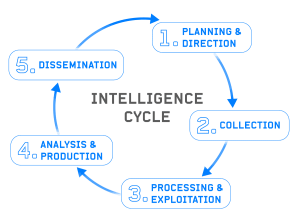
Note. Model illustrating the five steps of the intelligence cycle. From OSINT Fundamentals: The Five Steps of the Intelligence Cycle, by Fivecast, 2024 (https://www.fivecast.com/blog/osint-fundamentals-osint-the-intelligence-cycle/)
To achieve this, the U.S. should expand and integrate multi-discipline intelligence collection across Signals Intelligence (SIGINT), Geospatial Intelligence (GEOINT), Open-Source Intelligence (OSINT), and Measurement and Signature Intelligence (MASINT). Leveraging these complementary disciplines will enable a comprehensive intelligence picture capable of adapting to China’s evolving operational behavior, particularly in contested areas such as the South China Sea and around Taiwan. Emphasis should also be placed on persistent surveillance and early warning indicators to reduce the risk of strategic surprise (Walton, 2010). Given the complexity of the current threat landscape and the risk of miscalculation, closing critical intelligence gaps must remain a top priority. By enhancing intelligence collection, improving analytic integration, and strengthening allied information sharing, the United States can significantly improve decision-making speed and accuracy, reinforce deterrence, and maintain strategic advantage in the Indo-Pacific (Walton, 2010).
(3) Military: Implement an Offshore Balancing Strategy in the Indo-Pacific
The U.S. should adopt an offshore balancing strategy in the Indo-Pacific to deter the People’s Republic of China while the U.S. is engaged and committed in the war with Iran, relying on regional partners to check Chinese expansion and reserving direct intervention for only critical threats to vital U.S. national security interest (Mearsheimer & Waltz, 2016). Offshore balancing emphasizes empowering allied states to take the lead in maintaining regional stability, while the United States provides strategic oversight, intelligence support, and the capability to intervene selectively when the regional balance of power is at risk.
In practice, this approach would require strengthening the defense capacity of key regional partners such as Japan, Australia, and the Philippines, expanding joint military exercises, and increasing interoperability to ensure allied forces can operate effectively without immediate U.S. large-scale involvement. The U.S. would also maintain a limited but highly capable naval presence designed to deter aggression and respond rapidly if deterrence fails. This posture reduces the risk of overstretch, preserves U.S. military readiness amid ongoing commitments in the Middle East, and increases the burden on regional actors to contribute directly to their own security. Ultimately, offshore balancing enhances deterrence by making any attempt by China to dominate the Indo-Pacific more costly, uncertain, and dependent on overcoming a coordinated regional coalition rather than the U.S. alone.
Risks and Trade-Offs
Risk calculation is essential for policymakers to determine which threats must be mitigated and which can be accepted. In the context of the Indo-Pacific, two primary risks justify U.S. engagement and shape its broader strategic approach.
First, and arguably the most important, the potential disruption of semiconductor supply chains presents a critical economic and national security risk. Advanced semiconductors are essential not only for consumer technology, but also for defense systems, artificial intelligence, and critical infrastructure. A conflict involving Taiwan—which produces a significant share of the world’s most advanced chips—would severely disrupt global supply chains, undermine U.S. economic stability, and degrade military readiness (Benson et al., 2023). Ensuring continued access to these supply chains is therefore a core U.S. interest and reinforces the need for deterrence in the region (Snow, 2020).
Second, the security of global trade routes – particularly in the South China Sea – represents a vital economic and strategic concern. According to Dolven, O’Rourke, and Piekos (2025) in their Congressional Research Report an estimated of one-fifth to one-third of global commerce navigates through the South China Sea annually, making it a vital artery for the global economic ecosystem. Any disruption of freedom of navigation within these waterways, whether through coercive control or military conflict, would have immediate and far-reaching consequences for not just global supply chains, but also for the broader international political economy. For the U.S. and its allies, maintaining open and secure access to these sea lanes is vital to preserving economic prosperity and development in the global economy.
However, efforts to mitigate these risks introduce significant trade-offs. Most notably, increased U.S. military presence and expanded security measures in the region may be perceived by the People’s Republic of China as escalatory, potentially triggering a classic security dilemma. As both sides take actions to enhance their own security, these measures may be interpreted as offensive in nature, increasing tensions and raising the risk of miscalculation or unintended conflict (Jervis, 1978; see also Mearsheimer, 2016). Additionally, deeper U.S. engagement in the Indo-Pacific may strain resources and complicate its ability to respond to concurrent global commitments (i.e. war in Iran), further challenging strategic prioritization.
The Way Forward
The way forward requires the coordinated implementation of the above recommendations to mitigate escalation and prevent a crisis that could undermine the stability of the international order. This effort demands a unified approach with allies and partners, leveraging all instruments of national power when necessary—diplomatic, informational/intelligence, military, and economic—to keenly make the cost of Chinese aggression outweigh the benefits within its strategic calculation and assessment without instigating risk of tensions and strategic miscalculation (Snow, 2020; see also Worley, 2015).
Success will depend on sustained cooperation and mutual reinforcement among like-minded states. As emphasized in Proverbs 27:17, “As iron sharpens iron, so one person sharpens another” (New International Bible, 1978/2011). The U.S. does not have the bandwidth or resources alone to contain and deter potential Chinese aggression. In this vein, effective partnerships strengthen collective resilience, improve decision-making, and enhance deterrence. By synchronizing efforts across alliances, the U.S. can amplify its strategic influence while distributing the burden of maintaining regional security. At the same time, U.S. strategy must account for the possibility that deterrence and diplomatic efforts may fail. In a worst-case scenario, the U.S.—alongside its allies and partners—must be prepared to respond to large-scale kinetic conflict. This includes defending vital interests, deterring further aggression, and preserving the rules-based international order. To do so, the U.S. must take proactive measures to expand and accelerate its military capacity, modernize its force, and sustain readiness across all domains to confront an increasingly complex threat environment, including the potential for simultaneous conflicts in multiple theaters.
Ultimately, this approach reflects the evolving nature of the global security environment. By integrating allied cooperation, strengthening deterrence, and maintaining warfighting readiness, the United States can preserve its strategic advantage while reducing the likelihood of great power conflict in the Indo-Pacific.
References
Benson, E., Quitzon, J., & Reinsch, W. (2023). Indo-Pacific economic framework for prosperity: Squaring the circle on deeper cooperation. CSIS. https://www.csis.org/analysis/securing-semiconductor-supply-chains-indo-pacific-economic-framework-prosperity
Dolven, B., O’Rourke, R., & Piekos, W. (2025). China primer: South China Sea disputes. Congressional Research Service. https://www.congress.gov/crs-product/IF10607
Fivecast Tradecraft Specialist. (2023). OSINT fundamentals: The five steps of the intelligence cycle. Fivecast. https://www.fivecast.com/blog/osint-fundamentals-osint-the-intelligence-cycle/
Jervis, R. (1978). Cooperation under the security dilemma. World Politics, 30(2), 167–214. https://doi.org/10.2307/2009958
Mearsheimer, J. (2014). The tragedy of great power politics. W.W. Norton & Company
Mearsheimer, J. & Walt, S. (2016). The case for offshore balancing: A superior U.S. grand strategy. Foreign Affairs. https://www.foreignaffairs.com/articles/united-states/2016-06-13/case-offshore-balancing
New International Bible. (2011). Zondervan. (Original work published 1978)
Nye, J. (2008). Public diplomacy and soft power. The Annuals of the American Academy of Political and Social Science, 616, 94-109. https://www.jstor.org/stable/25097996
Snow, D. (2020). National security (7th ed.). Routledge.
Smith, S. (2021). The Quad in the Indo-Pacific: What to know. Council on Foreign Relations. https://www.cfr.org/articles/quad-indo-pacific-what-know
Vorndick, W. (2018). China’s reach has grown; so should the island chains. Asia Maritime Transparency Initiative. https://amti.csis.org/chinas-reach-grown-island-chains/
Walton, T. (2010). Challenges in intelligence analysis. Cambridge University Press.
Worley, D. (2015). Orchestrating the instruments of: A critical examination of the U.S. national security system. Potomac Books Incorporated.


4 comments
David Tullius
Cody (and Paul!),
Great podcast and great topic. As a former intel professional, I appreciate your breakdown of where the intelligence community should seek to enhance its capabilities in the region. I am sure every intelligence gathering entity on the planet would love to be better integrated, faster, and more accurate. For us in INDOPACOM, I think the best way to do that is to leverage our allies in the region who have an on ground understanding of the situation. Despite what we may believe, we cannot be everywhere at once, but with a little help from our friends we can make up the gaps. Great work, guys.
Greitin Rodriguez
I thoroughly enjoyed reading your National Security Memorandum. I found it very clearly written, well-documented and professionally presented throughout. Your job in demonstrating the importance of the Indo-Pacific region as one of the most significant areas of U.S. national security was particularly successful.
Your organization of your policy proposals by way of diplomatic, intelligence, and military methods was also outstanding. That format allowed me to easily track what you were saying and provided evidence of your ability to understand how multiple forms of power are used together.
Additionally, your inclusion of both source material and current world events added credibility to your Memorandum and demonstrated that you had given considerable consideration to linking your concepts to present-day international challenges.
In all respects, your Memorandum was exceptional in terms of its strength and quality of writing, congratulations on a great document!
Savannah Torres
Hi Cody, I really enjoyed your policy brief and podcast! Your policy brief is well-structured and appropriately integrates diplomatic, intelligence, and military tools into a cohesive strategy for addressing China’s influence in the Indo-Pacific. It also demonstrates strong analytical depth by connecting geopolitical context, theoretical frameworks, and credible sources to highlight the significance of deterrence and alliance-building.
Stephen Minka
Cody, your podcast matched your policy extremely well. They flow very logically from one another, and your executive summary, policy recommendations, and conclusion all speak to the same takeaway. I think your biggest strength is your consistent employment of the instruments of national power (diplomatic, informational/intelligence, and military) throughout the policy. It really helped bring cohesion to the policy logic between sections. Another strength is how you framed China as your pacing threat within the Indo-Pacific region. You articulated this very well and connected it back to modern-day implications regarding Taiwan and the South China Sea. Finally, you provided excellent scholarship to back up your ideas (Nye, Mearsheimer, Jervis).
My biggest piece of advice for your policy would be to tighten your background/context. While you do lay out a causal chain explaining how being pulled into resource fights in Ukraine and with Iran allows China to engage in the strategic behavior you describe, I found your section jumped around too much among the three conflicts. Try to tighten this up to speak more directly to how U.S. resource allocation creates the opportunity for Chinese aggression rather than introducing each theater. Other than that, I think you lay out a very clear problem that begs the question of “why now?” very well.
Your recommendations speak to your drivers very well. Diplomatically and militarily, you lay out some strong ideas that show great strategic depth, particularly in institutionalizing alliances and offshore balancing. My only piece of advice for these sections would be to briefly touch on feasibility constraints. For the NATO piece, it is an interesting idea to have them take on more Indo-Pacific planning, but for your policy to be realistic, you should at least mention some political constraints within NATO countries or a lack of threat perception. For the offshore balancing recommendation, you could add a sentence or two about how the U.S. would assuage credibility concerns with our allies by stepping back from forward deployment. Your intelligence section is great. You demonstrate clear knowledge of cross-domain integration (SIGINT, GEOINT, OSINT, MASINT) that China would have to consider. My only recommendation for this section would be to briefly touch on how there are frictions with intelligence sharing between allies (classification barriers, interoperability, etc.). Right now, you focus heavily on what our partners can do. But downplay the bureaucracy and political commitment necessary to reach your desired level of integration.
“Risks and Trade-Offs” and your “Way Forward” section speak directly to the concerns of escalation and necessity. You do a great job using the security dilemma theory to illustrate your thoughts on risks. Finally, bringing up semiconductors as a vulnerability in your supply chain was a great touch. I would only suggest ranking your risks conceptually, so a decision maker can look at your policy and know what risks are most pressing. Other than that, great job on this memorandum. You did excellent research and built a highly strategic memo from it.
V/R
Minka