I recently graduated Magna Cum Laude from St. Mary’s University with a Bachelor of Arts in Criminology and a minor in Psychology, and I am currently pursuing a Master’s in International Relations with a concentration in Security Policy. My research interests focus on transnational crime, particularly human trafficking and drug trafficking.
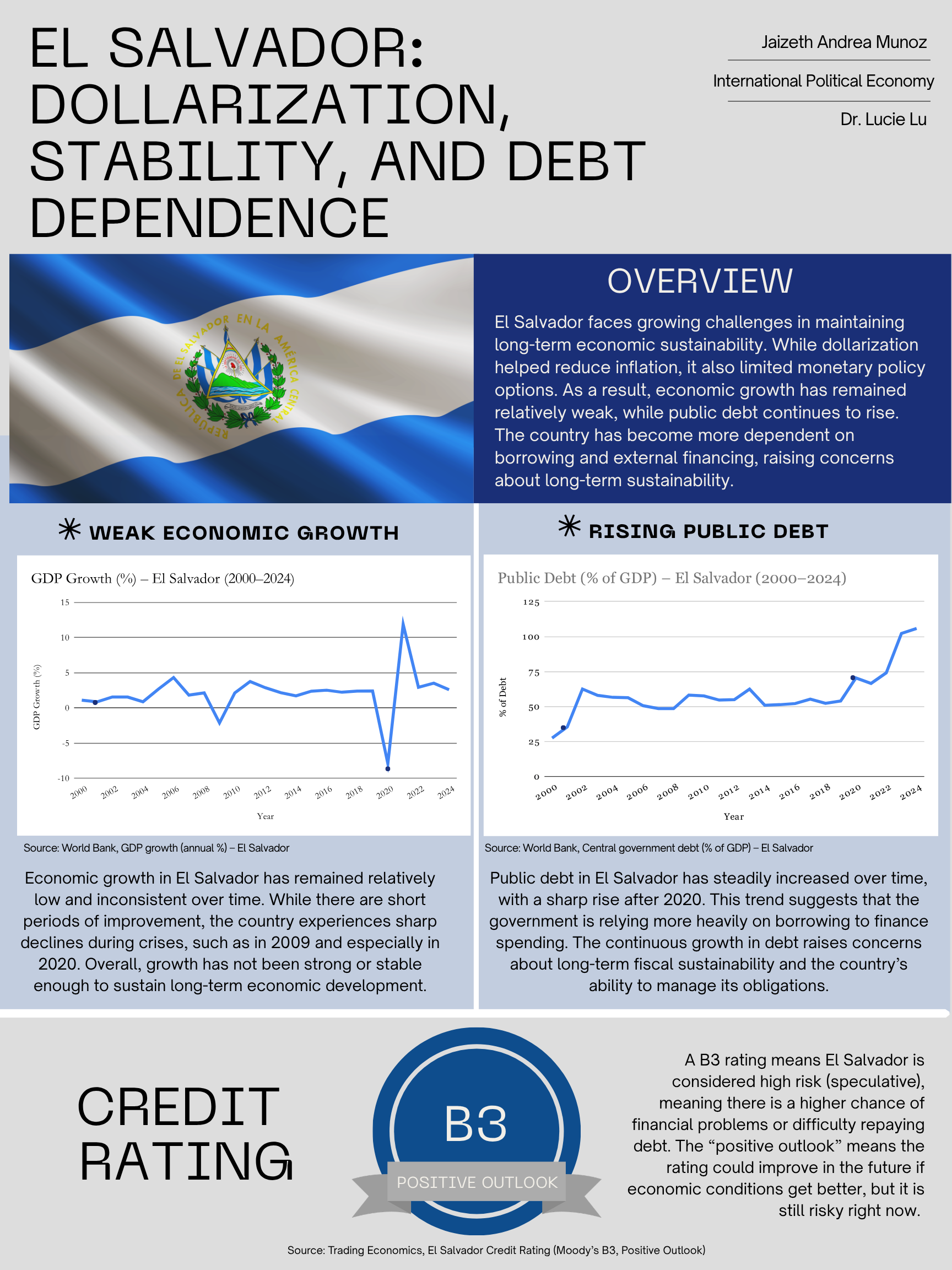
Hi Jaizeth, I love your infographic, it is very well structured and easy to follow through. I knew a bit about how El Salvador does not have the best economy, but I did not know it was this drastic and progressively getting worse over time. Hopefully they are able to do something about soon so that they can become more stable. Great Infographic!
Hello Jaizeth,
Bukele previously stated that the law did not allow for re-election; however, the Constitutional Chamber and the Legislative Assembly revised the interpretation of the Constitution, resulting in this consolidation of power. The opposition and various organizations have characterized these actions as an abuse of authority that undermines Salvadoran democracy. Nonetheless, no corrective measures were taken. These charts illustrate concerns regarding governance. It is difficult to understand how he was permitted to extend the presidential term from five to six years or to eliminate restrictions, thereby enabling Bukele to run for consecutive future terms.
Hi Jaizeth, You did a great job with this infographic, what stood out to me is how your data complicates the usual narrative around dollarization. It’s often framed as a stabilizing solution, but your graphs suggest that stability doesn’t necessarily translate into sustained growth, and may even mask deeper structural issues. The rise in public debt alongside relatively weak GDP growth is especially interesting because it points to a kind of dependency dynamic rather than real economic strengthening. It makes me wonder whether dollarization is actually limiting the government’s ability to respond effectively to economic shocks, rather than just stabilizing prices. I think your infographic does a strong job of showing that “stability” and “sustainability” aren’t the same thing, which is a really important distinction.
Hi Jaizeth,
Great job on your infographic! I found your infographic interesting and I learned quite a lot from this. Although economic growth remained stagnant throughout the years, it seems that it decreased dramatically in 2020 due to what I assume was the COVID-19 pandemic. Even though there was an increase the following year, it was shocking to see how it decreased in 2022 while the public debt continues to grow. Great job on your infographic Jaizeth!
Hi Jaizeth, I like the structure of your infographic. I found that it is easy to follow and understand the information presented. It was interesting to see the public debt continue to rise in El Salvador and it makes me wonder what policies the nation will undergo to achieve long-term economic stability. In my article, Venezuela also struggles with economic stability.
Hi, Jaizeth! I was unaware of El Salvador’s economic troubles. These graphs are shocking to see as they are incredibly volatile. Do you think the economic troubles are, in any part, due to the political issues in the country? After all, economics and politics are incredibly interrelated. My article was about the Philippines, which has similar politically-caused economic troubles. Good job!
Amazing infographic, I didn’t know about El Salvadors economic growth (only about their political predicament). The way its economic growth dropped sharply to raising almost instantly to declining back again is shocking. On my article regarding Vietnam’s social change I note the economic connection and how while it’s a growing one it still has more to go. This growth also reflects the social progress and fears of slowing down affects the societal aspects.
Your infographic is well organized and clearly shows changes in GDP growth and public debt of El Salvador so easy to recognize its economic weakness. My article focused on economic development and poverty in India where the gap between rich and poor people exists, and I found a similarity with El Salvador that both nations are struggling for ensuring stable economic development. Your article also made me realize that I should take relationship with other nations of India into consideration.
First, let me start by saying your published infographic is very well structured, organized, and easy to read. In regard to your data, I would argue that since El Salvador dollarized in 2001, its public debt-to-GDP ratio remained relatively stable until around 2020. One might expect an initial increase in public debt following dollarization, as the government adjusts to the shift from its domestic currency to the U.S. dollar—something that appears in the immediate aftermath of the conversion. However, for roughly a decade thereafter, debt levels remained relatively stable.
This trend changes around the onset of the COVID-19 pandemic, which significantly disrupted economic growth and fiscal stability. In response, El Salvador appears to have adopted new economic policies and strategies to adapt to these evolving conditions, likely resulting in increased government spending and borrowing. This raises an important question: is the recent increase in public debt primarily a consequence of long-term structural constraints associated with dollarization, or does it reflect short-term responses to transnational shocks that required immediate policy intervention?


9 comments
Rosa Inocencio
Hi Jaizeth, I love your infographic, it is very well structured and easy to follow through. I knew a bit about how El Salvador does not have the best economy, but I did not know it was this drastic and progressively getting worse over time. Hopefully they are able to do something about soon so that they can become more stable. Great Infographic!
Elizabeth Vazquez
Hello Jaizeth,
Bukele previously stated that the law did not allow for re-election; however, the Constitutional Chamber and the Legislative Assembly revised the interpretation of the Constitution, resulting in this consolidation of power. The opposition and various organizations have characterized these actions as an abuse of authority that undermines Salvadoran democracy. Nonetheless, no corrective measures were taken. These charts illustrate concerns regarding governance. It is difficult to understand how he was permitted to extend the presidential term from five to six years or to eliminate restrictions, thereby enabling Bukele to run for consecutive future terms.
Alfonsina Aldama
Hi Jaizeth, You did a great job with this infographic, what stood out to me is how your data complicates the usual narrative around dollarization. It’s often framed as a stabilizing solution, but your graphs suggest that stability doesn’t necessarily translate into sustained growth, and may even mask deeper structural issues. The rise in public debt alongside relatively weak GDP growth is especially interesting because it points to a kind of dependency dynamic rather than real economic strengthening. It makes me wonder whether dollarization is actually limiting the government’s ability to respond effectively to economic shocks, rather than just stabilizing prices. I think your infographic does a strong job of showing that “stability” and “sustainability” aren’t the same thing, which is a really important distinction.
Cielo Jerusalem Vargas
Hi Jaizeth,
Great job on your infographic! I found your infographic interesting and I learned quite a lot from this. Although economic growth remained stagnant throughout the years, it seems that it decreased dramatically in 2020 due to what I assume was the COVID-19 pandemic. Even though there was an increase the following year, it was shocking to see how it decreased in 2022 while the public debt continues to grow. Great job on your infographic Jaizeth!
Layla Rangel
Hi Jaizeth, I like the structure of your infographic. I found that it is easy to follow and understand the information presented. It was interesting to see the public debt continue to rise in El Salvador and it makes me wonder what policies the nation will undergo to achieve long-term economic stability. In my article, Venezuela also struggles with economic stability.
Christian Molina
Hi, Jaizeth! I was unaware of El Salvador’s economic troubles. These graphs are shocking to see as they are incredibly volatile. Do you think the economic troubles are, in any part, due to the political issues in the country? After all, economics and politics are incredibly interrelated. My article was about the Philippines, which has similar politically-caused economic troubles. Good job!
Martin Gonzalez
Amazing infographic, I didn’t know about El Salvadors economic growth (only about their political predicament). The way its economic growth dropped sharply to raising almost instantly to declining back again is shocking. On my article regarding Vietnam’s social change I note the economic connection and how while it’s a growing one it still has more to go. This growth also reflects the social progress and fears of slowing down affects the societal aspects.
Yuta Satake
Your infographic is well organized and clearly shows changes in GDP growth and public debt of El Salvador so easy to recognize its economic weakness. My article focused on economic development and poverty in India where the gap between rich and poor people exists, and I found a similarity with El Salvador that both nations are struggling for ensuring stable economic development. Your article also made me realize that I should take relationship with other nations of India into consideration.
Cody Granby
First, let me start by saying your published infographic is very well structured, organized, and easy to read. In regard to your data, I would argue that since El Salvador dollarized in 2001, its public debt-to-GDP ratio remained relatively stable until around 2020. One might expect an initial increase in public debt following dollarization, as the government adjusts to the shift from its domestic currency to the U.S. dollar—something that appears in the immediate aftermath of the conversion. However, for roughly a decade thereafter, debt levels remained relatively stable.
This trend changes around the onset of the COVID-19 pandemic, which significantly disrupted economic growth and fiscal stability. In response, El Salvador appears to have adopted new economic policies and strategies to adapt to these evolving conditions, likely resulting in increased government spending and borrowing. This raises an important question: is the recent increase in public debt primarily a consequence of long-term structural constraints associated with dollarization, or does it reflect short-term responses to transnational shocks that required immediate policy intervention?