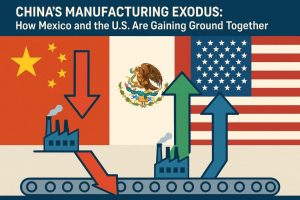

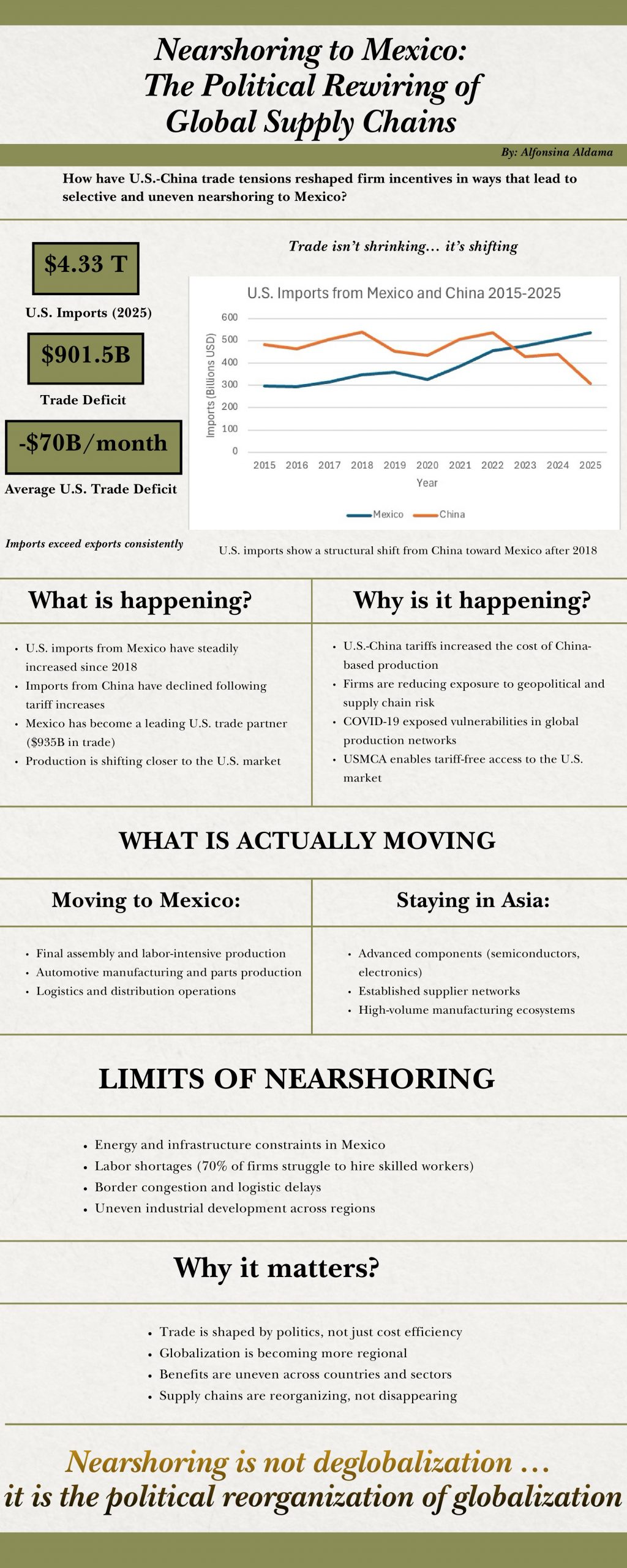
This infographic examines how U.S.–China trade tensions have reshaped global supply chains and contributed to the rise of nearshoring to Mexico. Since 2018, tariffs on Chinese imports and disruptions during the COVID-19 pandemic have increased the costs and risks of relying on China-centered production. In response, firms have adjusted their strategies by shifting parts of production closer to the United States, particularly to Mexico, which offers geographic proximity and tariff-free access under the USMCA. Trade data shows a clear shift in patterns, with Mexico becoming the United States’ largest trading partner and total trade levels reaching historically high levels. However, this transformation is not uniform. Firms are selectively relocating labor-intensive and time-sensitive stages of production, such as final assembly and logistics, while maintaining more complex manufacturing and supplier networks in Asia. At the same time, structural constraints in Mexico, including infrastructure limitations, labor shortages, and border congestion, limit the scale of nearshoring. Overall, the infographic demonstrates that global trade is not declining but being reorganized, as firms balance efficiency, risk, and geopolitical pressures across regions.
Sources:
- Bureau of Economic Analysis & U.S. Census Bureau. (2026, February 19). U.S. international trade in goods and services, December and annual 2025. U.S. Department of Commerce. https://www.bea.gov/news/2026/us-international-trade-goods-and-services-december-and-annual-2025
- Duran, P. (2026, February 9). Mexico emerges as the US’ most competitive trade partner. Mexico Business News. https://mexicobusiness.news/trade-and-investment/news/mexico-emerges-us-most-competitive-trade-partner
- Dallas Federal Reserve. (2025). Southwest Economy: Nearshoring and the Evolution of U.S.-Mexico Trade. https://www.dallasfed.org/research/swe/2025/swe2511
- FreightWaves. (2025). U.S. Hit Its Highest-Ever Trade Total with Any Nation in 2024: $840B with Mexico. https://www.freightwaves.com/news/us-hit-its-highest-ever-trade-total-with-any-nation-in-2024-840b-with-mexico
- Mexico Business News. (2025). Mexico’s Talent Shortage: 70% of Employers Struggle to Fill Positions. https://mexicobusiness.news/talent/news/mexicos-talent-shortage-70-employers-struggle


8 comments
Rosa Inocencio
Hi Alfonsina, I really enjoyed your infographic it was very easy to follow and easy to understand. You did a great job explaining how trade problems between China and the United States, and COVID pushed companies to relocate closer to the U.S. I also liked how you mentioned that Mexico is very important for trade, especially since it is something that is not very well know off. Great Infographic!
Isabel Gerwig
As a person who is starting to learn about international economics, this infographic was easy to read and understand in terms of your research! I really enjoyed your take on how Nearshoring isn’t deglobalization, but it is political reorganization. I feel like today, people do not take into account that relationships with countries are always evolving, and so this really shows how, while the relationship between the US and China has started to weaken, the relationship with Mexico has started to strengthen. Great job!
Layla Rangel
Hi, Alfonsina, I like your infographic. It’s interesting to see how many factors come into play during international trade from COVID to tariffs and you did well simplifying it for viewers to understand. My article “Venezuela: Oil Politics Fuel the Struggle for Stability” connects to yours because it shows how global economic shocks and trade pressures also affect countries that depend heavily on oil exports like Venezuela.
Christian Molina
Hello, Alfonsina! Trade is a really complicated thing, but you did a really good job of breaking it down simply. The interactions of politics, cost efficiency, labor, infrastructure, tariffs, etc. It’s a lot of things coming to one point. That being said, I never considered how the relationship between China and the US would affect Mexican trade. Really eye-opening stuff!
Martin Gonzalez
I didn’t realize how much the trading tensions between the US and China has helped in stronger trade ties with Mexico. Though it’s interesting that even with this Mexico’s infrastructure and labor shortage has caused increase problems which gives this whole situation more complicated. My article goes into the relation between Vietnam with both China and the US. Which as yours highlights I describe how the economic and political growing ties with the US has influenced Vietnam.
Emilio Orona
Hey Alfonsina, this infographic explains global supply chains and fragmentation pretty well. I am doing an economic brief similar to your topic, but mine is on intra-industry trade between China and Germany. Your infographic talks more about the shocks of globalization. In this category it would be COVID 19 affecting the center stage production of China. Which leads to countries like United States to start trading more with Mexico and this process is called nearshoring. This connects to my Bosnia and Herzegovina article because just as Mexico faces infrastructure and capacity constraints that limit its ability to fully absorb nearshoring, Bosnia and Herzegovina’s complex political/administrative structure and geographical location can limit its economic competitiveness and integration into large-scale global supply chains.
Samantha Garcia Mora
Hello Alfonsina! I love that you mentioned how trade is shaped by politics, not just cost efficiency; I strongly agree with that statement. Your infographic clearly informs readers on how Mexico is gaining economic momentum through nearshoring, while also highlighting the significant restrictions the country faces. This serves as a great example of why Mexico is considered a nation in transition. Great job!
Shaikha Alodssary
Alfonsina,
The relationship between the changing nature of the supply chain as opposed to the reducing one is clearly stated in your infographic. I found it interesting how the information about imports from Mexico versus that from China was analyzed, it indicates a major change in the trend following 2018. Your link between increased tariffs, the pandemic situation and USMCA sheds light on why companies are relocating their factories to places nearer to the United States.