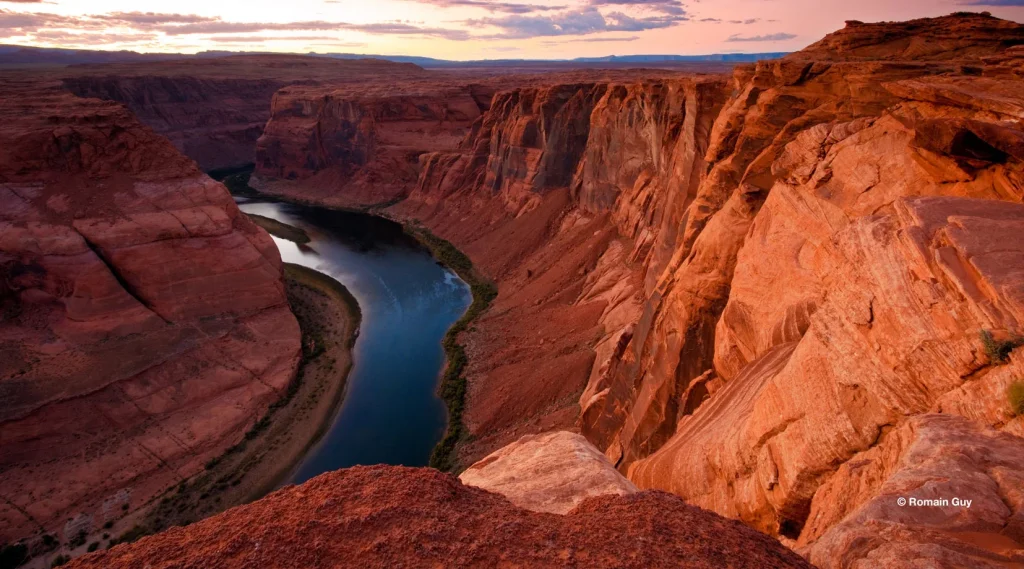

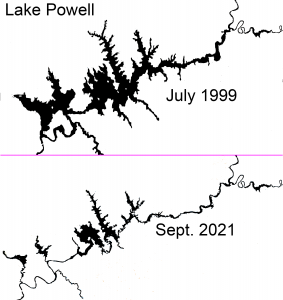
During the making of this article, I asked many of my peers what was the most terrifying thing they could think of. Their responses included: ‘a zombie apocalypse’, ‘Michael Myers, ‘the sensation of being alone’, and even ‘killer tomatoes’. Not a single person said the true silent killer that we learned to ignore in this day and age, drought. Drought affects life in many ways that people don’t often consider; inflated produce prices, lawn watering restrictions, forest fires, destruction of natural habitats and many more negative impacts. Yet local governance and other people in power have yet to address and find solutions to the ongoing drought in the American Southwest that has spanned the first decades of the 21st century. In Northern Arizona, Lake Powell has suffered through this drought, only for the effects to intensify and become even more devastating in the past few years.
A Controversial Construction
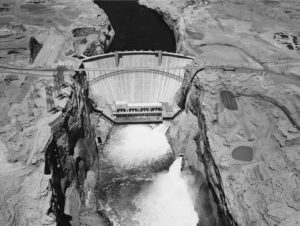
Before the construction of the Glen Canyon Dam, many stakeholders brought up concerns not only on the expense of the project, but the drastic changes this dam would make on the local environment of Glen Canyon. However, those who favored the project believed the benefits of creating Lake Powell outweighed the cost – the addition of a reservoir to the dwindling supply of water in the Colorado River Basin would help address the increasing water needs of a growing population and provide electricity by hydropower generators.
Ecotage (or monkeywrenching) is an act of sabotage which destroys, temporally decommissions, or blocks industrial equipment and people in order to protect the environment from industrial destruction.4 Illegal actions such as tree spiking (driving steel spikes into trees to damage chainsaws and discourage logging), damaging industrial equipment, and burning billboards are some of the tactics that can be used to stop big development projects which cause harm to the environment. You may ask yourself what does a book have to do with the construction of Glen Canyon Dam? Well, Abbey’s fictional story resonated with many environmental activists, many of whom replicated the actions described in the novel, or even started protests to destroy the Glen Canyon Dam.
Where’s the Water?
Who’s Affected?
The community most affected by Lake Powell’s drought is, perhaps to no one’s surprise, the growing population that depends on the Colorado River. Recently, there has been an influx of citizens to western states that use the Colorado as their primary source of water, including Utah, Arizona, New Mexico, Colorado, California, and Nevada.14 As the population grows, water consumption demands (drinking water, municipal, agricultural, and industrial water) will also have to expand. However, growing populations in the Colorado River Basin aren’t the only ones who are affected by Lake Powell’s drought; farmers, corporate interests, and even you are being affected.
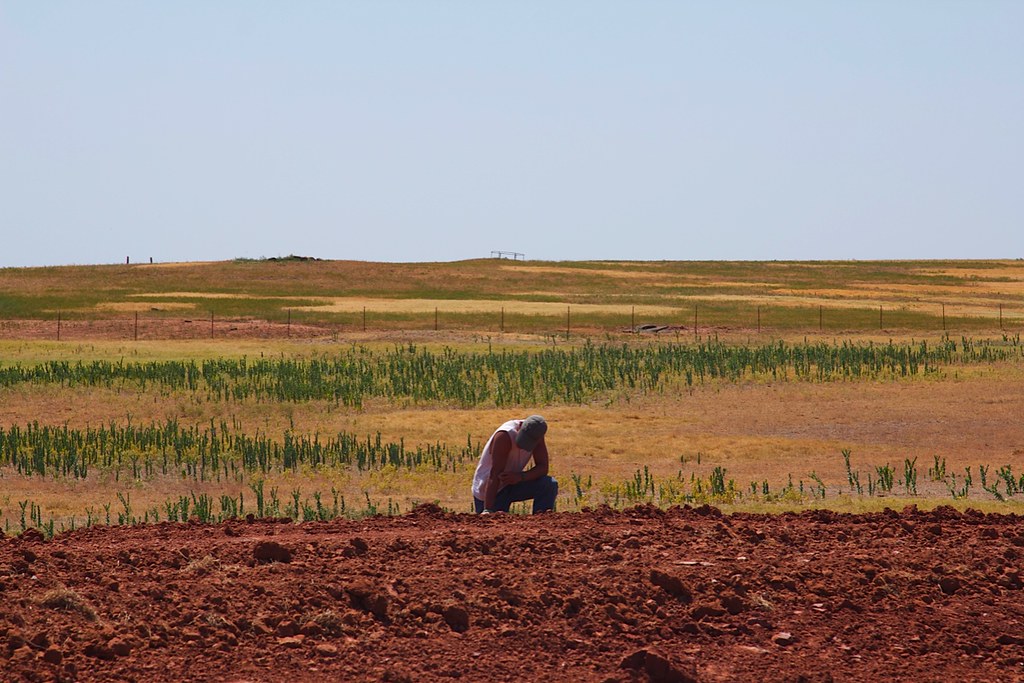
Southwestern farmers are most affected by the drought (Figure 3). The production of alfalfa, a vital crop in the region, has been the most damaged by Lake Powell’s drought, with the harvest being cut by more than half. About 50 years ago, 1.2 million acres of alfalfa was harvested, but in 2020 only 475,000 acres of alfalfa was harvested.15 Alfalfa is an extremely important crop. A main food source for dairy cows that is rich in fiber, protein, and calcium, alfalfa is mainly produced in arid western states and depends on irrigation. So, when an ongoing drought is limiting consumptive water usage, farmers aren’t able to obtain a high yield of alfalfa. This reduced harvest makes the crop increase in value, which causes dairy farms to either pay a higher price for alfalfa, or find an alternative feed for the cattle. The increased cost of alfalfa will therefore affect dairy consumers, causing yogurt, milk, cheese and other products to either have a higher price or to have lower quality.16
The Role of Collaborative Governance in Lake Powell
This Is Not The End
- Glen Canyon Dam Controversy | History to Go. (accessed 2025 Oct 20). https://historytogo.utah.gov/glen-canyon-dam-controversy/. ↵
- Glen Canyon Dam Controversy | History to Go. (accessed 2025 Oct 20). https://historytogo.utah.gov/glen-canyon-dam-controversy/. ↵
- Schulte SC. The Monkey Wrench Gang Advocates “ecotage.” EBSCO. 2023 (accessed 2025 Dec 4). https://www.ebsco.com/research-starters/environmental-sciences/monkey-wrench-gang-advocates-ecotage. ↵
- Schulte SC. The Monkey Wrench Gang Advocates “ecotage.” EBSCO. 2023 (accessed 2025 Dec 4). https://www.ebsco.com/research-starters/environmental-sciences/monkey-wrench-gang-advocates-ecotage. ↵
- Roth E. The Crack at Glen Canyon, 1981. Intermountain Histories. 2024 May 27 (accessed 2025 Dec 4). https://www.intermountainhistories.org/items/show/835 ↵
- U.S. Bureau of Reclamation. Colorado River Basin SECURE Water Act Section 9503(c) Report to Congress. Usbr.gov. 2021 Mar (accessed 2025 Dec 4). https://www.usbr.gov/climate/secure/docs/2021secure/basinreports/ColoradoBasin.pdf ↵
- Nwbeeson. 2021. English: Lake Powell surface area shrinkage from 1999 to 2021 from Landsat imagery, showing the effect of the protracted drought on the amount of water impounded by the Glen Canyon Dam. (accessed 2025 Dec 5). https://commons.wikimedia.org/wiki/File:Lake_Powell_surface_area_shrinkage.svg. ↵
- The U.S. Drought Portal | Drought.gov. (accessed 2025 Nov 4).https://www.drought.gov/. ↵
- How the Climate Crisis is Affecting Arizona. 2019 Nov 25. The Climate Reality Project. (accessed 2025 Dec 5). https://www.climaterealityproject.org/blog/how-climate-crisis-affecting-arizona…. ↵
- U.S. Bureau of Reclamation. Colorado River Basin SECURE Water Act Section 9503(c) Report to Congress. usbr.gov. 2021 Mar (accessed 2025 Dec 4). https://www.usbr.gov/climate/secure/docs/2021secure/basinreports/ColoradoBasin.pdf ↵
- Osezua M, Om Bade S, Gyimah E, Stanley Tomomewo O. 2023. Impact of Climate Change on the Water Resources, Lake Powell, United States. AJWR. 11(3):103–111. doi:10.12691/ajwr-11-3-3. ↵
- Climate change in Phoenix, Arizona. Climate Central. (accessed 2025 Nov 24). https://app.climatecentral.org/climate-local/41541. ↵
- U.S. Bureau of Reclamation. Colorado River Basin SECURE Water Act Section 9503(c) Report to Congress. usbr.gov. 2021 Mar (accessed 2025 Dec 4). https://www.usbr.gov/climate/secure/docs/2021secure/basinreports/ColoradoBasin.pdf ↵
- Population Growth – Save the Colorado. (accessed 2025 Dec 4). https://savethecolorado.org/threats/population-growth/. ↵
- Keppen D, Wade M. White Paper on the Importance of Alfalfa Production in the American West November 15, 2022. ↵
- Keppen D, Wade M. White Paper on the Importance of Alfalfa Production in the American West November 15, 2022. ↵
- English AJ. 2011. Extreme heat and drought are spreading across 14 states in the US, from Arizona all the way to Florida. (accessed 2025 Dec 5). https://commons.wikimedia.org/wiki/File:Parched_ground_-_Flickr_-_Al_Jazeera_English.jpg. ↵
- Saini V. 2025. From Heatwaves to Price Waves – Climate Change’s Growing Grip on Our Food System – Climate Fact Checks. (accessed 2025 Dec 5). https://climatefactchecks.org/from-heatwaves-to-price-waves-climate-changes-growing-grip-on-our-food-system/. ↵
- Veisi H, Kirchhoff CJ. 2025. Unpacking the success among water quality collaborative governance efforts in the United States. Environmental Science and Policy. 170. doi:10.1016/j.envsci.2025.104108. https://research.ebsco.com/linkprocessor/plink?id=6001e898-d26b-38cc-a238-16ceb563a842. ↵
- Larson KL, Wiek A, Withycombe Keeler L. 2013. A comprehensive sustainability appraisal of water governance in Phoenix, AZ. Journal of Environmental Management. 116:58–71. doi:10.1016/j.jenvman.2012.11.016. ↵



1 comment
Terry Shackleford
Great article! I have visited the Glen Canyon Dam and the beautiful Horseshoe Bend, so I found your article interesting, as I didn’t know the history behind the Glen Canyon Dam. You are so right about drought being one of our most significant needs as humans: we need water to grow food and live! We have our own issues right here with Medina Lake and the rivers drying out west of San Antonio. Also, many families are dealing with wells that have run dry and are forced to figure out how to get water to their homes because the Edwards Aquifer is low. Yet, we continue to build houses, add data centers, and allow farmers to pull water from the Aquifer.