
Formidable minds that dare to think differently hold the power to construct a prosperous and progressing world. From the groundless skepticism of Barbara McClintock’s intelligence and discovery of “jumping genes,” or transposons, attributed to a substantial amount of gender discrimination, to Rosalind Franklin’s discovery of the double helix structure of DNA being stolen by Watson and Crick to gain recognition from the scientific community proved their resilience to criticism, jealousy, and doubt allowed them to never inhibit their tenacious drive and curiosity that led them to pursue greatness. 1
In a society full of greed and malevolence, one man follows the same construct as these scientific pioneers by exemplifying brilliance, intelligence, but most importantly, empathy, by resisting the selfish desires of mankind. He saved countless lives through curating a future where preventative measures were taken to mitigate the risk of people contracting and suffering from poliomyelitis. The enticing yet selfish opportunity to profit from patients’ suffering to gain fame and a large fortune was placed before him, with the chance to make millions from his creation, but he made a noble choice by declining to patent his work. This moving and inspirational story highlights the core ideas about how science should be concerned with improving the state of humanity. His contributions to the biological sciences and medical advances underscore that benevolence and a genuine desire to improve the condition of humanity should be the pinnacle of healthcare. This man’s name is Jonas Salk. His story emphasizes how compassion led to action, as he became a beloved hero by developing a safe and accessible vaccine to end the devastating illness that caused worldwide agony and pain.
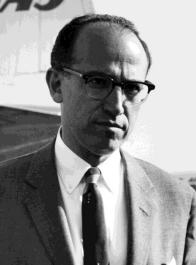
Jonas Salk kickstarted his career by being taken under the wing of Thomas Francis Jr., a driving force in the search to find a preventive vaccine to combat influenza. Through Francis’s mentorship, invaluable skills, and valuable resources, Salk was able to conduct laboratory research at the University of Michigan, further investigating influenza. Many outbreaks of influenza occurred within the troops deployed to war in December 1941. When Salk joined Francis’s efforts to eradicate influenza in 1942, they were prompted to achieve this task promptly in response to the request of the Secretary of War to initiate a solution to the escalating illness spreading among United States soldiers. Despite not having significant experience in this particular line of work, he, along with a team of scientists, took the lead to start vaccination trials with confidence that overlooked his imperfections. 2 After rigorous research, frustrating errors, tedious processes, and time to perfect the efficiency of the serum, Salk created an applicable vaccine that was ready to go through clinical trials. The data collected proved the vaccine to be highly effective by having a 75% chance of not contracting the virus after being immunized, which was a huge success attributed to Salk and Francis’s work. 3 Not only was their work invaluable to containing the influenza virus, but it also provided groundbreaking evidence that an inactivated (killed-virus) vaccine could confer immunity within patients in comparison to a live virus vaccine. Salk acquired astute knowledge, credibility, and recognition while working with Thomas Fransis Jr., but he wanted to pursue his own path and become independent in his scientific research.4
In 1947, Salk left the University of Michigan and set out to continue Influenza research at the University of Pittsburgh, where he received a small, run-down laboratory to conduct his experiments. Regulations, lack of funding, and strict university guidelines inhibited Salk’s unwavering desire to make scientific strides without the demands and orders of others. 5 Salk wanted personal autonomy and freedom to use his knowledge to the best of his ability for the greater good of humanity because he believed in his ability to resolve complex problems, including combating viruses that would provide immunity to those susceptible. His merit and dedication to finding innovative approaches to generate solutions to counteract diseases, which were proven in his work on influenza, were sought out by the director of the National Foundation of Infantile Paralysis, Harry Weaver, granting him what he’d always hoped for in December 1947. Salk’s pure aptitude for scientific research was rewarded by being given the opportunity to begin his conquest and navigation of the poliomyelitis disease.6
Poliomyelitis is a severe, highly infectious disease that is caused by a small, non-living particle known as a virus that is made up of short sequences of genetic material encased by a protein shell. 7 Despite its minuscule size, the virus has enormous, detrimental effects on those who contract the sickness. The symptoms are relatively unalarming, such as nausea, fatigue, and a fever, and the virus remains stagnant in the patient’s intestinal tract. Although the symptoms seemingly appear relatively benign in most cases, many feared the possibility that the disease would take a sinister turn as the virus attacks the nervous system, causing the paralysis of the cells within the spinal cord that are involved in the motor nervous system. The permanent damage left patients helpless as paralysis overcame their ability to move their muscles. No matter how often the patients attended doctors’ appointments and physical therapy, they were still left with lifelong heartbreaking effects that changed how they lived day by day. 8
Although the exact origin of the virus is unknown, it dates back to being prevalent in ancient Egypt through depictions of people suffering from the great ramifications of the illness, such as being portrayed as having misshapen limbs and a walking stick due to muscle atrophy attributed to paralysis. The virus became prevalent in the United States in the late 19th century and early 20th century.9 The poliomyelitis epidemic reached its height in 1916 and resurfaced with greater severity throughout the 1940s and early 1950s, causing widespread panic and fear. As poliomyelitis quickly surged across the globe, inducing anxiety among children, adults, and elders, Jonas Salk and his scientific research colleagues became devoted to the cause. They were determined to begin their extensive research and the race against the clock to develop a safe vaccine to mitigate and eventually eliminate the tragic consequences of the polio epidemic. With the weight of driving the country to a resolution and a plentiful amount of research funds from the National Foundation of Infantile Paralysis, Salk knew failure was not an option. 10
The development of a vaccine commenced as Jonas Salk and other brilliant minds collided at Harry Weaver’s round table in 1948 to decide on different methods to evaluate typing methods. In order to develop a vaccine for poliomyelitis, a series of tests was conducted to determine the amount of variation of the types of poliovirus to assess if a human vaccine was even plausible. 11 If a vaccine were produced for one type of poliovirus, it may not protect against the other types of the virus, rendering it ineffective. It was a necessity that Salk participated in the typing project assigned to him by the National Foundation of Infantile Paralysis to work towards a common goal to further observe developments in the overall poliomyelitis vaccine research. All the scientists at the round table traveled around the world to test their hypotheses regarding their typing project. Previous studies have alluded to two types of the virus. Both types mimicked each other’s structure, which meant that the vaccine in progress could potentially defend against both types. Salk began his work to validate this theory by gathering samples of each type of virus in monkeys. Salk and his team struggled through many trials and errors. From the difficulties of supplying and caring for the monkeys used for experimentation, to long and strenuous days tracking data, the scientist finally reached the conclusion that there were only two types of the polio virus, or so they thought. One of the other scientists who was working on the project observed that there was a third type of the polio virus. 12 The addition of another virus type complicated the project greatly by requiring more experimentation to compare and contrast the virus samples to see if there are more types of the virus that exist. Among the scientists with whom Salk was collaborating, he was the least experienced in this particular line of study. His associates had written lengthy publications with acute detail and demonstrations of deep understanding of the virus, dedicated years of immense research, and attended a variety of conferences that discussed polio. Due to limited materials, monkeys, and time, Salk came up with a typing method of his own that was different from those of the others who were working on the same project. 13
Tensions began to increase when a temperamental, yet extremely prominent polio virus researcher named Albert Sabin took Salk’s difference in redirecting his methodology to be more conscious about the use of valuable resources as an insult to his years and dedication to research surrounding the polio virus.14 Despite Salk not being well-versed in the polio virus, Harry Weaver believed that he was a perfect fit for his team, which he assembled meticulously due to his overwhelming enthusiasm and clever scientific methods and approaches that he demonstrated when researching influenza. With an exuding amount of trust in Salk’s ability, Weaver permitted Salk to use his own typing method. To no surprise, his genius method conserved not only experimental assets but time as well, causing the other teams of scientists to follow in his footsteps by trying his modernized and highly efficient technique.15 Despite Sabin’s negative perception and belittling Salk’s successes and cleverness, that didn’t stop him from becoming the face of the National Foundation of Infantile Paralysis. Salk’s kind and outgoing demeanor attracted journalists and donors who brought awareness to the cause. He assembled a scientific community by providing comfort, moreover hope, that a vaccine was being developed promptly by a highly capable and brilliant team of scientists.
Although Salk remained skeptical of Sabin and his intentions after their sour interaction regarding the dispute over the method used to type the polio virus, he made an effort to create a friendship. He was appreciative of Sabin’s mentorship and willingness to further immerse Salk in the world of polio research for the time being. But Salk’s intuition about Sabin and his intentions turned out to be right. The two scientific intellects quickly went from scientific colleagues to intense rivals.
Albert Sabin believed in creating a live-virus vaccine. A live-virus vaccine is made with an altered, or weakened, pathogenic virus. The modified virus, in its less harmful state, cannot cause the disease, but can mildly imitate the disease. The live-virus vaccine acts by mimicking the targeted virus in order to induce the individuals to evolve immune responses that are similar to those caused by the naturally occurring disease. A variety of viruses, such as rabies, smallpox, tuberculosis, and yellow fever, were treated with the live-virus vaccine approach. 16
Because of the successes of eradicating a multitude of viruses using this methodology, Sabin was certain that the live-virus vaccine was the most promising technique in combating the polio virus. Sabin argued that a live-virus vaccine causes an antibody response, consequently providing long-term immunity after only a minimal number of doses of the administered vaccine. 17 Salk wanted to take a different approach that completely differed from Sabin’s strategy in forming a live- virus vaccine. Salk wanted to work towards eliminating the polio virus by creating an Inactivated (killed-virus) vaccine. A killed-virus vaccine differs from a live virus vaccine by not containing living infectious particles. In order to prompt long-term formation of antibodies and cell-mediated immune responses to the virus, the killed-virus vaccine must be administered in high doses to maintain long-term immunity. 18 Due to Salk’s extensive research on influenza with Thomas Francis, he arrived at the conclusion that he could derive a polio vaccine by applying a similar procedure used in his previous works. 19
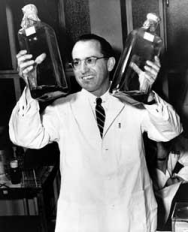
Despite working towards a common goal of providing a safe and legitimate polio vaccine, Sabin and other virologists were outraged and became openly critical and pessimistic in response to Salk wanting to take a different path by using a killed-virus approach because it was not as widely accepted by the scientific community as the use of a live virus approach. Some virologists went as far as discrediting the killed-virus technique by claiming it was “incomplete” despite the overwhelming evidence that it was effective in providing antibodies in influenza cases, thus alluding to the notion that it could be pertinent to the development of the polio vaccine. 20 Self-assured and optimistic, Salk defied his critics and began formulating a killed-virus vaccine to work towards his endeavors in the prevention of polio worldwide through his persistence and dedication to the cause. Step by step, Salk became closer to achieving his dream of eradicating polio. Through careful methodology, Salk inhibited the virus’s infectivity by forming a chemical solution made of formaldehyde. After the modifications made to the sample of the polio virus, it was still able to generate antibodies, which was key to making further strides in the development of the vaccine. In order to determine whether the chemical treatment was effective in killing the virus, Salk observed cellular growth in monkey kidney tissue to determine the survival rate of the cells after being in close proximity to the modified virus, to evaluate if there was any evidence that a live virus remained present. The process was made easier by one of Salk’s laboratory technicians, who recognized that the growth of healthy kidney cells became slightly acidic, and infected cells remained unchanged in acidity. He brought innovation to the lab by creating a new technique that used a color indicator called phenol red that detects the acidity of a solution, which deciphers if the virus was killed or not. If the dye in the solution remained red, that indicated that the virus was still activated. Indicating the success of the inactivation of the virus, the solution turned yellow, and readiness to proceed moving forward with the rigorous process. Every test had to have impeccable accuracy and identical conditions in order to curate the desired results in all three strains of the virus. After multiple tests of this dull yet necessary step, Salk began to move on to testing his inactive virus in monkeys to make sure no live virus persisted in the developing vaccine in order to ensure it was well equipped for the next phase in Salk’s plan of action to find a solution to the polio virus. 21
After twenty-eight days of waiting for results, there was no trace of an active virus in the tissue of the monkeys Salk tested the assays on. Using his previous expertise about the influenza vaccine he had worked on, Salk wanted to amplify the beneficial effects of the vaccine by adding mineral oil adjuvant. With the clock rapidly ticking and growing demand as cases skyrocket, Salk’s motivation to help thousands suffering drove him to complete the procedure of completing his creation of the polio vaccine in as little as three months. The vaccine was finally ready to be put through a multitude of trials in order to guarantee it was safe to distribute to polio patients. Salk began by inoculating infected monkeys first. The killed virus vaccine was proven to prevent the paralytic effects of the virus by releasing antibodies within the monkeys. This was a beacon of hope to the public for a resolution to put the pain the virus has caused to an end. The press swarmed Salk with an abundance of questions and eagerness to get more insight into when the vaccine will be available to the public. 22 Although all signs of the test trials in monkeys point to a near solution, the vaccine has not yet undergone human test trials. Salk presented to his associates the National Infantile Paralysis Foundation over his findings of antibodies in monkeys after being inoculated with the killed virus vaccine and his hypothesis that the number of antibodies in humans after contracting the disease was relatively equal. Regardless of the sensible data that Salk obstructed through the test trials, Sabin, along with the other virologists present, belittled Salk’s success and claimed that there was no way to discern if the antibodies produced came from the inactive virus, regardless of Salk and his team’s astute and clever methodology that demonstrated otherwise. Not wanting to give credit where credit was due, Sabin selfishly wanted to carry on with his own agenda of persisting in making a live virus vaccine. 23 Salk knew his killed virus vaccine held the potential to be used for the better good of humanity. He knew that his brilliant solution would not be able to flourish under Sabin and the other scientists. Salk’s desires and objectives differed greatly from the genuine inclination to want to help others, while Sabin valued the idea of being right by wanting to prove the validity of his years of research on the polio virus and the use of live vaccine methodology. With the escalation in polio cases, Salk knew he had to take matters into his own hands and begin to test his creation on humans.
Because the killed virus methodology was still relatively new to the scientific community, consequently refuted as an option to explore its capability to be a viable solution when creating a vaccine. Salk had to prove otherwise to gain access to be able to conduct a test trial. Salk carefully chose the Home of Crippled Children in 1952 for his vaccine to be tested among patients with a low amount of anti-polio antibodies to demonstrate its harmlessness and cause no detrimental side effects. Although the inoculation of fifty-two children was successful, the question of whether the Salk vaccine could produce antipolio antibodies within patients who have never contracted the disease still remained. 24 The pressure on Salk increased enormously as journalists, the press, and the public demands led to Salk appearing on air to respond to the lingering questions on the progression of the vaccine. Despite the vaccine being premature in the eyes of the scientific world, Salk stated that the results of the trials he conducted were promising, instilling optimism within the community. Despite trying to provide comfort that a solution to the polio outbreak was on its way, Salk received a heaping amount of backlash from his colleagues, who believed he was implying that the vaccine was nearly ready to distribute to the public, despite its drawbacks that needed to be looked over by other professionals in the field of study.25
After all the adversity Salk had experienced, including Sabin’s efforts to postpone the reality of potential test trials as well as some manufacturing issues, he finally gained an opportunity many of his critics had not anticipated. After attentive examination and detailed modifications, Salk’s killed-virus vaccine was chosen by the National Infantile Paralysis Foundation to be used in the largest field study in medical history. April 26, 1954, marked the day the waiting game began as the test trial was officially started to be conducted, and the study began to run its course. Lives were now in Salk’s hands. The anticipation for the results of the trial was agonizing, yet exhilarating. This monumental step for the polio vaccine project for the fact that it could save millions of lives. In order to evaluate if the vaccine was effective, the studies of the test trials involved a placebo and an inactive virus vaccine. The placebo vaccine contained a salt solution that mimicked the appearance of the vaccine. The placebo and the inactivated vaccine were assigned to random children who volunteered to participate in the trial, along with parental consent. 26 The children involved were given the nickname “polio pioneers” because of their bravery to agree to take part in the cause. Salk gained an overwhelming amount of support from the major pharmaceutical companies, which helped provide a substantial amount of vaccines that went through safety testing and followed Salk’s requests by using the three strains of the inactivated virus, to the generous volunteers who committed their time, money, and devotion to helping the children vulnerable to contracting the disease. 27 During the trial, it was critical to track the side effects from the vaccine, and the number of cases was analyzed to make sure the vaccine was helping the community rather than causing an adverse effect. The results that compared the placebo vaccine and the inactive vaccine would be used to examine whether the vaccine is harmless and prevents patients from contracting polio. 28 As days went on, the suspense of the results escalated as the public, and Salk himself, began to become more and more impatient. People across the nation begged for the preliminary vaccine to find some comfort that they have the chance of being protected against the disease. Although tempted to help out of empathy and compassion, Salk had to deny their request until it was certain that the vaccine worked. After a year filled with anxiety, despair, and restless nerves, the results from the trial were concluded. The life-altering news that the world had been waiting for was finally ready to be announced publicly.29
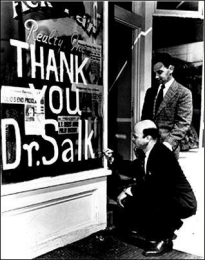
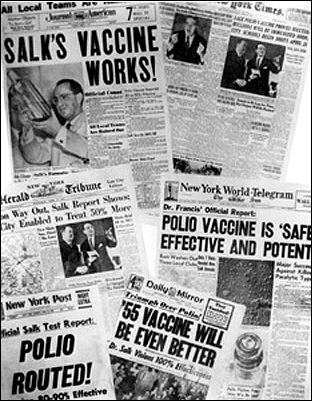
On April 12th, 1955, Salk’s vaccine was declared to be safe and effective. Uncontrollable joy from Salk and his colleagues filled the room in which it was announced. 30 As floods of people filled the auditorium, it was finally time for Salk to report the positive findings to the public. Salk exclaimed, “We might say that the study conducted in the field in the spring and summer of 1954 was a test of the question as to whether or not primary vaccination alone could prevent paralytic poliomyelitis, may lead to 100 percent protection from paralysis.” 31 The elated and relieved emotion radiated across the map. The nation celebrated this huge accomplishment. From bells chiming to storekeepers writing a “Thank You, Dr. Salk” on the windows, Salk finally gained the recognition he deserved and proved everyone who doubted him wrong. 32
Reporters and cameramen swarmed Salk to gain footage of the news. A reporter raised the question of who will own the patent for the vaccine. With the chance to make millions from his life-saving solution, he replied by stating, “Well, the people, I would say. There is no patent. Could you patent the sun?” implying it was unnecessary and selfish to profit from a vital vaccine that was preventing disease, suffering, and sorrow. After this statement, if not already adored by the people, Salk became a hero in the eyes of millions.33 Salk is a person whom many aspiring scientists and doctors should look to as an inspiration because of his actions. Salk symbolizes that helping others in need should have a pure intent of generosity and kindness, not at the hand of malice. Although he showed everyone his capability through his brilliant work, the core reason he chose to dedicate years of his life to this cause was benevolence alone.
- Barbara McClintock: Scientific Persistence Pays Off, (Anonymous Makematic, 2023); Lenora Champagne, Lenora Champagne on Scientist Rosalind Franklin. Directed by Julie Hébert. (Look What SHE Did!, 2020) ↵
- Charlotte Jacobs, Jonas Salk: A Life (New York: Oxford University Press, 2015), 60. ↵
- Charlotte Jacobs, Jonas Salk: A Life (New York: Oxford University Press, 2015), 68. ↵
- Charlotte Jacobs, Jonas Salk: A Life (New York: Oxford University Press, 2015), 74. ↵
- Charlotte Jacobs, Jonas Salk: A Life (New York: Oxford University Press, 2015), 76. ↵
- Charlotte Jacobs, Jonas Salk: A Life (New York: Oxford University Press, 2015), 88. ↵
- Milton W. Taylor, Viruses and Man: A History of Interactions (Cham, 2014), 2. ↵
- Daniel J. Wilson, Living with Polio: The Epidemic and Its Survivors (Chicago: University of Chicago Press, 2005), 1. ↵
- Man Mohan Mehndiratta, Prachi Mehndiratta, and Renuka Pande, Poliomyelitis: Historical Facts, Epidemiology, and Current Challenges in Eradication, (The Neurohospitalist 4, no. 4, 2014), 225. ↵
- Charlotte Jacobs, Jonas Salk: A Life (New York: Oxford University Press, 2015), 88. ↵
- Charlotte Jacobs, Jonas Salk: A Life (New York: Oxford University Press, 2015), 105. ↵
- Charlotte Jacobs, Jonas Salk: A Life (New York: Oxford University Press, 2015), 107. ↵
- Charlotte Jacobs, Jonas Salk: A Life (New York: Oxford University Press, 2015), 111. ↵
- Jeffrey Kluger, Splendid Solution: Jonas Salk and the Conquest of Polio (New York: G.P. Putnam’s Sons, 2004), 133. ↵
- Charlotte Jacobs, Jonas Salk: A Life (New York: Oxford University Press, 2015), 111. ↵
- Vetter, Volker, Gülhan Denizer, Leonard R. Friedland, Jyothsna Krishnan, and Marla Shapiro. 2018. “Understanding Modern-Day Vaccines: What You Need to Know.” (Annals of Medicine 50 no.2, 2018), 111. ↵
- Joseph L Melnick, Advantages and disadvantages of killed and live poliomyelitis vaccines (Bulletin of the World Health Organization 56, no. 1, (1978): 30. ↵
- Vetter, Volker, Gülhan Denizer, Leonard R. Friedland, Jyothsna Krishnan, and Marla Shapiro, “Understanding Modern-Day Vaccines: What You Need to Know,” Annals of Medicine 50 no.2, (2018): 114. ↵
- Charlotte Jacobs, Jonas Salk: A Life (New York: Oxford University Press, 2015), 128. ↵
- Charlotte Jacobs, Jonas Salk: A Life (New York: Oxford University Press, 2015), 128. ↵
- Charlotte Jacobs, Jonas Salk: A Life (New York: Oxford University Press, 2015), 129. ↵
- Charlotte Jacobs, Jonas Salk: A Life (New York: Oxford University Press, 2015), 131. ↵
- Charlotte Jacobs, Jonas Salk: A Life (New York: Oxford University Press, 2015), 133. ↵
- Charlotte Jacobs, Jonas Salk: A Life (New York: Oxford University Press, 2015), 134. ↵
- Charlotte Jacobs, Jonas Salk: A Life (New York: Oxford University Press, 2015), 149. ↵
- Charlotte Jacobs, Jonas Salk: A Life (New York: Oxford University Press, 2015), 173. ↵
- Charlotte Jacobs, Jonas Salk: A Life (New York: Oxford University Press, 2015), 175. ↵
- Charlotte Jacobs, Jonas Salk: A Life (New York: Oxford University Press, 2015), 179. ↵
- Charlotte Jacobs, Jonas Salk: A Life (New York: Oxford University Press, 2015), 180. ↵
- Charlotte Jacobs, Jonas Salk: A Life (New York: Oxford University Press, 2015), 193. ↵
- Charlotte Jacobs, Jonas Salk: A Life (New York: Oxford University Press, 2015), 197. ↵
- Charlotte Jacobs, Jonas Salk: A Life (New York: Oxford University Press, 2015), 189. ↵
- Charlotte Jacobs, Jonas Salk: A Life (New York: Oxford University Press, 2015), 200. ↵