


Policy Brief for the National Security Council
How should the United States respond to Iran’s disruption of maritime security in the Strait of Hormuz in a way that maintains deterrence while avoiding broader regional escalation and economic instability?
Executive Summary
The United States is currently confronting an escalating confrontation with Iran that has evolved into both a military and economic crisis with global implications. Since early 2026, tensions have intensified following U.S. military actions and subsequent Iranian responses, particularly through asymmetric escalation. These responses have included attacks on commercial shipping and renewed threats to disrupt transit through the Strait of Hormuz, one of the most critical global energy chokepoints. As a result, oil prices have increased drastically, maritime insurance premiums have surged, and growing instability in global markets (Reuters 2026).
Iran’s reliance on asymmetric strategies complicates U.S. decision-making. Rather than engaging in direct conventional conflict, Iran has focused on targeting economic vulnerabilities, specifically maritime trade and energy flows, allowing it to exert pressure while avoiding full-scale war. This creates a strategic dilemma for the United States: how to maintain credible deterrence and protect maritime security without triggering a broader regional conflict with significant economic consequences.
This brief assesses three policy options available to U.S. policymakers: expanded military escalation, deterrence and maritime containment, and diplomatic de-escalation with conditional pressure. Each option involves trade-offs between military effectiveness, economic stability, and escalation risk.
This brief recommends a hybrid strategy combining sustained deterrence with targeted diplomatic engagement. By maintaining operational control over maritime security while pursuing limited diplomatic channels, the United States can reduce escalation risks, protect global energy flows, and preserve flexibility in responding to future developments.
Background and Context
U.S.-Iran relations have been shaped by decades of geopolitical rivalry, beginning with the 1979 Iranian Revolution, which replaced a U.S.-backed monarchy with a regime opposed to American influence in the region. Since then, tensions have been driven by disputes over Iran’s nuclear program, economic sanctions, and regional influence, creating a persistent pattern of mistrust and confrontation (Bagheri 2015).
This relationship entered a more volatile phase following the collapse of the 2015 Joint Comprehensive Plan of Action (JCPOA) and the reimposition of U.S. sanctions in 2018. These developments intensified a cycle of economic pressure and retaliation, pushing the relationship toward more direct confrontation. In response, Iran increasingly adopted asymmetric strategies, including proxy networks and maritime disruption, allowing it to impose costs on adversaries without engaging in large-scale conventional conflict.
The Strait of Hormuz is central to this dynamic. As one of the most strategically important maritime chokepoints in the world, it facilitates the transit of approximately 20 percent of global oil supply. (Ratner 2018) Because of this, even limited disruptions to shipping can produce immediate consequences for global energy markets, increasing prices and disrupting supply chains.
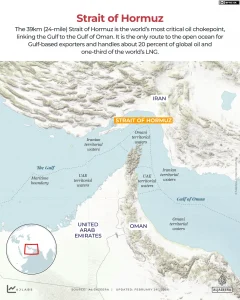
The vulnerability of the Strait of Hormuz is not only strategic but also operational. The waterway is relatively narrow, with shipping lanes that are highly concentrated, making vessels particularly exposed to disruption. Iran has previously demonstrated the ability to interfere with maritime traffic through tactics such as the harassment of tankers, the use of small fast-attack craft, and the deployment of naval mines (Loot and Kawagishi 2022). Even limited interference with shipping traffic can create delays, increase transit costs, and raise perceived risk levels among insurers and shipping companies. As a result, the economic impact of disruption is immediate, as markets react not only to actual blockages but also to the threat of instability. This dynamic gives Iran the ability to exert influence without needing to fully close the Strait, reinforcing the effectiveness of its asymmetric approach. This dynamic is significant because the primary risk is not only immediate disruption, but the duration of uncertainty surrounding maritime transit. Markets are more sensitive to prolonged instability than short-term shocks, meaning that even limited interference can generate sustained economic pressure if shipping routes remain unpredictable.
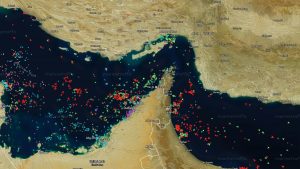
Since early 2026, tensions have escalated into an active confrontation with global implications. Iran has targeted commercial shipping and signaled its willingness to disrupt maritime traffic through the Strait, raising concerns among global energy markets. These developments have contributed to rising oil prices, increased shipping risks, and significant increases in maritime insurance premiums, reflecting the growing perception of instability in the region (Reuters 2026). In response, the United States has expanded its military presence, including naval deployments aimed at securing shipping lanes and deterring further disruptions. Recent reporting show that maritime insurance premiums for vessels transiting the Strait have risen sharply, reflecting increased perceived risk, while energy markets have responded with price volatility tied directly to disruption concerns.
Alongside this, U.S. responses are shaped by institutional dynamics. The executive branch retains the ability to act rapidly in response to emerging threats, often without explicit congressional authorization (NCC, National Constitution Center 2026) While this allows for flexibility, it also increases the risk of policy drift, where limited actions expand without clearly defined strategic objectives. This dynamic complicates policymaking, as short-term responses may lead to long-term commitments.
Policy Option 1 – Expanded Military Escalation
This approach involves increasing U.S. air and naval strikes against Iranian military assets linked to maritime disruption, including naval units and infrastructure supporting attacks on commercial shipping. This could include strikes on coastal missile systems, naval bases, or vessels directly involved in harassment operations.
The objective would be to restore deterrence and reestablish control over the Strait of Hormuz. In the short term, this strategy could reassure allies and signal strong U.S. willingness to act. Although, it carries a high risk of escalation. Iran is likely to respond through asymmetric retaliation, including proxy attacks or further disruptions to maritime traffic (CSIS 2024). This could lead to a broader regional conflict without a clear exit strategy, while also increasing volatility in global energy markets.
Policy Option 2 – Deterrence and Maritime containment
This strategy focuses on increasing U.S. naval deployments in the Strait of Hormuz, including escort operations for commercial vessels and coordination with allied forces. By maintaining operational control over key shipping lanes, this approach directly addresses maritime disruption while limiting escalation. It allows the United States to uphold freedom of navigation without engaging in large-scale offensive operations. It is important to note that it does not eliminate Iran’s ability to disrupt maritime activity and requires a sustained military presence, which may lead to long-term costs and strategic fatigue. In operational terms, this strategy would involve continuous naval patrols, intelligence and surveillance operations, and coordination through multinational maritime security initiatives. Escort missions for high-risk commercial vessels would be prioritized, particularly for energy shipments, while U.S. forces would maintain a visible presence to deter further interference. This approach emphasizes control rather than confrontation, focusing on ensuring the flow of maritime traffic rather than directly targeting Iranian capabilities.
Policy Option 3 – Diplomatic de-escalation with conditional pressure
This approach prioritizes reducing tensions through diplomatic engagement, potentially through intermediaries, while maintaining military and economic pressure to preserve leverage. The goal is to establish limits on escalation and prevent the conflict from expanding further. While this strategy could help stabilize global markets and reduce immediate risks, it depends on Iranian cooperation and may be perceived as weakening U.S. credibility if not supported by credible deterrence. Iran may also use negotiations strategically, limiting the effectiveness of this approach. Diplomatic engagement under this approach would likely rely on indirect channels, including regional intermediaries or multilateral frameworks, given the absence of formal U.S.-Iran diplomatic relations. Maintaining economic sanctions and military readiness would be essential to preserving leverage. This balance between pressure and engagement is critical, as diplomacy without credible deterrence risks being ineffective, while pressure without engagement increases the likelihood of continued escalation.
Risks and Trade-Offs
Each policy option presents significant trade-offs. One of the most critical is the balance between escalation and stability. While military escalation may restore deterrence in the short term, it increases the likelihood of a broader regional conflict that could involve multiple actors and expand beyond maritime security.
Another key trade-off is between credibility and overcommitment. The United States must demonstrate its ability to protect maritime security and uphold freedom of navigation. However, excessive military involvement risks long-term entanglement without clear strategic gains, increasing both financial and political costs.
Economic risks are also central. The duration of disruption is especially critical, as prolonged instability in maritime transit can generate deeper and more sustained economic consequences than temporary supply shocks. As we have been living currently in the U.S..
Because a significant portion of global oil supply passes through the Strait of Hormuz, even limited disruptions can generate immediate price shocks, increase transportation costs, and contribute to broader inflationary pressures in global markets (Kilian, Plante, and Richter 2026). This raises the issue from a regional conflict to a global economic concern.
The unpredictable nature of asymmetric conflict complicates decision-making. Iran’s reliance on indirect strategies makes it difficult to anticipate responses and control escalation dynamics, increasing the likelihood of unintended consequences (CSIS 2024).
Finally, there is the risk of policy drift. In the absence of clearly defined objectives, limited actions may gradually expand into deeper involvement, particularly given the speed at which executive decisions can be made.
Final Recommendation
The United States should adopt a hybrid strategy that combines deterrence with targeted diplomatic engagement. Under the current administration of Donald Trump, policy has emphasized strong military responses to Iranian actions. While this reinforces deterrence, relying only on escalation increases the risk of prolonged conflict and economic instability.
This hybrid approach is more effective than relying exclusively on either military escalation or diplomacy alone because it directly addresses both the security and economic dimensions of the crisis. Pure military escalation risks triggering a broader regional conflict that could further disrupt global energy markets, while a purely diplomatic approach may fail to deter continued Iranian interference. By combining deterrence with limited engagement, the United States is better positioned to manage escalation dynamics while maintaining flexibility in response to changing conditions.
In effect, this strategy allows policymakers to respond proportionally to Iranian actions while avoiding overcommitment. It also aligns more closely with current U.S. strategic priorities, which emphasize both competition and stability in key regions. Under the current administration of Donald Trump, this approach provides a way to maintain a strong posture without committing to large-scale military escalation, reducing both economic and political risks.
Note: AI tools were used in the final stages of this project to assist with minor editing, formatting, and clarity improvements. All analysis, arguments, and content are original work.
References
Al Jazeera. “Trump Issues 48-Hour Hormuz Strait Ultimatum, Threatens Iran Power Plants.” March 22, 2026. https://www.aljazeera.com/news/2026/3/22/trump-issues-48-hour-hormuz-strait-ultimatum-threatens-iran-power-plants
Atlantic Council. 2026. https://www.atlanticcouncil.org/dispatches/operation-overflow-how-to-break-irans-grip-over-the-strait-of-hormuz/
Center for Strategic and International Studies. “Iran’s War Strategy: Don’t Calibrate—Escalate.” https://www.csis.org/analysis/irans-war-strategy-dont-calibrate-escalate
Dallas Federal Reserve. Lutz Kilian, mIchael Plante, Alexander W. Richter https://www.dallasfed.org/research/economics/2026/0320
Lott, Alexander, and Shin Kawagishi. “The Legal Regime of the Strait of Hormuz and Attacks against Oil Tankers: Law of the Sea and Law on the Use of Force Perspectives.” Ocean Development & International Law 53, no. 2-3 (2022): 123–46. https://doi.org/10.1080/00908320.2022.2096158. https://stmarytx.on.worldcat.org/oclc/10310117096
National Constitution Center. “Does the War Powers Resolution Debate Take on a New Context in the Iran Conflict?” https://constitutioncenter.org/blog/does-the-war-powers-resolution-debate-take-on-a-new-context-in-the-iran-conflict
Reuters. “Iran War’s Energy Impact Forces World to Pay Up, Cut Consumption.” March 21, 2026. https://www.reuters.com/business/energy/iran-wars-energy-impact-forces-world-pay-up-cut-consumption-2026-03-21/
Reuters. “Maritime Insurance Premiums Surge as Iran Conflict Widens.” March 6, 2026. https://www.reuters.com/world/middle-east/maritime-insurance-premiums-surge-iran-conflict-widens-2026-03-06/