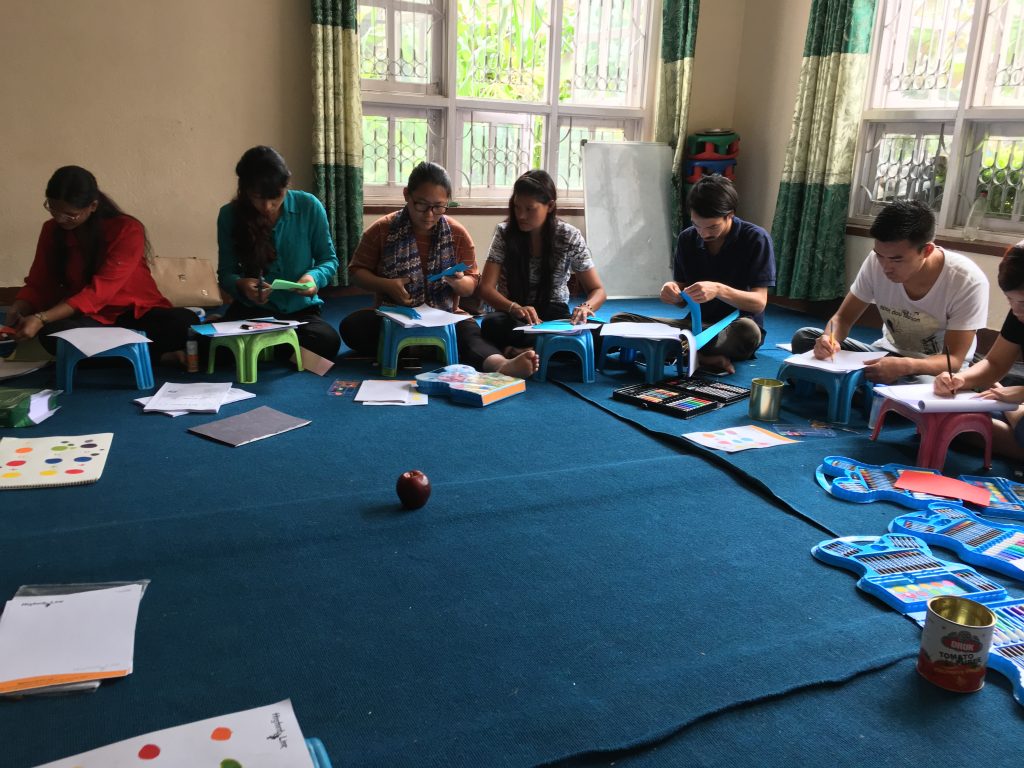

Featured image above, Nepalese students learning English taken by Kathia Martinez, in 2018 | Courtesy of Kathia Martinez
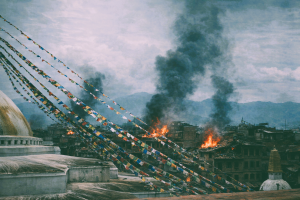
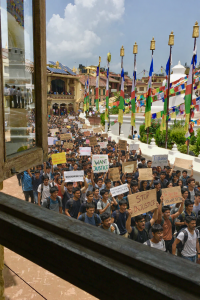
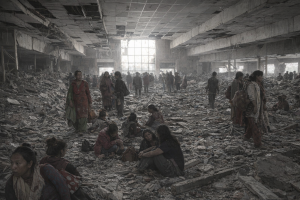
Blood on the streets, a government on fire, and protestors’ voices demanding change. This describes the scene in Nepal on September 8, 2025. Mostly known for its Himalayan Mountains, Nepal grew into a country rich in diverse ethnicities and languages, where people display an extraordinary political resilience. In September 2025, widespread unrest and protests forced Prime Minister K. P. Sharma Oli to resign. The government imposed a nationwide ban on various social media platforms, which sparked an additional surge in protests and united Nepal’s youth. Authorities targeted 26 major platforms including WhatsApp, Facebook, Instagram, and others claiming they had not complied with newly imposed registration rules.1 By requiring platforms to register, the government positioned itself to monitor dissenting voices and, at worst, silence them. This move intensified existing frustrations among youths, who already faced high unemployment and entrenched political corruption amidst a stagnant economy. Various forms of activism emerged from the protests, which began peacefully but quickly turned violent when government forces attempted to stop protestors by force. Protestors responded with arson and other aggressive tactics while authorities deployed even more aggressive crowd control methods, including live ammunition rounds. These events left hundreds of civilians—many of them young protesters—dead and thousands, injured.2 One article shares the story of Kamal, a 26-year-old student in Kathmandu. He recounts, “I was with my friend during the protest…I just saw him fall down in front of me. He was brought to the hospital, but there were so many injured people there. I was told he was no more. We had been friends since we were children. But they shot him in the chest, and he died. It was his first protest and his last.” Tragically, this experience echoed for far too many protesters who attended.3
But how did they get here? What is fueling this rebellion from the youth? What built up to such corruption and stagnation in Nepal, a country that adopted a new constitution just a mere 12 years prior? This article tracks what led to the new constitution and how despite the changes, challenges have remained.
What began as peaceful activism quickly escalated into violence and exposed the government’s heavy-handed response. When looking back at the beginning of Nepal’s monarchal collapse, we see that political uprisings due to people’s widespread discontent fueled the decade long Maoist insurgency (1996-2006). The Maoists-a faction of the Communist Party of Nepal, (CPN) capitalized on political instability and unmet needs, positioning themselves as the solution to the obsolete monarchy and the regime’s political corruption. High levels of corruption weakened trust. People in Nepal’s rural area’s endured challenges like unemployment, poverty, and lack of basic services, so the Maoists promised them better conditions, “The Maoist movement…draws support from Rais, Limbus, Gurungs, Magars, etc.., and also receives widespread support from the peasant class frustrated with poverty, illiteracy, unemployment, and corruption.”.4 The indigenous Rais, Limbus, Gurungs, and Magars live in the hills of Nepal, most villages and homes anchored in the mountains where it was not easy to have access to media or to receive up to date information. Taking into account this situation, Maoists swayed people within these regions with the threat of control over resources and indigenous rights being taken as those were common priorities for these people. 5 The Maoists won people over and brought national support to their side. Their engaging narrative convinced people that Communism could alter the current capitalist structure to serve the people’s needs. Maoists used local practices to gain trust, to engage, and to rally their supporters.
The Maoist insurgency of the 90s exploited the same rural discontent and ethnic marginalization that still fuels unrest today. Eventually the Maoists launched the People’s War, “The CPN‑Maoist first fired their salvo of ‘People’s War” on 12 February 1996, aimed to destroy constitutional monarchy and to establish a Maoist people’s democracy. Countermeasures resulted in casualties and further pushed away opposing districts.
The dominance of the Communist Party of Nepal and the Nepali Congress Party drive a political landscape where power circulates among a small group of elites, limiting space for new voices and innovative leadership. This not only perpetuates corruption but also discourages meaningful reforms that could address the structural issues facing the country. Nepal abolished their monarchy in 2008 and established new institutions such as parliament, the presidency, and an empowered judiciary intended to shape future political electoral contests and strengthen constitutional resilience.6 This was expected to break the cycle of grievance and inequity, but political fragmentation persisted. Since then, the Nepalese burgeoning democracy has struggled to overcome the many obstacles of corruption, continued institutional instability, and resulting political fragmentation that continued to go on passed 2015, when the country adopted a new constitution that established a federal republic. “However, political volatility persisted, with 14 governments in 16 years, mostly dominated by the Communist Party of Nepal…and the Nepali Congress Party”. 7 The disregard to amend this political misconduct highlights the ongoing political corruption, as well as the lack of political participation from the youth due to scarce opportunities plus underdevelopment in minority populated regions. The persistent instability and constant changes in government have undermined public trust in political institutions and stifled long-term policy planning.
Even after these democratic reforms, elite dominance and institutional instability continued to erode public trust and faith in the establishment. It’s a picture of progress from the government that keeps falling apart. A country that overcame an authoritarian monarchy, showing up in movements and putting in their all to fight back only to find themselves at square one. This unbroken pattern of elite control left Nepal’s Gen Z inheriting democratic promise without meaningful economic or political opportunities to start. Much of the Generation Z in Nepal has grown up under the potential of democracy but has not experienced its full benefits of job opportunities within their country or an economy that complements their needs. Their generation has experienced better education than those before them, more connections globally, and self-awareness of political drawbacks. But their ideals have often clashed with limited job opportunities, gatekeeping of government positions by elites, and economic stagnation. New Delhi correspondent, Alex Travelli, talks about the time young Nepalese people invest into getting an education to then leave the country just to find low-grade jobs, “It’s not that these are young people who necessarily want to leave Nepal…half of the country’s families depend on income sent by Nepalis’ working abroad.”. 8 As a result, frustration has not only increased but has now found new areas of expression, specifically through digital social platforms that let people organize and have political discussion. 9
Social media became the critical platform and outlet for this frustrated generation – until the 2025 ban turned it into a flashpoint. In aiming to restrict these platforms under the grounds of order, the government reveals possibilities of further authoritarian relapse. For thousands of young Nepalis, this regulation mirrored to earlier patterns of political control that the people had fought so hard to dismantle. The ban symbolized a bigger disconnect between the ruling political class and a generation demanding transparency, inclusion, and reform. South Asia Human Rights Watch Director, Meenakshi Ganguly, comments on the protests saying, “…there were a lot of issues. And, in fact, all of the issues were already being talked about on social media, which perhaps is why the government was looking to regulate the platforms. There were [online] campaigns about corruption, about ‘nepobabies’ and about the fact that regular citizens were not getting jobs, all while the politicians were not governing properly and not ensuring public welfare.”. 10 Furthermore, the ban marked a decisive turning point, highlighting the widening rift between Nepal’s political elites and its rising generation. By silencing digital platforms where grievances, activism, and calls for reform found expression, the government risked repeating the mistakes of the past, ignoring the demands for transparency and inclusion that fueled previous cycles of agitation.
- Suwal, S, (2025), The 2025 Gen Z uprising in Nepal: A three-part analysis, published by Harvard T.H. Chan School of Published by Harvard T.H Chan School of Public Health. ↵
- Suwal, S, (2025), The 2025 Gen Z uprising in Nepal: A three-part analysis, published by Harvard T.H. Chan School of Public Health. ↵
- The FRANCE 24 Observers, & Derre, M, (2025), How Nepalese police shot at protesters with “military‑grade ammunition” published by France 24, and supplemental source G., Shrestha, T. M., & Lamsal, S. Police, (2025), Police brutality against children and hospitals in Nepal, published by The Lancet. ↵
- N. Gul, (2022), Question of Nepal: Political Instability and Maoist Insurgency, published by Pakistan Institute of International Affairs. ↵
- Britannica Editors Rai. Encyclopedia published by Britannica, 2014; Britannica Editors Limbu. Encyclopedia published by Britannica, 2016; Britannica Editors Magar. Encyclopedia published by Britannica, 2023; and Britannica Editors Gurung. Encyclopedia published by Britannica, 2016. ↵
- L. Curtis, K. Hart and K. Martyn, (2025), Country Assessments Reports: Democracy in South Asia amid U.S. AID Cuts: What’s at Stake for Great Power Competition, published by Center for a New American Security. ↵
- L. Curtis, K. Hart and K. Martyn, (2025), Country Assessments Reports: Democracy in South Asia amid U.S. AID Cuts: What’s at Stake for Great Power Competition, published by Center for a New American Security. ↵
- A. Travelli, (2025), The key issues that drove Gen Z protests that toppled Nepal’s government, published by PBS NewsHour. ↵
- L. Curtis, K. Hart and K. Martyn, (2025), Country Assessments Reports: Democracy in South Asia amid U.S. AID Cuts: What’s at Stake for Great Power Competition, published by Center for a New American Security. ↵
- FRANCE 24 Observers, & Derre, M, (2025), How Nepalese police shot at protesters with “military‑grade ammunition” published by France 24 and supplemental source Human Rights Watch, (2025), Police fire on ‘Gen Z’ protest published by Human Rights Watch. ↵