
Caught in a Prolonged Political Transition
The Philippines, a beautiful Pacific Island nation with an equally rich history, has recently found itself the center of international attention. From the promises of post-colonial democracy to the entrenchment of patronage politics, the Philippines offers a stark example of a nation caught in a prolonged political transition. Despite popular uprisings and democratic reforms, institutionalized corruption has paralyzed the Philippines’ ability to implement the changes the population requested. How has corruption, not only survived through this time, but adapted to thrive? How can the Philippines emerge from this never-ending political transition?
To answer these questions, we need to first take a considerable step back, as corruption this deeply rooted never pops up overnight. Indeed, this corruption has been steadily taking hold of the nation’s governmental institutions since its complete independence from the United States in 1946. So, allow us to start at this turning point.
A New Start
As World War II wound down, General MacArthur and his forces weeded out the remaining Japanese troops by July 1945. The damage that the Philippines sustained became increasingly clear. A million Filipinos died in the war; with a pre-war population of 18 million, this means 1 in 18 Filipinos lost their lives.1 Major cities were reduced to rubble, with concrete, rebar, and spent ammunition covering the now deserted streets. Burnt farms exposed the carcasses of the animals that once roamed these fields. All the while, economic troubles plagued the nation. Though, in spite of all this trouble, all this destruction, the Philippines still had independence in its sight.
See, the Philippines had been planning and lobbying for independence from the United States for decades prior, and just before the war they had finally struck a deal guaranteeing Philippine independence from the US. But questions about whether or not the 1946 timeline for independence was still feasible took national attention. Post-war reconstruction is hardly the ideal environment to gain independence in, after all. Especially when the reconstruction funds were coming from the nation they sought independence from. But after all the debates had settled, the Philippines decided that they were all in on sticking to the 1946 timeline for independence, and they had to begin preparations right away.
The first point of order was finding a leader. In the 1946 election, Manuel Roxas (who previously served under Japan-backed government during occupation) won a narrow victory of around 54% of votes.2 Alongside the election for the Presidency, the Philippines held congressional elections. In one of the earliest instances of corruption, six leftist leaders, part of the “Democratic Alliance,” won their respective elections, yet were denied their seats in Congress on alleged claims of fraud and violence.3 Modern historians claim that the true motivation for this was political suppression. The Philippine Left was against American interests at the time, and the new government wanted to ensure that pro-American measures would not be blocked. This action is actually seen as one of the early factors that led to the Hukbalahap Rebellion.
But with elections finished, regardless of the shady misdealings, the new Roxas administration began organizing the Independence Day celebrations. With some American help, the Philippines rebuilt war-torn hotels and stadiums, hand-sewed new flags, made custom medals, and even printed custom stamps. And as July 4th rolled around, the excitement in the air was palpable. Parades rose all through the nation.4
A crowd gathers in a stadium for the Independence Day ceremony. Courtesy of the US Signal Corp. July 4, 1946.
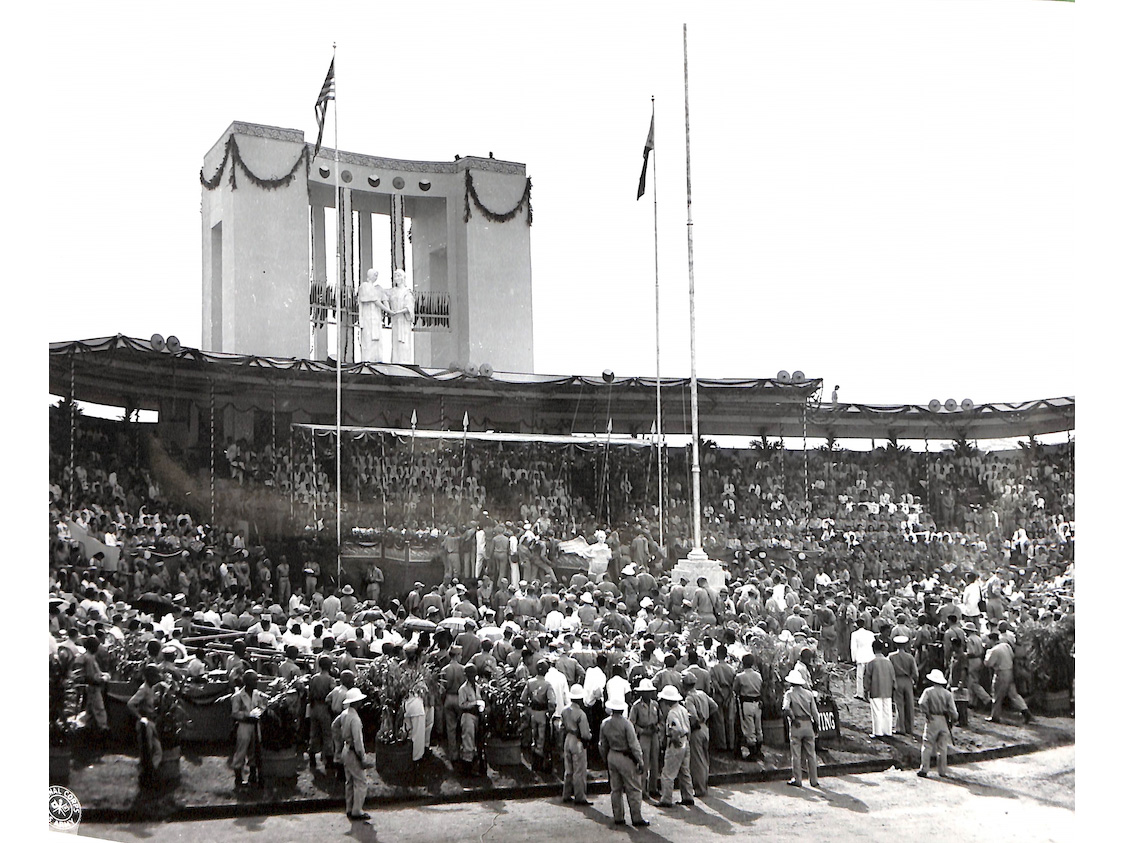
It was a cloudy and overcast day in the middle of the Philippines’ rainy season, and luckily enough for the people, the event was outdoors. As rain drenched the audience and the selected speakers, the last ever American High Commissioner, Paul McNutt, began the ceremony. “A new nation is born. Long live the Republic of the Philippines. May God bless and prosper the Philippine People, keep them safe and free,” he said. And symbolically, the rain ceased. High Commissioner McNutt lowered the American flag whilst President Roxas raised the Philippine flag. Roxas spoke:
I have raised the Philippine flag to wave henceforth alone and unshadowed over the entire Philippines. American sovereignty has been withdrawn. It has been transferred and is now possessed in full measure by the Filipino people. We have thus reached the summit of the mighty mountain of independence toward which we and our fathers have striven during the lifetime of our people.5
All the while, the Philippine Army Band played a version of the American National Anthem that slowly faded into the Philippine National Anthem. One unnamed observer wrote the flags touched in the wind “as if in a last caress, a last kiss”.6 This was a beautiful start for what was to be a bright future for the young nation.
Just two days prior, on July 2nd, 1946, the Philippine Congress, under the direction of the American government, ratified the Bell Trade Act.7 One key provision allowed the United States to control the value of the Philippine Peso. The US fixed it to a rate of 2 Philippine pesos per 1 US dollar. Additionally, there were to be preferential tariffs on products imported from the US. But most importantly, the Bell Trade Act guaranteed “parity rights” for Americans, meaning US citizens and corporations were to have the same rights as Filipino citizens and corporations in regards to any and all of the Philippines’ natural resources. This final measure was so extreme, the Philippines had to revise its constitution to account for it. The Philippines revised its constitution to protect US interest, now a foreign nation. Hence, ensuring a corrupting tight grip on its institutions.
But now, the young Republic of the Philippines had acquired independence. While it faced some misfortune in its early years, such as Roxas’ passing only 2 years into his presidency, the next major corruption event lies in the presidency of Ferdinand Marcos (not to be confused with Ferdinand “Bongbong” Marcos Jr., his son).8
The Rise of an Autocrat Fosters Corruption
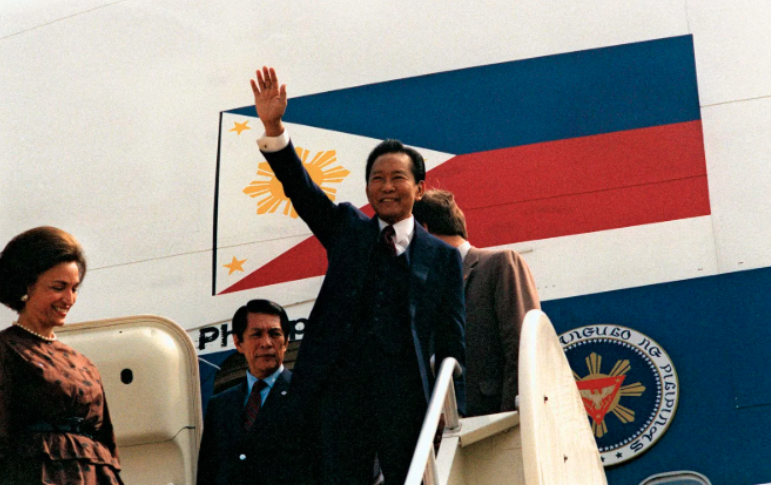
While earlier politicians were undoubtedly corrupt, it was Marcos who really showcased just how inherently corrupt and skewed the Filipino constitution was. Marcos was legitimately elected to office in the election of 1965. In his first term, he used his presidential powers to lay the groundwork for “crony capitalism,” a system where he granted economic monopolies to close associates.9 He also installed (or created) loyalists in the Philippine Army, allowing certain officers to bypass rules and regulations, and providing others with public office. He also misappropriated public funds into personal bank accounts. But to help his popularity, Marcos invested heavily in public infrastructure.10 This did wonders for his approval rating, and he comfortably won reelection.
In his second term, Marcos continued the corruption he fostered. He put more of his associates in charge of government positions, gave bailouts to his associates’ businesses, and used presidential powers to benefit himself and those close to him. But Marcos’ poor behavior came to light. The infrastructure “investments” that Marcos championed in his first term were actually built on foreign loans, and those loans came due. But unfortunately, the Philippines could not pay them. This tanked both the economy, and Marcos’ popularity. In an attempt to rectify the payments, Marcos turned to the International Monetary Fund (IMF). The IMF mandated that, among other things, the Philippine Peso had to float and decline in value. Naturally, inflation followed.11
The front page of the September 24, 1972 edition of the Philippines Daily Express after Marcos declared martial law. Courtesy of Wikimedia.

Marcos’ popularity hit rock bottom. The streets filled with protestors, some burning effigies of Marcos. Marcos saw few ways out of this situation. He floated the idea of using legal loopholes to serve a third term (though the odds of him being legitimately elected were slim-to-none).12 In reaction, the 1971 Philippine Constitutional Convention introduced the “Block Marcos” amendments, designed solely to prevent Marcos from serving a third term. Imelda Marcos, Ferdinand Marcos’ wife, was caught paying off politicians to vote against the measures.13 But that was simply not enough for Marcos.
In his most corrupt move yet, Marcos declared martial law. He justified the move by taking an awfully American stance. He said that the threat of Communism, and Islamic separatist movements had reached a point where they could no longer be ignored. Of course, the real reason, was that this move benefitted him the most.14
In the following months, Marcos arrested 11 opposing politicians, and the rest were forced into exile or hiding. Marcos then rewrote the entire Constitution to strengthen his power. In his time as dictator, there were 3,257 known extrajudicial killings. There were over 35,000 documented tortures. 737 individuals were “disappeared.” Over 70,000 people were incarcerated, largely without reasonable cause. Marcos used his power to violently suppress any and all who opposed his regime.15
Beyond this, Marcos continued to siphon money into private bank accounts, many of which in the United States. He also bought private properties with government funds, including multiple penthouses in New York City.16 All in all, Marcos became the poster boy for corruption.
Eventually, the people of the Philippines rose up against Marcos’ authoritarian regime, and he was deposed in the People Power Revolution. He then fled to Honolulu, Hawaii at the suggestion of then President Ronald Reagan. His entire family was banned from the Philippines, though later this measure was revised to only ban Ferdinand himself.17 But the Philippines, though bruised and battered by the revolution and the constitutional rewrite, were once again free from authoritarian rule.
A New Start, Again
Corazon Aquino, a prominent leader from the People Power Revolution, was sworn in shortly after the removal of Marcos from office. She first reorganized the government to rid it of Marcos loyalists and ensure an authoritarian takeover could not occur again. She issued proclamations removing Marcos-appointed politicians, including securing the resignation of 15 Marcos-appointed Supreme Court Justices. She then suspended the 1973 Marcos constitution and assembled a team of anti-authoritarian activists, lawyers, and former judges to write a new, corruption-proof constitution which was ratified in 1986.18
So then today one might hope to see the Philippines free of corruption. After all, the Philippines and her people fought so hard for so long to rid their nation of the corrupt decay. But, unfortunately, that is far from the truth.
One current headline from the Associated Press reads “Hundreds of thousands rally in Manila against flood-control corruption scandal,” another from NPR reads “Thousands in Philippines protest corruption, demand return of stolen funds.”19 There are hundreds of articles just like these two. Articles discussing the abuse of power coming from the government and its contractors. Articles discussing public outrage against this corruption. Articles that sound just like those published roughly 50 years ago.
Filipinos celebrate in the streets after the victory of Ferdinand Marcos Jr. (referred to here as “BBM”) and Sara Duterte. Courtesy of China Daily HK.
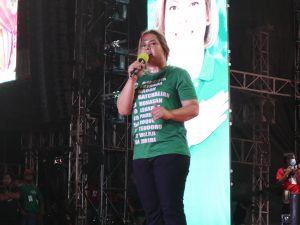
Fittingly, the current President of the Philippines has a name from 50 years ago too: Ferdinand Marcos Jr. The former dictator’s only son returned his family to executive power. Though he has not yet declared martial law, his presidency has been tainted by corruption just like his father’s. Ironically, it also happens that Marcos Jr.’s biggest corruption scandal is about infrastructure, and Marcos Sr. is notorious for unpayable infrastructure built on foreign loans.
The Vice President, Sara Duterte, also has a familiar name. She is the daughter of Rodrigo Duterte, the previous President of the Philippines, who is currently being tried for crimes against humanity and the extrajudicial killings of tens of thousands.20 Two families have competed to lead the Philippines since its independence. In fact, dynastic rule has become a staple of Filipino politics. Even Corazon Aquino’s son, Benigno Aquino III, became president in 2010.
So why is it that despite decades of fighting, multiple constitutional reforms, and two revolutions, the Philippines remains plagued by corruption and dynastic rule? My analysis points to the fact that the Philippines is still a very young nation. While this article covered just over the past 8 decades. The Philippines, like all nations, has had its fair share of growing pains. But beyond that, the two things keeping the Philippines in this prolonged transition are bureaucracy, and the social concept of “utang na loob.”
Starting with the latter, “utang na loob” is the idea of social indebtedness. In English, it roughly translates to “debt of gratitude,” or “debt from one’s inner self.” Essentially, this part of the Filipino social contract dictates that one should feel indebted to those who support them, and should pay them back in kind. For example, if your family invested in your future, you should send them money once you have a full-time career. If your neighbor paid for your lunch, you should help repair his car. In many ways, utang na loob can help build a sense of community. But in many ways, utang na loob serves as a restriction, and an enabler for toxic practices, particularly in politics.
For example, if a politician who received considerable campaign donations has just won office, he is indebted to those donors and must repay them. He might do this by offering them jobs in government, or by awarding their companies government contracts. In this way, utang na loob leads to nepotism and misspent government funds. But another example might be that a judge presiding over a case notices an important family name, say the Duterte or Marcos family, and knowing their influence, he wants to get that family indebted to him. And so when the case comes back in the families favor, that judge may coincidentally receive a promotion in the following months. In this way, politicians of all positions are incentivized to help those with influential names, knowing those families must pay back the help in kind. Utang na loob and its implications in politics inherently creates dynasties. And though there are measures to prevent this, at least in theory, they are buried deep in bureaucratic procedure. Trials for corruption can take months, years, or even never happen at all. Because of red tape and legal loopholes, there are very few ways to actually enforce anti-corruption laws.
What Now?
The Philippines’ corruption ranking from 2012-2025, according to the Transparency International Corruption Perceptions Index.21 Their lowest ranking in green, and their highest in red. Original image created by Christian Molina.
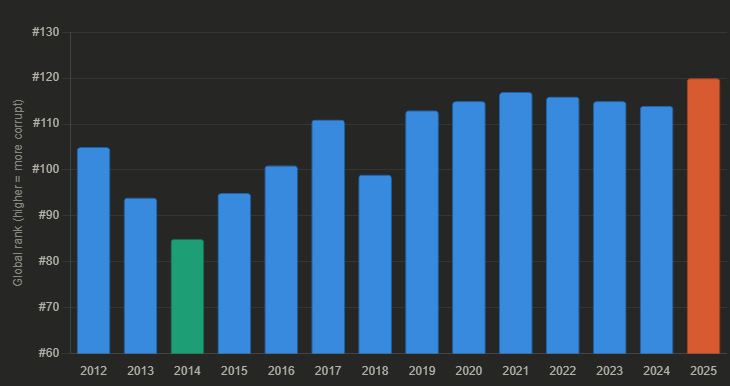
So, if utang na loob incentivizes dynasty building and corruption, and bureaucracy prevents anti-corruption enforcement, what can be done? How can the Philippines escape this prolonged transition and root out corruption? First, and perhaps most obviously, is a much needed overhaul of bureaucracy in the Filipino government. Streamlined corruption hearings are a must. Waiting months or years to hold a politician accountable simply does not work. Furthermore, to clamp down on utang na loob in government, the Philippines should find a way to exclude family names during high-profile legal cases. Though this may sound unconventional, trying the parties with pseudonyms could help prevent nepotism or favoritism in the justice system. And to account for utang na loob in the private sector, the president and vice president’s power should be limited. The president should not be able to award government positions to donors, nor should members of the Bids and Awards Committee be able to award government contracts to donors.
However, while government must act to rid the Philippines of corruption, eradication requires a multifaceted approach . To truly get to the heart of corruption and dynasticism, the cultural concept of “utang na loob” must fundamentally change, and exit politics. This article can only highlight the deeply rooted issues that have prevented progress. The article cannot delve into the larger sociological impacts of utang na loob. However, from a political standpoint, quid pro quo systems similar to those of utang na loob inherently reproduce corruption. Philippine youths must recognize this to work to reshape the social contract to exclude the idea of indebtedness from all spheres of politics. If the Philippines’ past helps to predict its future, their history of hard-working, brave people who keep fighting until they set things right means young of Filipinos can fight to realize a brighter future. The battle to transform their cultural roots of indebtedness reminds us of the weight of tradition on the health of political institutions.
- The National WWII Museum, “July 4, 1946, The Philippines Gained Independence from the United States” July 2, 2021, Accessed March 6, 2026. ↵
- The National WWII Museum, “July 4, 1946: The Philippines Gained Independence from the United States” Published July 2, 2021, Accessed March 6, 2026. https://www.nationalww2museum.org/war/articles/july-4-1946-philippines-independence. ↵
- Michael Johnston. “Essential Lessons from an Unpromising Source: What Reformers Can Learn from the Philippines on Corruption Control.” Public Administration and Policy 27, no. 3 (2024): 344–56. https://doi.org/10.1108/PAP-04-2024-0066. ↵
- The National WWII Museum, “July 4, 1946: The Philippines Gained Independence from the United States” Published July 2, 2021. Accessed March 6, 2026. https://www.nationalww2museum.org/war/articles/july-4-1946-philippines-independence. ↵
- Manuel Roxas. Papers, addresses and other writings of Manuel Roxas (Vol. 1). Manila: Bureau of Public Libraries. 1954. https://www.officialgazette.gov.ph/1946/07/04/inaugural-address-of-president-roxas-on-the-independence-of-the-philippines/. ↵
- The National WWII Museum, “July 4, 1946: The Philippines Gained Independence from the United States” Published July 2, 2021. Accessed March 6, 2026. https://www.nationalww2museum.org/war/articles/july-4-1946-philippines-independence. ↵
- The National WWII Museum, “July 4, 1946: The Philippines Gained Independence from the United States” Published July 2, 2021. Accessed March 6, 2026. https://www.nationalww2museum.org/war/articles/july-4-1946-philippines-independence. ↵
- Albert Celoza. Ferdinand Marcos and the Philippines: The Political Economy of Authoritarianism. Greenwood Publishing Group. 1997. ↵
- Albert Celoza. Ferdinand Marcos and the Philippines: The Political Economy of Authoritarianism. Greenwood Publishing Group. 1997. ↵
- Albert Celoza. Ferdinand Marcos and the Philippines: The Political Economy of Authoritarianism. Greenwood Publishing Group. 1997. ↵
- Richard Kagan. “Marcos Declares Martial Law in the Philippines: Law: Research Starters: EBSCO Research.” EBSCO, 2023. https://www.ebsco.com/research-starters/law/marcos-declares-martial-law-philippines. ↵
- Richard Kagan. “Marcos Declares Martial Law in the Philippines: Law: Research Starters: EBSCO Research.” EBSCO, 2023. https://www.ebsco.com/research-starters/law/marcos-declares-martial-law-philippines. ↵
- Richard Kagan. “Marcos Declares Martial Law in the Philippines: Law: Research Starters: EBSCO Research.” EBSCO, 2023. https://www.ebsco.com/research-starters/law/marcos-declares-martial-law-philippines. ↵
- Richard Kagan. “Marcos Declares Martial Law in the Philippines: Law: Research Starters: EBSCO Research.” EBSCO, 2023. https://www.ebsco.com/research-starters/law/marcos-declares-martial-law-philippines. ↵
- Richard Kagan. “Marcos Declares Martial Law in the Philippines: Law: Research Starters: EBSCO Research.” EBSCO, 2023. https://www.ebsco.com/research-starters/law/marcos-declares-martial-law-philippines. ↵
- Albert Celoza. Ferdinand Marcos and the Philippines: The Political Economy of Authoritarianism. Greenwood Publishing Group. 1997. ↵
- Albert Celoza. Ferdinand Marcos and the Philippines: The Political Economy of Authoritarianism. Greenwood Publishing Group. 1997. ↵
- Encyclopedia Britannica. “Philippines History, The Early Republic” Encyclopedia Britannica. Last modified January 30, 2026. https://www.britannica.com/place/Philippines/The-early-republic. ↵
- AP (Associated Press). “Hundreds of thousands rally in Manila against flood-control corruption scandal.” AP. Last modified November 16, 2025. https://apnews.com/article/philippines-flood-control-corruption-protests-d390012c4eb5c37fc906b4fdc53e14fb. and NPR, “Thousands in Philippines protest corruption, demand return of stolen funds.” NPR. November 30, 2025. https://www.npr.org/2025/11/30/nx-s1-5626219/philippines-protest-corruption-stolen-funds ↵
- U4 Anti-Corruption Resource Center. “The Philippines: Corruption and Anti-Corruption.” U4. Accessed January 31, 2026. https://www.u4.no/publications/the-philippines-corruption-and-anti-corruption-efforts/fullversion#extent-of-corruption. ↵
- Transparency International. “CPI Philippines.” Transparency International. Accessed February 1, 2026. https://www.transparency.org/en/cpi/2024/index/phl. ↵