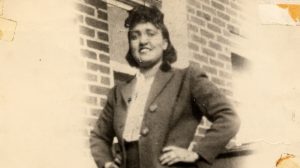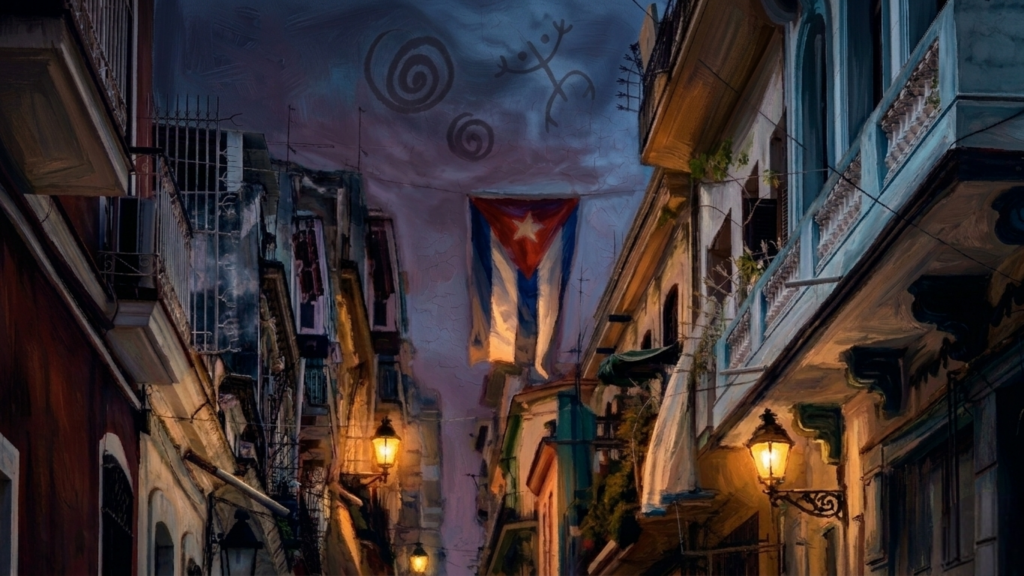

Cuba, a nation forged in anti-imperialist struggles from colonial conquests to the 1959 Revolution, currently navigates through a precarious transition marred by economic collapse – from mass emigration and chronic blackouts that plunge entire provinces into darkness for twenty hours at a stretch, to acute shortages of fuel, staple foods such as rice, beans, and chicken, life-saving medicine, and spare parts for machinery and vehicles. Taino heritage, nearly erased and long suppressed in favor of the consolidated socialist state-identity “Cubanismo,” now experiences a quiet resurgence. Taino identity stands as a symbol of endurance against institutional entropy and decay. This topic connects to Nations in Transition by examining how Taino cultural symbolism — embodying quiet resolve and adaptability — intersects with the regime’s continuity and decay across its iterations. In doing so, it melds humanistic themes of survival with contemporary geopolitical pressures such as US sanctions and lost alliances, while exploring implications for Cuba’s future collective identity, sociocultural politics, and potential post-regime renewal in an uncertain global landscape. Cuba’s story comes alive through Doña Elda’s account of her life. Mi abuelita.
The Land That Remembers
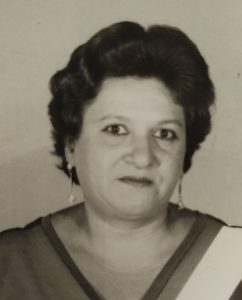
I am Doña Elda, an elder from the sequestered valleys of Baracoa in Oriente, where the untamed land itself mirrors the enduring spirit of my Taino ancestors — a wild and quiet resilience that the state has long tried to extinguish, yet still whispers through the mountains, the rivers, and the maternal line I carry. Mine has been long, this life as with my memories, now in its ninth decade. I know, I remember firsthand the breadth of august vows committed, and those broken — the revolutionary promises I once embraced in my youth, only to watch them erode into the dimming hopes and gross exploitation of today. My time spans the arc of Cuba’s promises and failures, from the fervor of those early years to the weight of what remains, and the grief for what never became. In 2026, as blackouts swallowed entire days while the shelves of our bodegas lay empty. I find myself at the crossroads outside town, only this time in a different spirit, I stand where the dirt paths diverge like the fractured narratives, imperatives of our nation. One path leads back to the crumbling monument of a regime that once ignited hope but now breeds despair; the other hints at uncertain renewal, where echoes of identities long thought lost might offer a quiet solace against despair. Cuba’s decline is not a storm born yesterday, but a slow unraveling transition rooted in centuries of imperial imposition and revolutionary impotence. I recount our story to you as I stand here — not as a lament, but as an empirical chronicle of how a nation’s ideals erode under their own weight. With only the subtle threads of cultural endurance in the legacy of my descent, I will guide you through the history that has brought us to this crossroads.
Seeds of Erasure: 1492 and the Pattern That Endures
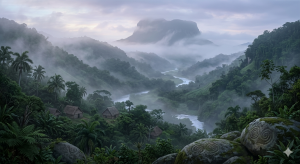
Cuba’s trajectory of decline began in the cataclysm of 1492, when colonial conquests set into motion a pattern of erasure that still echoes through our modern crises today. The Taino, my distant forebears, organized in matrilineal chiefdoms where descent flowed through the women and residences clustered around maternal uncles, therein fostering adaptive networks that balanced resources and kinship across eastern Cuba and the vast majority of the Greater Antilles.1 This social structure enabled resilience by way of centering women as the keepers of knowledge, culture, and stability, allowing the Taino culture and identity to endure, even as countless men died amid the war of conquest. To that end, as the Spanish arrival brought aggregate decimation through disease, conflict, and forced labor; all of the men were killed off over time, and the targeted violence against the remaining women was so great, that Taino survival had been skewed almost entirely toward maternal lines, the only standing preservation of genetic traces today. On that note, today, mitochondrial DNA studies reveal Amerindian ancestry in 33% of Cubans, peaking at 59% in Holguin and 58% in Las Tunas.2 As the culture would endure, transcending time through lineage, so too would the stories of our heroes, through legend; Hatuey, the first among many, the great Taino cacique who staunchly resisted the Spanish invasion and was burned alive at the stake, embodied early anti-imperialism, with his defiance galvanizing the indigenous population to resist the colonial scourge.3 By the mid 16th century, Spanish colonization had decimated Taino communities across Cuba, with most of the population killed off, and our culture, knowledge, lands, and symbols co-opted. What few living expressions and vessels remained, had began to fade into isolation and obscurity.4
From Conquest to Revolution: Symbols Co-opted, Voices Silenced
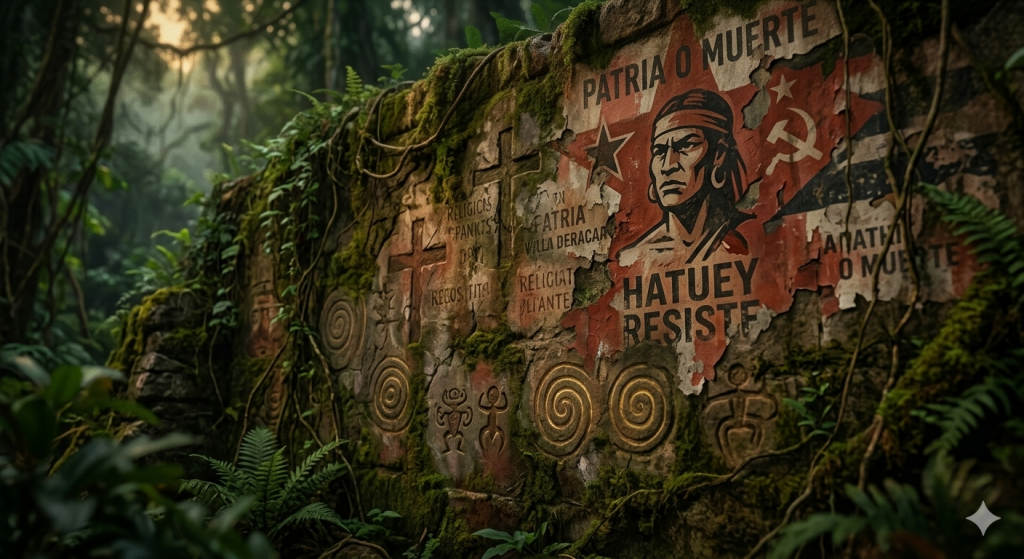
This pattern of suppression persisted well into the revolutionary era, where anti-imperialist ideation masked pain and fatigue, the likes of which by this point was in no way exclusive to Taino descendants anymore. The 1959 Revolution, overthrowing Batista’s corrupt regime, promised sovereignty and equality, drawing on Marti’s vision of a unified Latin American fight against empire and colonial influence. Yet – as fate would have it – in practice, it consolidated “Cubanismo”, a state-sanctioned identity blending Spanish and African elements, while sidelining indigenous legitimacy so to forge a sort of national unity, unconstrained by narratives thought inconvenient to the paradigm at hand.5 Post-revolutionary policies would further co-opt Taino icons such as Hatuey’s likeness for propaganda or naming military operations after him, but actual communities in Oriente, such as La Rancheria in Guantanamo – with hereditary leadership traceable to the 1660s – yet remains on the periphery.6 Moreover, in the spirit of ‘Cubanismo’, the 1980s Rectification Campaign sought to revive ideological zeal and socialist purity amid growing inefficiencies and emphasize internationalism as a tool for domestic cohesion. Looking back, it was an ironic time period – becoming the scourge for regime momentum alone. Missions like Operation Carlotta in Angola (1975-1991), involving 330,000 Cubans and thousands of casualties, countered egoism and bolstered revolutionary fervor, thus reinforcing the regime’s position so as to continue weathering internal strains.7 But see, these efforts only masked the underlying decay setting in; corruption had infiltrated the system, and economic dependencies on the Soviet bloc proved fragile.
The Slow Burn: From Special Period to 2026 Free Fall
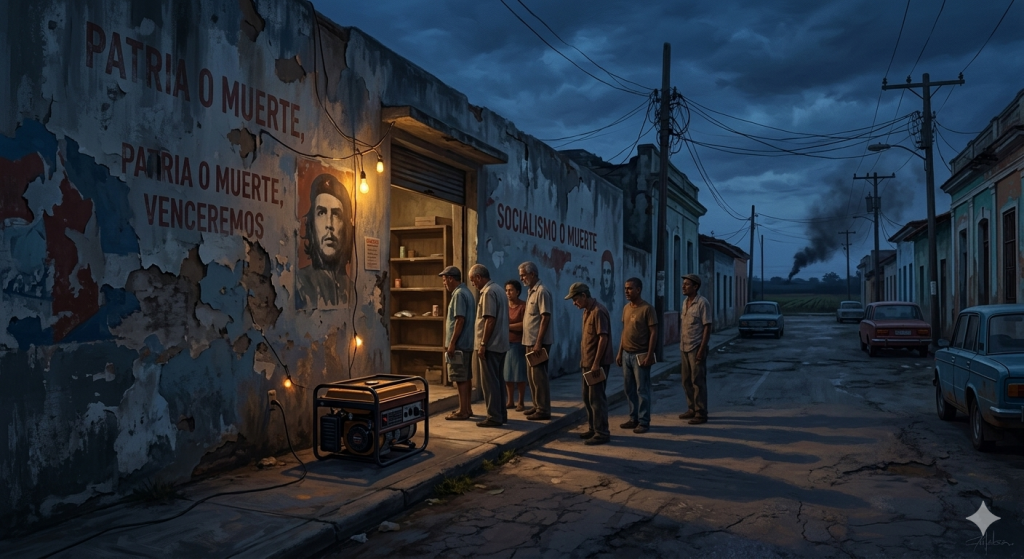
The Special period of the 1990s marked the first acute phase of decline for us, triggered by the USSR’s collapse. GDP plummeted, blackouts became routine, and malnutrition greatly harmed Cuba’s already-precarious social order.8 The regime survived through austerity and limited reforms, drawing once more upon the historical legitimacy of anti-imperialism and internationalist solidarity.9 I remember the noble Jose Marti’s talking points and the basis for his convictions against imperialist hegemony in my studies as a girl, and how profoundly similar Fidel’s own ideas were at the time; I thought it right then, especially before Fidel revealed his impetus as communist — I think it wrong now, and long since, to blame your adversaries out of convenience, to circumvent accountability for your own failures. Alas, the bell began to toll again in the 2010s, as this resilience was only temporary; alliances like Venezuela’s oil subsidies propped up the economy, but corruption and inefficiency continued to jeopardize the social contract. Today, the free fall accelerates: chaos in the Venezuelan state has severed lifelines, sanctions from the US have intensified, and sectors such as agriculture and tourism have collapsed under blackouts and shortages of fuel for irrigation pumps and transport trucks, staple foods that now rot in fields or arrive spoiled, essential medicines that leave clinics empty, and spare parts that leave factories and vehicles paralyzed.10 Population data reveals that we are an aging nation, with 22.3% over 60, while over 10% of the remaining population has emigrated since 2020 alone, thus draining vitality.11 I see the nature of our discontent grow worse every year; protests erupt, not as organized revolts against an oligarchy but as desperate expressions of disenfranchisement, intensified by rampant corruption that betrays our revolutionary ideals of old.12 The regime’s vulnerability remains empirically observable: CIA assessments accentuate grim economics while insider negotiations and oil blockades continue to signal a pragmatic push toward collapse.13 Or so I’ve heard.
Quiet Shifts in the Shadow of the State
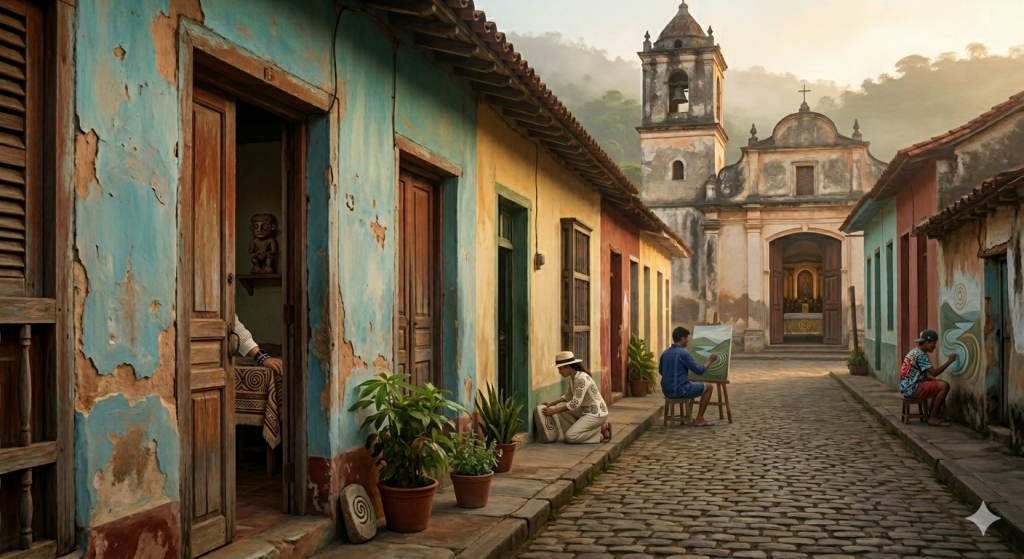
Amid this institutional entropy, however, a subtle shift stirs in the cultural ethos, especially among the young people that would remain. Hidden within the paintings that hang in our small church, on the faded tiles of a few old buildings in town, and in the simple carvings my neighbors now place beside their doors alongside other symbols, the spiral – that ancient Taino motif of energy and continuity – appears again. It is not a loud declaration, but a quiet reminder that something older than the state still lives.14 As state identity politics falter – “Cubanismo” exposed as a hollow construct – people quietly reclaim fragments of erased histories, for self assurance, for recent learning, for survival. Who are we, and what have we to persevere for, if the overarching identity we’ve been led to adopt is predicated on false pretenses? In Oriente, where Taino DNA persists strongest, communities like Caridad de los Indios host modest revivals and gatherings, not as political movements but as functional mechanisms for endurance before jeopardy.15
For me, my endurance, my will to persevere is resoundingly personal: my maternal line traces back to those one thousand or so many Amerindian women who survived the horrors of conquest. Their genes – and now my own – serve as a quiet testament to tenacity.16 We as a people find great power in our identity – as any people would – especially when that identity embodies the strength, the grit needed to face hardship after hardship. But ours isn’t merely for ourselves, this fortitude, but for all Cubans that may feel less than whole, we must be strong for each other — that should be ‘Cubanismo’.
At the Crossroads
At the same crossroads, that dusty fork outside Baracoa, where paths diverge like existential choices before me. One veers toward regime decay with its loyalty into oblivion: faded murals of revolutionary heroes peel under the relentless sun and humid air, empty oil barrels litter fields once tilled with communal zeal, and the air thick with the acrid scent of generators and machines sputtering their last effort. This path marked by a thousand promises evokes betrayal of its yearning for equality distorted by corruption, anti-imperialism, and hollowed by dependency. The other opens tentatively: spirals etched in the dirt blend with diverse motifs with flourishing vegetation that leads to thriving market for produce and for ideas unconstrained by the dogma of an authoritarian state. Here, Taino legitimacy finally manifests in the open, growing modestly but certainly, not as a new face but as one bold and vibrant thread in the social fabric.
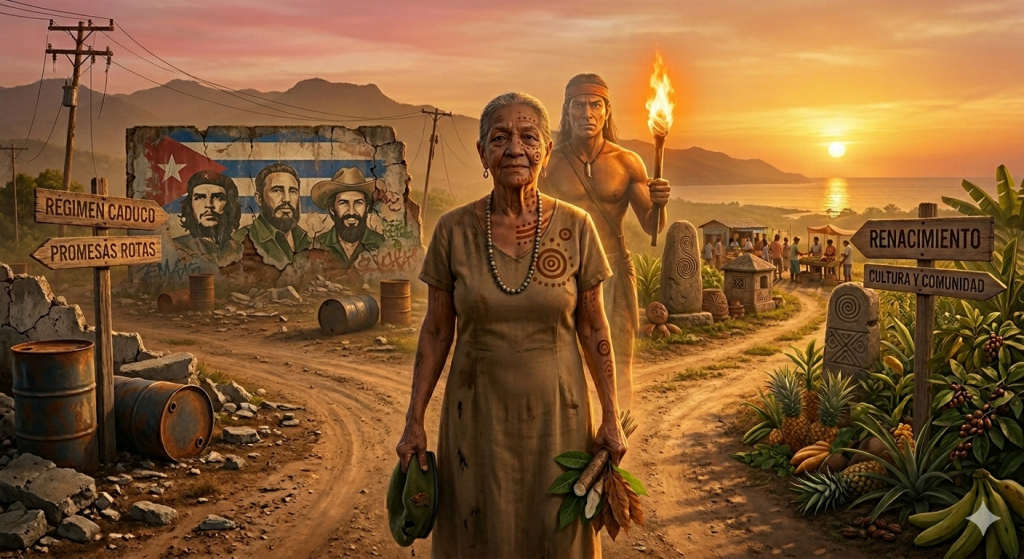
The sun is setting, and I catch myself; I take a seat on the stone between the junction. I ponder. The current regime buckles, it collapses not entirely yet, but increasingly probably shattering under mounting internal and geopolitical pressures. US strategies, such as blockades and negotiations with insiders aim for an endgame by year-end, exploiting economic desperation.17 But I know that in this vacuum, cultural shifts provide subtle anchors for new players: Oriente’s Indo-Cubans, numbering at least 4,000 engage in quiet diplomacy – signaling legitimacy without upheaval, representation without compromise.18 These are novel circumstances indeed. Solutions demand pragmatism and clarity. Would easing sanctions, fostering internal reforms, and integrating diverse narratives into governance help shed the rigidity of egalitarian? Can this be Cuba’s moment of transition and development?19
It is dark now, but I know my way. As I now stand here contemplating the two paths before me, Hatuey’s torch flickers behind me – a silent, steady illumination. What price do we pay to preserve and revive our identity? Where does grief end, and pragmatism begin? In Cuba’s long decline, these questions linger with me. They urge us toward a renewal where endurance, not rigid ideology, guides the way. My path feels clear, I believe the same can be true for Mi Cuba.
- William F. Keegan and Morgan D. Maclachlan, “The Evolution of Avunculocal Chiefdoms: A Reconstruction of Taíno Kinship and Politics,” American Anthropologist 91, no. 3 (September 1989): 615–620. ↵
- Smithsonian National Museum of the American Indian, “Indigenous Cuba: Hidden in Plain Sight,” last modified 2016–2026, https://www.americanindianmagazine.org/story/indigenous-cuba-hidden-plain-sight; Translating Cuba, “An Unprecedented DNA Study Confirms and Recovers Indigenous Identity in Cuba,” December 19, 2022, https://translatingcuba.com/an-unprecedented-dna-study-confirms-and-recovers-indigenous-identity-in-cuba. ↵
- Isaac Saney, “Homeland of Humanity: Internationalism within the Cuban Revolution,” Latin American Perspectives 36, no. 1 (January 2009): 111. ↵
- Smithsonian Magazine, “Bringing Taíno Peoples Back Into History,” last modified December 30, 2022, https://www.smithsonianmag.com/smithsonian-institution/bringing-taino-peoples-back-history-180967637/. ↵
- Saney, “Homeland of Humanity,” 112. ↵
- ICT News, “Indigenous Identity: The Taino Movement,” November 28, 2025, https://ictnews.org/news/indigenous-identity-the-taino-movement. ↵
- Saney, “Homeland of Humanity,” 111–113. ↵
- ONEI, “Cuba en Cifras: Population and Economic Trends 2022,” Oficina Nacional de Estadística e Información, https://www.onei.gob.cu/. ↵
- Saney, “Homeland of Humanity,” 113. ↵
- Reuters, “Exclusive: CIA Highlighted Cuba’s Grim Economy but Gave Mixed View on Government Falling,” January 10, 2026, https://www.reuters.com/world/americas/cia-highlighted-cubas-grim-economy-gave-mixed-view-government-falling-2026-01-10/; Al Jazeera, “After the US Attack on Venezuela, Will Cuba’s Economy Survive?” January 23, 2026, https://www.aljazeera.com/features/longform/2026/1/23/after-the-us-attack-on-venezuela-will-cubas-economy-survive. ↵
- ONEI, “Cuba en Cifras.” ↵
- Politico, “Plans in Flux on Cuba Regime Change,” January 23, 2026, https://www.politico.com/newsletters/national-security-daily/2026/01/23/plans-in-flux-on-cuba-regime-change-00744836. ↵
- Reuters, “Exclusive.” ↵
- Nicole Marroquin and Leslie Sotomayor, “Talking About Belonging and Survival: An Invitation,” Visual Arts Research 45, no. 1 (Summer 2019): 50. ↵
- BBC Travel, “Cuba’s Taíno People: A Flourishing Culture, Believed Extinct,” February 6, 2019, https://www.bbc.com/travel/article/20190205-cubas-tano-people-a-flourishing-culture-believed-extinct; ICT News, “Indigenous Identity.” ↵
- Translating Cuba, “An Unprecedented DNA Study.” ↵
- Wall Street Journal, “The U.S. Is Actively Seeking Regime Change in Cuba by the End of the Year,” January 22, 2026, https://www.wsj.com/world/americas/the-u-s-is-actively-seeking-regime-change-in-cuba-by-the-end-of-the-year-1d0f178a; Politico, “Plans in Flux.” ↵
- ICT News, “Indigenous Identity”; BBC Travel, “Cuba’s Taíno People.” ↵
- Saney, “Homeland of Humanity,” 123. ↵