
Two hundred years before the birth of Christ, the ancient Mediterranean was dominated by two powers, Rome and Carthage. The Carthaginian Empire ruled the Mediterranean through trade and naval dominance until the Roman Republic brutally defeated it in a war.1 It was only a matter of time before the rivalry between the two powers would bring them head-to-head once again in another major war. It was also a war that saw one man’s destiny rise to become one of the greatest generals in history, Hannibal Barca. Raised to enact vengeance and forced to achieve the impossible, he would go down as Rome’s greatest enemy. After years of consolidating power in Spain alongside his father Hamilcar and his brothers, an opportunity emerged for him that would surprise Rome: an attack on Saguntum.2

As Hannibal and the Carthaginians gradually extended control over Spain, Saguntum, worried about its independence, managed to secure an alliance with Rome, even referring to itself as Saguntum’s protector at the expense of the Ebro River treaty. In 219 BCE, Hannibal besieged the city, which lasted for eight months, until the city finally capitulated, with Rome doing nothing to aid them. An outraged Rome sent an embassy to Carthage looking for an explanation for this heinous act. The embassy presented the Carthaginian senate with a choice: surrender Hannibal and other colleagues, or go to war. With that, the Second Punic War had begun.3 The Romans, believing in easy victory, assembled two armies: “one army would be sent to Spain and another to Africa.”4 The army heading to Spain was under the command of the Roman Consul Publius Cornelius Scipio, who made a pit stop at Massalia (now Marseille) before heading out. However, his trip was cut short when he learned that Hannibal was close to his position in Southern Gaul, trying to cross the Rhone. He set out to confront him only to find that he had already moved on, reaching ever closer to the Alps and the Roman homeland. Scipio returned to Italy to raise a new army in case Hannibal managed to survive the crossing, which he did. However, it came at a tremendous cost of over half of his men. His weak, demoralized army found itself trapped in Roman territory with no other option than to fight.
The Romans, for the most part, didn’t seem too fazed about his arrival. Their military doctrine revolved around direct confrontation as the only means to fight honorably and win. Hannibal learned this very well, and he quickly learned to mold his tactics around this doctrine and use it to his advantage. As a result, the Romans were very predictable, and so when he presented the element of surprise, it caught them off guard. The Battle of Ticinus against Scipio was a major loss for the Romans. Celtic tribes in Northern Italy defected to Hannibal’s side, allowing Hannibal to replenish his forces so that when the other Roman Consul Longus and his army (the army meant to invade Africa) confronted Hannibal at the Battle of Trebia, he carefully crafted a scheme to take on Longus, and won. At this point, Rome was on high alert as Hannibal had gained Northern Italy, inflicted major losses, and begun moving south to replenish his army and Celtic allies. He would later come across another Roman army under the command of the Consul Flaminius at the Battle of Lake Trasimene, where he used the environment to ambush them and even kill Flaminius himself. Rome was now in a state of crisis as Hannibal was in close proximity to the city itself.5 The Roman Senate hastily elected a dictator to deal with the threat. Fabius Maximus rose to power and quickly reformed army tactics to those of attrition. He understood that Hannibal was too smart and difficult to fight, but that he also relied on victories and replenishment, so Fabius instead avoided all direct confrontation with Hannibal and instead wore him down through scorched earth, small skirmishes, and defeats. This proved very effective as Hannibal’s progress was stifled because of it. However, the Roman populace, yearning for quick victory, grew impatient with Fabius’s tactics, and he became very unpopular, even being dubbed “cunctator” or “The Delayer.” Fabius’s dictatorship, along with his ingenious strategy now known as the Fabian Strategy, came to an end. The Senate hastily elected two new consuls, Varro and Pallus, to be sent into battle and confront Hannibal once again.6
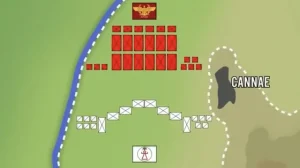
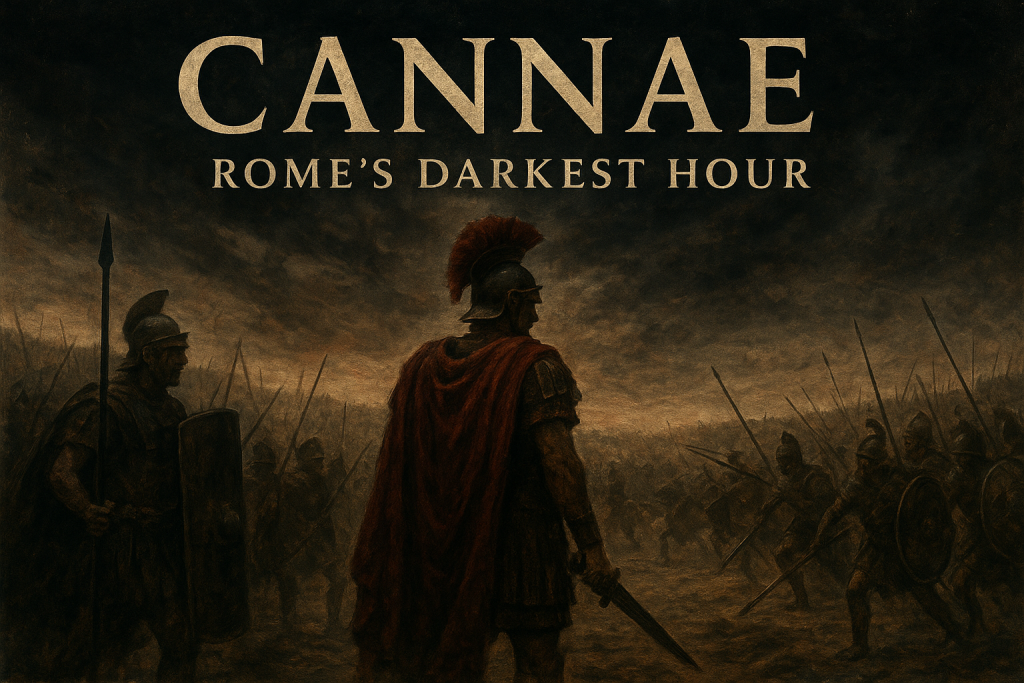
About 70,000 Romans marched to confront Hannibal at Cannae, where he secured a major supply depot.7 Under the command of Gaius Terentius Varro and Lucius Aemilius Pallus, they hoped to obtain a quick and easy victory after the “dishonorable” tactics of Fabius Maximus. When Hannibal’s men looked out at the countless number of Roman soldiers, they couldn’t withstand what they saw. Hannibal, however, didn’t seem too fazed about it, even joking to one of his commanders, Gisco, that “In all those great numbers before us, there is not one man called Gisco.” He knew that if he could present them with the unexpected, he’d win. On the day of battle, the Romans, reverting to their traditional direct confrontation method, mobilized their outstretched army (which was a lot bigger due to their sheer numbers) with the calvary stationed on both the right and left flanks, lining between the Aufidus (modern Ofanto) river and the hills of Cannae hoping that it would prevent Hannibal’s superior Numidian cavalry from outflanking them. Hannibal’s infantry was lined up in a “convex formation” like the outside of a bow, with his weakest center outward, his Numidian cavalry on both flanks, and stationed with their backs to the south, ensuring that the dusty winds blew in the Roman army’s direction. The Roman plan was simple: break through Hannibal’s center and destroy it. But Hannibal had a plan to deal with the larger enemy threat. As the Roman infantry advanced into the Carthaginian center, the Numidian cavalry engaged and outmaneuvered the Roman horsemen on both flanks, forcing them to retreat along with the consul Varro, abandoning the infantry. As the Numidians continued pursuing the Roman cavalry, the Carthaginian center line retreated inward, driving them deeper in a tightening pocket as they followed suit. Hannibal, in a brilliant move, allowed the Romans to trap themselves on all sides rather than encircling them as the Numidian cavalry returned to strike them from the rear, surrounding them. With the infantry now completely trapped, the retreating troops turned back to fight, slowly closing in on all sides. Little by little, the Romans were cut down as they were so closed in that they couldn’t even move, let alone defend themselves, leaving them to perish by the Carthaginian sword. This was the genius of Cannae. This was Hannibal’s vengeance.8
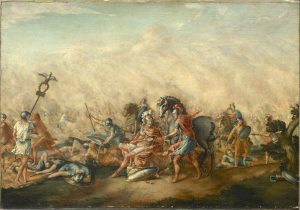
Sixty to eighty thousand Roman soldiers fell to the Carthaginian sword. The cream of Rome’s military and political figures died within a single day, including the consul Paullus and a great number of Roman senators. To lose so many within a single battle, the fate of the Roman Republic should’ve been sealed as Hannibal’s sword of vengeance pierced through Roman invincibility. Southern Italy defected to Hannibal. Rome itself was in mass hysteria over the monumental defeat. By the rules of ancient warfare, it should solidify his ultimate victory. Finally, Hannibal achieved his vengeance, and the road to Rome was wide open. Hannibal had won… or so he thought.9 He proved himself very effective in reading the Roman mind, but if he thought that Rome would surrender, then he was about to discover an undesirable truth about the Romans, one that would change the course of history: they never surrender.10 At a nearby survivors’ camp, two young officers discussed fleeing Rome and finding service elsewhere. One young officer drew his sword and threatened to cut anyone down who would dare to leave Rome. That officer was the son of Publius Cornelius Scipio, whom the Romans would come to call Scipio Africanus, Rome’s great savior.
Supplementary Media (Not analyzed directly):
[1. Artiste Tunisien 01, “Hannibal – Rome’s Worst Nightmare [Full Movie],” YouTube video, published by BBC, May 14, 2006, https://www.youtube.com/watch?v=PCYLHTrZ_Z4.]
[2. OverSimplified, “The Second Punic War – OverSimplified (Part 2),” YouTube video, January 19, 2024, https://www.youtube.com/watch?v=Q-nWA0WeF98.]
- Joshua J. Mark, “Battle of Cannae,” World History Encyclopedia. Last modified March 24, 2020. ↵
- Joshua J. Mark, “Battle of Cannae,” World History Encyclopedia. Last modified March 24, 2020. ↵
- E. T. Salmon, “The Strategy of the Second Punic War,” Greece & Rome 7, no. 2 (1960): 134–135. ↵
- Gregory Daly, Cannae: The Experience of Battle in the Second Punic War (London: Routledge, 2002), 10. ↵
- Amish B. Smith, The War That Made Rome an Empire: The Second Punic War and Its Enduring Social Impact (unpublished manuscript, December 2023), 3-10. ↵
- Amish B. Smith, The War That Made Rome an Empire: The Second Punic War and Its Enduring Social Impact (unpublished manuscript, December 2023), 10. ↵
- Gregory Daly, Cannae: The Experience of Battle in the Second Punic War (London: Routledge, 2002), 16-25. ↵
- Yozan D. Mosig and Imene Belhassen, Revision and Reconstruction of the Battles of Cannae (216 BCE) and Zama (202 BCE) (University of Nebraska–Kearney, 2006), 8-12. ↵
- Joshua J. Mark, “Battle of Cannae,” World History Encyclopedia. Last modified March 24, 2020. ↵
- Joshua J. Mark, “The Price of Greed: Hannibal’s Betrayal by Carthage,” World History Encyclopedia. Last modified March 26, 2020. ↵