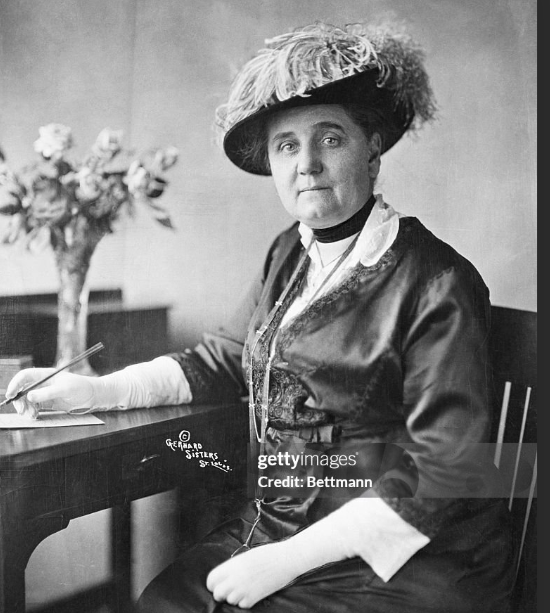

It was September 18, 1889, the first settlement house in Chicago had just opened. Jane Addams and Ellen Starr excitedly welcomed people to the Hull House. With the rapid growth of the immigrant population and the lower-class community, the opening of the first settlement house in a mostly immigrant working class neighborhood was a big deal. After many months of trying to open the Hull House, it finally came together and Jane and Ellen’s hard work finally paid off. How did Hull House come to be and why was it so important for the immigrant community?
Jane Addams was born on September 6, 1860, in northern Illinois to John and Sarah Addams. Jane was the eighth of nine children. Unfortunately, when Jane was two years old, her mother passed away. Jane graduated from Rockford Female Seminary on June 22, 1881, as the valedictorian of her class. After being unsure what to do with her life, at the age of twenty-seven she decided to visit London for the seconded time.1 During that trip, she and her friend, Ellen Starr, visited the Toynbee Hall, a Settlement House in the Whitechapel industrial district in London. After visiting the Toynbee Hall, they were inspired to build their own settlement house on the low-income side of Chicago. Jane wanted to help the lower-class community and help immigrants assimilate into American Society.2 Settlement houses were needed during the Progressive Era because of the mass number of immigrants coming to America. In Chicago alone, around 2.7 million immigrants arrived, and Jane saw this as an opportunity to help them.3
In February of 1889, Jane and Ellen, who was a teacher at the time at Kirkland School, discussed starting a settlement house. They wanted to take some ideas from the Toynbee Hall but also wanted to add their own ideas. Jane wanted to work with immigrants and help them assimilate in the United States. This is something the Toynbee Hall had not done. Jane says she “found no precedent at Toynbee Hall for dealing with foreign life.”2
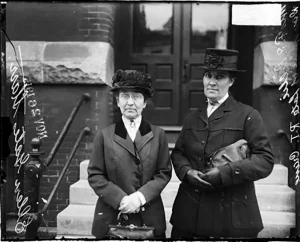
While Jane was trying to build Hull House, she faced a lot of criticism from her family and friends. They believed that building something like this couldn’t be possible. They were also criticized because Jane and Ellen were women in a society that believed women should get married or chose a career meant for women. Women were not supposed to run an organization. Jane also faced financial hardship with no help from the government. She had to raise money on her own.2
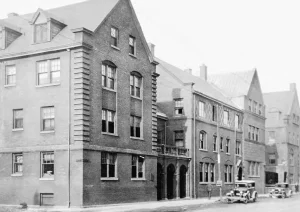
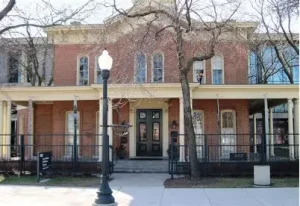
When Jane was determining where to establish Hull House, she came across the Hull Mansion built by Charles Hull in 1856. The home had been converted to a warehouse. She ultimately decided to start the settlement there, on the west side of Chicago, in an area known as an overcrowded, poor neighborhood. Jane initially rented the second floor of the mansion because this was all she could afford. Hull House was near factories and many tenement houses that were severely over crowded with immigrants from Poland, Russia, Greece, Italy, and even Austria-Hungary.6
In the first few months of leasing the house, Jane spent quite a bit of money to repair the building. Jane had to sacrifice a lot by cutting back on personal expenses to be able to provide for Hull House. After a while, Jane asked a few friends for monthly donations. They would give $50 a month. As time went on, their donations increased to $150 a month. Shortly afterwards, Helen Culver inherited the mansion from her cousin, Charles Hull. She agreed to let Jane and Ellen use the mansion rent free as long as they named the settlement house after her uncle, Charles Hull.2
When Hull House first opened, many people were skeptical and did not participate. They thought Jane and Ellen were up to no good. A man thought it was “the strangest thing he had met in his experience.” Many people also thought they were trying to convert people to Protestantism. Eventually, they started having more people coming. Jane realized Hull House was becoming helpful when two boys would visit the clubs once a week. As time went on, a few men would help with the boys’ club and teach them about manners. The second year of Hull House being open, more than 2,000 people would visit every week.8
One of the programs Hull House offered was a daycare and a kindergarten program, where some of Ellen’s former students came to help teach the younger kids. The also had programs for the older children too. When it came to the adults at Hull House, they had clubs that were organized by ethnicity. The Germans and Irish would have their own clubs so they could socialize with each other. The also had women only clubs. They offered college level classes in a variety of subjects. They also had night classes on civic rights and duties.8
Hull House expanded to nineteen building complexes that added a public kitchen, coffee house, gym, swimming pool, art and music studio, a drama group, library, vocational training, reading rooms and a cooperative boarding club for girls, among a few other programs for families to use.8 Something that set Hull House apart was that they did not push their religion on anyone; everyone could choose to practice their own religion.2
Hull House was the center of Jane’s reform movement. One Christmas day, they were shocked to find out some girls turned down candy. When she asked them why, they told her that they worked at a candy factory fourteen hours a day, eighty-two hours a week and they could not stand to see candy anymore. Jane was sad to hear this. She began to ask around and found out how exhausted everyone was from working in these factories.2
One day in a nearby factory, three boys were injured by a machine. When Jane found out about this, she went to talk with the owner. He said, “they would do everything possible to prevent the recurrences of such tragedy.” To no one’s surprise, the problem was not fixed. Unfortunately, the third boy was killed due to how horrible his injuries were. This inspired Jane to do something. She had heard about a woman named Mary Kennedy, who was a union organizer, and founder of Ladies Federation Labor Union. Jane invited Mary Kelly to Hull House so they could talk. Jane wanted to know what they could do to help the workers. Kelly advised her to print out fliers about labor union meetings. Over the next few years, they worked together to enforce labor laws.2
As Jane became more involved in civic engagement, she was appointed to the Chicago Board of Education and became the Chairman of the School Management Committee.8 She was also one of the founders of the Chicago School of Civics and Philanthropy. The following year, she was the first woman president of the National Conference of Charities and Correction. In Jane’s own neighborhood, she became more involved in sanitary conditions, narcotic consumption, and even became the garbage inspector on the 19th ward. Jane was the first woman granted an honorary degree by Yale University in 1910. On December 10, 1931, Jane was a co-winner for the Noble Peace Prize.8
In conclusion, Jane and Ellen started an amazing program that helped a lot of people. Their dreams were able to become a reality through their hard work and perseverance. Jane was truly an amazing woman that fought for the rights of immigrants with the help of so many people. As James Weber Linn noted, “In those [first] ten years, Jane Addams grew . . . as a citizen. Beginning with little but the hope of somehow ‘socializing’ a part of what Carlyle had called ‘this huge black Democracy of ours,’ she had given much, but she had got much more. . . . She had given . . . sympathy, . . . time, . . . energy, and money; she had got an understanding.”2 Hull House faced hundreds of challenges every day and took a while to attract people, but it ended up helping thousands of people every day. At Hull House, everyone was welcome, whether you were from the United States or not.
- Louise W. Knight, Citizen: Jane Addams and the Struggle for Democracy (Chicago: University of Chicago Press, 2005). ↵
- Louise W. Knight, Citizen: Jane Addams and the Struggle for Democracy (Chicago: University of Chicago Press, 2005). ↵
- Meier, Dustin. “Secure from the World’s Contagions: Settlement House Summer Camping in the Progressive Era.” The Journal of the Gilded Age and Progressive Era 22, no. 3 (2023): 260–77. https://doi.org/10.1017/S1537781423000026. ↵
- Louise W. Knight, Citizen: Jane Addams and the Struggle for Democracy (Chicago: University of Chicago Press, 2005). ↵
- Louise W. Knight, Citizen: Jane Addams and the Struggle for Democracy (Chicago: University of Chicago Press, 2005). ↵
- O’ROURKE, BRIDGET K. “‘To Learn from Life Itself’: Experience and Education at Hull-House”.” In Jane Addams in the Classroom, edited by DAVID SCHAAFSMA. University of Illinois Press, 2014. http://www.jstor.org/stable/10.5406/j.ctt6wr64k.6. ↵
- Louise W. Knight, Citizen: Jane Addams and the Struggle for Democracy (Chicago: University of Chicago Press, 2005). ↵
- Nobel Prize Outreach, “Jane Addams – Biographical,” NobelPrize.org, accessed March 11, 2026,. ↵
- Nobel Prize Outreach, “Jane Addams – Biographical,” NobelPrize.org, accessed March 11, 2026,. ↵
- Nobel Prize Outreach, “Jane Addams – Biographical,” NobelPrize.org, accessed March 11, 2026,. ↵
- Louise W. Knight, Citizen: Jane Addams and the Struggle for Democracy (Chicago: University of Chicago Press, 2005). ↵
- Louise W. Knight, Citizen: Jane Addams and the Struggle for Democracy (Chicago: University of Chicago Press, 2005). ↵
- Louise W. Knight, Citizen: Jane Addams and the Struggle for Democracy (Chicago: University of Chicago Press, 2005). ↵
- Nobel Prize Outreach, “Jane Addams – Biographical,” NobelPrize.org, accessed March 11, 2026,. ↵
- Nobel Prize Outreach, “Jane Addams – Biographical,” NobelPrize.org, accessed March 11, 2026,. ↵
- Louise W. Knight, Citizen: Jane Addams and the Struggle for Democracy (Chicago: University of Chicago Press, 2005). ↵