

Executive Summary
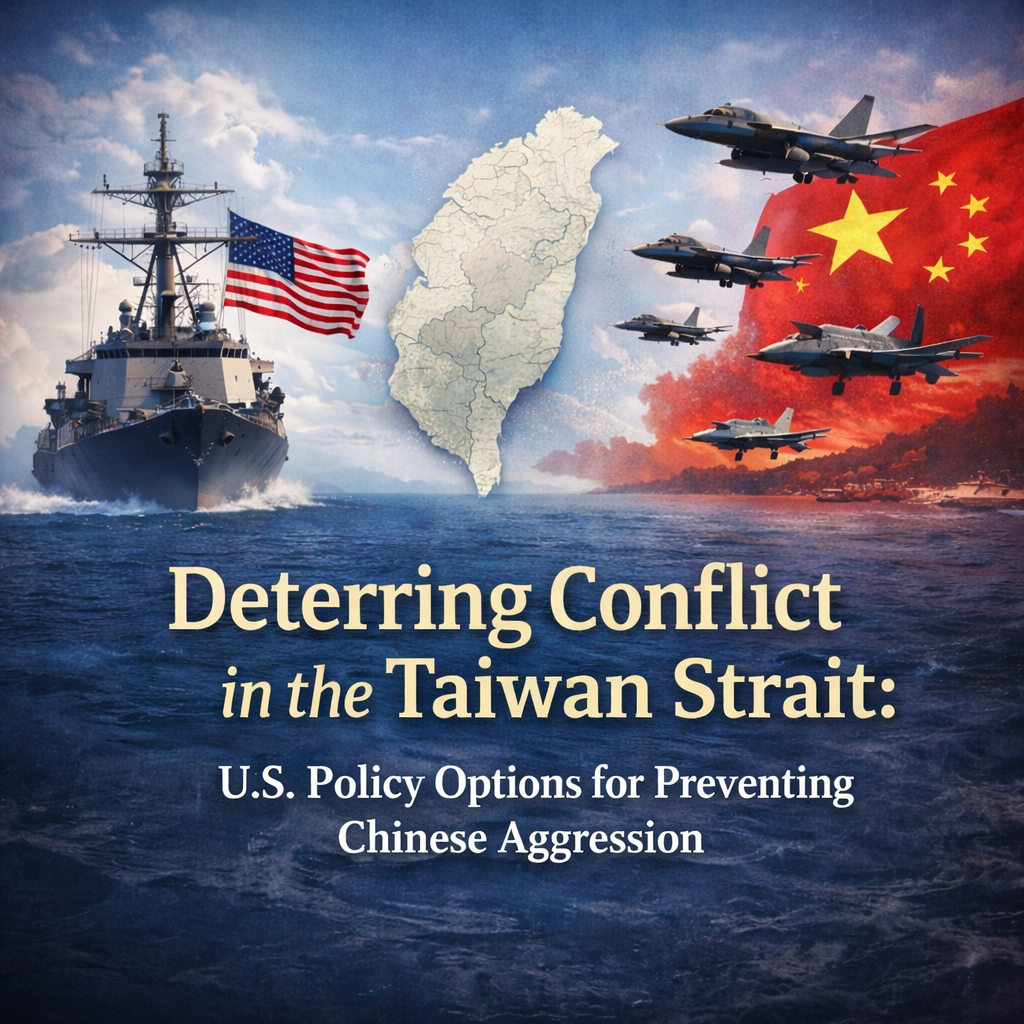
Rising tensions between the United States and China over Taiwan represent one of the most dangerous flashpoints in modern international politics. China has significantly increased its military pressure on Taiwan through military exercises, simulated blockades, and air incursions over Taiwanese airspace. Chinese aggression signals a growing readiness to use force if necessary in the event of escalated tensions. As a result, the United States has strengthened its Indo-Pacific military presence to support Taiwan in the event of escalation. The central challenge for U.S. policymakers is balancing effective deterrence against China while avoiding escalation into direct conflict.
This brief evaluates three policy options available to the United States in response to Chinese and Taiwanese tensions in the Indo-Pacific. The first option is adopting strategic clarity, which could enhance deterrence. The second option is to implement a denial-based deterrence strategy, focused on increasing Taiwan’s defense capabilities and regional posture. The third option is to maintain the current policy of strategic ambiguity. Each option reflects a different approach to deterrence, ranging from direct military commitment to indirect cost-imposition strategies.
This brief recommends a denial-based deterrence strategy combined with continued strategic ambiguity that maximizes deterrence while minimizing escalation risks. This approach prioritizes deterrence by denial rather than deterrence by punishment, aligning with contemporary defense strategy in asymmetric conflicts. By strengthening Taiwan’s defenses, accelerating arms deliveries and reinforcing regional alliances, the United States can raise the cost of Chinese aggression without triggering a direct, premature crisis.
Background & Context
Taiwan occupies a central position both geopolitically and economically. The Taiwan Strait, which lies between China and Taiwan, is one of the most important shipping routes in the world. Nearly half of global container shipping transits through the Taiwan Strait. Therefore, Taiwan is crucial to the United States’ efforts to maintain economic and regional stability in the Indo-Pacific region, specifically by containing Chinese regional expansion. A heightened conflict in this region could consequently disrupt global trade and supply chains, with cascading effects on the global economy (Sacks, 2023).
Additionally, Taiwan plays a critical role in the global economy due to its dominance in semiconductor production. Taiwanese firms produce a significant share of the world’s advanced microchips, which are essential for industries ranging from consumer electronics to defense systems. A disruption to Taiwan’s semiconductor industry would have severe consequences for global supply chains and technological development, further elevating the strategic importance of stability in the Taiwan Strait (Sacks, 2023).
China considers Taiwan a core national interest and has committed to achieving reunification by force if necessary. Recently, China has escalated military pressure through increasingly frequent and widespread military exercises in the region. More notably, Chinese forces executed extensive drills in late 2025 simulating a blockade of the island, signaling increased operational readiness; some speculate an invasion could occur as soon as 2027 (ICG, 2026).
Recent developments in 2026 highlight the accelerating risk of escalation in the Taiwan Strait. United States officials have emphasized the need for Taiwan to increase its defense spending to accelerate military preparedness as a precautionary measure to combat intensifying Chinese threats (Reuters, 2026). However, Taiwan’s leadership has warned that without enhanced deterrence, Chinese sporadic aggression will likely continue to increase (Reuters, 2026). As China’s military capabilities continue to expand, the credibility of U.S. deterrence increasingly depends not only on commitments but also on the perceived ability to deny China a rapid and successful invasion.
Currently, the United States maintains a policy of strategic ambiguity, deliberately leaving it unclear if Washington would intervene militarily in the event of a Chinese attack on Taiwan. This policy has historically resulted in a strategy of dual deterrence, discouraging both a Chinese invasion and Taiwanese advancements toward formal independence. This approach seeks to deter both Chinese aggression and Taiwan’s unilateral moves toward independence. However, evolving power dynamics and increased Chinese military capabilities could place this framework under increased strain. Given these dynamics, the United States faces several strategic options for managing deterrence and escalation in the Taiwan Strait.
Policy Option I: Strategic Clarity
Under a strategic clarity approach, the United States would commit to defending Taiwan in the event of a Chinese invasion. This could include formal declarations, increased troop deployments in the region, and the integration of Taiwan into broader U.S. defense planning. Strategic clarity would provide a strong and unambiguous deterrent signal to China, reducing the likelihood of miscalculation by Chinese leadership. By clearly outlining the United States’ intentions, it could strengthen confidence among regional allies such as Japan and the Philippines, resulting in reinforced alliance cohesion. This approach shifts deterrence from uncertainty to credibility, but risks intensifying security dilemma dynamics between the United States and China.
If Washington adopts formal commitments to defend Taiwan, China could interpret this as a direct challenge to its sovereignty, potentially accelerating Chinese military action. This could, as a result, lock the United States into a direct conflict scenario, reducing flexibility in crisis management.
Policy Option II: Maintaining Strategic Ambiguity
Maintaining strategic ambiguity involves continuing the United States’ current policy framework, which avoids direct commitments while maintaining support for Taiwan through arms sales, diplomatic engagement, and regional partnerships. Strategic ambiguity preserves flexibility and reduces the likelihood of provoking a Chinese invasion. It allows the United States to calibrate its response based on evolving circumstances while maintaining a degree of uncertainty that complicates Chinese decision-making.
However, this policy may no longer be able to provide sufficient deterrence. As China’s military capabilities continue to expand, the lack of a clear U.S. commitment may increase the risk that China perceives an opportunity to act militarily. Ambiguity may also undermine confidence among regional allies, particularly if the U.S. commitments appear uncertain. More importantly, ambiguity may shift from a source of deterrence to a signal of weakened resolve.
Policy Option III: Denial-Based Deterrence
A denial-based deterrence strategy focuses on making a Chinese invasion of Taiwan costly and operationally difficult to achieve. Rather than solely relying on threats of retaliation, this approach emphasizes strengthening Taiwan’s ability to defend itself and complicating Chinese military operations. This strategy includes expanding Taiwan’s asymmetric defense capabilities, accelerating U.S. arms deliveries and reducing procurement delays, expanding joint military exercises and strengthening coordination with regional allies, and pre-positioning U.S. military assets in the Indo-Pacific.
This strategy enhances deterrence by raising the operational and political costs of an invasion for China. It also reduces reliance on immediate U.S. intervention while strengthening Taiwan’s resilience (Center for Strategic and International Studies, 2024). This approach aligns with modern deterrence theory, which emphasizes denial over punishment in asymmetric conflicts. By increasing the difficulty of a successful invasion, this strategy directly targets China’s cost-benefit calculations.
However, this approach requires sustained investment and coordination, which may still provoke Chinese countermeasures. There is also a risk that incremental deterrence efforts may intensify broader security dilemma dynamics, where defensive measures from each side are perceived as offensive threats.
Risks & Trade-Offs
Each policy option requires careful management, as they all entail significant risks and trade-offs. A conflict that would involve the world’s two largest military powers could escalate into a broader regional or global conflict, risking large-scale great power confrontation. Given that the United States and China are both nuclear-armed states, escalation could carry catastrophic potential.
The economic consequences of a Taiwan conflict would be severe. The disruption of maritime trade routes and supply chains in the Taiwan Strait, primarily in semiconductors and manufacturing, could have long-term global effects. The United States and China are deeply economically interdependent, and a conflict between the two powers would likely result in widespread sanctions and a collapse in bilateral trade. Such disruption would extend beyond regional instability, affecting global supply chains, financial markets, and technological production.
If the United States fails to deter Chinese aggression or respond effectively, it could undermine confidence among allies in the Indo-Pacific, weakening the broader United States’ alliance system, raising serious credibility concerns.
Lastly, efforts to strengthen deterrence, particularly in military deployments or increased arms sales, may be perceived by China as escalatory, prompting further military buildup and increasing tensions. Global commitments could also dilute U.S. focus and resources, potentially weakening deterrence in the Indo-Pacific. Overall, this reflects a classic security dilemma, where defensive measures by one state are interpreted as offensive threats by another.
Final Recommendation
The United States should adopt a denial-based deterrence strategy while maintaining its historical strategic ambiguity. This approach strikes the optimal balance between deterrence and escalation management. By focusing on strengthening Taiwan’s defense capabilities, the United States can reduce reliance on direct U.S. intervention by increasing the costs of Chinese aggression without making direct commitments that could provoke escalation. Maintaining strategic ambiguity preserves flexibility and avoids forcing China into binary decisions that could accelerate conflict. This approach ensures that deterrence is achieved through capability rather than solely through declaratory policy.
Implementation should prioritize accelerating arms deliveries to Taiwan, enhancing regional military coordination, and supporting Taiwan’s defense investments. This includes enhancing regional military coordination through joint exercises with allies such as Japan and the Philippines, as well as increasing domestic defense spending and preparedness.
Overall, the U.S. strategy should not aim to resolve the conflict outright but rather to prevent it and preserve the conditions for a peaceful resolution. By raising the costs of aggression while avoiding unnecessary provocation, this approach offers the most sustainable path to preserving stability in the Taiwan Strait while safeguarding U.S. strategic interests in the Indo-Pacific. In doing so, the United States can deter conflict while maintaining strategic flexibility in an increasingly competitive Indo-Pacific security environment.
References
Center for Strategic and International Studies. (2024). Taiwan’s defense and deterrence in the
Indo-Pacific.https://www.csis.org/analysis
China. Council on Foreign Relations. https://www.cfr.org/task-force-report/us-taiwan-relations-in-a-new-era
International Crisis Group (2026, March 2) The three-Body problem in the Taiwan Strait.
Reuters Staff. (2026, March 20). China poses pressing threat, deterrence needed to avert
invasion, Taiwan says. Reuters.
https://www.reuters.com/world/china/china-poses-pressing-threat-deterrence-needed-avert-invasion-taiwan-says-2026-03-20/
Reuters Staff. (2026, March 30). U.S. lawmakers urge Taiwan to pass stalled $40 billion defence
budget. Reuters. https://www.reuters.com/world/china/taipei-visit-us-lawmakers-urge-taiwan-pass-stalled-40-billion-defence-budget-2026-03-30/
Sacks, D. (2023, June 20). Why is Taiwan important to the United States? Council on Foreign
Relations. https://www.cfr.org/articles/why-taiwan-important-united-states
Sacks, D. (2023). The U.S.-Taiwan relationship in a new era: Responding to a more assertive

2 comments
Mía Perez
I like this article because it clearly breaks down a very complex issue into understandable policy options. I really enjoyed how you explained strategic clarity, strategic ambiguity, and denial-based deterrence in a balanced way, since it made it easier to see the strengths and weaknesses of each approach. It helped me understand how U.S. decisions in the Taiwan Strait are not just military choices but also economic and diplomatic ones. The focus on real-world risks like escalation and global supply chains stood out to me as especially important.
Cody Granby
Elijah,
First, let me say great job on your policy brief! This is a relevant and contentious topic that demands keen examination since you are right miscalculation can lead to a kinetic conflict between the People’s Republic of China and the United States. However, I would argue that simply raising the cost of Chinese aggression will not stop China from seizing Taiwan. For China, Taiwan is an integral part of its historical identity and territorial sovereignty that China vows to reunify making it an important objective for China. Next year marks the 100th anniversary of the People’s Liberation Army and its aims to successfully modernize its military capabilities, what better way to celebrate this occasion by reunifying Taiwan. This raises a fundamental question: would a denial-based deterrence combined with historical strategic ambiguity be sufficient to deter Chinese aggression, given the political, historical, and symbolic importance China places on Taiwan?