Tags from the story

Paul Jones
Paul Jones commissioned into the USAF prior to the tragic events of 9/11 and continued to serve until the United States officially completed the withdrawal of its troops from Afghanistan 20 years later. Over the course of his military career, which encompassed the entirety of the Global War on Terrorism, Paul visited three dozen countries where he developed an understanding of, and an appreciation for, coalitions and alliances. He is currently pursuing a Master of Arts in International Relations with a concentration in Security Policy. Building on his accomplished background as a healthcare executive, Paul’s research interests include international cooperation, public policy and administration.
Author Portfolio PageRecent Comments

The Complicated Process of Seeking Asylum in the United States
Emilia Caballero CarmonaOctober 29, 2020


6 comments
Christian Molina
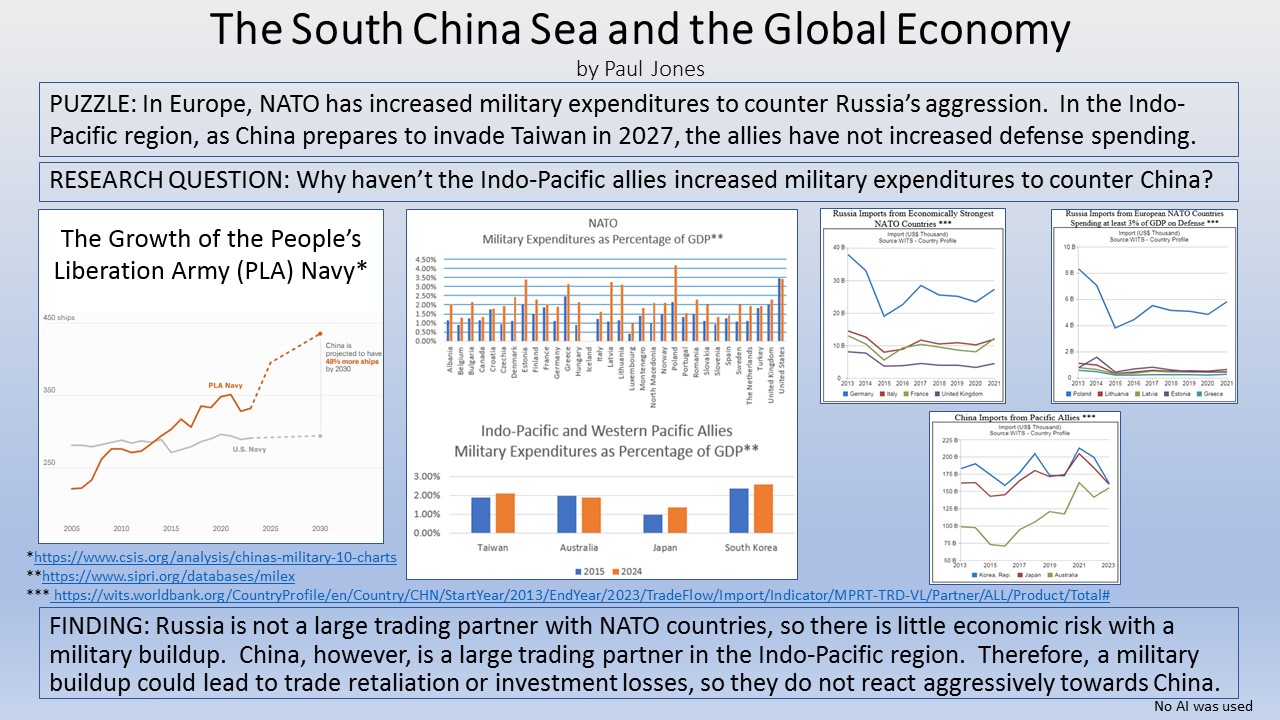
Hello! I was instantly hooked by the mention of the South China Sea. See, I wrote an article on the Philippines, and one of the most pressing political issues/talking points is the South China Sea and how the Philippines should handle it. That being said, I definitely came in with a biased view. But your infographic mentioning the economic importance of China in the Indo-Pacific was a good point against military strengthening against China.
Yuta Satake
I really enjoyed learning about connection between military expenditure and economic impact. Your finding is very insightful because it demonstrates what differences exist in NATO-Russia and NATO-China economic tie. My article focused on economic development in India, so I found strong a connection with my article that economic condition can be highly affected by outside factors. Thank you so much for sharing such insightful information.
Martin Gonzalez
Hello, I quite liked how your piece goes into the economic parts of China, Russia, and Nato’s influence regarding the south China sea. My article goes into Vietnam’s views of China being poor while its growing closeness with the US and other NATO partners. A part of that military and trade retaliation may have some connection with China’s neighbors to the south such as Vietnam, the Philippines, Indonesia, and others.
Emilio Orona
Hey Mr. Jones, this infographic does a great job explaining the intertwined phenomenon between economic interdependence and global conflict. Your comparison of analysis demonstrated how China would be greater affected positively due to high level of economic interdependence which creates significant risks for escalation, since military buildup or confrontation could trigger trade retaliation, disrupted investment flows, or broader economic losses. This connects so well with my article of Bosnia and Herzegovina because both cases show how external relationships constrain political and strategic decision-making. In this case the South China Sea region must balance security concerns with economic dependencies.
Greitin Rodriguez
Hi Paul! I really liked how your infographic tied together the military strategies of different countries and their respective degrees of economic dependence. Your arguments were so strong and believable when put into this context.
I particularly loved how you showed the difference in military build-up between NATO’s allies and those in the Indo-Pacific region, and the numbers showing each country’s trade relationship with China supported your major findings.
The thing that stood out for me was your conclusion that economic dependence on China will discourage countries from increasing their military build-up. This was such a powerful point as it shows how security decision are determined by many things other than purely military threats. The way globalization can limit national defense policies has always been something I’ve thought about.
A question I have is whether you believe this type of dependency will be able to remain in place as tensions escalate or if countries begin to “decouple” themselves from China economically? It appears to me that these actions would allow for an increase in defense spending in the future.
Overall, I found your infographic very informative and well done!
saldossary
Good evening,
This is a really great infographic. It is interesting that you chose to discuss an important issue such as the South China Sea and its influence on the world’s economy. Your research question is well formulated, and the design helps in illustrating the theme of the infographic in an adequate manner. Your graphs are helpful in showing the difference between the military expenditures and economic relations between the NATO alliance and the Indo-Pacific regions. In addition, I really like your key insight as it shows how economic relationships affect political decisions.
Shaikha A. Aldossary