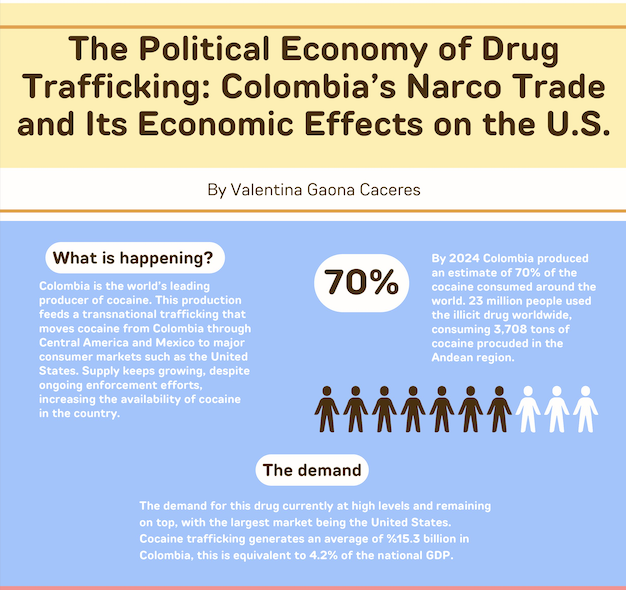

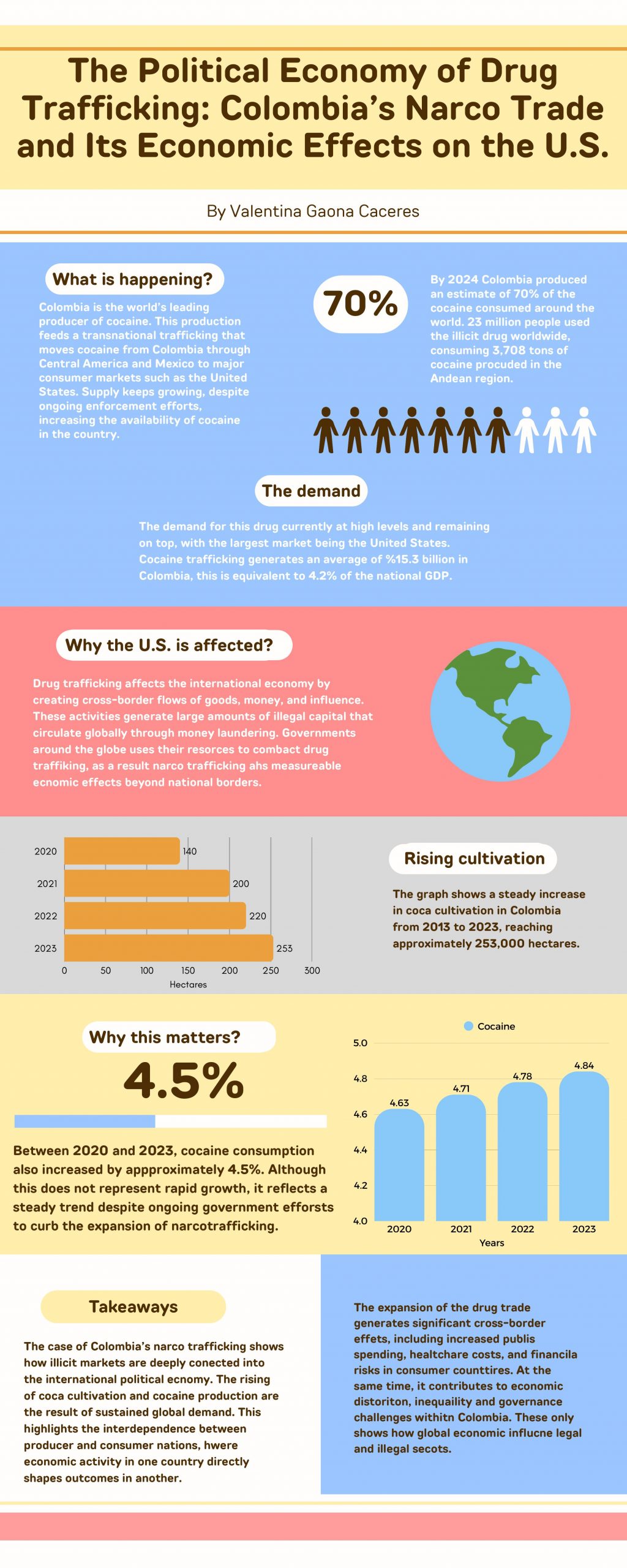
Colombia is the world’s leading producer of cocaine. This production feeds a transnational trafficking that moves cocaine from Colombia through Central America and Mexico to major consumer markets such as the United States. Supply keeps growing, despite ongoing enforcement efforts, increasing the availability of cocaine in the country. The expansion of the drug trade generates significant cross-border effects, including increased public spending, healthcare costs, and financial risks in consumer countries. At the same time, it contributes to economic distortion, inequality, and governance challenges within Colombia. These trends show how global economic influence affects both legal and illegal sectors.


5 comments
Rosa Inocencio
Hi Valentina, I really liked how your infographic was very easy to follow. I likes how it explains the impact that cocaine production has on other economies/contries like the United States, since they are their number one customer. I liked the colors and graphs that you made, it looks really good, great infographic!
Jaizeth Munoz
Hi Valentina! I liked your infographic structure and visuals; they made everything really clear and easy to follow. I also liked the topic you chose, because it highlights how this illegal income is a big part of Colombia’s economy. What stood out to me was how you connected it to the U.S., since it shows how demand here helps keep that system going. The data you included, such as the 70% figure and the steady increase in coca cultivation, really helped demonstrate that this is a consistent trend that has persisted for many years. It also made me think about how this functions almost like a market driven by demand, even if it’s illegal.
It also made me think about how domestic enforcement in the U.S. could affect Colombia’s economy. If the U.S. increases enforcement and reduces demand, do you think that would significantly impact production and income in Colombia, or would the market just adjust in other ways?
Shannon Bowshier (Elms)
Hello!
Your infographic provides a compelling and well-structured analysis of the political economy of drug trafficking, particularly in how it connects Colombian narco-trade to economic and social effects in the United States. What stood out to me most is how you frame drug trafficking not just as a criminal issue, but as a complex economic system that shapes both domestic and international outcomes. This is especially effective because it aligns with broader political economy discussions about how illicit markets can influence state institutions, trade flows, and economic incentives.
I also thought your use of data and visuals helped make a complicated issue more accessible. By illustrating the scale and interconnectedness of the drug trade, your project highlights how Colombia became a central hub in global narcotics networks, driven by strong U.S. demand and supported by extensive financial and distribution systems. This reinforces your argument that the narco-economy operates across borders and has real economic consequences for both countries. One suggestion I would offer is to make your central takeaway slightly more prominent visually. Given the strength of your analysis, emphasizing your main conclusion, perhaps in a highlighted box or bolded statement, would help ensure that viewers quickly notice and grasp the key argument. Overall, this is a strong and insightful project that effectively connects empirical evidence to a broader political economy framework.
Stephen Minka
Valentina, I like how your infographic presents tariffs as a regressive tax because lower-income households pay more as a percentage of their income. Your images depict tariff increases leading to price increases, and they correlate higher prices with lower-income goods. But they fail to account for issues like substitution and global supply chains. Also, it would have been nice to see some sources clearly cited. Thanks.
V/R
Minka
Greitin Rodriguez
I liked how well the infographics explained the ways in which Colombian cocaine production has an impact on U.S. economy. I enjoyed how you were able to provide examples of data from the issue (70% global) as well as how the coca cultivation has grown steadily each year. I also thought that your explanations for how this affects other countries economically was very useful. It was very helpful for me to see that while this may be a problem for some communities at home, it is also a world-wide problem.