
Executive Summary
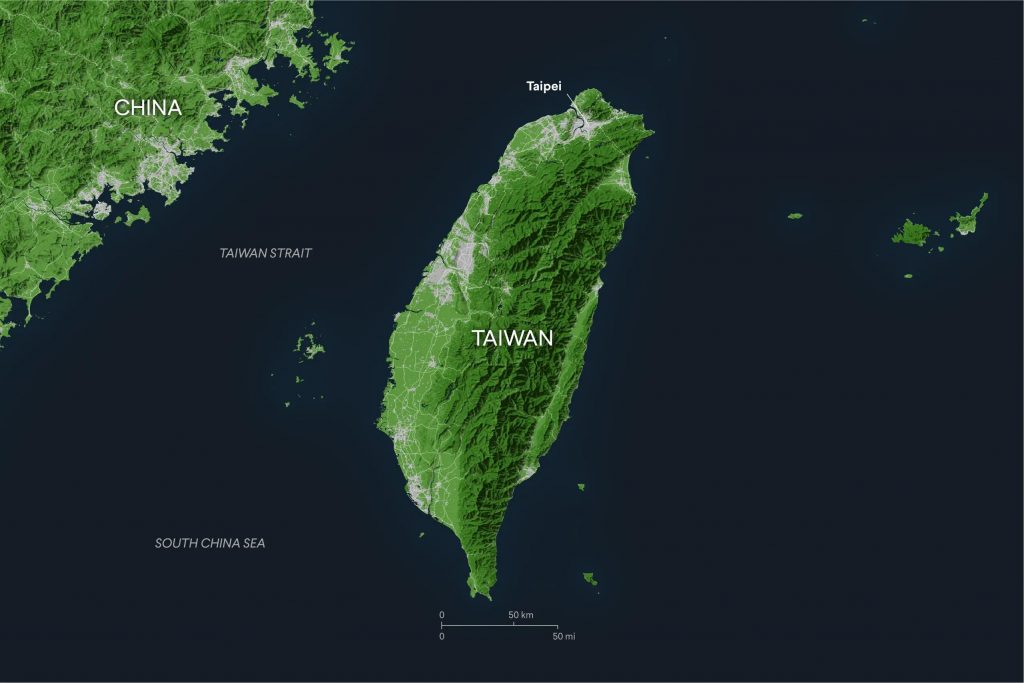
The increasing tension between the United States and China regarding Taiwan represents one of the greatest dangers facing international stability. Taiwan’s importance stems from both its geographical position as an island in the heart of the Indo-Pacific region, where the majority of world trade occurs by sea and also from the fact that it produces approximately 90 percent of all semiconductors worldwide.
China asserts that Taiwan is a part of its territorial domain and has been increasing its military presence in relation to Taiwan for many years. These actions have resulted in concern over possible future conflicts. The United States currently finds itself at a crossroads. How will it prevent or deter Chinese aggression without causing either side to escalate into a full-scale war involving two nuclear-armed states?
This policy brief reviews the strategic options available to the United States including (1) stating that it will use force to protect Taiwan, (2) continuing the status quo policy of “strategic ambiguity” in which the United States does not state whether it would come to Taiwan’s defense if China were to invade and attack Taiwan and (3) disengaging the United States militarily from Taiwan in order to reduce tensions. All three of these policy alternatives present trade-offs between deterring China from invading Taiwan on the one hand, and risking a larger scale conflict on the other.
The author of this brief recommends that the United States continue to pursue a strategy of strategic ambiguity but strengthen U.S. deterrence capabilities with respect to China by preparing the U.S. military for potential confrontation, coordinating with its allies, and strengthening U.S. economic resiliency. This strategy maintains maximum flexibility for the United States while decreasing the risk of miscalculation on the part of either side, and ultimately provides a basis for supporting long term U.S. national security interests.
Background and Context
Historical Foundations of U.S.–Taiwan Relations
The Taiwan conflict originated in the Chinese Civil War and that ultimately resulted in a situation where the communist party established itself as the ruling authority on mainland China. While the nationalistic government was able to escape to Taiwan, the nationalistic government had now been forced into a position to govern Taiwan independently while still being recognized by other countries however China has continued to assert its claims of sovereignty over Taiwan since then.
Since the establishment of diplomatic relations with the PRC in 1979, U.S. policy regarding Taiwan has been defined through the Taiwan Relations Act. Under this legislation, the U.S. has committed itself to supplying Taiwan with defense equipment while continuing to have no formal diplomatic relations with Taiwan. However, at the same time, the U.S. also accepts the One-China Policy. The U.S. recognizes that the PRC is the legitimate government of China and therefore acknowledges China’s claim of sovereignty over Taiwan. The combination of these two policies creates “strategic ambiguity”
Why Taiwan Matters
Taiwan is critical to the United States’ national security for three major reasons.
The first reason is that Taiwan’s location in the Indo-Pacific area serves as a buffer to limit China’s expansion of its military influence in the Pacific region. If China were able to control Taiwan, this would give China a significant advantage over other countries in the region.
Taiwan is also an integral part of the technology supply chain for many parts of the world with regard to semiconductors. The Congressional Research Service reported that Taiwan produces nearly all of the world’s most technologically advanced microchips which are required for both civilian and military applications.
Finally, Taiwan has a democratically elected government while China remains under an authoritarian regime. Therefore, when the U.S. supports Taiwan, it demonstrates the commitment by the United States to democratic principles and to maintaining international stability.
China’s Perspective
In China’s view, Taiwan is considered an essential domestic matter and Beijing has consistently maintained that “reunification” will ultimately take place. Recently, China has significantly escalated military pressures against Taiwan by conducting numerous airspace violations, sea-based naval exercises, and missile testing (U.S. Department of Defense, 2023) for example. For China, this includes U.S. involvement in Taiwan as being part of what it sees as an attempt to interfere with Chinese domestic matters and therefore undermine China’s sovereignty.
A significant component of China’s evolving strategic approach is increasingly relying upon “gray zone” activities. Actions taken short of armed conflict which have the effect of increasing pressure on Taiwan and include such things as cyber-attacks, economic coercion, and military posturing.
Current U.S. Strategy
The United States is now implementing a strategy of strategic ambiguity toward China’s aggressive stance on Taiwan. In other words, the U.S. will continue to provide Taiwan with arms and aid. However, the U.S. has made no explicit commitments to intervene militarily if China attacks Taiwan.
Strategic ambiguity was put into place as a way to dissuade two opposing actions:
China from launching an invasion of Taiwan
Taiwan from formally declaring independence
As the situation escalates due to increasing hostilities, there are questions about whether or not the strategy continues to be successful.
Policy Options
Option 1: Commit to Defending Taiwan (Strategic Clarity)
This choice would be the first time that the U.S. has publicly stated it is prepared to use military force to protect Taiwan from an invasion by China.
Advantages:
- Increases deterrent strength through eliminating ambiguity
- Sends message of support to allies (Japan & Australia)
- Demonstrates firm commitment of the U.S. to stability in the region
Disadvantages:
- Would be very provocative to China
- Limits the ability of the U.S. to have options during a crisis
- Increases the probability of rapid escalation with China
Chinese Reactions:
The Chinese government will view this policy as a serious challenge to their claim to sovereignty over Taiwan. The reaction of China would most likely include increased military activities in relation to Taiwan, increasing retaliatory actions against the U.S., and accelerating planning for reunification. If China perceives there is a high level of certainty that Taiwan may separate permanently, China might take a pre-emptive action to prevent a long-term separation of Taiwan.
Option 2: Maintain Strategic Ambiguity (Current Approach)
Beginning with this option allows the U.S. to continue its existing stance on Taiwan while enhancing the ability of Taiwan to defend itself in addition to maintaining alliance support across the region.
Advantages:
- Maintaining options available for the U.S.
- Avoiding a direct confrontation or provocation
- Aiding in deterring aggressive behavior from China via continued ambiguity
Disadvantages:
- The risk that there could be an unintentional miscalculation by China leading to the initiation of hostilities
- May cause confusion as well as concern among allies
- Will require very clear communications to avoid misinterpretation by both sides.
Chinese Reactions:
It is highly probable that China will use additional forms of ‘gray zone’ warfare against Taiwan, such as military posturing, economic pressure without immediately initiating a full scale war. Due to the lack of clarity regarding how the United States will intervene, it is also likely that China will choose to initiate a gradual escalation of pressure on Taiwan rather than engaging in an immediate attack.
Option 3: Reduce U.S. Involvement (Strategic Restraint)
The choice would be to scale back military and diplomatic support for Taiwan so that there is less tension between Taiwan and China.
Advantages:
- Lessened risk of an immediate war
- Reduced military cost, economic cost.
- Focus can be placed elsewhere on a global basis.
Disadvantages:
- Deterrent capabilities will decrease
- U.S. Credibility is decreased
- Chinese Aggression may increase
Chinese Reactions:
China may perceive U.S. decreased support as an opportunity to speed up unification. China may use increased military force or political pressure on Taiwan which increases the risk of war over time.
Risks and Trade-Offs
The U.S. faces an inherent contradiction in terms of using strong deterrents to discourage Chinese actions against Taiwan versus the fear of escalating into a conflict. On the one hand, creating strong deterrents can potentially stop Chinese aggression. However, at the same time it will have increased the potential for engaging in a war. In contrast, reducing tension can lessen immediate threats of war; however, it has the potential of increasing the threat of future aggression.
A second important consideration is how to balance clarity and flexibility. Clarity on defending Taiwan will enhance the deterrent effect; however, it creates limited options in the event of a crisis. Flexibility in terms of ambiguity provides more options; however, creates additional confusion as to what type of response there would be in the event of a crisis.
In addition to these two considerations are the trade-offs involved in supporting Taiwan versus focusing on other international issues. Supporting Taiwan can take focus away from addressing other pressing global problems; however, not supporting Taiwan can cause the loss of U.S. credibility and alliances in the Indo-Pacific region.
One of the largest concerns regarding the potential for conflict is the possibility of miscalculation. Either side could misread the intentions of the other, resulting in unintentional escalation.
Recommendation
The U.S. should maintain strategic ambiguity and strengthen deterrence.
Actions:
- Continuing to provide defense-oriented military assistance to Taiwan
- Strengthening relationships with regional allies (Japan, Australia)
- Maintaining a visible and credible U.S. military presence in the Indo-Pacific
- Increasing the U.S. economy’s resilience, especially related to semiconductor supplies
- Engaging diplomatically with China to reduce misunderstandings
How does this work?
Combining strategic ambiguity with stronger deterrents maintains a delicate balance between deterring aggressive behavior and promoting stability. By refraining from sending an overt message to China that a U.S. invasion of Taiwan would occur if provoked, we avoid provocation. However, by showing that aggressive acts toward Taiwan would incur great costs, we show our deterrence credibility.
At the same time, ambiguity decreases the chance of miscalculations due to clearly defined “redlines” which could result in a country taking preventive action. Additionally, having enhanced military and economic capabilities demonstrates that we remain capable of responding to future challenges.
Ultimately, this approach gives us a range of choices based upon rapidly developing conditions while safeguarding U.S. national security and regional stability.
Conclusion
Taiwan Strait is one of the most dangerous and complicated hotspots currently facing international relations. To avoid war, yet continue to protect U.S. interest strategically, requires careful navigation by the U.S.
An equally weighted combination of strategic ambiguity combined with enhanced deterrence seems to offer the best possible means for achieving the above mentioned goals.
References
Allison, G. (2017). Destined for war: Can America and China escape Thucydides’s trap? Houghton Mifflin Harcourt.
Bush, R. C. (2013). Difficult choices: Taiwan’s quest for security and the good life. Brookings Institution Press.
Congressional Research Service. (2024). U.S.-Taiwan relations.
https://crsreports.congress.gov/product/pdf/IF/IF10275
Department of Defense. (2023). Annual report to Congress: Military and security developments involving the People’s Republic of China.
https://media.defense.gov/2023/Oct/19/2003323409/-1/-1/1/2023-MILITARY-AND-SECURITY-DEVELOPMENTS-INVOLVING-THE-PEOPLES-REPUBLIC-OF-CHINA.PDF
Center for Strategic and International Studies. (2023). The first battle of the next war: Wargaming a Chinese invasion of Taiwan.
https://www.csis.org/analysis/first-battle-next-war-wargaming-chinese-invasion-taiwan
RAND Corporation. (2016). War with China: Thinking through the unthinkable.
https://www.rand.org/pubs/research_reports/RR1140.html
Schelling, T. C. (1966). Arms and influence. Yale University Press.

2 comments
Mía Perez
like this article because it clearly explains a really complex international issue in a way that’s easy to follow. I really enjoyed how you broke down strategic ambiguity, strategic clarity, and strategic restraint, since it made the different U.S. policy choices much easier to understand. It helped me see how the Taiwan issue isn’t just military, but also political, economic, and diplomatic at the same time. The way you explained the risks of miscalculation stood out to me as especially important and interesting.
Paul Jones
Greitin
Your policy brief is very well thought out and clearly communicated such that any audience can easily understand the significance of the growing tensions in the South China Sea. For example, I appreciated how you formatted your three policy options with a brief summary followed by advantages, disadvantages, and Chinese reactions. This bulletized approach makes for a very concise communication style that minimizes any confusion or misunderstandings, ultimately lending to engaging debates amongst scholars while also welcoming those less familiar with international relations to the discussion. To coincide with this well written document, your podcast brilliantly articulates the dynamic challenges as two world powers, China and the U.S., approach the delicate situation with Taiwan. There are significant economic complexities with trade between China and the U.S. that must be considered, and it is also important to note how other nations across the globe are watching how the U.S. responds. Overall, this topic is very well researched and presented in both the brief and the podcast.
One thing you might have included is the timeline with China’s intent to invade Taiwan in 2027. Additionally, it might have also been helpful to discuss how China’s been heavily investing in their military capabilities for this purpose, so much so that China currently has more naval ships than the U.S., with continued growth projected in upcoming years. This critical piece of information provides unique insights and adds a sense of urgency to the discussion. While the U.S. is distracted with combating drug trafficking in the Caribbean, fighting alongside Israel in the current Iran war, sending support to Ukraine, considering possible military operations to take Cuba, and so many other matters of U.S. National Security, now would be the perfect time for China to invade Taiwan. Your message is extremely relevant. Again, thank you for taking the time to research and present this critical topic and sharing it for others to become better informed. Very well done.
No AI was used