


RESEARCH QUESTION
This study examines the relationship between the frequency of shared recreational activities and verbal aggression in romantic relationships. The first variable measures how often partners spend time together engaging in activities such as going to the gym, attending events, or watching shows, which reflects relationship interaction and bonding. The second variable measures verbal aggression, specifically whether a partner insults, swears, or yells, which reflects negative communication and conflict. These variables are important because they directly affect relationship quality, mental health, and social well-being. Understanding this relationship helps identify behaviors that promote healthier relationships and reduce harmful communication patterns.
LITERATURE REVIEW
Romantic relationships play an important role in individuals’ emotional and social well-being, especially during young adulthood. The quality of these relationships can influence mental health, communication, and overall life satisfaction. Positive relationship behaviors, such as spending time together, are often linked to healthier relationships, while negative behaviors, such as verbal aggression, can lead to serious consequences. Because of this, it is important to understand how relationship interactions, including shared activities and conflict patterns, are connected to verbal aggression.
One important aspect of relationship quality is the amount of time couples spend together engaging in shared activities. Research has shown that shared leisure activities can strengthen romantic relationships and increase satisfaction. A study examining couples over time found that engaging in leisure activities with a partner, especially without others present, was positively associated with higher relationship satisfaction and commitment. In contrast, spending leisure time without one’s partner was linked to lower relationship quality. These findings suggest that the context and presence of a partner during activities matters, and that spending time together helps build emotional bonds and connection. This is important because stronger relationships are often associated with better communication and fewer negative interactions, which may reduce the likelihood of conflict and aggression.
Research also shows that the amount and type of time couples spend together influences relationship outcomes. A study of married couples found that spending more time talking and engaging in shared activities was linked to higher relationship satisfaction, greater closeness, and more positive perceptions of the relationship. In contrast, couples who spent more time arguing reported lower satisfaction and more negative relationship qualities. Even after accounting for communication style during conflict, time spent in everyday interactions such as talking still predicted better relationship outcomes (Hogan et al., 2021) . These findings suggest that regular interaction and shared activities play a key role in strengthening relationships and may help reduce negative behaviors such as verbal aggression.
In addition to positive interactions, relationship patterns and stability also play a significant role in conflict. Research on young adult relationships has found that many couples experience “churning,” or repeated breakups and reconciliations. One study found that individuals in these on-and-off relationships were more likely to experience conflict compared to those in stable relationships (Halpern-Meekin et al., 2012). Specifically, individuals in churning relationships were twice as likely to report physical violence and were also more likely to report verbal abuse. These findings suggest that unstable relationship patterns may contribute to increased conflict and difficulty managing disagreements. The authors argue that both churning and abuse may stem from poor conflict management and an inability to prevent escalation. This highlights the importance of stability and healthy interaction patterns in reducing negative relationship behaviors such as verbal aggression.
Verbal aggression is a significant form of intimate partner violence (IPV) that can have serious effects on individuals. Although it may not involve physical harm, behaviors such as insults, name-calling, and belittling can still cause emotional and psychological damage. Another study examined verbal IPV among college students and found that approximately 11.3% of participants reported experiencing this form of abuse (Collier et al., 2025). The study also found that individuals who experienced verbal IPV were more likely to report negative outcomes, including poorer mental health, increased loneliness, and greater relationship difficulties. Additionally, those experiencing verbal aggression had lower levels of social support and higher levels of psychological distress. These findings demonstrate that verbal aggression is not a minor issue, but rather a serious problem that can impact multiple areas of a person’s life.
Additional research highlights the seriousness of verbal aggression in romantic relationships and the factors associated with it. Verbal aggression, including yelling, swearing, and insults, is one of the most common forms of intimate partner violence and often occurs before physical aggression (Chung et al., 2011) . An ecological study found that verbal aggression is influenced by multiple factors at the individual, relationship, and community levels, such as psychological distress, relationship characteristics, and social environment. The study also showed that risk factors differ by gender, suggesting that verbal aggression does not have a single cause but is shaped by a range of influences. These findings emphasize that verbal aggression is complex and widespread, reinforcing the need to understand relationship behaviors that may reduce its occurrence.
Furthermore, the study highlights how verbal IPV can affect academic performance and social functioning. Students who experienced verbal abuse were more likely to struggle academically and report problems with focus, motivation, and engagement. They were also more likely to experience isolation and difficulty maintaining relationships with peers and family members. This suggests that verbal aggression can extend beyond the relationship itself and negatively impact broader aspects of life. The findings emphasize the need for increased awareness and prevention efforts, particularly among young adults in college settings.
When considering these studies together, it becomes clear that both positive and negative relationship behaviors play a critical role in relationship outcomes. Shared activities and quality time contribute to stronger, healthier relationships, while instability and poor conflict management increase the likelihood of aggression and abuse. Verbal aggression, in particular, has significant emotional, social, and academic consequences, making it an important area of study. Understanding how relationship behaviors influence verbal aggression can help researchers and practitioners develop strategies to promote healthy relationships and reduce harmful behaviors.
Overall, studying the connection between shared activities and verbal aggression is important because it provides insight into how relationships function and how they can be improved. By identifying factors that strengthen relationships, such as spending time together, as well as factors that increase conflict, such as instability, researchers can better understand how to prevent verbal abuse. This has important implications for improving individual well-being and promoting healthier relationships in society.
METHODS
Data
The experimental data come from the Crime, Health, and Intimate Partner Problems Survey (CHIPPS), a cross-sectional probability sample of St. Mary’s University undergraduate students (n = 200) designed to analyze differences in partner violence and recreational activities. Students were randomly chosen via their student email. The survey was then disseminated via email so that participants could complete it on their computer or mobile device. Respondents were offered a $10 gift card to participate in the survey. Data were collected from Spring 2024 to Spring 2025.
Measures
Focal Variables
Frequency of Recreational Activities with Partner. This variable measures how often respondents spend time engaging in recreational activities with their partner, such as going to concerts, the gym, or watching movies. Responses originally ranged from 1 = Never to 5 = Very often. For analysis, this variable was recoded into a binary measure where 0 represents low frequency (never, rarely, sometimes) and 1 represents high frequency (often, very often). Higher values indicate more frequent shared activities between partners. This variable is used as the main independent variable in the analysis.
Frequency of Partner Verbal Aggression. This variable measures how often respondents experienced verbal aggression from their partner, including behaviors such as insults, yelling, or swearing. Responses originally ranged from 1 = This has never happened to 9 = Not applicable. For analysis, this variable was recoded into a binary measure where 0 represents no verbal aggression and 1 represents any occurrence of verbal aggression within the past year. Responses indicating events outside the past year or not applicable were treated as missing. Higher values indicate the presence of verbal aggression. This variable is used as the dependent variable in the analysis.
Covariates
Feelings about Current Relationship. Respondents were asked to gauge their “level of happiness toward their current relationship.” Responses consisted of “Very unhappy” = 0, “Unhappy” = 1, “Happy” = 2, and “Very happy” = 3.
Respondent’s Age. Age (in years) was recorded by asking respondents, “How old are you?”. Respondents answered anywhere from 18 to 22 years of age.
Gender. Gender was coded by asking respondents to indicate their gender. Initial responses included “Male” = 1, “Female” = 2, “Transgender” = 3, and “Other” = 4. Due to few responses in the “Transgender” and “Other” categories, this variable was dichotomized so that “Male” = 0 and “Female” = 1.
Race/Ethnicity. To ascertain respondents’ race/ethnicity, they were asked, “With which group do you most closely identify?” Response categories ranged from “Non-Hispanic White” = 1, “Hispanic” = 2, “African American” = 3, “Asian” = 4, and “Other” = 5. The variable was then recoded into a series of four dummy variables with “Non-Hispanic White” as the reference group (e.g., Hispanic/African American/Asian/Other = 1, Else = 0).
Household Income. To gauge the total income in respondents’ households, they were asked to “select the category that gives the best estimate of your total annual household income (income of all family living in your home) before taxes in the last year (not including scholarships or grants).” Possible responses ranged from “None/Under $5,000” = 0 to “$75,000 or more” = 10.
Class. Respondents were asked to identify their current student classification. This classification follows the Office of the Registrar’s method, which bases classification on the total amount of hours (including those currently enrolled by the student) when determining their classification. These options included “Freshman” = 0, “Sophomore” = 1, “Junior” = 2, “Senior” = 3.
Employment Status. Lastly, respondents were asked to identify their current employment status. Responses included “Other” = 0, “Unemployed” = 1, “Part-time” = 2, “Full-time” = 3.
Bivariate Analysis
Regression Analysis
RESULTS
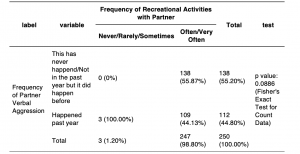
A chi-square test was conducted to examine the relationship between the frequency of shared recreational activities and verbal aggression in romantic relationships. The results were not statistically significant, p = 0.0886, indicating that there is no strong evidence of an association between these two variables. Because the p-value is greater than 0.05, the null hypothesis is accepted, and the alternative hypothesis is rejected. This suggests that the frequency of engaging in shared recreational activities is not significantly related to whether verbal aggression occurs. Although a slightly higher proportion of individuals who frequently engaged in activities reported lower levels of verbal aggression, this difference was not large enough to be considered statistically significant.
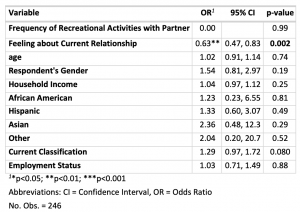
A binary logistic regression was conducted to examine whether shared recreational activities and sociodemographic variables predict verbal aggression in romantic relationships. The results showed that shared recreational activities were not a statistically significant predictor of verbal aggression (p = 0.99). However, feelings about the current relationship were statistically significant (OR = 0.63, p = 0.002), indicating that higher relationship satisfaction is associated with lower odds of experiencing verbal aggression. All other variables, including age, gender, household income, race/ethnicity, class, and employment status, were not statistically significant predictors. Therefore, the null regression hypothesis is partially rejected, as one variable (relationship satisfaction) significantly predicts verbal aggression while the main variable of interest does not. These findings suggest that emotional aspects of the relationship may play a more important role in predicting verbal aggression than shared activities.
CONCLUSION
This project examined the relationship between how often couples engage in shared recreational activities and the presence of verbal aggression in romantic relationships. This topic is important because relationship behaviors influence mental health, emotional well-being, and overall quality of life, especially among college students. The results showed that shared recreational activities were not statistically significant, meaning that spending more time together did not strongly relate to whether verbal aggression occurred. However, relationship satisfaction was a significant factor, suggesting that how individuals feel about their relationship matters more than how often they spend time together. One possible reason for these findings is that verbal aggression may be driven more by communication quality, emotional connection, and conflict management rather than the amount of shared time. Another reason could be the imbalance in the data, where most participants reported experiencing verbal aggression, making it harder to detect differences between groups. Overall, this study suggests that simply increasing time spent together may not be enough to reduce verbal aggression, and greater focus should be placed on improving relationship quality and communication.
REFERENCES
Chung, G. H., Tucker, M. B., Li, G., Zhou, X., & Hwang, S. (2011). Exploratory analysis of verbal aggression in romantic relationships among unmarried men and women: Predictive patterns by gender and race. Journal of social and personal relationships, 28(7), 1005–1023. https://doi.org/10.1177/0265407510397984
Collier, K. A., Fowler, K., & Wareham-Fowler, S. (2025). Verbal Abuse as a Form of Intimate Partner Violence (IPV): Exploring Academic Performance, Mental Health, Loneliness, Relationship Quality, and Social Support Among Female and Male University Students. Journal of Interpersonal Violence, 0(0).
Dobson, K., & Ogolsky, B. (2022). The role of social context in the association between leisure activities and romantic relationship quality. Journal of Social and Personal Relationships, 39(2), 221-244.
Halpern-Meekin, S., Manning, W.D., Giordano, P.C. and Longmore, M.A. (2013), Relationship Churning, Physical Violence, and Verbal Abuse in Young Adult Relationships. Journal of Marriage and Family, 75: 2-12. https://doi.org/10.1111/j.1741-3737.2012.01029.x
Hogan, J. N., Crenshaw, A. O., Baucom, K. J. W., & Baucom, B. R. W. (2021). Time Spent Together in Intimate Relationships: Implications for Relationship Functioning. Contemporary family therapy, 43(3), 226–233. https://doi.org/10.1007/s10591-020-09562-6