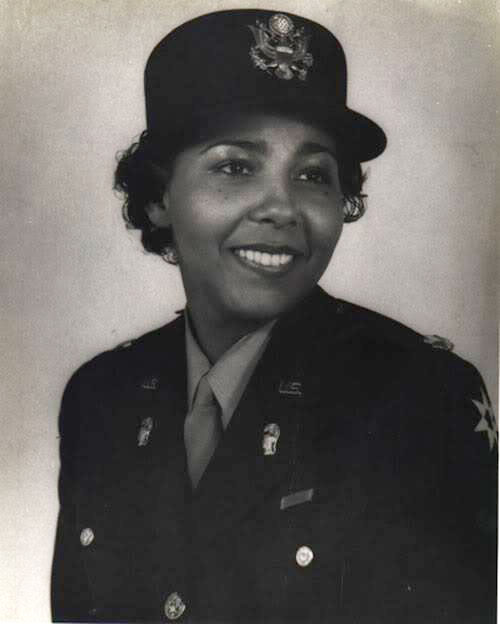

The 6888th Central Postal Directory Battalion, also known as the 6-triple-8, was one of the most phenomenal groups of women that you ever wanted to hear about. This was a unit of African American women deployed overseas during World War II. Both at that time and today, hardly anyone knows about the 6888. Most Americans wouldn’t have known that there were black women serving in the war at all. But theirs was a segregated unit with its own African American officers. Despite horrific experiences of discrimination, they served their country with honor.
All this wouldn’t have been possible if it weren’t for the bravery and determination of one woman, Major Charity Adams, the remarkable face behind this entire operation. According to Kevin M. Hymel, “In 1942, Major Charity Adams joined the Women’s Army Auxiliary Corp, which was known as WAAC at the time.”1
In 1942, the Women’s Army Auxiliary Corps (WAAC) was created without any official military status; and later, on July 1, 1943, President Franklin D. Roosevelt established the Women’s Army Corps (WAC) as part of the Army. Furthermore, First Lady Eleanor Roosevelt and Mary McLeod Bethune founded the National Council of Negro Women, which advocated for African American women to be allowed to join the Women’s Army Auxiliary Corps and serve as officers and enlisted personnel.2
Charity Adam’s career had just begun. Despite an Executive order issued to ban racial discrimination, the Armed Forces remained segregated. As stated in the Six Triple Eight Congressional Gold Medal Act of 2021, “Enlisted women served in segregated units, participated in segregated training, lived in separate quarters, ate at separate tables in mess halls, and used segregated recreational facilities. Officers received their officer candidate training in integrated units but lived under segregated conditions.”2
During segregated training, African-American women could only use the pool at the training base for an hour every week and the rest of the time was available only to the white women on the base. Moreover, the pool was drained right after the African-American used it. This gives you an indication of how these women were seen. They also created a Red Cross Club and wouldn’t allow any African Americans to join. Furthermore, when it came time for their officers to graduate from officer training school, their names were called out, and Charity Adam’s name was called last. You would expect her name to be called at the beginning because her name is “Adams,” but her name was called last.4 However, Charity Adams still made history and became the first African American woman to earn an army commission.1
According to the Six Triple Eight Congressional Gold Medal Act of 2021, “About 6,520 African-American women served in the WAAC and the WAC during World War II.”2 Multiple units of White women in the WAC were sent to serve in the European Theater of Operations (ETO) during World War II, but African American women were excluded from this opportunity. This led to giving the opportunity for African Americans to serve overseas as well.2
During World War II, receiving mail was significant because it was the only connection the soldiers had with their families. At that time, all they had was physical mail. This included letters, and food or equipment that soldiers might have needed from their families. During that time, there was supposedly a 6-month backlog of mail and by 1945, the US Army faced a massive backlog of undelivered mail. Moreover, there was a significant shortage of soldiers to manage the Postal Service for the US Army overseas.2 There was over 17 million pieces of undelivered mail. The Six Triple Eight Congressional Gold Medal Act of 2021 affirms that “Army officials believed that this undelivered mail was hurting morale.”2
The White officials were afraid that if they sent black WACs overseas, they would cause a problem. Eventually, there was sufficient pressure from the press that they decided that the women can go overseas.10 The Six Triple Eight Congressional Gold Medal Act of 2021 acknowledges that “In November 1944, the War Department approved sending African-American women to serve in Europe.”2. The 6888th Central Postal Directory Battalion, referred to as the 6888th and ‘‘Six Triple Eight,” comprised of approximately 800 African American women from the WAC, Army service forces, and Army Air Forces.2 No other than Major Charity Adams was made company commander.13
Major Charity Adams and Captain Noel Campbell (Battalion Executive Officer) received orders, all sealed up in envelopes, and were told not to open the envelopes until after they had been in flight for at least an hour. The sealed envelope made them more curious about the orders than normally. Later, they learned that on their return flight, the plane was a hospital plane, returning wounded military personnel to the States.14 There were several others with whom they had some pleasant exchanges, but there were two captains from “way down South,” who worked diligently to avoid any association with the only two Negroes on the plane. Weeks later, these same two captains met them in an officers mess in London and greeted them like long lost friends because they were the only people they had seen since their arrival, who looked vaguely familiar to them.15
Most people had a sealed envelope with secret orders and had been instructed when to open the envelope. After so much curiosity, one of the soliders couldn’t wait any longer and said aloud, “I’m going to open this thing.”16 Campbell and Adams were shocked to find out that they would be going to London. These women had received absolutely no information about London.17
Upon arrival, they conveyed to the ATC office in London. The two women seemed so strange to the people of London that even U.S. military personnel already in London at the time could not believe Negro WAC officers were real.18 As Charity Adams Earley writes in One Woman’s Army: A Black Officer Remembers the WAC, after reporting to Paris to meet “Lt. Gen. John C.H. Lee, commanding general, Communications Zone, European Theater of Operations,” they later received an invitation to have dinner.19 As expressed in One Woman’s Army: A Black Officer Remembers the WAC, “The word ‘invitation’ is read in the military as ‘is ordered to,’ so, of course, we remained in Paris for the dinner.”20
Charity Adams quotes that during the course of the dinner and all the pleasant conversation, General Lee turned to Adams and asked, “Adams, can your troops march?” “Yes, sir, they are the best marching troops you will ever see,” Adams replied.21 General Lee then asked when their outfit would be in Birmingham. Charity Adams said that “They will arrive on the twelfth, Sir, and be in quarters on the thirteenth.” “Good, I will be in Birmingham on the fifteenth to review the troops,” General Lee stated.22
The white WACs in the UK all used the same WAC recreational hotel in London. It was clear that negros suffered discrimination considering they were both women and African American. The Red Cross wanted to set up a separate hotel for the black WACs to live in. Even though they thought it was pleasant, it was still segregated. Charity Adams refused to accept any segregated facilities that they wanted to create. “Yesterday I visited the hotel. It is very nice, but it is very segregated. What it does is to create a segregated hotel when we already have an integrated situation.”23 Shortly after, they ended up in Birmingham, England and were given a dilapidated school (King Edward School), heated by steam, that hadn’t been used in many years during the war. It was a big cold stone building.24
Charity Adams ‘s One Woman’s Army illustrates how Major Adams and Captain Campbell had a list of things that they had working on since they found out what they would be doing:
1. meeting the troops and bringing them to the post
2. getting them assigned to quarters and to units
3. making sure the mess hall operated
4. having Special Service work at lifting morale
5. seeing that laundry facilities were in order
6. getting job assignments made
7. relieving fears of being overseas
8. getting officers assigned to quarters, units, and jobs
9. getting all personnel trained in our postal duties, and on and on.”22
With all the moving around, Noel and Adams still managed to prepare for and receive the troops. On February 10, the two went to London to receive final orders for their unit. February 1945, the six-triple-eight arrived in Birmingham. Following the successful parade of troops for General Lee, the unit settled in to be the postal directory service, and to live with the citizens of Birmingham.26
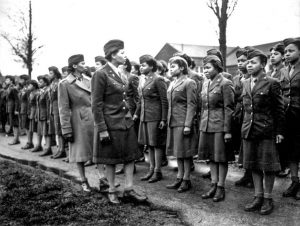
Upon leaving the United States in early 1945, the woman who eventually made up the 6888, experienced rigors of war. Kevin M. Hymel illustrates how “During the trip across the Atlantic Ocean, German-U boats forced the convoy of troop ships to change course.”27 Kevin M. Hymel expresses how “Another time when departed from their ship, a German V1 rocket, also known as a ‘’buzz bomb’’ for the sound of its engine, drove into the area as the noise of the engine filled the air.”27 The women took cover but luckily no one was killed. Despite these events, this event served as a harsh reminder that even behind the lines, soldiers were still at risk.27
The 6888th were organized on March 4, 1945, at Birmingham England, and assigned to organize and deliver mail until after the end of the war in May. Kevin M. Hymel states that, “With approximately 850 officers and invested personnel this Women’s Army Corps (WACs) unit was organized into four postal directory companies, A, B,C, and D and the headquarters company which handled all administrative and service support duties.”30
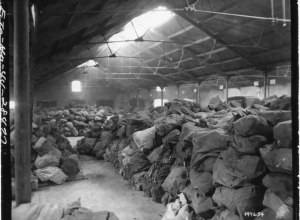
Upon their arrival, As recognized by Congress in the Six Triple Eight Congressional Gold Medal Act of 2021, “the 6888th found warehouses filled with millions of pieces of mail intended for members of the Armed Forces, United States Government personnel, and Red Cross workers serving in the ETO.”2 Seeing the warehouses stacked with mail from the floor to ceiling that had not been touched for two years was very discouraging for the women.27
The 6888’s first job was to deliver the Christmas packages and mail that had piled up from Christmas 1944. The rats that had gotten into the Christmas packages were enormous. They had eaten all the Christmas goodies that the families had sent for their respective loved ones.33
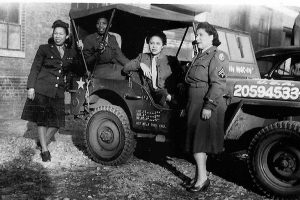
The 6888th was an independent unit. The Six Triple Eight Congressional Gold Medal Act of 2021 emphasizes that, “It managed its own mess halls, motor pools and supply rooms. It had its own military police, and a chapel.”2 All jobs in the 6888th involving mail services, communication and recreation were staffed by African American women.2
In 1945, the U.S. Army’s knowledge of women’s needs was limited. The basic needs such as food, shelter, and clothing were known, and provided. However, counseling services and recreational facilities; those small but important services needed for morale, such as beauty salons, were provided by the women themselves. It was easier to find these services in the States. In Europe, white women have available and convenient services, but Negro women used different makeup colors and hair treatments, which was difficult to access abroad. Eventually, these services were provided but it would have been better for the equipment to arrive before the troops because they needed every kind of morale booster possible after their long trip.36
The 6888 encountered terrible conditions. The warehouses were cold, unheated, and stacked floor-to-ceiling with undelivered mail. A lot of the mail was rat infested because of the food that the families would send for the soldiers during Christmas time. It was terrible. The working areas were cold with nothing heated. To battle the cold some women wore ski pants, heated jackets, fatigues or anything else to keep warm.37
Unfortunately, there were some set backs during the operation. In her first account, Charity Adams explains how when the general visited the unit, he threatened to replace Adams with a white lieutenant. The General asked, “Adams, where are the other personnel of this unit? It certainly does not look like a battalion to me….I’ll tell you what I am going to do, Major Adams. I’m going to send a white first lieutenant down here to show you how to run this unit.”38 According to One Woman’s Army, Adams responds by saying, “Over my dead body, Sir.”38 A tragedy had occurred and three women got killed by the explosion of land mines.40
Despite these terrible conditions, the 6888th created a strategy to track individual servicemembers, organize mail, determine the recipients for incorrectly addressed mail, and handle mail addressed to servicemembers who had passed away. Because servicemen served in the ETO, many had similar and identical names. For example, many individuals were named Johnny Smith.2 Due to this, they created an effective card index, which they used to distinguish them using their military serial numbers.42 Kevin M. Hymel emphasizes that, “The WACs set up a system of army postal office cards to pitch mail. Once the courts were full. The mail would be delivered to the APO ‘s for further distribution for soldiers.”27
As noted by the Six Triple Eight Congressional Gold Medal Act of 2021, “One general predicted that the backlog in Birmingham, England, would take 6 months to process and the lack of reliable mail service was hurting morale.”2 However, these remarkable women were able to get it rolling in three months. Their motto was ‘‘No mail, low morale’.’ This remarkable group of women processed an average of 65,000 pieces of mail per shift and were able to clear the 6-month backlog of mail within 3 months.2
Kevin M. Hymel remarks, ” May 1945, with the war in Europe over the unit transferred to Rouen, France via the port of La Havre.”42 In France, the mail had backed up for two to three years and because of their remarkable work, the battalion was ordered to deliver the mail in six months and with no doubt they did it in three. As noted by Kevin M. Hymel, “After five months in Rouen, the battalion transferred to Paris.”47 This was the first time in their military service that these women were housed in lavish hotels.47
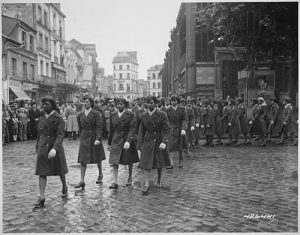
As the living conditions improved, the job kept getting harder. It was so hard that almost half of the WACs transferred home. Initially, the battalion consisted of about 850 women but by November 1946, only 558 women remained. In this analysis Kevin M. Hymel points out that, “On 27th of February 1946 the 6888th boarded the Claymont Victory for its return to the United States. The battalion was disbanded on March 9th 1946 at Camp Kilmer, New Jersey.”47 The women of the 6888th central postal battalion were truly an admirable group of women. They served their country in insufficient conditions, accomplished their mission and proved that African-American women could do anything if given the opportunity.47
Their accomplishments encouraged the General Board, United States Forces, European Theater of Operations to adopt the following: ‘‘The national security program is the joint responsibility of all Americans irrespective of color or sex’’ and ‘‘the continued use of colored, along with white, female military personnel is required in such strength as is proportionately appropriate to the relative population distribution between colored and white races’’ as stated by the Six Triple Eight Congressional Gold Medal Act of 2021.2
The 6888th made history as the only African-American Women’s Army Corps unit to serve overseas during World War II. They were awarded the European African Middle Eastern Campaign Medal, the Women’s Army Corps Service Medal, and the World War II Victory Medal for their service.2
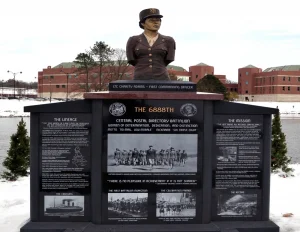
It is so erratic to see that these women overseas fighting for equality and served their country with honor just for them to came back home to be treated like a second-class citizen with minimal recognition from their own country. Major Charity Adams ended the war as a lieutenant colonel, and the highest ranking black woman in the army. After several years, in 2019, the Army awarded the 6888th the Meritorious Unit Commendation. According to Edna W. Cummings, “In 2022, due in large part to Cummings’s efforts, the Six Triple Eight was awarded the nation’s highest civilian honor—the Congressional Gold Medal.”53
- Kevin M. Hymel, “6888th Central Postal Directory Battalion,” On Point 14, no. 4 (2009): 22. ↵
- United States, Six Triple Eight Congressional Gold Medal Act of 2021, 1 online resource (Washington, D.C.: U.S. Government Publishing Office, 2022). ↵
- United States, Six Triple Eight Congressional Gold Medal Act of 2021, 1 online resource (Washington, D.C.: U.S. Government Publishing Office, 2022). ↵
- Charity Adams Earley, One Woman’s Army: A Black Officer Remembers the WAC, 1 online resource (x, 218 pages): illustrations, Texas A & M University Military History Series; 12; 12 (Texas A & M University Press, 1989), 44. ↵
- Kevin M. Hymel, “6888th Central Postal Directory Battalion,” On Point 14, no. 4 (2009): 22. ↵
- United States, Six Triple Eight Congressional Gold Medal Act of 2021, 1 online resource (Washington, D.C.: U.S. Government Publishing Office, 2022). ↵
- United States, Six Triple Eight Congressional Gold Medal Act of 2021, 1 online resource (Washington, D.C.: U.S. Government Publishing Office, 2022). ↵
- United States, Six Triple Eight Congressional Gold Medal Act of 2021, 1 online resource (Washington, D.C.: U.S. Government Publishing Office, 2022). ↵
- United States, Six Triple Eight Congressional Gold Medal Act of 2021, 1 online resource (Washington, D.C.: U.S. Government Publishing Office, 2022). ↵
- Charity Adams Earley, One Woman’s Army: A Black Officer Remembers the WAC, 1 online resource (x, 218 pages): illustrations, Texas A & M University Military History Series; 12; 12 (Texas A & M University Press, 1989): 122 ↵
- United States, Six Triple Eight Congressional Gold Medal Act of 2021, 1 online resource (Washington, D.C.: U.S. Government Publishing Office, 2022). ↵
- United States, Six Triple Eight Congressional Gold Medal Act of 2021, 1 online resource (Washington, D.C.: U.S. Government Publishing Office, 2022). ↵
- Charity Adams Earley, One Woman’s Army: A Black Officer Remembers the WAC, 1 online resource (x, 218 pages): illustrations, Texas A & M University Military History Series; 12; 12 (Texas A & M University Press, 1989): 54 ↵
- Charity Adams Earley, One Woman’s Army: A Black Officer Remembers the WAC, 1 online resource (x, 218 pages): illustrations, Texas A & M University Military History Series; 12; 12 (Texas A & M University Press, 1989): 131 ↵
- Charity Adams Earley, One Woman’s Army: A Black Officer Remembers the WAC, 1 online resource (x, 218 pages): illustrations, Texas A & M University Military History Series; 12; 12 (Texas A & M University Press, 1989): 131. ↵
- Charity Adams Earley, One Woman’s Army: A Black Officer Remembers the WAC, 1 online resource (x, 218 pages): illustrations, Texas A & M University Military History Series; 12; 12 (Texas A & M University Press, 1989). ↵
- Charity Adams Earley, One Woman’s Army: A Black Officer Remembers the WAC, 1 online resource (x, 218 pages): illustrations, Texas A & M University Military History Series; 12; 12 (Texas A & M University Press, 1989): 132. ↵
- Charity Adams Earley, One Woman’s Army: A Black Officer Remembers the WAC, 1 online resource (x, 218 pages): illustrations, Texas A & M University Military History Series; 12; 12 (Texas A & M University Press, 1989): 134. ↵
- Charity Adams Earley, One Woman’s Army: A Black Officer Remembers the WAC, 1 online resource (x, 218 pages): illustrations, Texas A & M University Military History Series; 12; 12 (Texas A & M University Press, 1989): 138 ↵
- Charity Adams Earley, One Woman’s Army: A Black Officer Remembers the WAC, 1 online resource (x, 218 pages): illustrations, Texas A & M University Military History Series; 12; 12 (Texas A & M University Press, 1989): 138. ↵
- Charity Adams Earley, One Woman’s Army: A Black Officer Remembers the WAC, 1 online resource (x, 218 pages): illustrations, Texas A & M University Military History Series; 12; 12 (Texas A & M University Press, 1989): 139 ↵
- Charity Adams Earley, One Woman’s Army: A Black Officer Remembers the WAC, 1 online resource (x, 218 pages): illustrations, Texas A & M University Military History Series; 12; 12 (Texas A & M University Press, 1989): 140. ↵
- Charity Adams Earley, One Woman’s Army: A Black Officer Remembers the WAC, 1 online resource (x, 218 pages): illustrations, Texas A & M University Military History Series; 12; 12 (Texas A & M University Press, 1989): 164. ↵
- Charity Adams Earley, One Woman’s Army: A Black Officer Remembers the WAC, 1 online resource (x, 218 pages): illustrations, Texas A & M University Military History Series; 12; 12 (Texas A & M University Press, 1989): 153. ↵
- Charity Adams Earley, One Woman’s Army: A Black Officer Remembers the WAC, 1 online resource (x, 218 pages): illustrations, Texas A & M University Military History Series; 12; 12 (Texas A & M University Press, 1989): 140. ↵
- Charity Adams Earley, One Woman’s Army: A Black Officer Remembers the WAC, 1 online resource (x, 218 pages): illustrations, Texas A & M University Military History Series; 12; 12 (Texas A & M University Press, 1989): 143 ↵
- Kevin M. Hymel, “6888th Central Postal Directory Battalion,” On Point 14, no. 4 (2009): 22. ↵
- Kevin M. Hymel, “6888th Central Postal Directory Battalion,” On Point 14, no. 4 (2009): 22. ↵
- Kevin M. Hymel, “6888th Central Postal Directory Battalion,” On Point 14, no. 4 (2009): 22. ↵
- Kevin M. Hymel, “6888th Central Postal Directory Battalion,” On Point 14, no. 4 (2009): 22 ↵
- United States, Six Triple Eight Congressional Gold Medal Act of 2021, 1 online resource (Washington, D.C.: U.S. Government Publishing Office, 2022). ↵
- Kevin M. Hymel, “6888th Central Postal Directory Battalion,” On Point 14, no. 4 (2009): 22. ↵
- Charity Adams Earley, One Woman’s Army: A Black Officer Remembers the WAC, 1 online resource (x, 218 pages): illustrations, Texas A & M University Military History Series; 12; 12 (Texas A & M University Press, 1989): 150. ↵
- United States, Six Triple Eight Congressional Gold Medal Act of 2021, 1 online resource (Washington, D.C.: U.S. Government Publishing Office, 2022). ↵
- United States, Six Triple Eight Congressional Gold Medal Act of 2021, 1 online resource (Washington, D.C.: U.S. Government Publishing Office, 2022). ↵
- Charity Adams Earley, One Woman’s Army: A Black Officer Remembers the WAC, 1 online resource (x, 218 pages): illustrations, Texas A & M University Military History Series; 12; 12 (Texas A & M University Press, 1989): 144-145. ↵
- Kevin M. Hymel, “6888th Central Postal Directory Battalion,” On Point 14, no. 4 (2009): 24. ↵
- Charity Adams Earley, One Woman’s Army: A Black Officer Remembers the WAC, 1 online resource (x, 218 pages): illustrations, Texas A & M University Military History Series; 12; 12 (Texas A & M University Press, 1989): 160. ↵
- Charity Adams Earley, One Woman’s Army: A Black Officer Remembers the WAC, 1 online resource (x, 218 pages): illustrations, Texas A & M University Military History Series; 12; 12 (Texas A & M University Press, 1989): 160. ↵
- Charity Adams Earley, One Woman’s Army: A Black Officer Remembers the WAC, 1 online resource (x, 218 pages): illustrations, Texas A & M University Military History Series; 12; 12 (Texas A & M University Press, 1989): 189. ↵
- United States, Six Triple Eight Congressional Gold Medal Act of 2021, 1 online resource (Washington, D.C.: U.S. Government Publishing Office, 2022). ↵
- Kevin M. Hymel, “6888th Central Postal Directory Battalion,” On Point 14, no. 4 (2009): 24 ↵
- Kevin M. Hymel, “6888th Central Postal Directory Battalion,” On Point 14, no. 4 (2009): 22. ↵
- United States, Six Triple Eight Congressional Gold Medal Act of 2021, 1 online resource (Washington, D.C.: U.S. Government Publishing Office, 2022). ↵
- United States, Six Triple Eight Congressional Gold Medal Act of 2021, 1 online resource (Washington, D.C.: U.S. Government Publishing Office, 2022). ↵
- Kevin M. Hymel, “6888th Central Postal Directory Battalion,” On Point 14, no. 4 (2009): 24 ↵
- Kevin M. Hymel, “6888th Central Postal Directory Battalion,” On Point 14, no. 4 (2009): 25. ↵
- Kevin M. Hymel, “6888th Central Postal Directory Battalion,” On Point 14, no. 4 (2009): 25. ↵
- Kevin M. Hymel, “6888th Central Postal Directory Battalion,” On Point 14, no. 4 (2009): 25. ↵
- Kevin M. Hymel, “6888th Central Postal Directory Battalion,” On Point 14, no. 4 (2009): 25. ↵
- United States, Six Triple Eight Congressional Gold Medal Act of 2021, 1 online resource (Washington, D.C.: U.S. Government Publishing Office, 2022). ↵
- United States, Six Triple Eight Congressional Gold Medal Act of 2021, 1 online resource (Washington, D.C.: U.S. Government Publishing Office, 2022). ↵
- Edna W. Cummings, A Soldier’s Life: A Black Woman’s Rise from Army Brat to Six Triple Eight Champion, 1 online resource., The Black Soldier in War and Society (University of Virginia Press, 2025), 8. ↵