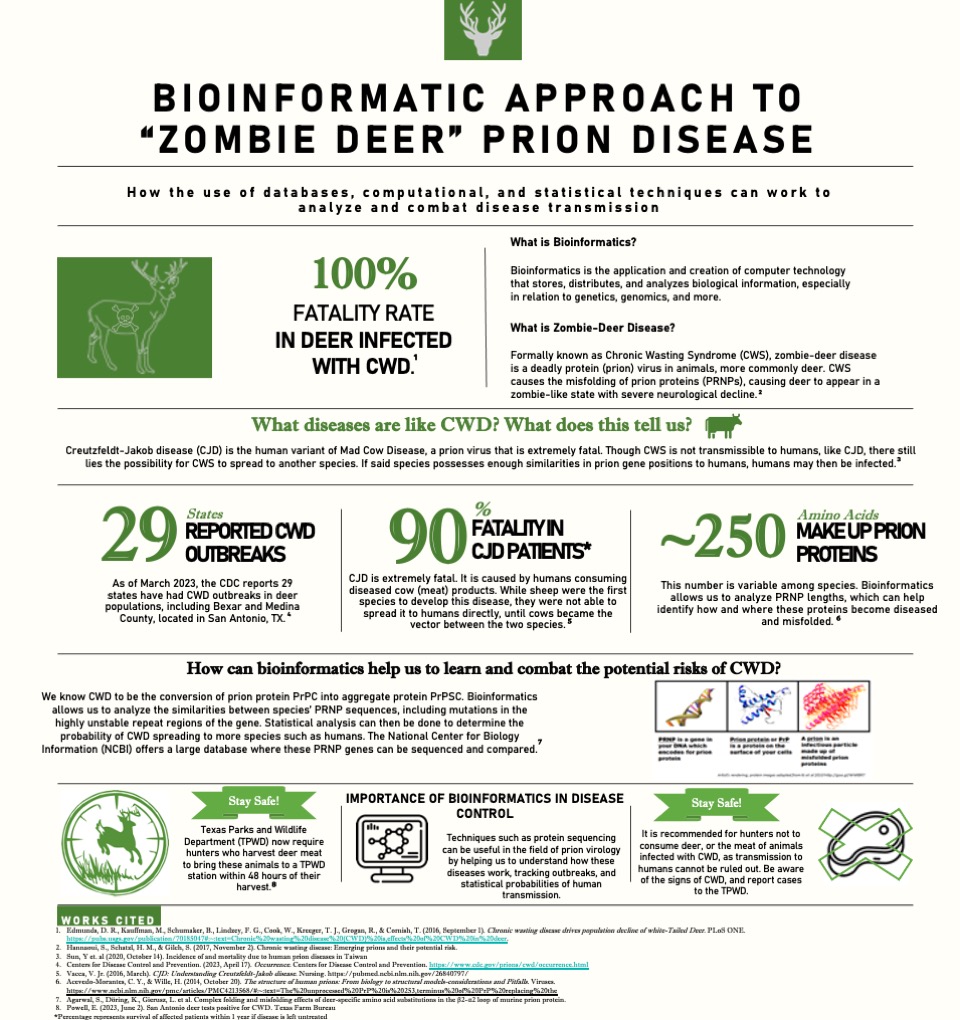


I would like to thank Dr. Lori Boies for her guidance and feedback that gave me confidence to continue with researching this topic. Bioinformatics is a field that is rapidly growing and evolving, so I’m grateful for the opportunity to contribute and inform others of its importance. To my anonymous peer editors, thank you for your comments and feedback, as they made revision much less stressful for me. Finally, I’d like to thank Dr. Gary Ogden, for making me aware of this issue and its recent appearance in cities like San Antonio.

12 comments
jrosas11
This infographic really caught my attention because the idea of “zombie deer” prion disease sounds disturbing and interesting at the same time. As a forensic science major, I liked seeing how bioinformatics can be used to study diseases in a way that isn’t just lab based but also has real environmental and public health effects. The visuals helped explain a pretty complicated topic in a way that didn’t feel overwhelming. One thing that could make it even better is adding a simple example of how this research helps scientists track or control the disease. Overall, it was engaging and definitely made me want to learn more.
Raynne M
This infographic was very informative and really interesting. The topic of chronic wasting syndrome is extremely interesting to me, especially as a pre-veterinary student. I appreciated the section regarding transmission to humans, as I was unaware that CWS may be transmissible to humans if it is passed through an organism with similar prion gene positions to humans. I was also surprised to learn that Creutzfeldt-Jakob disease was originally developed in sheep and not transferable to humans, until cows contracted it and were able to infect humans. I would suggest re-formatting the figure at the bottom-right of the infographic, as the small size makes the words difficult to read. I appreciated the connection to bioinformatics and found the section explaining what bioinformatics ae and how it may be applied to this topic to be very informative.
Laila Sosa
Hi Sophia,
I was imminently intrigued by the use of “Zombie Deer” in your title and what this disease entails. The way the infographic is formatted allows for easy understanding of both bioinformatics and the “Zombie Deer” virus. Learning about this disease and how it deals with the prions is extremely intriguing since I’ve only heard of mad cow disease (MCD) and how unlike MCD it is not transmissible to humans. Which leads to my biggest question as to why and how this is, but it can spread to other species. Overall, this is a well put together and informative infographic that has increased my understanding on this matter. Thank you and Great Job!
rtennill
Your infographic was very interesting and caught my attention. I was interested in learning about “zombie deer”. I have hunted all my life and never heard about this disease before, and it was interesting to learn more about it. Due to the misfolding of the proteins, the prion proteins then express the disease of the deer looking like zombies, and to find out that humans can attract a disease similar is compelling. I am interested in learning about how bioinformatics will help decrease the chances of people obtaining CJD. Overall, technology is developing more each year and allows scientists and researchers to understand protein sequences and learn more about diseases. This helps us learn more about recent outbreaks like Covid-19 and learn about future diseases faster to reduce outbreaks.
Samuel DLC
The way you structured the infographic is very appealing to the eye. I like how you’re drawn to each piece of information because of the bold letters and color. The use of pictures is also useful because it gives insight to what is being talked about. The topic is also really interesting, and I didn’t realize that there had been an outbreak here.
Gonzalez Elizabeth
What a beautifully designed infographic! Your infographic caught my attention because I have never heard about the prion disease. I found it interesting that you discussed the use of databases and computers to analyze the spread of the disease. I was unsure about bioinformatics until I read your infographic, but I now understand that it involves using computers to obtain and analyze scientific data, such as genes. Undoubtedly, bioinformatics is required to close significant information gaps about diseases such as “zombie deer.” This definitely contributes to the area of science as it is always developing. I believe that the pandemic has made us particularly aware of the significance of disease control and the ways we can research more on how to be aware of outbreaks and suitable methods to stay in control.
Olivia
How fascinating! The organization of your infographic makes it easy to read and understand such an interesting topic. I knew someone affected by CJD and seeing how fatal it is from your infographic really highlights the importance of understanding its origin and transmission (which I find fascinating that it can be passed from other species!). It is encouraging to know that this bioinformatics field of study can bring a lot of insight and analysis of the causes so that we are able to combat it and diseases like it.
jdo1
This is such a good infographic, and I can clearly see why. Not only is the topic very unique, but the information itself is very detailed and easy to understand. Not many people think about neurological disorders of other animals, so I found this very interesting as a topic. It is a good thing to spread awareness of CWS not just for the sake of the deers, but also in case it may spread to humans one day, if some other animal with a similar prion genes as us.
Elizabeth Santos
Hey Sophia, congrats on your award for best infographic! Your infographic is really interesting and I like how you connected such a unique topic to a field that many of us do not know much about. Bioinformatics is certainly needed to fill in important gaps in knowledge relating to conditions like “zombie deer”. I think we have especially realized the importance of disease control in light of the pandemic, so this really adds to an evolving scientific field.
jdelafuente6
This is such a well-put-together infographic! I just learned a little about this deer prion in immunology, so your infographic caught my eye! I thought it was cool how you were able to talk about how databases and computers were analyzing how the disease is transferred. Before reading your info-graph, I wasn’t quite sure what bioinformatics was, but now I know it has to do with computer technology accessing/analyzing the sciences, like genetics. I have a friendly suggestion for you; you should consider making the part about deer meat, and how it should be processed at the TPWD station, a little bigger. I think that part is super important and not a lot of people are aware of that. Overall, this infographic was great, and it aligns perfectly with what I learned about in Immunology class.