

Policy Brief on Youth Unemployment as a National Security Threat in South Africa (2010–2024)
Executive Summary
Youth unemployment in South Africa has reached crisis proportions, with official statistics indicating that unemployment among individuals aged 15 to 24 consistently exceeds 60%. This policy brief challenges the prevailing view that youth unemployment is primarily an economic issue, contending instead that it constitutes a growing threat to national security, encompassing impacts on regime legitimacy, social cohesion, and state capacity. Drawing on political economy analysis, the brief demonstrates that unemployment is a driving force behind, rather than a consequence of, South Africa’s persistent structural inequality, which arises from skills mismatches, spatial exclusion, labor-market segmentation, and insufficient labor-absorbing economic growth (Rodrik, 2008; Kingdon & Knight, 2004).
Persistent youth unemployment has contributed to increased crime rates, ongoing instability, and diminished trust in government, resulting in recent protests and political divisions (Chigudu, 2025; Ramoroka et al., 2024). If these patterns persist, they may further erode state capacity. In this brief, I analyze three policy solutions and propose a combined approach of short-term government employment, medium-term private-sector development, and long-term educational initiatives.
Background and Context
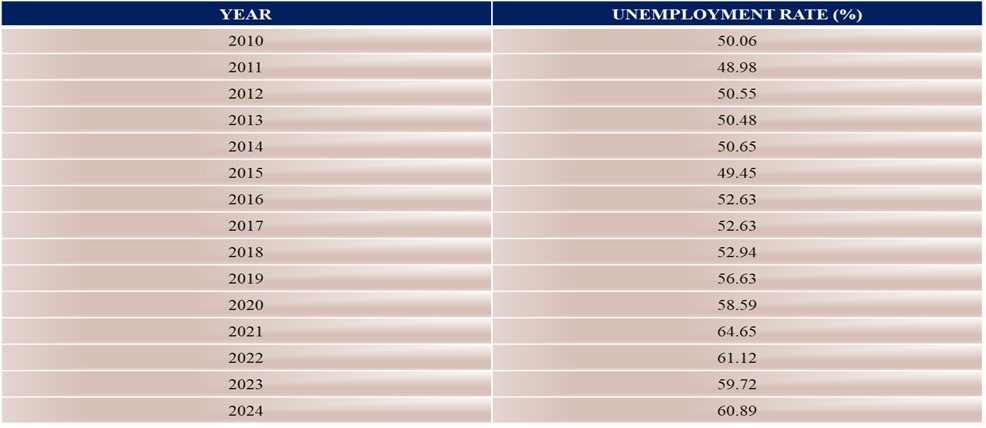
Table 1: Youth Unemployment Trends in South Africa (2010–2024)
Source: MacroTrends. (n.d.). South Africa youth unemployment rate 1991–2024
Table 1 presents the same dataset used in Figure 1, providing a numerical representation of youth unemployment trends between 2010 and 2024.
Figure 1: Unemployment rates (%)
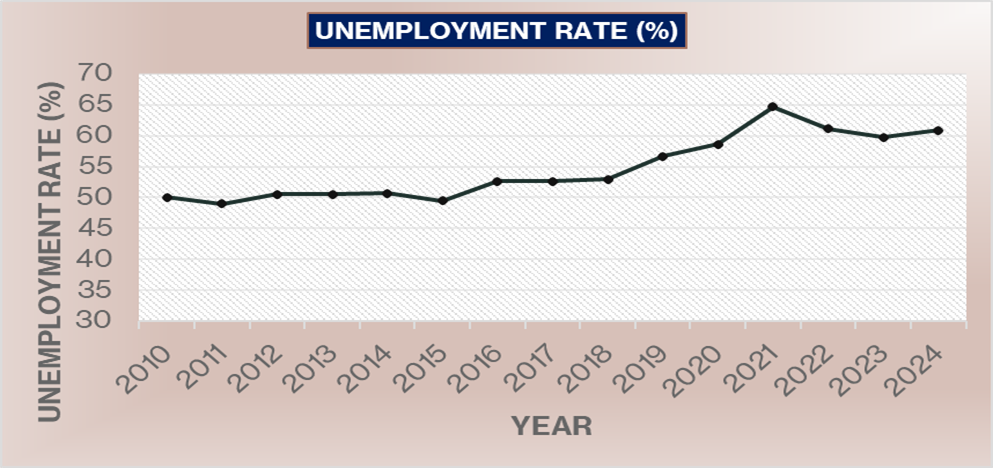
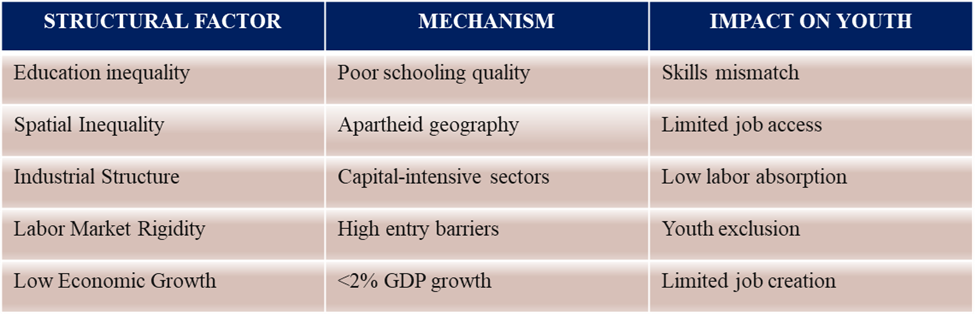
Table 2: Structural Drivers of Youth Unemployment
Youth unemployment rates in South Africa can be best described from the perspective of political economy. In South Africa, the structural mismatch of historical inequality, institutions, and markets has shaped the labor market for young people today. Marked differences in inequality from before the end of apartheid still exist today, structurally through education, space, and access to labor markets (Seekings & Nattrass, 2015).
Youth unemployment has hovered above 50 percent between 2010 and 2024 and exceeded 60 percent more recently. This points to structural deficiencies in the economy rather than cyclical deficiencies. South Africa has experienced too little labor-absorbing growth. Growth has been focused on capital-intensive sectors of the economy, such as mining and finance (Rodrik 2008; Bhorat et al. 2016).
Education contributes to strengthening unemployment. Access to education has improved, but the quality of education received by many is poor, failing to equip them with skills for formal sector jobs (Spaull, 2013). This creates a labor market that favors those with better quality education and disadvantages those who lack access to it. (Bhorat et al., 2002).
Spatial inequality exacerbates this problem even further. Jobs tend to be centralized in cities, while youth live outside of these centers in townships and rural areas with little transportation and connection to these economies (Turok, 2018). This geographic mismatch creates structural barriers to employment.
Macroeconomic issues have too constrained demand. Economic growth rates have stayed under 2% for too long now, which has suppressed employment growth. COVID-19 hit young workers hard, as many were working in vulnerable sectors such as retail and informal jobs (Pillay, 2023).
From a national security perspective, these structural conditions create an environment conducive to instability. High unemployment contributes to crime, protest activity, and political dissatisfaction, undermining state legitimacy (Chigudu, 2025).
Policy Options
One policy option is to increase public employment programs. Public employment programs allow the government to offer fast jobs to citizens. Creating jobs through things like government-funded construction work and community work. This can decrease short-term turbulence by allowing young people who are unemployed to have an income and something to do. The issue with these programs is that they do not seem to have significant long-term impacts on employment and can hurt the government’s budget (Seekings & Nattrass, 2015).
An alternative approach would be to focus on providing incentives to the private sector to create jobs. This could include wage subsidies and tax incentives, as well as comprehensive labour market reforms to reduce the costs associated with formal employment. The objective of such policies would be to increase labor demand by encouraging firms to grow and hire more young and inexperienced workers. This could be achieved by subsidizing a portion of the young workers’ wages to account for low initial productivity, while providing tax cuts or credits to encourage firms to make informal or temporary jobs formal. Labour market reforms can complement these incentives by reducing the time and costs to register a business, cutting red tape, and strengthening the flexibility of the labor market.
This approach is generally seen as more sustainable than short-lived public works programs, as it uses market mechanisms to boost employment and supports private-sector job creation rather than relying on jobs provided directly by the state. One weakness of this approach is that it depends on good macroeconomic conditions, investor confidence, and a generally positive business environment to succeed. In weak or slowing economies, firms may not hire even with fiscal incentives, constraining the ability of this policy tool to affect employment quickly. Its ability to reach the most marginalized may also be limited in the short-term; while job growth will help to increase overall employment opportunities, those who are unemployed (e.g. long-term unemployed, rural youth), or unemployable (i.e. lacking basic literacy or job skills) may not gain employment under such a policy without complementary programs to provide training and skill development, or provide some form of social protection. As Banerjee et al. (2008) point out in the case of developing labor markets with structural constraints, both demand and supply side policies may be needed to provide inclusive and equitable employment gains.
Another strategy is to improve vocational and technical education. Structural unemployment is partly affected by skills mismatch between seekers and employers’ needs. Especially in developing and emerging markets, much unemployment is created by skills possessed by job seekers that don’t match the needs of employers. While graduates flow out of formal education programs, there remains a high demand for job-ready skills that haven’t been developed by the school system, particularly in manufacturing, construction, IT, and service sectors. By investing in Technical and Vocational Education and Training (TVET) programs, governments can better prepare learners with applicable skills, certifications, and work experience that allow for employability soon after training.
Additionally, greater collaboration between schools and employers can improve responsiveness to labor market needs (through partnership programs, apprenticeships, and work-integrated learning) and ease transitions into the workforce, which often takes the longest for youth who experience unemployment at the highest rates. Meaningful education reform, however, is challenging and requires significant coordination across institutions. It can also demand long-term funding and qualified teachers, and new infrastructure and equipment.
Education reform is arguably one of the most effective long-term solutions to unemployment. However, education is slow to show results. From reforming curricula to retraining teachers and rolling out education nationwide, it takes time to build an effective educational system. Effects of such reform won’t be seen in employment numbers for years, if not decades. While vocational and technical training are excellent solutions to unemployment, they will take longer to work than other methods, such as public works or temporary jobs programs (Spaull, 2013).
Risks and Trade-offs
There are trade-offs with every option. Public jobs come quickly but are expensive and a short-term fix. Private-sector bonuses and school improvements help in the long run, but do nothing to immediately fix security.
One dilemma is finding the right balance between short-term stabilization efforts and long-term structural reforms. If we focus too much on the former, we risk fueling further instability because we are not tackling the underlying causes of the crisis. But if we concentrate only on long-term issues, we may do little to address the current unemployment problem.
Institutional weaknesses also present risks. Corruption and limited state capacity may hinder the enforcement of policies and decrease overall efficacy (Rodriguez et al., 2024). Governance constraints could also be an obstacle; reforms may be limited due to political issues such as labor protections and existing institutional setups, which may decrease labor market fluidity (Kingdon & Knight, 2004).
Furthermore, continuous unemployment causes political implications. Increasing unrest among young voters has already started to shape elections and trust in government (Ramoroka et al., 2024).
Final Recommendation
The youth unemployment threat to national security should be approached with a hybrid policy recommendation. In the short term, public employment programs can be used to temporarily ease instability. This would involve placing temporary employment services in high-risk areas.
Over the medium term, policymakers can provide more incentives for private-sector employment creation. Wage subsidies and tax credits should be targeted towards labor-intensive sectors and small businesses, which will more likely absorb youth.
For structural problems in the labor market, a long-term investment in vocational and technical education needs to be implemented. Reforming education to focus on skills-based learning can help prepare those who will enter the labor market.
This whole-of-government or integrated approach responds not only to current threats but also helps reduce structural drivers to strengthen economic security.
Conclusion
Youth unemployment is a national security issue in South Africa. It is a complex problem entrenched in structural inequalities that cannot be solved through piecemeal efforts. Continued failure to address it will lead to higher crime, social instability, and political illegitimacy.
It is important to have a policy approach that brings together short-term stabilization and long-term reform. With this kind of strategy, policymakers can tackle both the immediate problems and the underlying causes of unemployment, helping to create a more stable and sustainable economy.
Reference
Banerjee, A., Galiani, S., Levinsohn, J., McLaren, Z., & Woolard, I. (2008). Why has unemployment risen in the new South Africa? 1. Economics of Transition, 16(4), 715-740.
Bhorat, H., Cassim, A., & Tseng, D. (2016). Higher education, employment, and economic growth: Exploring the interactions. Development Southern Africa, 33(3), 312-327.
Bhorat, H., Lundall, P., & Rospabe, S. (2002). The South African labour market in a globalizing world: Economic and legislative considerations. Geneva: International Labour Office.
Chigudu, D. (2025). Youth-Driven Conflict and Unemployment: Examining the Role of Economic Deprivation in Africa. African Journal of Peace and Conflict Studies (formerly Ubuntu: Journal of Conflict and Social Transformation), 14(3), 9-36.
Kingdon, G. G., & Knight, J. (2004). Race and the incidence of unemployment in South Africa. Review of Development Economics, 8(2), 198-222.
MacroTrends. (n.d.). South Africa youth unemployment rate 1991–2024. Retrieved from https://www.macrotrends.net/datasets/global-metrics/countries/zaf/south-africa/youth-unemployment-rate
Pillay, N. (2023). The impact of COVID-19 on poverty in South Africa.
Ramoroka, T., Kgobe, F. K. L., Malandela, G., Semono, C. A., & Ayinde, A. F. (2024). South Africa’s Unemployment Conundrum: Implications for the 2024 National Elections. Africa Insight, 53(4), 32-49.
Rodriguez, M. C. R., Chiinze, T. N., De Clerck, M. S., Khatun, M. F., Manuilova, N., & Tang, M. V. (2024). South Africa: Fiscal Transparency Evaluation. International Monetary Fund.
Rodrik, D. (2008). Understanding South Africa’s economic puzzles. Economics of transition, 16(4), 769-797.
Seekings, J., & Nattrass, N. (2015). Policy, politics, and poverty in South Africa. Springer.
Spaull, N. (2013). South Africa’s education crisis: The quality of education in South Africa 1994-2011. Johannesburg: Centre for Development and Enterprise, 21(1), 1-65.