


Executive Summary
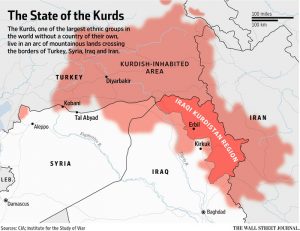
The current U.S-Iranian conflict threatens to draw members of the 40-millon strong Kurdish ethnic group into the struggle – further complicating analready volatile situation. The U.S. government’s history with Kurdish groups is mixed at best. Kurds in Iraq and Syria have been partners in the fight against Islamic State (IS) and as surrogates in the Syrian Civil War. However, these relationships complicate regional stability with NATO ally Turkey and other regional actors. Supporting any action in Iran (or Eastern Kurdistan) may provide the U.S with options, but also possible difficulties in further attempts at a lasting regional peace.
While there are compelling reasons to support Kurdish independence inside Iran, the most prudent course of action is to maintain neutrality and discourage direct action against the Iranian regime by Kurdish forces. Opening a ground front – be it directly or indirectly – will only serve to exacerbate an already spiraling conflict, stress alliances, and lead to unnecessary suffering without a strong chance of success. This stance may not completely insulate the region from violence but will mitigate the risk of political backlash and risk to civilians and non-military infrastructure. Remaining neutral will also strengthen U.S credibility in the region, which has become ever more strained since the war began.
Background and Context
Iranian Kurds have a long history of resistance and subjugation in Iran. In 19
46, The short-lived Republic of Mahabad was established in Northeastern Iran. After less than a year, its leaders were killed and territory seized. The previous administration was successful in curbing Kurdish nationalism prior to the 1979 revolution. The newly declared Islamic Republic declared a jihad against Kurds, killing around 10,000 in two years. In 2022 massive protests erupted when a Kurdish woman, Masha Amini, was killed by the Iranian morality police. Finally, Kurds have been targeted specifically in crackdowns since summer 2025 when U.S bombers attacked the Ira
nian nuclear program.
The current U.S. relationship with Kurdish groups in other countries is complicated. In Syria, the U.S supported the Kurdish-led Syrian Democratic Forces (SDF) who resisted both Bashar Al-Assad and IS. However, since the fall of Assad, the U.S has embraced the newly formed government, sidelining its longtime ally. In Iraq Kurds enjoy a semi-autonomous region and representation in the post-U.S. occupation government. In 2023 Kurds overwhelmingly voted for full independence from Iraq, prompting military intervention from Bagdad. Appeals to Washington by political leaders rendered little tangible results.
In February 2026, six Kurdish opposition parties allied to create the Coalition of Political Forces of Iranian Kurdistan (CPFIK) to centralize efforts to pursue Kurdish autonomy in Iran. These groups hope to take advantage of possible regime collapse and pursue Western support for their aims. Despite this, cooperation between groups in Iraqi Kurdistan (or The Kurdistan Region of Iraq) is not forthcoming. Kurdish Politicians have distanced themselves from groups advocating an incursion, including the First Lady of Iraq, Shanaz Ibrahim Ahmed.
Policy Options
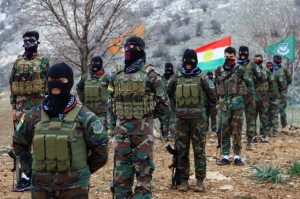
The first policy option is for the U.S to enter into a formal public agreement with Kurdish forces. Under this course of action, the U.S would provide intelligence, logistics, training, funding, equipment, and combat multipliers such as close air support (CAS) to Kurdish fighters. This option would open a ground front in northwestern Iran, tying down Iranian military assets and personnel while reducing the risk to U.S ground troops. Kurdish troops are generally seen as experienced and competent, particularly among the Western-trained Counter-Terrorism Group (CTG). However, such an agreement would likely incur diplomatic penalties from Turkey, who considers several groups in the potential coalition as terrorist organizations. Politicians in the Iraqi government, including in the Kurdish Regional Government (KRG) have expressed a strong desire to stay out of the conflict. It is also likely that Iranian forces, particularly the Iranian Revolutionary Guard Corps (IRGC) would increase attacks into Iraqi Kurdistan against military and civilian targets. Despite the strong U.S air defense network around Erbil, casualties – including in U.S bases in the area – are all but inevitable.
The second option is to provide clandestine support for a cross-border incursion into Iran. The U.S can provide nontangible aid in the form of over-the-horizon radar (OTH) and intelligence reporting. The special operations community can also be leveraged to provide small unit training, and limited logistical support while retaining a small footprint inside friendly Iraq. This option allows for similar but less potent benefits of full support. It reduces the potential political backlash (so long as it remains covert) and allows the U.S to remain flexible. A commitment to support a public incursion would negatively affect any future ceasefire and peace talks, where non-public aid can be denied at the negotiating table. Conversely, U.S support also comes with nominal control of the battlefield. By providing ammunition the U.S gets a say in where it is fired. By remaining publicly hands-off, that control dissipates. Kurdish objectives on the ground may differ from those of the U.S. and exposure of clandestine support would almost certainly lead to backlash from both regional partners and Iran.
The third option is to practice deliberate neutrality regarding Kurdish groups entering the conflict. This option maintains the delicate balance of alliances and influence in the region. The CPFIK itself recognizes taking kinetic action in Iran will open all Kurds to risk. They express concerns that Turkey will enforce a buffer zone to prevent refugees, Iran will target Iraq Kurds, and Azerbaijan may take stoke ethnic violence between Azeris and Kurds. U.S strategic objectives in the conflict continue to be the vital Strait of Hormuz oil transit route. Maintaining strategic focus on the Strait and the U.S air campaign better suits current objectives in the conflict. Should the Iranian regime become destabilized a failure to capitalize may be seen in hindsight as a missed opportunity for Kurdish autonomy. It is also likely Iran will continue to pick targets in Northern Iraq whether there is a cross-border attack into Iran or not.
Risks and Trade‑offs
There are risks to any of the previously outlined courses of action. The U.S should consider several additional challenges that may become apparent as the conflict unfolds. Firstly, U.S policy often leads to mission creep over time. Commitments in 2026 will have lasting ramifications in the region for decades to come. After decades of involvement, policymakers should take care that short term gains do not betray long term goals. Supporting a Kurdish independence movement in Iran, covertly or otherwise, may draw the U.S into the broader regional struggle and directly into a political firestorm that future administrations will be responsible for. While the U.S should consider a concrete stance on Kurdish autonomy, forcing the issue during the current conflict is unlikely to yield desired results.
Secondly, a potential Kurdish state in Iranian territory would upset the current regional balance of power by redrawing national borders. The U.S already struggles to mediate between governments in Bagdad and Erbil. It is likely that a similar semi-autonomous state would seek support from the U.S. and draw the county into another simmering conflict in the Middle East. While the idea of a friendly nation in the heart of the region is appealing, it is unlikely – barring total regime collapse in Tehran – that a Kurdish state could exist unmolested. Future conflict with the Islamic Republic is almost certain. The U.S would be forced to either support the new state or once again abandon a fledgling allied Kurdish movement.
 Finally, there are pressing humanitarian concerns that must be addressed. Iranian protest movements in early 2026 were brought on in part by an ongoing water crisis that left many Iranians desperate. A new state in the region would also face logistical challenges brought on by climate change and require outside aid. There is already a burgeoning refugee and internally displaced person (IDP) crisis brought on by the conflict. Regardless of the policy decision made, migration will further stoke ethnic tensions and overburden aid organizations, electrical grids, and healthcare systems. If the conflict continues civilians will unfortunately remain in the crosshairs. U.S support often comes with the protective umbrella of air defense systems, which could mitigate losses suffered both by fighters and civilians.
Final Recommendation
The U.S. should pursue a strategy of neutrality regarding Kurdish forces entering the U.S-Iranian conflict. While there are potential short-term tactical or strategic benefits of supporting Kurdish led kinetic action inside of Iranian borders, the risks far outweigh exceed the advantages. An attack into Iran, U.S military supported or not, is unlikely to bring about the dream of an autonomous Eastern Kurdistan. Past actions by the Iranian regime show that the current government will go to great lengths to ensure territorial ethnic integrity. An incursion may create a military dilemma for Iran, but without a clear pathway to achieve an independent state these efforts would likely lead to significant loss of life for little gain. Potential political fallout with Turkey and Iraq is therefor not worth the cost of greenlighting action. U.S policy should focus on diplomatic outreach to Ankara, Baghdad, Baku, and Erbil to limit the scope and scale of the current conflict. Efforts should also be made to bolster defensive capabilities, particularly in Northern Iraq, where Iranian strikes will likely continue to target potential staging areas and infrastructure. Finally, the U.S should reaffirm its current regional commitments, including to the SDF in Syria and Peshmerga in Iraq. U.S support for its allies should be steadfast to encourage cooperation and deter its enemies.
References:
Abdulrahim, R., & Sengupta, S. (2026, March 5). Iranian Kurdish Forces Say They May Enter Iran. Who Are the Kurds? The New York Times. https://www.nytimes.com/2026/03/05/world/middleeast/iran-kurds-who.html
Davison, J., & McNeill, R. (2026, August 12). Trump’s mixed messages and Iran’s bombs kept the Kurds out of the war. https://www.reuters.com/investigations/trumps-mixed-messages-irans-bombs-kept-kurds-out-war-2026-04-08/
Gresh, G. (2009). Iranian Kurds in an Age of Globalisation. Iran and the Caucasus. https://brill.com/view/journals/ic/13/1/article-p187_11.xml?ebody=citedBy-130798
Gresh, G. (2017). Iran’s Forgotten Kurds. The Kurds in a Volatile
iddle East. https://www-jstor-org.stmarytx.idm.oclc.org/stable/resrep04759.9?searchText=%28The+Kurds+between+Iran+and+Iraq%29&searchUri=%2Faction%2FdoAdvancedSearch%3Fq0%3DThe%2BKurds%2Bbetween%2BIran%2Band%2BIraq%26f0%3Dall%26c1%3DAND%26f1%3Dall%26acc%3Don%26so%3Drel&ab_segments=0%2Fbasic_search_gsv2%2Fcontrol&refreqid=fastly-default%3A10184dc7a1494b169b52cc36abfc5f7c&seq=1
Honigman, J. (2022). Never Mind Betrayal: America’s Indifference to the Kurds is a Strategic Blunder. Journal of Strategic Security, 15(1). https://www-jstor-org.stmarytx.idm.oclc.org/stable/48652011?searchText=Kurdistan&searchUri=%2Faction%2FdoBasicSearch%3FQuery%3DKurdistan%26so%3Drel%26sd%3D2020%26ed%3D2026&ab_segments=0%2Fbasic_search_gsv2%2Fcontrol&refreqid=fastly-default%3Affbd92d6fa7ee40743f077a790f2f50a&seq=12
In Letter to Biden, Barzani warns of Iraqi Kurdistan’s collapse, urges mediation. (2023, September 13). Shafaq. https://shafaq.com/en/Report/In-letter-to-Biden-Barzani-warns-of-Iraqi-Kurdistan-s-collapse-urges-mediation
Iran targets Kurdish groups in Iraq, begins wave of attacks on Israel. (2026, March 5). Al Jazeera Staff. https://www.aljazeera.com/news/2026/3/5/iran-targets-kurdish-groups-in-iraq-begans-fresh-wave-of-attacks-on-israel
Jalal, L. (2026, March 1). The Coalition of Political Forces of Iranian Kurdistan: Risks and Opportunities. Kurdish Peae Institute. https://www.kurdishpeace.org/research/democracy/the-coalition-of-political-forces-of-iranian-kurdistan-risks-and-opportunities/
Koohi-Kamali, F. (1992). The development of nationalism in Iranian Kurdistan. https://www.taylorfrancis.com/chapters/edit/10.4324/9780203993415-12/development-nationalism-iranian-kurdistan-fereshteh-koohi-kamali
Mohséni, C. (2018). The Instrumentalization of Ethnic Conflict by the State: The Azeri-Kurdish Conflict in Iran. In F. Gillespie, G. Dorronsoro, & O. Grojean (Eds.), Identity, Conflict and Politics in Turkey, Iran and Pakistan (p. 0). Oxford University Press. https://doi.org/10.1093/oso/9780190845780.003.0013
Saeed, Y. (2026). How would a Kurdish offensive change the war in Iran? Dispatches. https://www.atlanticcouncil.org/dispatches/how-would-a-kurdish-offensive-change-the-war-in-iran/
Yampolska, L., & Lateef Abdulqader, A. (2026). THE REPUBLIC OF MAHABAD: A POST-WAR PROJECT OF KURDISH AUTONOMY IN IRAN. Ministry of Education and Science of Ukraine. https://dspace.hnpu.edu.ua/server/api/core/bitstreams/2e9d69cc-48b3-4715-91ec-abbff63b8f6c/content#page=39
AI Disclosure:
The structural format of the brief was outlined using Microsoft Copilot, a generative artificial intelligence chatbot. The concepts, research, and body of the brief were created by the author.