Acknowledgments
I would like to thank Professor Shackleford, who gave valuable feedback throughout the process and Irene Urbina Zuniga, who helped guide me through formatting my infographic and posting on the Research Scholars website.
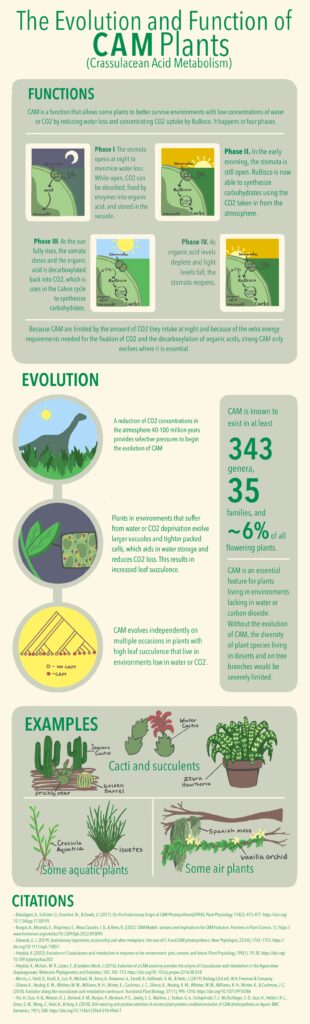
I would like to thank Professor Shackleford, who gave valuable feedback throughout the process and Irene Urbina Zuniga, who helped guide me through formatting my infographic and posting on the Research Scholars website.



51 comments
Joseph Ferrer
I liked how this infographic explained CAM plants clearly and simply. The visuals helped me understand how these plants save water by opening their stomata at night, which is something I usually get confused about in class. The way the phases were organized made the process easier to follow, and the examples of real plants helped connect it to the real world. One improvement could be making some of the text a little bigger, but overall, it was informative and easy to understand.
garana
This infographic really connected with me because it shows just how smart plants are at surviving challenging environments something I’ve always admired. The use of Pictures for both the CAM phases and the plant examples made the science feel more approachable. The statistic showing that CAM exists in at least 343 genera and 6% of flowering plants was especially eye opening. For improvement maybe adding quick bullet summaries under each phase could help visual learners understand the main points faster overall this is a great infographic!
Ashley Garcia
Hi Emma, firstly, I wanted to comment on how much I liked the artwork and organization, it makes understanding the information easier to understand. Secondly, I found it interesting that some plants have similar physical features due to the CAM functions, such as bigger/thicker, rounder leaves (such as cacti and succulents), but, I didn’t know there were this many plant types such as Isoetes, the aquatic plant that relies on it for CO2 conservation.
Raegan Tennill
Overall, I found this infographic to be very insightful and helpful! I especially liked the visuals of each phase and evolution of CAM plants, they helped me understand what was happening at a certain phase! I liked how the infographic presented the phases first and then explained about the evolution of CAM plants. This helps readers like me understand that evolution occurs to help plants adapt better to their environment. Overall, it was interesting to learn about CAM plants and how they obtain CO2 at night and can synthesize carbohydrates during the day.
Lonni Garcia
Hi Emma! I love how this infographic has a lot of visuals that relate to what is being discussed. I’m a visual learner so I feel like this really helped me understand the concept more. The infographic shows the importance CAM is to plants in environments that have low concentrations of water or CO2. The fun fact about where CAM is known to exist was interesting to me because it shows that evolution in plants is important.
natalie
I loved how this infographic was formatted and all the visuals that were incorporated in it. I remember learning this topic in bio so seeing this and going more in depth about this topic was very helpful. The functions of CAM is a very interesting topic and seeing how the evolution of CAM began was very intriguing as well as seeing how many species CAM exists in.
Alexa Miner
What a really interesting infographic! I loved how you described every detail with pictures and steps that are easy to follow! Every picture added fit well and had plenty of information! Very informative. Good job!
Madison Magaro
Hi Emma, I really enjoyed reading your infographic about the evolution and function of CAM plants. I like the structure and colors that you decided to use for it because it draws me in to read more. It is important for plants to be able to survive in areas with a low water or CO2 supply. Overall this was a great topic and I enjoyed looking at the examples of the plants.
Gabriella Galdeano
I loved learning about CAM plants through this infographic. The artwork looks so good! It is so interesting how some plants were able to evolve to survive in an environment low in CO2 or water. Opening the stomata in the nighttime instead of the day is such an effective way to preserve water. I think that more background on RuBisCO could make this infographic even more informative. You did a great job!
Bianca Ramos
This was such a well-done infographic! The content was incredibly visually appealing, with amazing graphics that demonstrated the concepts! The writing explained the concept clearly and I was able to easily understand how CAM plants function. The infographic clearly showed how important this CAM ability is to the survival of plants in environments with low water or CO2 content. I especially enjoyed the variety of plants shown as examples in the end.