

Energy Shocks and the Clean Energy Transition
What effect did the 2022 Ukraine War energy crisis have on the trajectory of the renewable energy transition in Latin America? Did the volatility of the oil market push governments to solidify their energy security in renewable sources, or did oil exporters see a chance for increased revenues from taking advantage of new demand in the market (Cárdenas et al. 2022)? Were these forces mitigated by existing renewable energy policies? What might this mean for the impacts of the most recent energy crisis stemming from the war in Iran?
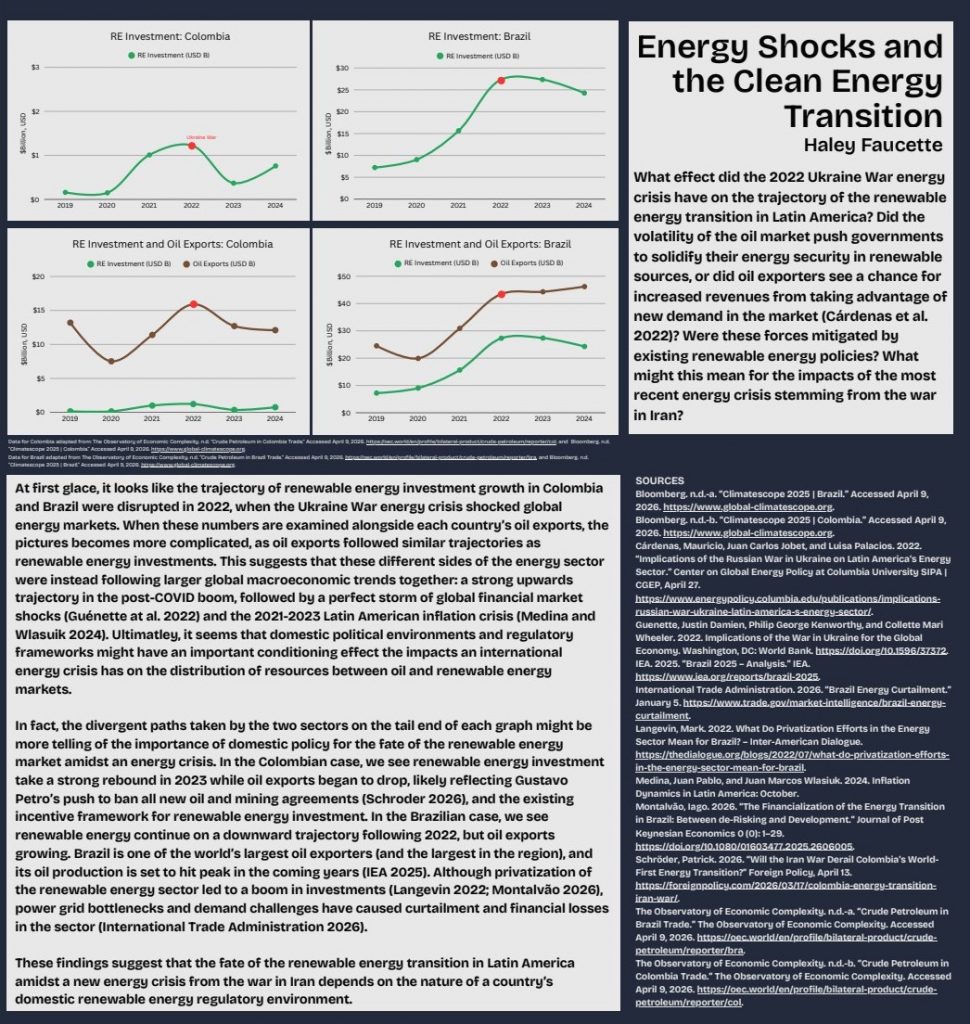
At first glace, it looks like the trajectory of renewable energy investment growth in Colombia and Brazil were disrupted in 2022, when the Ukraine War energy crisis shocked global energy markets. When these numbers are examined alongside each country’s oil exports, the pictures becomes more complicated, as oil exports followed similar trajectories as renewable energy investments. This suggests that these different sides of the energy sector were instead following larger global macroeconomic trends together: a strong upwards trajectory in the post-COVID boom, followed by a perfect storm of global financial market shocks (Guénette at al. 2022) and the 2021-2023 Latin American inflation crisis (Medina and Wlasuik 2024). Ultimately, it seems that domestic political environments and regulatory frameworks might have an important conditioning effect the impacts an international energy crisis has on the distribution of resources between oil and renewable energy markets.
In fact, the divergent paths taken by the two sectors on the tail end of each graph might be more telling of the importance of domestic policy for the fate of the renewable energy market amidst an energy crisis. In the Colombian case, we see renewable energy investment take a strong rebound in 2023 while oil exports began to drop, likely reflecting Gustavo Petro’s push to ban all new oil and mining agreements (Schroder 2026), and the existing incentive framework for renewable energy investment. In the Brazilian case, we see renewable energy continue on a downward trajectory following 2022, but oil exports growing. Brazil is one of the world’s largest oil exporters (and the largest in the region), and its oil production is set to hit peak in the coming years (IEA 2025). Although privatization of the renewable energy sector led to a boom in investments (Langevin 2022; Montalvão 2026), power grid bottlenecks and demand challenges have caused curtailment and financial losses in the sector (International Trade Administration 2026).
These findings suggest that the fate of the renewable energy transition in Latin America amidst a new energy crisis from the war in Iran depends on the nature of a country’s domestic renewable energy regulatory environment.
References
Bloomberg. n.d.-a. “Climatescope 2025 | Brazil.” Accessed April 9, 2026. https://www.global-climatescope.org.
Bloomberg. n.d.-b. “Climatescope 2025 | Colombia.” Accessed April 9, 2026. https://www.global-climatescope.org.
Cárdenas, Mauricio, Juan Carlos Jobet, and Luisa Palacios. 2022. “Implications of the Russian War in Ukraine on Latin America’s Energy Sector.” Center on Global Energy Policy at Columbia University SIPA | CGEP, April 27. https://www.energypolicy.columbia.edu/publications/implications-russian-war-ukraine-latin-america-s-energy-sector/.
Guenette, Justin Damien, Philip George Kenworthy, and Collette Mari Wheeler. 2022. Implications of the War in Ukraine for the Global Economy. Washington, DC: World Bank. https://doi.org/10.1596/37372.
IEA. 2025. “Brazil 2025 – Analysis.” IEA. https://www.iea.org/reports/brazil-2025.
International Trade Administration. 2026. “Brazil Energy Curtailment.” January 5. https://www.trade.gov/market-intelligence/brazil-energy-curtailment.
Langevin, Mark. 2022. What Do Privatization Efforts in the Energy Sector Mean for Brazil? – Inter-American Dialogue. https://thedialogue.org/blogs/2022/07/what-do-privatization-efforts-in-the-energy-sector-mean-for-brazil.
Medina, Juan Pablo, and Juan Marcos Wlasiuk. 2024. Inflation Dynamics in Latin America: October.
Montalvão, Iago. 2026. “The Financialization of the Energy Transition in Brazil: Between de-Risking and Development.” Journal of Post Keynesian Economics 0 (0): 1–29. https://doi.org/10.1080/01603477.2025.2606005.
Schröder, Patrick. 2026. “Will the Iran War Derail Colombia’s World-First Energy Transition?” Foreign Policy, April 13. https://foreignpolicy.com/2026/03/17/colombia-energy-transition-iran-war/.
The Observatory of Economic Complexity. n.d.-a. “Crude Petroleum in Brazil Trade.” The Observatory of Economic Complexity. Accessed April 9, 2026. https://oec.world/en/profile/bilateral-product/crude-petroleum/reporter/bra.
The Observatory of Economic Complexity. n.d.-b. “Crude Petroleum in Colombia Trade.” The Observatory of Economic Complexity. Accessed April 9, 2026. https://oec.world/en/profile/bilateral-product/crude-petroleum/reporter/col.

5 comments
Christian Molina
Howdy, Haley! I must say, I never even considered the impact of the war in Ukraine on Latin American countries. It makes sense, though. Comparing Latin American countries against each other seems like it adds complications, though. Different countries with different political parties, different goals, and different talking points might view building renewable energy infrastructure differently. Good job on your infographic, Haley!
Layla Rangel
Hey Haley, I really like your infographic on Energy Shocks and the Clean Energy Transition. You clearly compare Colombia and Brazil well and show how domestic policy affects renewable energy outcomes during the crisis. A clear connection between your infographic and my article “Venezuela: Oil Politics Fuel the Struggle for Stability” is that Venezuela shows how relying heavily on oil can create instability, while Colombia and Brazil show how policy and renewables can help manage energy shocks in different ways.
Martin Gonzalez
While I did learn about Brazil’s clean energy policy, seeing it compared to Columbia’s relationship with oil and renewable energy really puts things into perspective. The 2023 rebound is especially interesting. I have an article on Vietnam that focuses on the social aspects but a part of that progression is the environment. Vietnam, similar to Columbia, is growing its investment into renewable energy which reflects the greater social shifts.
Emilio Orona
Hey Haley, I like that you were able to connect the issue of renewable energy between a European war with Latin American transitioning of energy. I also found interesting that the war caused the oil volatility to change which is why it pushed other countries to seek other resource. I just found it so intriguing how all of international relations are a cause and effect. I was also amazed how two neighboring countries reacted different to the circumstances: Colombia saw renewable energy investment rebound alongside declining oil activity. Brazil, however, continued increasing oil exports while renewable investment slowed, reflecting infrastructure constraints and its strong oil sector. This connects to my article of Bosnia and Herzegovina in that both cases show how internal institutional and governance structures shape how countries respond to external shocks, determining whether crises accelerate or limit long-term structural change.
Greitin Rodriguez
Hi Haley!
You did an excellent job with your infographic showing more than simply “causes and effects” for renewable energy investments and oil export.
The comparison between Colombia and Brazil has been especially successful at illustrating how different domestic policy options can create drastically different economic outcomes despite the exact same global shock.
What really jumped out at me is your example comparing Colombia’s rebound in renewable investments compared to Brazil’s continuation of oil export dependency. This is a great illustration of how domestic political leadership and regulatory structures are what drive energy transitions as opposed to purely market-driven elements. Your examples made me think of potential distinctions in energy security strategies based on whether a country depends on exporting versus diversifying their economy.
I thought your final statements regarding the significance of domestic regulatory environments were very well done.
One thing I wondered was; would external pressures such as International Climate Agreements or Foreign Investment Incentives have the ability to offset differences in domestic policy moving forward or will domestic policy continue to be the most important element?