
RESEARCH QUESTION
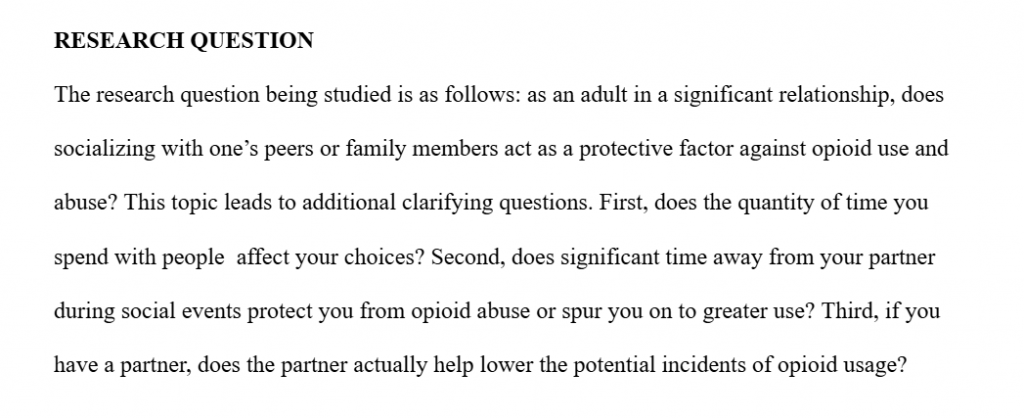
The research question being studied is as follows: as an adult in a significant relationship, does socializing with one’s peers or family members act as a protective factor against opioid use and abuse? This topic leads to additional clarifying questions. First, does the quantity of time you spend with people affect your choices? Second, does significant time away from your partner during social events protect you from opioid abuse or spur you on to greater use? Third, if you have a partner, does the partner actually help lower the potential incidents of opioid usage?
LITERATURE REVIEW
When conducting research on this topic, I found significant gaps in the research.
In regard to the first question I asked, Nina C. Christie researched the “Role of Social Isolation in Opioid Addiction.” Opioid use directly affects the brain, causing a sense of isolation or loneliness and increasing the risk of suicide. Opioid use also impairs one’s ability to participate in a social network. Christie also reports that there is a correlation between decreasing average social network size and the increasing number of drug overdoses. However, she cautions that there is also a national trend increase in feelings of social isolation in general. She advises that at the end of her meta-analysis of current literature, there needs to be more investigation on the topic (Christie 2021).
In regards to the second question, I could not find any research concerning the amount of time spent socializing without one’s partner. However, in “Opioid Use Among Individuals in Intimate Relationships” by Jarnecke and colleagues (2025), the quality of intimate relationships and the impact of that on opioid use were studied. Again, this study was limited by a lack of research, and there was a recommendation for replicating their findings with a larger, more diverse population. Ninety-three individuals who self-reported as being in an intimate relationship and opioid abusers were surveyed. The authors found that “Many participants reported low relationship quality and intimate partner violence in their relationship” (Jarnecke, 2025). In addition, participants stated that arguments with their partners affected their cravings for opioids, and a third reported using opioids with their partners.
In regards to the third question, I found only three sources that addressed the protective effect of married couples on opioid use. Others found in their study of 53 heterosexual adult married or cohabiting couples struggling with opioid use disorder that “positive partner relationships may play a role in lowering this risk” (Polenick, 2025) of returning to opioid use. However, they caution that if both partners struggle with opioid addiction, then even after treatment, there is a high risk of them continuing to abuse. This was a limited study; it suffered from both a sample size and a non-representative sample set of more traditional couples, fluent English speakers, who were from either Rhode Island or Massachusetts. In addition, it relied on self-reporting from surveys.
From the literature analysis, I would expect that people in a long-term, healthy intimate relationship would be predisposed to not rely on opioids, and that opioid use would decrease in correlation with increased time with one’s partner. On the other hand, if one partner is already an opioid abuser, or if there is abuse present in the home, then I would expect opioid usage to increase with increased exposure or time spent with one’s partner.
This leads one to ask, with so many gaps in research, why is this topic important? Specifically, we are trying to quantify and qualify the impact of marriage or a long-term relationship on opioid use. The CDC reports that over 70% of overdose deaths are from opioids and that the number of deaths in 2023 from opioid addiction (105,000) was ten times the number in 1999 (CDC, 2025). This is correctly categorized as an epidemic. The U.S. Census Bureau estimates that 47% of adults are married in the U.S., and that 53.2% of all households are coupled. This means that being in an intimate relationship may be the single greatest factor opioid users have in common- greater than race, ethnicity, socio-economic status, or language. Understanding how the presence, or the quality, of that intimate relationship impacts drug use is vital.
METHODS
Data
The data come from the Crime, Health, and Intimate Partner Problems Survey (CHIPPS), a
cross-sectional probability sample of St. Mary’s University undergraduate students (n = 250)
designed to analyze differences in partner violence and religion. Students were randomly chosen
via their student email. The survey was then disseminated via email so that participants could
complete it on their computer or mobile device. Respondents were offered a $10 gift card to
participate in the survey. Data was collected between Spring 2024 and Spring 2025.
Measures
Focal Variables
Time Spent Socializing. To gauge how respondents felt, an ordinal question asking
about socialization was used. This question asked, “How much time do you spend socializing with the following people/groups without your current (if not currently with someone, think back to your most recent) partner/spouse.” Respondents could
choose “All the Time” = 0, “Often” = 1, “Sometimes” = 3, Rarely = 4 to “Never” = 5.
Opioid Use. To explore initial attitudes towards the use of opioids, respondents were asked “the number of days/month opioids were used.” Answer options ranged from “Did use” = 0 to “Did not use” = 1
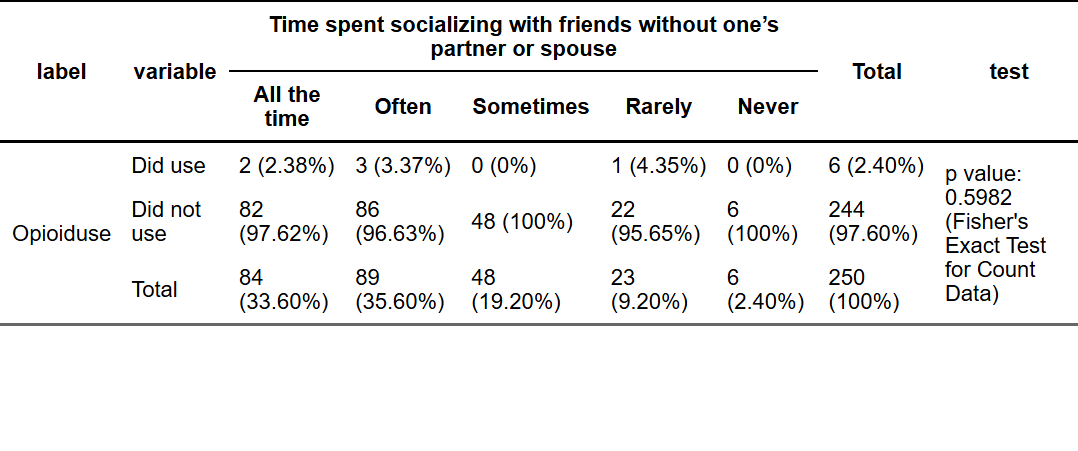
Table 1. Bivariate Analyses of Time Spent Socializing on Opioid Use
RESULTS
Table 1 displays a bivariate analysis of the sample’s socialization based on how often the respondents used opioids. The chi-square test (p ≤ .60) indicates that there is no significant relationship between Opioid use and the time spent away from one’s partner or spouse. Because of this, there is a failure to reject the null hypothesis.
CONCLUSION
The data found no correlation between socialization and opioid use. However, because respondents were self-reporting regarding intimate partner violence, data were limited. The sample group also only included a limited number of private-school university students and is not representative of the general population. A larger-scale study should be completed for this finding to be conclusive.
REFERENCES
U.S Census. (2025). Census Bureau releases new estimates on America’s families and Living Arrangements. Census.gov https://www.census.gov/newsroom/press-releases/2025/families-and-living-arrangements.html
CDC. (2025). Understanding the opioid overdose epidemic. Centers for Disease Control and Prevention. https://www.cdc.gov/overdose-prevention/about/understanding-the-opioid-overdose-epidemic.html
Christie N. C. (2021). The role of social isolation in opioid addiction. Social cognitive and affective neuroscience, 16(7), 645–656. https://doi.org/10.1093/scan/nsab029 https://pmc.ncbi.nlm.nih.gov/articles/PMC8259283/
Jarnecke, A. M., Schumm, J. A., Flanagan, J. C., Saraiya, T. C., & Back, S. E. (2025). Opioid Use Among Individuals in Intimate Relationships. Couple & family psychology, 10.1037/cfp0000290. Advance online publication. https://doi.org/10.1037/cfp0000290 https://pmc.ncbi.nlm.nih.gov/articles/PMC12574659/
Kreider, R. M. (2024). Same-sex couples made up 1.7% of all coupled households. Census.gov.https://www.census.gov/library/stories/2023/05/coupled-households-declined-in 2020.html
Polenick, C. A., Kaba, D., Zhou, A. N., Han, B. H., & Cotton, B. P. (2021). Dyadic associations between relationship quality and risk of opioid use among couples receiving methadone for opioid use disorder. Drug and Alcohol Dependence, 218, 108397. https://doi.org/10.1016/j.drugalcdep.2020.108397 https://www.sciencedirect.com/science/article/abs/pii/S0376871620305627


1 comment
Emilio Orona
Hey Evelyn, this article is so impactful because it tells us about the importance of isolation and its detrimental effects. I do agree that socializing with family and peers reduce stress. Furthermore, it would protect us from opioid use. What is interesting is that the literature review still strongly suggests a theoretical connection between isolation, relationship quality, and substance use, while the empirical results demonstrate the opposite. This gap highlights how complex opioid use is, especially since intimate relationships can either reduce risk or increase it. This connects to my article of Bosnia and Herzegovina, where post-conflict societies often experience long-term disruptions in social trust and community bonding especially since Bosnia and Herzegovina is divided into 3 ethnicities, so the culture may crash between them.