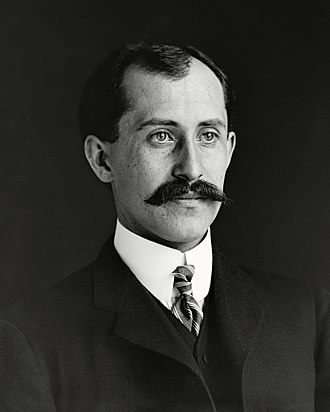

Orville Wright and his brother are widely acknowledged as the fundamental founders of engine powered airplanes. A lot of people remember the Wright Flyer going airborne, but there is more to the story. The Wright brother’s accomplishment is often overlooked by the process and journey they followed to achieving the engine powered airplane. To fully comprehend the magnitude of this achievement we need to look at the years of preparation, the obsession with engineering, and the life of Orville prior to his great achievement of taking flight. Orville was a man born in Dayton, Ohio who loved machines and had an affinity for them. He grew up in an era where experts and scientists were in a race to achieve flight. Driven by the captivating concept of flight and how the principles of science and engineering could be used to solve the problem of flying an airplane with an engine, Orville and his brother Wilbur also decided to pursue this goal. Orville’s fascination with flight began with a small toy helicopter he received from his father. This toy induced his curiosity for flight and how it can be mechanically controlled. This interest from his early childhood is what shaped Orville’s problem solving skills. To begin Orville’s process to working on the airplane, he initially started working at a bicycle shop with his brother Wilbur where they first tested the aerodynamics of gliders before taking them out to Kitty Hawk to fly. They first began their experiments by following existing aeronautical data, until they realized its deficits and deemed it unreliable, so they started from square one and collected new data. In the bicycle shop, Orville built a wind tunnel and assessed over two hundred wing shapes to find the ideal design for flight. As Orville would later on describe, it was their persistent disciplined search for flight controlled mechanics that separated them from the failed attempts of others.1
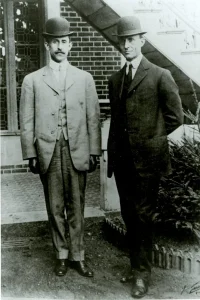
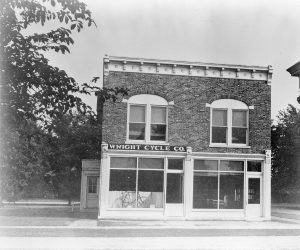
In the late 1890s to early 1900s, the future of aviation was being developed in a bicycle shop in Dayton, Ohio. Here, Orville Wright was with the tools and obsession for achieving the one goal of becoming the first person to fly an engine powered airplane. Even though most people acknowledge human’s flight to be a fool’s errand, this did not phase Orville as he was driven by the curiosity of mechanically controlled flight. The bicycle shop he worked at was more than a place of earnings; it was his personal space for practical thinking where he used his mechanical intuition for building and repairing bicycles to figure out how to conquer one of humanity’s greatest obstacle. Unlike other programs who had subsidies from the government or other organizations, the Wright brothers funded their research through profits made from their bicycle business. Although this can be seen as a financial limitation, it freed them from the expectations and pressure from sponsors. Without this pressure, it gave Orville more freedom to carefully comprehend the scientific puzzle of flight control. While others mostly focused merely on generating lift with power, Orville understood that it was pointless if you still couldn’t fully control the plane. This belief was rooted in him from earlier years through a toy helicopter he was gifted from his father Bishop Milton Wright. The principles governing toy helicopter’s flight is what they used to guide their studies of controlled flight. This confirmation is what inspired Orville to commit himself to proving the world wrong, making him relentless through his failed attempts and starting over if he needed to. With no funding or academic credentials, and with just a bicycle shop, he held an unshakable belief that one day man could fly.2
The journey towards the first flight was defined by a bunch of setbacks and intellectual frustrations. In the late 1890s, Orville and Wilbur began testing their gliders at Kitty Hawk, North Carolina, but their early designs had some flaws and kept failing. For their experimental ground they chose a sandy coastline, because of its steady winds and soft dunes which was ideal for gliding. However, these advantages did not compensate for their airplane’s fundamental flaws. The wings they created did not provide enough lift for stability, which led the airplane to tilt and roll out of control. After numerous attempts they reached a pivot when Orville concluded the source of their failures were the previous aeronautical data they were following. In devastation rather than accepting defeat they ditched all old data and began creating new ones. At the bicycle shop in Dayton, Orville constructed a small wind tunnel and used it statistically to test over two hundred different wing shapes to deduce what design performed as expected. It was a tedious process, but it was the dedication and discipline they had that separated them from their rivals. After successfully finding a wing that worked, accordingly, a new problem arose. They had no manufacturer to produce an engine both light and powerful enough for their aircraft. With no choice, the brothers had to design their own engine and build it entirely from scratch. Unfortunately, the most devasting event yet to come as days before their final attempt at Kitty Hawk, a ground test went horribly wrong and damaged their aircraft, forcing Orville to make urgent repairs in the freezing conditions while working with a limited budget. In the face of what seemed to be absolute despair, they still pushed forward. With their resources almost exhausted and the wind blowing across the sand dunes, it all came down to one questions of whether the aircraft would actually stay airborne.3
The defining moment to answer the question of humans control over flight arriver on the cold morning of December 17, 1903 at Kitty Hawk, North Carolina. This day was induced by the difficulty faced, weather delays, and mechanical repairs. After years of hard work, numerous crashes and doubt from the community, Orville’s belief that controlled flight can be achieved was about to be made a reality. Everything they sacrificed, the money and time weighed on the imminent event. It wasn’t exactly a spectacular scene, as there were no crowds gathered, no reporters or cameras to document and capture what was about to unravel. Merely a small group of local men from a nearby lifesaving station came to watch as Orville entered the plane and Wilbur took his position at the wingtip. To decided who would fly on the first attempt, the brothers flipped a coin, making it Orville’s turn to fly. With nothing left to calculate or adjust, and the cold wind approaching, they started the engine for flight. At 10:35am the machine was lifted off the ground and for twelve seconds Orville Wright was in the air and covered a distance of about one hundred and twenty feet. It was a short journey in comparison to the time achieved by modern aircraft, but the duration and distance and at that time was besides the point. The key point was that for the first time in human history, we were able to take flight in an engine powered aircraft while being able to maneuver and return it back to the ground. With this accomplishment, every doubt, failed test, and sleepless night working in the freezing cold proved to be worth it as Orville finally prevailed. He brought to pass that man could in fact fly.
Following the immense triumph, the Wright brother did not stop with one completed flight. They had three additional flights that same morning, with each attempt the aircraft went further than the last. The longest of the four trials lasted about a minute and covered a distance of eight hundred and fifty two feet which was astounding. Each subsequent flight was confirmation that their achievement was not a fluke, but a result of their years of hard work. Later that afternoon a huge disappointment arose bringing their celebration to an end. A strong gust of wind knocked their aircraft over from the sand it was resting on. It rolled aggressively across the beach damaging the machine beyond repair and unfortunately the aircraft that had made Orville fly to make history would never fly again. Although the Wright brothers felt no despair as they were overjoyed by the satisfaction of completing the mission they set out to do. Orville and Wilbur walked to a nearby weather station and sent a short telegram to their father, Bishop Milton Wright , informing him that they had successfully flown an engine powered airplane. As time passed after the astounding event, Orville watched as the airplane reshaped, business trades, warfare and human connection.4 After Wilbur died from typhoid fever in 1912 Orville mourned the loss quietly and moved on, remaining a respected figure in aviation and science until his death in 1948. His life in grand perspective stands as proof that persistency, discipline, and the willingness to try in the face of mockery can induce greatness and establish historical moments.
- Orville Wright, “How We Made the First Flight,” Journal of the Franklin Institute 217, no. 2 (1934): 239. ↵
- Orville Wright, “How We Made the First Flight,” Journal of the Franklin Institute 217, no. 2 (1934): 239. ↵
- Daniel C. Schlenoff, “The Equivocal Success of the Wright Brothers,” Scientific American 289, no. 6 (2003): 95. ↵
- Tom D. Crouch, The Bishop’s Boys: A Life of Wilbur and Orville Wright (New York: W.W. Norton & Company, 1989), 245. ↵