


Policy Brief: U.S. National Security Strategy in the Middle East and Eastern Europe
Target Audience
National Security Council (NSC) Staff and U.S. Defense Policy Planners
Executive Summary
As this policy brief analyzes, the U.S. national security challenge towards the Middle East and the Eastern Europe is undergoing some transformations, especially in the context of the changing geopolitical frustrations, reliance on energy, and incessant turmoil. The major research question of this analysis is the following: What should the United States reconsider about its national security posture to enable the country to hedge its devotion to the Middle East and also cope with the increasing levels of great power competition in Eastern Europe?
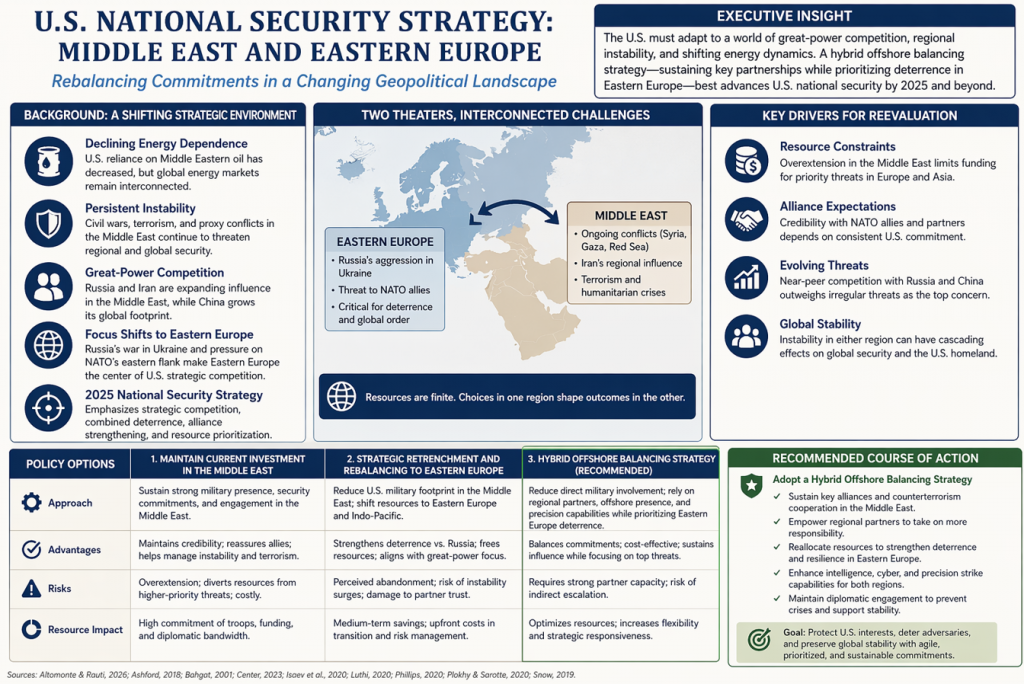
The U.S. national security issues in the Middle East and Eastern Europe have been changing by the increasing great-power competition, changing energy dynamics, and ongoing instability in the region. This brief reevaluates U.S. regional commitments, in accordance with the 2025 U.S. National Security Strategy, which emphasizes strategic competition with the major powers, but remains open to flexibility in global interaction. The recent events, such as the ongoing war in Ukraine, the strengthening of Russian-Iranian collaboration, and the re-escalation of instability in Gaza and the Red Sea area, demonstrate that the present strategic environment is more interdependent and unstable than assessments in the past indicated it to be.
Traditionally, the U.S. involvement in the Middle East has been the result of energy security, counterterrorism, and commitments to allies. Nevertheless, the strategic environment is shifting as the reliance on oil in the Middle East becomes less important, Russia is returning to the global stage as a geopolitical player, and the conflict-affected areas in the region are becoming more unstable, like in Syria. Meanwhile, the Eastern region and Ukraine, in particular, has become a centre of the great-power confrontation. This is a short brief that describes three policy alternatives: (1) maintaining strong investment in the Middle East, (2) strategic retrenchment and rebalancing to Eastern Europe and, (3) a hybrid offshore balancing strategy. Both courses of action have unique risks and trade-offs that involve issues of credibility, instability, and limited resources in the region. The suggested action plan is a hybrid offshore balancing policy, which minimizes direct military engagements in the Middle East without foregoing important alliances or redistributing the strategic resources to the deterrence of enemies in the Eastern Europe.
Background and Context
Stability in the Middle East has long been of primary U.S. national security policy concern because of its strategic importance in global energy markets and counterterrorism. Snow (2019) defines national security strategy as one where national interest are safeguarded using a mix of military, economic, and diplomatic instruments. All three were historically needed in the Middle East. The U.S. has been very engaged in energy security. Bahgat (2001) emphasizes the fact that the United States and Saudi Arabia are two countries which are closely interdependent because oil has determined the environment of diplomatic and military cooperation. U.S. dependence on Middle Eastern oil has decreased in the recent years, but global markets are still interconnected and, therefore, any disturbances in the markets impact U.S. interests.
Meanwhile, the area remains unstable due to civil wars, terrorism, and the competition of great powers. Phillips (2020) highlights the way in which the Syrian conflict has developed into a venue of international rivalry where the interests of Russia, Iran, and the United States have been involved. This is in line with Luthi (2020) wider argument that the Cold War type of competition has resurfaced in various regions such as in Middle East. There is also terrorism that is the perpetual threat. According to Isaev et al. (2020), Islamic terrorism still poses security concerns to the world, and counterterrorism efforts should be maintained even after the groups such as ISIS have been defeated in its territorial ambitions.
In the meantime, the strategic focus of the U.S. is slowly shifting towards Eastern Europe. According to Plokhy and Sarotte (2020), Ukraine is a flashpoint that American strategic assumptions have bumped into the revived great-power politics especially when it comes to Russia. This difficulty has only got worse over the recent years and it has necessitated a reevaluation of the commitments made by the U.S. Ashford (2018) criticizes the American overinvestment in the Middle East over time and says it deprives the country of more urgent strategic priorities. On the same note, the policy report of the Washington based (Center, 2023) highlights the increasing role of Russia in the Middle East and its implication on the security of the U.S. and Israel. Collectively, these forces imply that the US needs to re-examine the manner in which it distributes its strategic resources in regions without jeopardizing world stability.
The 2025 National Security Strategy focuses on combined deterrence, strengthening of alliances, and priorities in resources to great-power competition, especially with Russia and China. This is a departure of the previous strategies in which emphasis was laid more on counterterrorism and Middle Eastern stability. In 2026, the Middle East is becoming increasingly unstable due to persistent conflict and proxy war between Iran, Russia and non-state actors. Simultaneously, the further war in Ukraine and the military pressure of the eastern front of NATO by Russia make Eastern Europe the epicenter of strategic conflicts (Altomonte & Rauti, 2026). The developments lead to the conclusion that there is a need to adopt more adaptive approaches that capture more interdependent security dynamics between the two regions as opposed to viewing them as distinct policy arenas.
Policy Options
Option 1: Maintain Robust Engagement in the Middle East
This strategy includes maintaining existing degrees of military presence, alliances obligations, and counterterrorism missions in the Middle East. Rationale: A strong presence guarantees stability in a volatile area, it reassures friends like Saudi Arabia and Israel and it does not allow enemies like Russia and Iran to increase their influence. According to Snow (2019), the key elements of national security strategy are credibility and deterrence. Benefits: Maintains U.S. presence in a key strategic area, Aids in continuing counterterrorism efforts and strengthens alliances and discourages enemies. Drawbacks: Expensive in financial and military terms, distracts attention to new threats in Eastern Europe, and Exposes it to getting involved in long-term regional wars.
This policy entails maintaining a high degree of military presence and involvement in Middle East. Although this strategy guarantees stability and confidence among allies, it is becoming less and less consistent with the 2025 NSS priority to redistribute the resources to great power competition. Also, recent events hint at the fact that even substantial U.S. presence has not deterred instability or restricted adversarial influence (Policy, 2026). This brings the issue of long-term viability and strategic effectiveness of this option into question.
Option 2: Strategic Retrenchment and Rebalancing to Eastern Europe
The choice is to substantially cut U.S. investments in the Middle East and redirect their attention to deter Russia in Eastern Europe. The reasoning is that Ashford (2018) considers that American interests in the Middle East tend to be exaggerated, whereas the Russian threat is a more immediate threat to the stability of the world. In this respect, Plokhy and Sarotte (2020) emphasize the strategic value of Ukraine. Benefits: Liberates resources to challenge great powers, Deterrents against Russia, and Seems to be in line with evolving global priorities. Cons: Risk to destabilize the Middle East, Risk to weaken relations with main allies and Provides opportunities to adversaries to gain influence.
The strategic retrenchment and rebalancing strategy to Eastern Europe is the strategy of putting downward pressure on U.S. commitments in the Middle East and relocation of military, economic and diplomatic resources to Eastern Europe. This alternative is better since it directly corresponds to the 2025 National Security Strategy of deterring Russia, increases the effectiveness of NATO by reinforcing the frontline states, and the overall resource efficiency, as the efforts are focused on the most urgent and critical threat (Altomonte and Rauti, 2026). Consequently, this would enhance military preparedness and deterrence in Eastern Europe, offer more assistance to Ukraine and NATO allies, and send strong signals to the adversaries of U.S. strategic priorities and dedication to great-power conflict. Nevertheless, due to constant instability in the Middle East, the complete withdrawal may lead to power voids, which can be used by the enemies like Iran and Russia, and this alternative is therefore a risky decision to be applied in isolation.
Option 3: Hybrid Offshore Balancing Strategy
This strategy involves less active engagement in the Middle East direct military intervention with diplomatic and strategic intervention and a shift in its investments to Eastern Europe. It is justified by the fact that Offshore balancing enables the United States to have a leverage without being overcommitted. It focuses on partnering with regional partners instead of taking the center stage. This is according to the advice of Ashford (2018) of a more moderate foreign policy. The pros are; Equalizes resources distribution regionally, Strategic flexibility, and Minimizes chances of military overstretching. Conversely, Disadvantages include; depend heavily on the capacity of regional partners, may decrease immediate crisis responsiveness, and has a potential of being viewed as decreased devotion among allies.
This plan minimizes the direct U.S. military presence in the Middle East but keeps leverage via regional partners, diplomacy, and minimal force projection and at the same time reinvests resources in deterrence in Eastern Europe. It is more desirable since it strikes a middle ground between competing priorities without resulting in overextension, and is more consistent with the principles of integrated deterrence as discussed in the 2025 National Security Strategy (Shakibi Nejad, 2026). Consequently, this strategy keeps the U.S. influence in the Middle East cheaply, avoids strategic overcommitment, allows it to sustain a focus on great-power competition in Europe, and have greater overall flexibility in responding to crises in other regions. In contrast to the previous formulation, the new formulation acknowledges that full disengagement in 2026 is impractical and that counterterrorism activities and presence at sea need to be maintained.
Risks and Trade-offs
All the policy options are associated with serious risks and trade-offs that should be taken into account. The continued vigorous involvement in the Middle East could lead to the loop of intervention and overextension. The involvement of external actors, as seen in the case of Syria by Phillips (2020), may extend wars and make them difficult to end. Although strategic retrenchment is attractive in terms of resource allocation, it has the hazard of creating power vacuities. Issaev et al. (2020) caution that the unstable situation in the Middle East may create an environment where terrorism thrives, and eventually endanger the security of the global community.
Some of these risks are alleviated through the hybrid offshore balancing approach, but more challenges are presented. A decrease in visibility can undermine deterrence and embolden its enemies like Russia who have already increased its intervention in the Middle East (Center, 2023). Also, the consideration of energy is still pertinent. Even though the U.S. reliance on oil in the Middle East is on the low side, a disruptive event at the world market can affect the economic stability (Bahgat, 2001). Any change in policy should therefore consider the interrelatedness of energy markets. Lastly, there is the inquiry of credibility. According to Snow (2019), unstable or sudden policy shifts may erode U.S. credibility, reducing allies to be more reluctant to collaborate and adversaries to challenge U.S. firmness.
Final Recommendation
According to the above analysis, the suggestion of this brief is the application of a hybrid strategy of offshore balancing. This is the best option that provides the best balance among competing strategic priorities. It enables the United States to have some control in the Middle East at reduced costs and risks of having direct military involvement. Simultaneously, it allows redirecting the resources toward overcoming the more pressing problem of great-power competition in Eastern Europe.
Key elements of this recommendation include:
Downsizing the Military Presence in the Middle East: Over time reduce the number of troops in the area, but retain important bases and response forces.
Empowering Regional Partners: Empower allies by selling weapons, sharing intelligence and conducting joint training so that they can become more responsible of securing the region.
Stiffening the spine of Eastern Europe: Strengthening military and economic aid to NATO allies and partners like Ukraine in order to resist Russia aggression.
Perseverance in Counterterrorism Operations: Maintain specific actions against the terror threats in intelligence-based procedures instead of broad-based operations.
Upkeeping Diplomatic Engagement: Proactively participate in conflict resolution and multilateral diplomacy in order to stabilize the major regions.
This plan is an expression of a practical understanding of the changing world trends. The international system is being drawn in a new era of great-power competition, and this demands adaptable and versatile approaches, as Luethi (2020) suggests. The United States can enhance the national security strategy by implementing a hybrid offshore balancing strategy so that its national security is in line with modern challenges; it would remain stable in the region and responsive globally.
Conclusion
To sum up, the United States has a challenging and dynamic national security environment, which is needing a delicate rebalancing of the strategic priorities. Although the Middle East is still relevant because of instability, terrorism threats, and energy concerns, the emergence of the great-power rivalry, especially in Eastern Europe, requires more resources and attention. A hybrid offshore balancing approach provides the right direction to go, as it is cheaper in maintaining costly military commitments and maintains influence bases using regional alliances and diplomacy. This will allow the United States to stay engaged without overextension, and it will provide it with the flexibility to react to the emerging threats. Simultaneously, the deterrence in Eastern Europe should be reinforced to take care of more urgent geopolitical problems. Conclusively, a moderate and responsive approach will enable the United States to protect its national interest, credibility internationally, and to respond efficiently to the changing dynamics in both areas without undermining long-term security goals.
References
Altomonte, C., & Rauti, A. W. (2026). The 2025 Us National Security Strategy and The Strategic Repositioning of Europe. Bocconi.
Ashford, E. (2018). Unbalanced: rethinking America’s commitment to the Middle East. Strategic Studies Quarterly, 12(1), 127-148.
Bahgat, G. (2001). Managing dependence: American-Saudi oil relations. Arab Studies Quarterly, 1-14.
Center, W. (2023). Report, Russia in the Middle East: National Security Challenges for the United States and Israel in the Biden Era.
Issaev, L. M., Aisin, M. B., Medvedev, I. A., & Korotayev, A. V. (2020). Islamic terrorism in the Middle East and its impact on global security. RUDN Journal of Political Science, 22(4), 713-730.
Lüthi, L. M. (2020). Cold Wars: Asia, the Middle East, Europe. Cambridge University Press.
Phillips, C. (2020). The battle for Syria: International rivalry in the new Middle East. Yale University Press.
Plokhy, S., & Sarotte, M. E. (2020). The shoals of Ukraine: Where American illusions and great-power politics collide. Foreign Aff., 99, 81.
Policy, U. F. (2026). Explaining the Failures of US Policy in the Middle East. ProQuest.
Shakibi Nejad, M. (2026). Evolution of Hegemonic Processes and Power Competition in the Middle East: US Hegemony, China’s Rise, and Energy Corridors. China’s Rise, and Energy Corridors.
Snow, D. M. (2019). National security (7th ed.). Routledge.