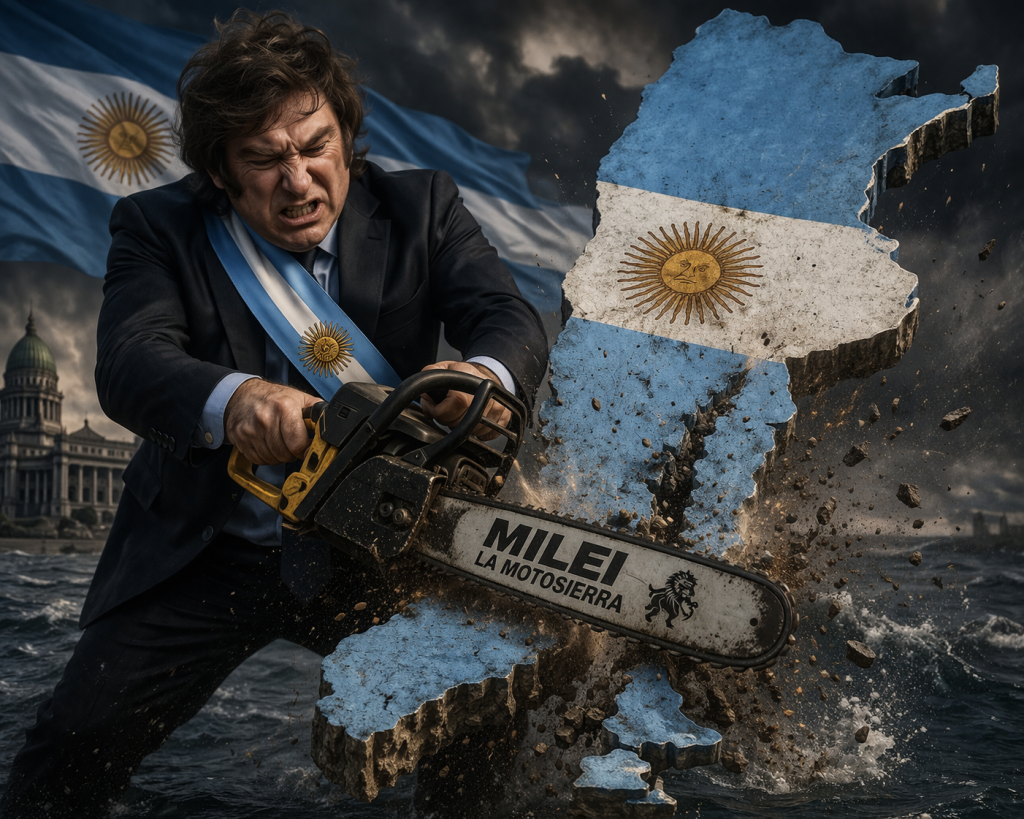

Argentina possesses one of the biggest economies in Latin America, at the same time, Argentina accounts for one third of the debt of the International Monetary Fund (IMF).1 This is NO mistake, Argentina experienced a cycle of hyperinflation while recovering financially from government overspending over the previous decades. One of the many solutions attempted came with dollarization. Argentina has tried to reset its economy 4 times over the past 50 years by changing its currency, and yet inflation still persists. Other attempts to fix their economy included many bailouts from the IMF and yet no improvements. Enter President Javier Milei who imposed his new approach, ‘Chainsaw Economics.’ He argues it will effectively avoid further economic disaster.2 This article assesses whether Chainsaw Economics can help Argentina in the long term, or is it just a temporary band aid, or worse, is Argentina undercutting its ability to progress for the future?
President Javier Milei took his office in Argentina in 2023, with a strong vision for what he wanted for his country. He self identifies as right-wing libertarian, and joined the coalition La Libertad Avanza. President Milei implemented an extreme austerity plan hoping to help his country and secure another bailout with the United States for $40 Billion USD. Austerity measures strict economic policies used to control debt by making spending cutes and tax hikes. This bailout plan was a political move to secure the legislative election which was a currency swap line of $20 billion and a private loan of $20 billion. This bailout, however, is not enough to get Argentina out of the economic mess that it is currently in. Argentina has had many issues over the years when it comes to overspending the government budget, so Milei has a different approach to fixing the economy. “Chainsaw economics” is what Milei has turned to, which includes drastic reductions in public spending, cuts to energy and transportation subsidies, public sector layoffs, and pension freezes just to name a few of what it means.3 Milei’s political campaign focused on the people and his solution was to fix hyperinflation and the debt that Argentina currently has. This has caused him to do whatever it takes to lessen government involvement and put all his efforts into fixing their economy. President Milei got rid of most government funded programs such as transportation, energy, and welfare programs whose negative impact we explore further below. Milei has even has limited power of the Department of Treasury by limiting the amount of money that they are printing.4 Although these measures may produce short-term fiscal stabilization and reduce inflationary pressures, the rapid contraction of public spending risks generating long-term social fragmentation, inequality, and political instability that could ultimately undermine Argentina’s broader economic recovery.
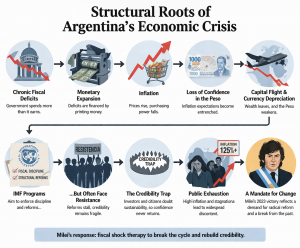
Structural Roots of Argentina’s Economic Crisis
To understand why Milei is taking this approach to reforming the government and economy, it is essential to examine the economic vulnerabilities of the system. Chronic fiscal deficits have been financed through monetary expansion which only fuels the inflation. As inflation expectations become entrenched, citizens lose the confidence in their currency (the Argentine Peso), which accelerates capital flight and currency depreciation. According to the Council on Foreign Relations, repeated cycles of deficit spending, default, and external borrowing have prevented Argentina from establishing durable macroeconomic credibility. Argentina’s relationship with the IMF further illustrates this credibility problem. While IMF programs are meant to enforce fiscal discipline and structural reform, there is often resistance. Argentina is experiencing a “credibility trap” in which investors and citizens alike doubt the sustainability of economic reforms.5 Without credibility, even policies meant to be fiscally sound struggle to anchor inflation expectations or restore confidence. With this context, Milei’s electoral victory came as a response to public exhaustion of corruption with a renewed need for government reform. Voters faced triple-digit inflation and stagnant growth were willing to support a candidate promising radical change. 6 Milei wanted to fix the structural issues of Argentina which is why he resorted to an intensified version of fiscal shock therapy.
Milei’s economic philosophy comes from libertarian and neoliberal traditions, emphasizing minimal state intervention, deregulation of commodities, and fiscal discipline. Supporters argue that making big reductions in government spending can restore Argentina’s Fiscal health and signal seriousness to global markets.11 Not only was the “chainsaw” metaphor used for Milei’s campaign but also has underscored the administration intention to cut deeply and quickly rather than have a slow and gradual reform. In a video posted by La Nacion, Milei is actively explaining what he plans to do with the cuts of the different departments, which are referred as minesterios. 12. Later through social media a video would be shown of Milei physically ripping off of a board what ministerios he plans to cut while he would yell “Afuera”, which means goodbye in english, after ripping off all the ministerios he plans of getting rid of he said his catchphrase “Viva La Libertad Carajo!”, which means Long live liberty damn it. 13 This showcases how Milei is trying to find ways to tie his actions for the betterment of the people. Early reports have suggested that the government has achieved measurable fiscal tightening, such as reductions in primary deficits and moderation of inflation rates.14 These developments have given some credibility to the argument that aggressive austerity measures can stabilize macroeconomic indicators in a short period of time. By reducing deficit financing and containing monetary expansion, inflationary pressures may decline temporarily. However, fiscal consolidation in a fragile economy like Argentina can come with many contractionary risks. When public spending falls rapidly, aggregate demand declines. Argentina is already facing economic strain, so such a contraction can lead too rapid rates of unemployment, declining wages, and reduced customer spending. These signs are already starting to emerge, even though supporters frame these effects as necessary, the social consequences may outweigh the gains.
Social Costs and Rising Inequality
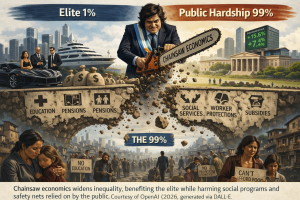
The biggest risks of Milei’s austerity program are social rather than economic. Reductions in subsidies for energy and transportation increase living costs for households, particularly those who make lower income.15 One of the biggest effects of this austerity program has been the public sector layoffs as it has eliminated stable sources of income for thousands of families and pension freezes erode in purchasing power for retirees who already struggle with inflation. Reports indicate that many Argentinians are experiencing heightened economic hardship under the new policies, with some communities facing increased poverty and food insecurity.16
An example of someone experiencing the struggle with these changes is Francisco Jimenez, who works long hours as a food delivery driver. He works 7 days a week, 8 hours a day and even that is not enough to meet the needs of getting food or affording the rent for his family. Jimenez talked about how he voted for Milei since he wanted a change and was sick and tired of the other party being in power for so long, he argues that Milei just needs more time. Jimenez is one of the many who suffer since while there has been some change, that change has not reached to the majority of people who need the help for their basic needs. Although fiscal balances improve on paper, the lived experience of austerity can be deeply destabilizing. While Argentina already experiences social safety nets are weakened, the economic shocks disproportionately harm vulnerable populations. Not only this immediate hardship but also long-term reductions in spending on education, healthcare, and welfare programs may undermine human capital development. This austerity takes away access to essential services and can have lasting consequences for economic mobility and productivity. Structural inequality, once intensified, becomes difficult to reverse. Shock therapy without adequate social protection mechanisms risk deepening rather than resolving economic fragility.17 If poverty rates increase and inequality widens, the resulting social fragmentation may create political resistance that undermines the sustainability of reforms.
Political instability and Reform Durability
Economic reform cannot succeed without political legitimacy. Democratic governments rely on public consent, so server austerity often provokes protests, labor strikes, and political polarization. Argentina has a long history of mass mobilization during periods of economic distress which suggests that sustained social hardship could generate significant backlash. Credibility depends not only on fiscal discipline but also on institutional trust.18 If citizens perceive reforms as punitive or ideologically driven, trust in institutions may erode further. In such environment, future governments may face pressure to reverse reforms. Perpetuating Argentina’s cycle of instability. While initial fiscal improvements may reassure international markets, domestic political resistance remains a critical constraint.19 Reforms that do not have social support are very fragile. If unemployment rises or living standards decline even more, electoral turnover or legislative obstruction could derail the austerity program.
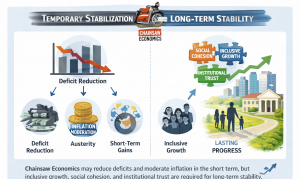
Temporary Stabilization vs. Long-Term Stability
The main question remains whether “chainsaw economics” can represent necessary discipline or dangerous overreach. In short term, reducing fiscal deficit and tightening monetary conditions may indeed moderate inflation and restore partial credibility. Argentina is associated with fiscal mismanagement; this economic temporary stabilization could represent progress. Economic sustainability, however, requires more than just a deficit reduction. Long-term stability depends on inclusive growth, social cohesion, and institutional legitimacy. If austerity deepens inequality and loses public trust, it may undermine the conditions required to have a lasting reform. While neoliberal frameworks prioritize fiscal balance, they often underestimate social resilience limits.20 Economic models may predict stabilization under strict austerity, but societies are not just economic systems, they are political communities that shaped by expectations of fairness and protection. In Argentina’s case, short-term macroeconomic gains achieved through aggressive spending contraction may come at the cost of long-term social fragmentation. Rising inequality, weakened safety nets, and political polarization threaten to reverse initial progress. If public backlash forces policy reversal, Argentina may once again enter the cycle of instability that has defined its recent history.
Conclusion
Argentina’s economic crisis emerged from decades of fiscal imbalance, inflation, and credit credibility failures. President Javier Milei’s “Chainsaw economics” represents one of the most radical attempts to fix the corruption through aggressive austerity and state contraction. Early signs of fiscal tightening and moderate inflation suggest that short term stabilization might be working. However, macroeconomic indicators do not fully measure the impacts of economic reform. The social and political consequences of rapid fiscal contraction can bring long-term risks. Increased poverty, worsening inequality, and growing institutional distrust undermine reform durability and destabilize Argentina’s democratic framework. “Chainsaw economics” provide a temporary fix that addresses the fiscal symptoms, but it also deepens structural vulnerabilities. Whether Milei’s approach ultimately proves visionary or misguided does not depend on how high the inflation rate rises or whether he balances the budget, but on the ability of Argentina to preserve social cohesion and political legitimacy during these adjustments. Without this balance, short-term economic stabilization may come at the expense of long-term political stability.
- Council on Foreign Relations, (2025), Argentina’s struggle for stability. ↵
- Firstpost, (2025), How Javier Milei’s shock therapy failed Argentina. ↵
- The Guardian, (2025), Argentinians struggling under Milei’s chainsaw austerity. ↵
- Michigan Journal of Economics, (2025), Inflation and Economic Health: A Case Study of Javier Milei’s Plan for Economic Recovery. ↵
- Peterson Institute for International Economics, (2025), Argentina’s credibility trap. ↵
- The Guardian, (2025), Argentinians struggling under Milei’s chainsaw austerity. ↵
- Journal of Democracy, (2024), Who Is the Real Javier Milei? ↵
- Journal of Democracy, (2024), Who Is the Real Javier Milei? ↵
- Michigan Journal of Economics, (2025), Inflation and Economic Health: A Case Study of Javier Milei’s Plan for Economic Recovery. ↵
- Michigan Journal of Economics, (2025), Inflation and Economic Health: A Case Study of Javier Milei’s Plan for Economic Recovery. ↵
- Columbia Economic Review, (n.d.), Javier Milei’s “chainsaw revolution” is just neoliberalism in a new costume. ↵
- La Nación. (2023, August 16). La propuesta de Javier Milei con los ministerios (Video), YouTube https://www.youtube.com/watch?v=AlPtFzh5wjk&t=596s ↵
- Javier Milei. (2023). Javier Milei y su propuesta con los ministerios (Video), YouTube. https://www.youtube.com/watch?v=c8MtgMGJ8KA. ↵
- Chatham House, (2025), Milei’s Argentina shows where South America might be heading. ↵
- The Guardian, (2025), Argentinians struggling under Milei’s chainsaw austerity. ↵
- The Guardian, (2025), Argentinians struggling under Milei’s chainsaw austerity. ↵
- Firstpost, (2025), How Javier Milei’s shock therapy failed Argentina. ↵
- Peterson Institute for International Economics, (2025), Argentina’s credibility trap. ↵
- Chatham House, (2025), Milei’s Argentina shows where South America might be heading. ↵
- Columbia Economic Review, (n.d.), Javier Milei’s “chainsaw revolution” is just neoliberalism in a new costume. ↵