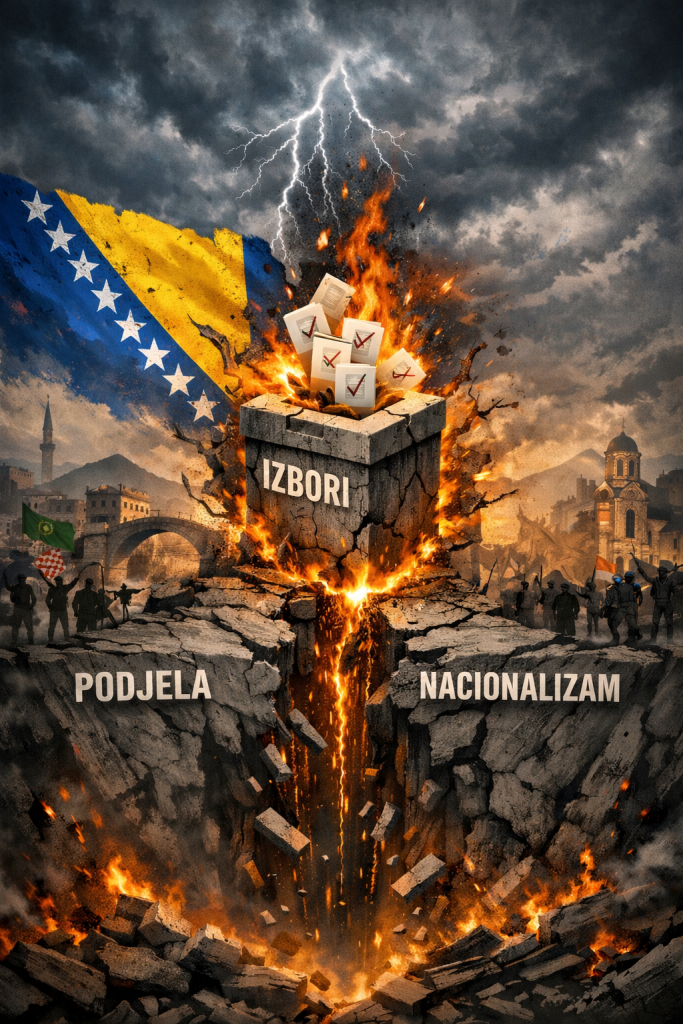

Bosnia and Herzegovina rejects failure but tells a story of an unfinished transition. It appears as a modest nation in the international system nestled between Croatia, Serbia, and Montenegro. However, their socio-economic and political tensions reached a grand scale during the siege of Sarajevo (1992-1996). Bosnia Herzegovina (Bosnia) has occupied center stage in the many ethnic nationalism debates since. Decades after the Yugoslavia disintegration (1992) until the end of the war between Bosnia and Serbia culminated with the Dayton Accords that froze the nation of Bosnia and Herzegovina into an unending transitional state with a fragile balance between its three main ethnic groups. These groups are bosniaks mainly Muslim, Serbs mostly from the Eastern Orthodox Christian, and Croats which are mainly Roman Catholic. Once the vibrant center of the former Yugoslavia, Bosnia has become an “between” space. It remains between war and peace, seeking unity but anchored in ethnic fragmentation, having reached sovereignty at the price of required international oversight, and has still not managed to reach the threshold required for earning European Union membership, instead stuck in the spot of eternal EU candidacy. Their political experiences enshrined in its political institutions shape their GNI per capita, investment in human assets, and economic and environmental vulnerability, and led the United Nations to classify Bosnia as a nation in transition.
The historical context related to their state of fragility. For centuries, the region has remained geographically constant, but its political and cultural influences have shifted as control passed between empires such as the Ottoman and Austro-Hungarian. In more recent history the region sat in the Yugoslavia Empire. All these cultures and successive legacies determined the structural context within which the country developed.1 This prolonged history of under different cultural imposition which are very different primarily represented by Bosniaks (Muslims), Serbs (Orthodox Christians), and Croats (Catholics). These racial constructs have been developed and evolved towards a political institutionalization.
In the early 1990s, the collapse of the former Yugoslavia led to the fragmentation of central authority and the outbreak of violent conflicts across the region. Influenced by the declarations of independence from Slovenia and Croatia in 1991, Bosnia and Herzegovina declared independence in 1992. However, this declaration did not result in a conventional civil war; rather, it quickly evolved into a systematic campaign of ethnic cleansing carried out by Bosnian Serb forces, supported by Serbia. Between 1992 and 1995, civilians were deliberately targeted through mass killings, forced displacement, detention camps, and the prolonged siege of Sarajevo. As David Rieff argues, even extensive international media coverage of the conflict failed to prevent widespread atrocities, revealing the limits of humanitarian awareness without decisive political or military intervention.2
The massacre in July 1995 of over 8,000 Bosniak men and boys were highlighted the failure of international intervention in Srebrenica where civilians came to the designated United Nations area. The inability of the United Nations to protect civilians exposed the limitations of its passive peacekeeping approach. Although the conflict received significant media attention, this visibility did not prevent ethnic cleansing or mass violence. Ultimately, the scale of atrocities and the failure of limited humanitarian and diplomatic efforts pressured the United States and NATO to take decisive action through military intervention and diplomatic engagement.2 These efforts culminated in the Dayton Accords, which formally ended the conflict but left Bosnia and Herzegovina politically divided.
The conflict preceding the Dayton Accords was not only a civil war, but also a structured campaign of ethnic purification aimed at altering the demographic and cultural landscape of Bosnia and Herzegovina 4 The conflict that came before the Dayton Accords rather than a civil war, became a structured campaign of ethnic purification modified to alter the demographic and cultural landscape of Bosnia and Herzegovina by Bosnian Serbs supported by Serbs from Serbia. Bosnian Serb Units of the armed forces implemented coordinated strategies to acquire land mass that involved genocide, expulsion, and torture of civilians. Maximum damage became the goals and main mission rather than byproducts of a civil conflict. These intentional efforts to erase the historical significance of targeted groups intended to deny the shared Bosnian identity. In order to stop incentivizing destruction and ethnic killings, international actors like the U.S. pressured Bosnia, Croatia, and Serbia to compromise by cementing the importance of these ethnic divisions. The institutionalization of ethnic construction, not merely random flaw, but by design became the most direct consequence of the war. The new Constitution determined by the Dayton Accords sought to halt this cleansing by promising group representation.5 However, by attaching these guarantees, the agreement metamorphoses wartime divisions into permanent political gridlock, effectively freezing the outcomes of the violence into the state’s institutional fabric. These campaigns core elements were the dismantling of religious sites: mosques, libraries, and historical institutions. As a result, the Dayton Constitution transformed wartime divisions into long-term political structures, creating persistent governance challenges and effectively freezing the outcomes of the conflict into the state’s institutional framework.
This implementation of policy planted the seed for long term instability. Scholars’ analysis suggest that the war was not only about territorial control but also about the destruction of identity itself. Cultural heritage—including mosques, bridges, libraries, and archives—was systematically targeted as a means of eliminating the physical evidence of multiethnic coexistence. This “cultural cleansing” functioned alongside ethnic cleansing, reinforcing the creation of mono-ethnic territories and reshaping collective memory in ways that continue to influence political behavior today.6
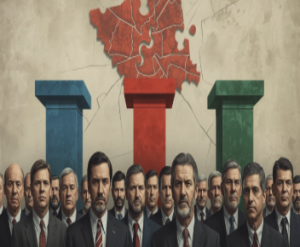
Under the Dayton Accords the territory was divided into two separate main entities: Federation of Bosnia and Herzegovina and Republic of Srpska along with the Brcko District. In the federal level the country is represented by one member of the Bosniaks, one member of the Serbs, and one member of the Croats.7 The system intended to prevent tyranny from any one specific group has led instead to political paralysis. Giving priority to each group interest prevents making unifying decisions. Governing this nation is equivalent of running three countries. The agreement outlined the organization of free and fair elections, the creation of a Provisional and later Permanent Election Commission, and the role of the OSCE in supervising electoral processes. It emphasized political neutrality, freedom of expression, voting rights, and participation of refugees, setting the foundation for a representative government in a multi-ethnic society. This structure successfully ended large-scale violence, it embedded ethnic identity into the core of the state values, creating a fragile democracy that depends on constant compromise rather than effective leadership. This structure triggered a prolonged transition where peace exists, but political development remains stalled.8 According to constitutional scholar Maja Kovačević, Bosnia and Herzegovina’s constitution reflect a “deep tension between civic equality and ethno-national representation,” leaving the country trapped between competing visions of sovereignty and identity. 9 The Office of the High Representative (OHR), created under Dayton, retains sweeping powers to impose laws and remove elected officials. While this mechanism has helped maintain stability, it has also limited democratic accountability.
The presidential election system overtime has promoted policymaking paralysis and social anxiety. In this system there are no incumbents and their constituents are ethnic lobbies rather than people seeking electorate unity. This has produced repeated deadlock, and resistance to any sort of solution through reform. Thor described this paralysis as ethnocratic authoritarianism where the elites consecrate and keep the power through ethnically segmented governance structures. Political competition occurs within ethnically homogeneous and often post-cleansing territories, leaders are incentivized to reinforce division rather than pursue cross-ethnic policy solutions, weakening democratic accountability and entrenching nationalist dominance.10 Bosnia and Herzegovina face a situation where the leaders benefit more by dividing the people than from working together. This provides a prime example of persistent ethnic nationalism weakening the nation. The changes to the map that resulted from the Dayton Accords has also affect Bosnia negatively economically.
The Bosnian economy grows slowly because it is landlocked, and lacks fertile land, or access to water basins. Bosnia’s slower than required growth has kept it on the path, but always short of European Union membership. In essence stalling its access to the EU. Overall, this system has caused more instability ripe for reigniting political conflict rather than integrated resolution.11 In 1992 news reports from Yugoslavia revealed that over 100,000 people were killed and millions were displaced. In 1995 the birth of the tripartite presidency was established through the Dayton peace agreement. It was designed to keep a peace mechanism mandating ethnic representation over unified citizenship in the highest office. During 1996 the first post war elections occurred in which the people elected set up the pattern that would hold political accountable not to broad electorates, but to ethnic constituents. During the decade of 2000-2010, was the dark decade for Bosnia and Herzegovina due to the political paralysis and inability to reform due to fear of losing influence from ethnic constituency. The most recent crisis occurred in 2024-2025. The system’s limitations became especially apparent with the conviction of Milorad Dodik, a Bosnian Serb political leader who openly challenged the authority of the international peace envoy and pushed secessionist rhetoric, leading to political resistance and institutional crisis. Attempts by República Srpska politicians to block central governance and delegitimize state institutions underscored how ethnocentric political incentives can escalate into threats to national stability, not just bureaucratic paralysis but real political conflict that triggers international concern.
The most recent census of Bosnia and Herzegovina reveals that the majority of the people are Bosniaks which is about 50%. Serbs make up roughly 30% and Croats 15%. 12 There is a 5% of other people who have no political representation which leads to some citizens emigrating to other countries, and birth rates remain low while the population ages on. This “brain drain” has hollowed out institutions and weakened civil society, raising concerns about the country’s long-term viability as a functional state.13
Economically Bosnia and Herzegovina remains stuck in between the post socialist transition and the integration of globalization. The country has been trying to improve its macroeconomic framework, but according to the U.S. Department of Commerce, Bosnia and Herzegovina’s economy remains characterized by low productivity, heavy reliance on imports, and a large informal sector.14 FDI inflows are not very high due to their upper middle-class income and political uncertainty. Each entity has its own rules and regulations which create barriers for intra-commerce trade and businesses. Despite these many obstacles, Bosnia and Herzegovina has not acceded to EU membership but Bosnia collaborates a lot with the EU, and remains its number one trade partner thanks to their proximity. The United Nations Development Program reports that while global human development progress is slowing overall, inequality in Bosnia and Herzegovina remains particularly pronounced, reinforcing regional and ethnic disparities.15 For many citizens, the promise of post-war reconstruction and prosperity has yet to materialize, fueling disillusionment with democratic institutions.
The political entities may share a narrative, but the cultural aspects portray a different narrative. In big cities like Sarajevo and Mostar, mosques, churches, and synagogues stand within walking distance, symbolizing centuries of shared history. The education department however is very non-uniform; they teach two schools of taught under the same building.16 According to USCIS Guide, respect for religious traditions and local customs is vital, as unresolved trauma from the war continues to shape interpersonal relations. While open conflict has ended, reconciliation remains incomplete.
Discrimination and misrepresentation increase conflicts in the country. Since Bosnians, Croats and Serbs have the power, the “other” have no autonomy or right. The term “other” is all those individuals who don’t categorize within the main ethnicities. Furthermore, those people are pushed out of the country into neighboring nations. Their crisis is deeper and more personal compared to the rest. Their ethnicity is known a political construct rather than race construct due to their inability to participate in the democracy. This accelerates the departure of their citizens and with their identity comes their skills. This affects the labor quality and comparative advantage a country innates. unemployment remains high and opportunities limited, many citizens experience the consequences of the election system not only as abstract constitutional flaws, but as daily barriers to dignity, voice, and belonging.5
The new generations are the new hope with their data transformation. Data from DataReportal indicates rising internet penetration and social media use, particularly among younger Bosnians. 18 Activism has progressed and been used frequently where social media provides best political platform. This data revolution has connected the younger Bosnians with alternative forms of governance. This tool will not lead the reform of the system, but it has shift the way civic engagement happens.
Theoretically the country enforces and prioritizes the integration to the European Union, neoliberalism led through cooperation and multilateralism. In the real world which is application it does not prove the theoretical basis. The policy has hampered EU membership. Analysts at the Future Analysis Forum argue that Bosnia’s EU path represents both an opportunity and a pressure point: integration could provide a unifying national project, yet resistance from nationalist leaders threatens to derail the process. 19 The relations with Turkey, United States, and the EU make it complicated to find a stable resolution.

The candidacy to the European Union was revisited in 2024 and holds hope for some conditional reform. However, reform efforts face strong resistance from entrenched political elites who benefit from the current system. Bosnia’s stalled European integration can also be understood through the lens of “hybrid regimes” or “stabilitocracies,” where external actors such as the European Union prioritize stability over deep democratic reform. This dynamic allows nationalist elites to maintain power while appearing compliant with international expectations, further slowing meaningful institutional change. In order for these reforms to progress there are various factors in need like domestic will, international support, and a radical change in representation that allows anyone to run for presidential election. Would joining the EU solve this issue? The Human Rights Watch and EU observers warn that entering the EU without addressing constitutional discrimination would risk entrenching the very inequalities the accession process is meant to overcome, as ethnic elites benefit from the status quo and resist changes that would dilute their influence. Until then, Bosnia and Herzegovina remains a nation in transition—stable, but underdeveloped, democratic in form yet limited in function.20
Bosnia and Herzegovina illustrates the pinnacle of cases of ethnic nationalism that symbolize how post conflict states struggle to balance peace, representation, and democratic consolidation. The country’s upcoming election in the midst of ongoing constitutional issues emphasized the difficulties of becoming an autonomous state after the weakening by earlier empires, and following the death in 1980 of its last Yugoslav uniting hero, Tito. Bosnia and Herzegovina survived the worst of its earlier conflict but still struggles today to maintain the peace. It retained independence but still suffers from the constraints established by the founding compromise enshrined in the Dayton Accords. Bosnia seeks European integration while grappling with internal fragmentation. As Kovačević notes, Bosnia’s constitutional identity is not fixed but contested; a reflection of a society still negotiating what it means to be a nation.21 Bosnia and Herzegovina presents an astonishing example of a nation in transition with an unclear future shaped by institutional ethnic nationalism and reform stagnation. Whether it can move beyond permanent transition toward a more stable and inclusive political order will depend not only on institutional change, but on the willingness of its citizens.
- Encyclopedia Britannica. “Bosnia and Herzegovina.” Encyclopedia Britannica. Accessed January 26, 2026. ↵
- Rieff, David. “The Humanitarian Trap.” World Policy Journal 12, no. 4 (Winter 1995/1996): 1–11. Accessed April 11, 2026. https://www.jstor.org/stable/40209443. ↵
- Rieff, David. “The Humanitarian Trap.” World Policy Journal 12, no. 4 (Winter 1995/1996): 1–11. Accessed April 11, 2026. https://www.jstor.org/stable/40209443. ↵
- Celine Jacquemin, Human Rights Crises and International Response: framing Rwanda and Kosovo. Ph. D., Political Science Thesis, University of California, Irvine, (2003). ↵
- Kovačević, Maja. “Constitutional Identity in Bosnia and Herzegovina.” International Journal of Constitutional Law 21, no. 4 (2023): 1069–1094. ↵
- Helen Walasek, “Bosnia and the Destruction of Identity,” in Critical Perspectives on Cultural Memory and Heritage: Construction, Transformation and Destruction, ed. Veysel Apaydin (London: UCL Press, 2020). ↵
- World Atlas, “What Type of Government Does Bosnia and Herzegovina Have?” Accessed January 26, 2026. ↵
- Encyclopaedia Britannica. “Bosnia and Herzegovina.” Encyclopaedia Britannica. Accessed January 26, 2026. ↵
- Kovačević, Maja. “Constitutional Identity in Bosnia and Herzegovina.” International Journal of Constitutional Law 21, no. 4 (2023): 1069–1094. ↵
- Carl Thor Dahlman, “Embedded Authoritarianism: The Construction of Local Ethnocracy in Bosnia and Herzegovina,” in Spatializing Authoritarianism, ed. Natalie Koch (Syracuse, NY: Syracuse University Press, 2022). ↵
- Future Analysis Forum. “Bosnia and Herzegovina in 2025: Historical Foundations, Political Fractures, and the European Integration Challenge.” March 8, 2025. Accessed January 26, 2026. ↵
- Wikipedia contributors. “2013 Population Census in Bosnia and Herzegovina.” Wikipedia. Accessed January 26, 2026. ↵
- Central Intelligence Agency. “Bosnia and Herzegovina.” The World Factbook (2023 Archive). Accessed January 26, 2026. ↵
- U.S. Department of Commerce, International Trade Administration. “Bosnia and Herzegovina – Market Overview.” Accessed January 26, 2026. ↵
- United Nations Development Programme (UNDP). “Globalni napredak u ljudskom razvoju usporava dok nejednakosti rastu.” Accessed January 26, 2026. ↵
- Encyclopaedia Britannica. “Bosnia and Herzegovina.” Encyclopaedia Britannica. Accessed January 26, 2026. ↵
- Kovačević, Maja. “Constitutional Identity in Bosnia and Herzegovina.” International Journal of Constitutional Law 21, no. 4 (2023): 1069–1094. ↵
- DataReportal. “Digital 2026: Bosnia and Herzegovina.” Accessed January 26, 2026. ↵
- Future Analysis Forum. “Bosnia and Herzegovina in 2025: Historical Foundations, Political Fractures, and the European Integration Challenge.” March 8, 2025. Accessed January 26, 2026. ↵
- Ministry of Foreign Affairs of Bosnia and Herzegovina. “Basic Directions of Bosnia and Herzegovina’s Foreign Policy.” Accessed January 26, 2026. ↵
- Kovačević, Maja. “Constitutional Identity in Bosnia and Herzegovina.” International Journal of Constitutional Law 21, no. 4 (2023): 1069–1094. ↵