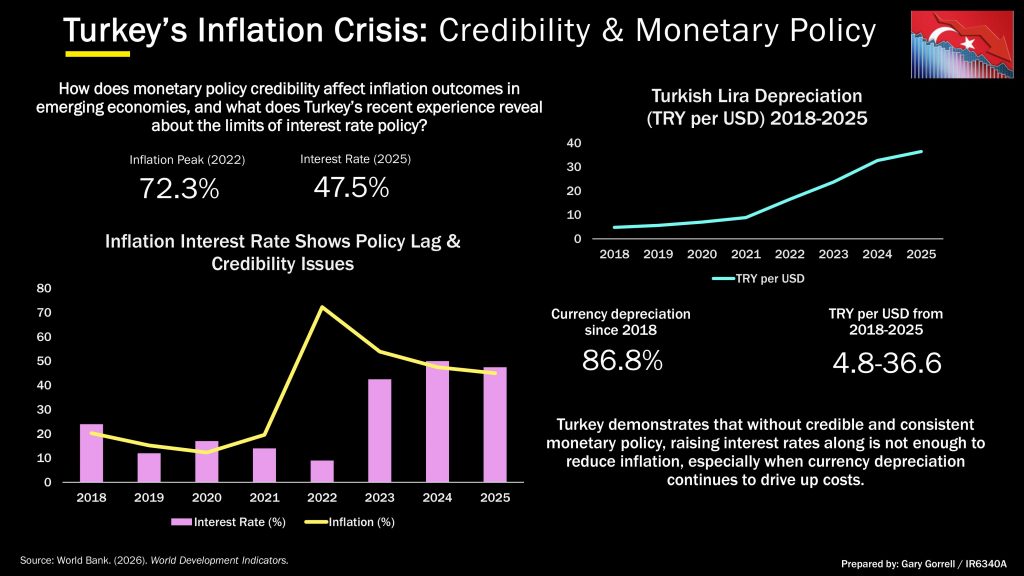

This infographic shows how Turkey’s inflation crisis comes down to policy credibility and timing. The first chart highlights a clear breakdown in monetary policy, where interest rates were lowered even as inflation was rising, followed by a delayed shift to aggressive tightening. That lag helps explain why inflation peaked at 72.3% and has remained elevated despite higher rates. The second chart reinforces this by showing the sharp depreciation of the lira—from 4.8 to over 36 per U.S. dollar—which reflects declining investor confidence and drives up import costs. The key metrics, including the 86.8% loss in currency value and the 47.5% policy rate, help ground the visuals and make the scale of the problem clear. Together, the charts show a sequence of policy misalignment, lost credibility, market reaction, and persistent inflation. The main takeaway is that getting policy right isn’t enough if markets don’t believe it will last.

5 comments
Talal Alsaif
Hi Gary,
Looking at this infographic feels like watching a chain reaction unfold, one policy decision leading to another consequence, and eventually spiraling into a full-blown crisis. What stands out most is how clearly you show that this isn’t just about inflation numbers, but about credibility. The first chart tells a powerful story: interest rates moving in the wrong direction at the wrong time, followed by a delayed correction. That lag makes the inflation spike to 72% feel almost inevitable rather than surprising.
The second chart adds another layer by showing the collapse of the lira. The depreciation from 4.8 to over 36 per dollar really drives home how markets respond when confidence breaks down. It’s not just a currency story, it feeds directly back into inflation through higher import costs, reinforcing the crisis.
What I found especially compelling is your final takeaway: even aggressive rate hikes aren’t enough if markets don’t trust the policy path. That’s a subtle but powerful insight. It shifts the discussion from “what policymakers did” to whether people believed them, which is ultimately what drives outcomes.
Overall, your infographic tells a cohesive story of policy missteps, credibility loss, and economic consequences, making a complex issue feel clear and intuitive.
Alfonsina Aldama
Hi Gary, What I found most interesting is your argument that credibility matters as much as the policy itself. Looking at your data, it almost seems like the timing of rate increases came too late to shape expectations, which might explain why inflation stayed so high even as rates rose to 47.5%. It made me think about whether earlier or more consistent tightening could have changed how markets responded, especially before inflation peaked at 72.3%. At the same time, the sharp depreciation of the lira shows that once confidence is lost, it’s difficult for policy alone to reverse that trend. So your infographic raises a bigger question about whether credibility can realistically be restored after that point, or if structural adjustments become necessary. I think you did a great job pushing that idea beyond just the data.
Layla Rangel
Gary, this infographic on Turkey’s Inflation Crisis is very insightful. It shows that Turkey’s inflation stayed high even after interest rates increased because people didn’t trust the government’s policies. This shows that raising interest rates alone isn’t enough because credibility & trust are essential for controlling inflation. This ties into my article on Venezuela where inflation is a major issue for the nation.
Yuta Satake
Your infographic was very insightful! One of the charts clearly illustrated how the lag between inflation and interest rates occurred in Turkey. In addition, my article focused on development in India, so I found that your argument that credible and consistent monetary policy plays a vital role in reducing inflation has a meaningful implication for my article. Thak you so much for providing informative insights!
Greitin Rodriguez
Hi! I think this is a great infographic you do an excellent job relating policy credibility to real economic outcomes. In addition, one of the most powerful aspects of this infographic is how your two charts relate. It becomes clear from the data presented how long it takes for the interest rates to rise after inflation increases, and combined with the significant depreciation of the lira, it makes a very convincing case for your theory about the loss of trust among investors. The employment of statistics makes it much easier to understand the scale of the problem that Turkey faces.
In this regard, it might also be useful to mention some external forces that can play a role in influencing the economic state of affairs. Emerging countries might suffer because of external factors, regardless of what internal policies they implement. In this case, one should determine whether Turkey’s problems are unique or represent a global trend. According to research by the International Monetary Fund, stability and reliability become very important in such conditions.
Overall, your main takeaway is clear and convincing. Do you believe earlier and more consistent rate increases would have been sufficient to stabilize the lira, or had credibility already suffered too much damage to reverse the situation?