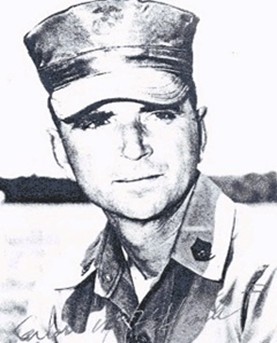
It was April 1966, and Hathcock had not expected to be in Vietnam. The war had come suddenly, and for most of his military career, he had not even been training for his MOS, also known as his job. He had been attending rifle shooting tournaments for the Marines. However, he was still a machine gunner and had initially been assigned to the 1st Marine Division’s Military Police unit at Chu Lai, where he worked as a desk sergeant and machine gunner. This had been a very demoralizing experience for Hathcock, who had spent his life in America becoming a national champion in marksmanship competitions and had won the coveted Wimbledon Cup and the U.S. 1,000 Yard High Power Rifle Championship. To Hathcock, marksmanship had been the very essence of a Marine and the primary skill of his trade; however, he had found himself not being utilized in Vietnam and stuck in a routine Military Police unit that did not use the exceptional qualities he had spent years perfecting in competition. Even though he had been a poster-perfect Marine who had set unmatched records in marksmanship competitions, he had arrived in Vietnam equating marksmanship skills only with paper targets.1
By September 1966, Hathcock was sitting around experiencing the worst moment of his life yet. Since April, Hathcock had been merely surviving in Vietnam as an MP, a MOS that he had not even properly trained for because he had spent years becoming excellent at shooting rifles at incredible distances. Hathcock had gradually become accustomed to his current life, making friends and coming to terms with his situation, but fate had other plans for a man like Hathcock. Captain Jim Land arrived in Da Nang midway through September with orders to establish the 1st Marine Division’s sniper program. Marine high command had realized that men who could understand their surroundings and possess the patience and discipline to eliminate targets only when necessary were a powerful tool—especially in an environment where sending large numbers of soldiers into the forest often led to many of them being killed by “hamburgers,”2, a term referring to Viet Cong soldiers. After Captain Land arrived and settled into the task of creating the sniper program, he began reviewing possible candidates. By October 3, he had looked through all of them, and when he saw Hathcock’s name, he selected him along with a few others. Hathcock joined a small group of elite marksmen at the division headquarters. For the remaining time they had in Da Nang, Land, Hathcock, and the other snipers spent their waking hours searching for rifles and scopes that could be rebuilt into match condition by armorers. Once equipped with modified Winchesters and Remingtons, the group moved north to Hill 55, a base of operations thirty miles southwest of Da Nang located in a region heavily populated by the Viet Cong. At Hill 55, the base for the sniper school was properly established. Once it had been set up, Land proceeded to distribute the weapons that the new trainees would use. Each sniper team consisted of two men. The spotter, who was responsible for locating targets and ranging for the shooter, carried an M14 rifle. The shooter carried a bolt-action rifle, though the specific model varied. It was said that they ranged from “Remingtons to Winchesters to M-1D (Korean War vintage) sniper rifles.”3 Even so, this set of weapons was enough to begin the school and to start Carlos Hathcock on the path to becoming the most effective sniper in Vietnam. The men were also given access—thanks to the Lake City Arsenal—to specialized ammunition. They obtained “173-grain, boat-tailed bullets that traveled at 2,550 feet per second and would strike the target at the same spot with every shot. A dozen strong.”4 With these resources in place, the classes began. However, as the program started, compliments and requests began arriving from other Marines in the region. One message stood out among the many letters and verbal requests directed to the staff. It called for the snipers to “get the Viet Cong woman who led a guerrilla platoon that terrorized the Marines at Hill 55.”5
Then, in November 1966, things had started to get back to normal for Carlos Hathcock as he found himself on Hill 55, located south of Da Nang. He had become accustomed to the “Indian Country”6 around him, knowing every trail and paddy because he had previously patrolled them as an MP machine gunner. However, he still had two goals he had wanted to accomplish for nearly two months. One of them, of course, was the elimination of the Viet Cong, which he had been accomplishing with great success, as he had racked up over thirty in one month alone. However, the mission he was on this day was a bit more personal. A female Viet Cong commander, known as the Apache, had made a name for herself by spending her nights torturing young Marines within earshot of the base. Carlos had spent the night listening to a young Marine’s nightmarish screams as he was tortured on a bamboo rack. He had heard the screams and had done nothing, consumed with rage because he could do nothing against this enemy at the time. The boy was made to run towards the Marine wire, having been emasculated by the Apache with a curved knife. The boy died in the concertina wire in front of Hathcock. Carlos was consumed by anger and vengeance. He rushed to Captain Land and announced that he wanted to eliminate her. Captain Land also wanted to eliminate her and agreed with Carlos that they needed to eliminate her. Over the next few days, they planned to set up shop in her territory, a clearing near a bomb-scarred hill two miles west of Hill 55. It was a hot afternoon with the temperature and humidity both close to ninety-five degrees. Hathcock and Land hid in a grassy hide beneath the leaves of a small palm tree. Carlos was armed with his match-conditioned Winchester Model 70 and an eight-power scope. He realized that his rifle was not for a fair fight but for an assassination. He ordered himself to remain patient while they hid in the hot weather with an army of ants biting him. They observed a particular junction where the trail made a left turn through the clearing. Finally, Hathcock spotted movement among the broken tree trunks at the crest of the hill. Through the powerful spotting scope, they quickly identified the figures as Viet Cong. Carlos soon verified with his own eyes that one of them was indeed the Apache. She first appeared at roughly 1,200 yards. Hathcock knew that only one plan would work: he would strike when she reached the turn in the trail where she would be most exposed. He narrowed his focus as she suddenly began running in panic directly toward his hide. Hathcock took a deep breath and let the crosshairs settle on her chest. The Winchester fired a single round that cracked through the land. The bullet ripped through her collarbone and spine, sending blood and fragments spraying as she was knocked violently off her feet. Hathcock immediately cycled the bolt with disciplined speed and fired again, placing a second round into her lungs and destroying her vital organs. The Apache had been terrorizing the Marines stationed on Hill 55 for months, but now she was dead, lying still in the orange dirt. There would be no more frightened Marines, no more suffering—at least, not for that night. For an instant, it seemed as though it was all over, as though this might have been the height of Hathcock’s career. But still, there was work to be done. The other Viet Cong escort, frightened by what had happened, made a run to try to sprint back up the hill. Hathcock quickly took aim with a third bullet, firing between the man’s shoulders, killing him instantly. Hathcock celebrated with a joyful laugh, knowing that the “hatchet lady” had been removed from the list. This was a great victory for the Marines, but it was also beginning to go to Hathcock’s head. He had gained a reputation that few other Marines, even those who were enlisted, ever had, and had come to think that none of the “hamburgers”7 were smart enough to get away from him. With this newfound confidence, Carlos continued with even riskier patrols. He was convinced that his skill and energy would catch the “Homer”8 by surprise—or so he thought. He started to take risks, going back to the same hunting ground the next day, violating his own doctrine of not going back to the same place the following day. By the time he ended Operation Rio Blanco, the North Vietnamese Army had taken notice and placed a substantial bounty on his head. They knew the threat that Hathcock had become because of this day, and they would not forget it. But that would not become a problem until later in the story.9
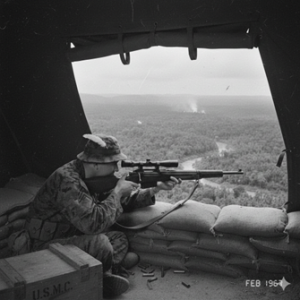
On November 20, 1966, Carlos Hathcock was in the high mountains bordering Laos during the operation Rio Blanco. He had just eliminated the notorious Apache and scores of other Viet Cong and was ready to begin striking the enemy in their own territories of Elephant Valley and Charlie Ridge. He had come into the war as a demoralized MP desk sergeant at Chu Lai, but now he had proved himself to be exceptionally good at killing Vietcong with his Winchester Model 70, which he called his “whispering death”10, converting his rifle into a threat to the enemy at all times. But he did not know that his newfound confidence was leading him into a final test of momentum. Captain Jim Land called Hathcock and his spotters, John Burke, for a clandestine operation, even though a busy major did not know about the operation. He made his way through the pitch-black jungle, trekking five kilometers through Indian Country to set up a small firing position on a small rise overlooking a trail, and there he waited until dawn. As soon as it was light, Hathcock spotted the target, who was a professional French interrogator known to have tortured American pilots who had been captured by North Vietnamese forces. The ambush was quickly becoming more than they had bargained for when a seven-man Viet Cong patrol came out of the forest to meet their target, who had entered the area. Carlos could feel his heart pounding against the matted grass, but he was not going to go down in that jungle to a group of Viet Cong soldiers. Hathcock had his reticle sight centered on the shoulders of their target and pulled the trigger, dispatching the French interrogator with a single .30-06 bullet. But their mission was still unfinished. Hathcock had to get Burke back over the ridge before they were surrounded by the Viet Cong. Just moments before, the two Marines had been lying motionless, waiting for their chance to get their target. Now they were running for their lives, under fire. Charging through the trees, hoping that the dense underbrush would protect them from the incoming fire. The two Marines ran up the hill, racing the five-kilometer distance back to their extraction point. They made the distance in just twenty minutes, an incredible feat that would have been impressive even on flat terrain. They arrived at the waiting UH-1 Huey helicopter just as the crew chief grabbed the two men by the collars, pulling them aboard. The incredible escape had filled Hathcock with a sense of confidence. He now believed that no hamburger was smart enough to evade him. He had also gained the reputation that only a handful of enlisted men had achieved, solidifying his position as the “Super Sniper.”11 However, this confidence was about to be put to the test. Not yet aware, the Marine had a price on his head, one that would soon become the catalyst for the events that followed.12
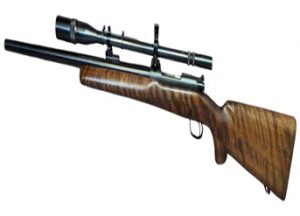
It was now January 1967, and Carlos Hathcock was stalking through the “buggy-hot”13 jungle outside of Hill 55. Having already faced dozens of Viet Cong, he had also eliminated the infamous Apache. Now, he was determined to prove that he had mastered the Indian Country. He had begun his tour as a demoralized desk sergeant, but he had now proven himself to be an extraordinarily good killer of Homers with his Winchester Model 70, bringing the number of confirmed kills up to eighty. His goal now, besides continuing to prove himself as the best sniper, was to hunt the enemy, doing the only thing he knew best, making his rifle a constant threat to those who opposed him. He, however, had no idea that he was becoming more confident, which would eventually lead him into a duel with an enemy who was his equal. He had been informed by Major Wight that an elite North Vietnamese Army sniper had been sent specifically to collect the bounty on the “White Feather”14, the nickname he had acquired due to the feather he wore in his hat. He knew, much like he had known with the Apache, that he could not allow the enemy to operate freely in the area. He, along with his spotter, John Burke, set out to hunt the NVA sniper. By mid-afternoon, the search was stepped up as Hathcock and Burke advanced cautiously up a draw in an attempt to pinpoint the hiding place of the enemy. While on his way, he came across a pass where someone had deliberately scattered rice in order to lure birds, which would act as an early warning system. At this time, he knew he was not just up against a normal guerrilla fighter but a man with skills as good as his own. While advancing towards the crest of a ridge, he was given a test of his self-discipline. He was full of confidence in his skills and tried to position himself against a tree in a sitting position in order to get a view behind his position. However, as he tried to position himself in a cross-ankle shooting position, his boot slipped on the wet ground and made a loud “plop” sound on the twigs on the ground.
A rifle cracked, followed by sudden silence.
The NVA sniper, who had been patiently waiting for Hathcock to reveal himself, had reacted instantaneously to the sound and fired. The bullet had flown through the air and had struck Burke’s canteen, spewing water in all directions. For an instant, Carlos had thought the water was blood and had believed that Burke had been killed. However, the situation had now become one of deadly skill and survival. Realizing that they had underestimated their enemy, Hathcock and Burke quickly went into cover and began to maneuver to counter the enemy’s position. After moving their position, Hathcock slowly looked over the cover he was using and spotted the faint reflection of the sun off the scope of the enemy’s rifle, which was in the gully. In that instant, he had centered the reticle of the scope and fired the shot. There was the flash of the muzzle of Hathcock’s rifle, followed by the sharp report of the .30-06 round breaking the sound barrier. Then everything was silent once more. The bullet had passed directly through the enemy sniper’s scope and into the eye of the enemy sniper. When he went to the body of the enemy, he noticed that the lens of the scope had been shattered, but the frame had remained more or less intact. However, the head of the enemy sniper had not fared quite as well. He had managed to send a .30-06 round directly through the scope and into the eye of the enemy sniper. This had meant that the enemy sniper had been looking directly at Hathcock when he had fired the round. This had been a shot of exceptional skill, but it had also been one of deadly mistakes. Hathcock knew that he had come close to losing everything because of his cockiness. However, he had learned from the experience and knew that he would never allow his cockiness to place him in such a precarious position again.15
It was the end of the road for Hathcock in Vietnam. April 1967 found Carlos Hathcock preparing to leave the country, but he was far from the “green kid” who had reported for duty a year before. He had grown accustomed to the “Indian Country” and the feel of the Winchester Model 70 he carried. He had also come to understand that the reality of war was no longer about paper targets, but about living, breathing human beings. He had now finished his goal while finishing his tour with honor. He had accomplished that goal exceptionally well, leaving the war zone with a staggering eighty confirmed kills. This was an outstanding feat, considering he had transformed from a demoralized MP desk sergeant to the legendary Super Sniper dubbed “Long Trắng”16 or the White Feather. He returned to the United States ready to teach what he had learned, taking the role of a marksmanship instructor at Quantico and eager to pass on the elite skills of the trade to a new generation of Marines.
Hathcock was of the view that since he had become one of the most effective snipers in Vietnam, he had the right and the responsibility to share his knowledge in order that his students would not meet a grim fate in the bush. Together with Captain Jim Land, he was part of a wider mission to legitimize the role of the sniper in the Marine Corps, transforming it from a neglected art to a permanent military role. He also helped to solidify the doctrine of the sniper, laying the foundations with essentials, dos and don’ts, and the things that he learned the hard way, like how you never hunt the same ground twice, and that unpredictability is total if you are going to survive. a mental attitude of total discipline and precision, which would come to define the scout-sniper of the modern era. By the time he was to begin his role as a teacher, he had become a living legend. His in-the-field combat experiences became examples of what could be accomplished with the right training, patience, and leadership. He proved that one well-trained and skilled marksman with a rifle could achieve as much in terms of strategic warfare as an entire patrol unit. This further solidified the status of the sniper as a respected and integral part of the Marine Corps and other branches of the U.S. military. In this way, the evolution of the man with the white feather into the legendary Marine sniper was complete. He became the expert who would play an integral role in laying the groundwork for the training of the Marine Corps sniper program of the future. Standing in front of his students, the man with the white feather was no longer simply the skilled marksman he had become. He had become the embodiment of the Marine sniper legacy, ensuring that the most deadly force in combat could still be delivered with one well-placed shot.17
- Charles Henderson, Marine Sniper: 93 Confirmed Kills (Berkley, 2001), 9, 19, 20, 45. ↵
- Charles Henderson, Marine Sniper: 93 Confirmed Kills (Berkley, 2001), 39. ↵
- Charles Henderson, Marine Sniper: 93 Confirmed Kills (Berkley, 2001), 75. ↵
- Charles Henderson, Marine Sniper: 93 Confirmed Kills (Berkley, 2001), 76. ↵
- Charles Henderson, Marine Sniper: 93 Confirmed Kills (Berkley, 2001), 45, 54, 71, 72, 73, 74, 75. ↵
- Charles Henderson, Marine Sniper: 93 Confirmed Kills (Berkley, 2001), 78. ↵
- Charles Henderson, Marine Sniper: 93 Confirmed Kills (Berkley, 2001), 10. ↵
- Charles Henderson, Marine Sniper: 93 Confirmed Kills (Berkley, 2001), 10. ↵
- Charles Henderson, Marine Sniper: 93 Confirmed Kills (Berkley, 2001), 78-90. ↵
- Charles Henderson, Marine Sniper: 93 Confirmed Kills (Berkley, 2001), 120. ↵
- Charles Henderson, Marine Sniper: 93 Confirmed Kills (Berkley, 2001), 71. ↵
- Charles Henderson, Marine Sniper: 93 Confirmed Kills (Berkley, 2001), 100-120. ↵
- Charles Henderson, Marine Sniper: 93 Confirmed Kills (Berkley, 2001), 107. ↵
- Charles Henderson, Marine Sniper: 93 Confirmed Kills (Berkley, 2001), 112. ↵
- Charles Henderson, Marine Sniper: 93 Confirmed Kills (Berkley, 2001), 150-165. ↵
- Charles Henderson, Marine Sniper: 93 Confirmed Kills (Berkley, 2001), 241. ↵
- Charles Henderson, Marine Sniper: 93 Confirmed Kills (Berkley, 2001), 180, 186, 190, 200, 244, 245, 260. ↵