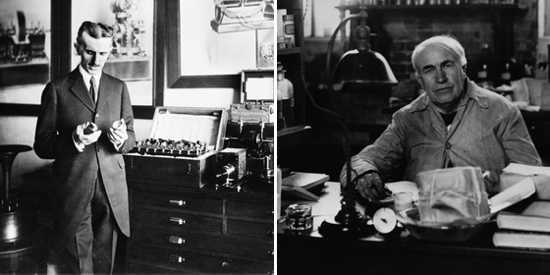

Nikola Tesla was a man who was often shadowed by other inventors of his time, many of whom had more influence and money. Now Tesla is seen as an under-appreciated genius who was held back by the people and technology of his time. Tesla fit the description of Harry Goldman’s claim that many pioneers of science and technology become “just another name,” and are reduced to just a story, while forgetting the struggles they dealt with to reach their accomplishments. People in Tesla’s day recognized his genius in later years, when he was just a name in the background of some of his rivals.1 Further pushed by Edwin H. Armstrong, Nikola Tesla is described as a visionary for his time. Tesla described objects that could broadcast messages to the world without wires: radios. Equipment like this was not yet made in his time, which caused many to doubt him. Tesla’s genius was not reflected by material reward nor by lasting public recognition for most of his life.2 In order to fully understand Nikola Tesla, it is not enough to just know all his inventions and visions, but also the story of his life before and after coming to America, when his genius was still unrecognized and when recognition was always a step away.
Nikola Tesla had his plans set before coming to America, shaped by background that led to his talents. Tesla was born on July 10, 1856 in a small village of Smiljan in the Austrian empire, known today as present-day Luka, Croatia. He was raised by his two parents, Milutin Tesla and Georgina “Đuka” Mandić. His family was religious as most of his family were very active in the church, his father being a Serbian Orthodox priest. His mother on the other hand was a simple inventor of household items. Tesla’s father expected him to join the clergy, but Tesla had a photographic memory and a hobby of inventing things like his mother.3 Tesla was described as a gifted student in math. His education in Europe exposed him to the topic of electricity. Tesla attended the polytechnical college of Graz, where, in a lecture, he suggested an idea to his professor that involved alternating current (AC), a type of electrical current that can reverse direction unlike direct current (DC), which only flows in one direction. At the time of this, DC was widely used but was not efficient in long distances as it lost energy overtime. This created the AC dilemma. Tesla proposed a system using rotating magnetic fields and multiple phases of current, which the professor did not approve of. He later moved to the University of Prague, and although doing well in both colleges, he left without a degree. Still, he made great strides in solving the AC dilemma.4 And although he did not get any degrees, it is noted that his education was the main foundation of his later breakthroughs in AC.5 After his father’s death, Tesla worked in engineering positions that included one that was connected with an Edison system; this was not enough for him, so he hoped that his ideas could come to life in the United States, the land of opportunity.
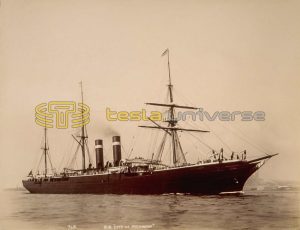
In June 1884, Nikola Tesla arrived in New York. Apart from the letter of introduction to Thomas Edison, he came empty handed from the rough trip to America.6 In the letter for Edison, Batchelor states, “I know of two great men, and you are one of them; the other is this young man.”7 This should have been a great start for Tesla, and it initially was. Tesla was a immigrant with little knowledge of America, and despite these limitations, he was set to have a good job in hopes that a genius would recognize another genius. This idea is what made Tesla and Edison’s first meeting important. Their interaction was quick and Tesla was immediately given a task. At Edison’s machine works, Tesla was hired as a unknown man with aspirations. His belief that hard work and genius would secure his future, though, would soon be put on hold.8
By the mid-1880s, Edison was already one of the most famous inventors in the world, known for inventions like the phonograph and for his work in electric and power systems. He built a reputation not only as an inventor but also as a businessman. To a newly arrived immigrant like Tesla, working for Edison meant more than just having a job; it meant entering the center of modern innovation. Edison represented what Nikola Tesla wanted to be as he had taught himself everything he knew, a self made inventor who had turned his ideas into success..
Nikola Tesla caught Edison’s eye pretty quickly. Tesla is described as no ordinary employee. He was efficient and had a great understanding of electrical systems while working on problems that others found difficult. He quickly proved himself to Edison and others surrounding him. Edison acknowledged Tesla’s work and granted him almost complete freedom in his work.9 Tesla produced results that were exactly what Edison was looking for.
Although both of these men respected each other, they both differed in the ways they worked. Edison was known for prioritizing trial and error methods and did not like depending on mathematics for his work. And that was exactly what Tesla was very good at.10 Tesla and Edison also had different visions for the progress of electricity. Edison was invested in direct current (DC) while Tesla believed alternating current (AC) would be the future.11 The tension in the difference of their work dynamics and vision had been there since the beginning.
Tesla had started to become involved in Edison dynamos and generators. He was assigned the difficult task of improving them, and was told there was a large reward, fifty thousand dollars, for the one who succeeded in improving them.12 To Nikola, this was his chance to gain more recognition and money. Tesla believed that his hard work was about to pay off. After traveling overseas and risking it all, while working countless hours, he expected to receive the promised reward. Tesla was determined to finish this task; he was committed. Similar to how he faced tasks when he was younger, Tesla would always respond to a difficult task with his full focus.13 Tesla took this opportunity to further prove his skills, working day and night to complete this task quickly. This was his first step to stand out and make a name for himself. This, to him, was more important than the money he believed he would receive.
Tesla’s time with Edison was brief, but revealed a reality far different from the hopeful image Tesla had envisioned of industrial America. Nikola Tesla entered into Edison’s service as a naive and hopeful man believing that his ideas would send him towards success. Instead, he was about to be shown that business did not always reward talent. 14
The reality was shown when Tesla finished his work. He improved Edison’s devices in six months and asked about the fifty thousand dollars that he claimed were promised. When Tesla mentioned his reward, Edison laughed and told Tesla that he did not understand “American humor.”15 Whichever way Tesla interpreted this remark, a cruel joke, a cultural misunderstanding, or taking advantage of him, it all meant the same thing: Tesla was not getting the reward he had hoped and worked so hard to get.
This event was the first struggle Tesla had to face, because it shattered more than his expectations of this new land. His hope that he could get recognition by working under Edison was broken. Tesla felt humiliated and disappointed by Edison’s dismissal. Months of labor only for the person he admired to laugh at his face. Tesla was a person whose brilliance was often shadowed by the systems and figures around him.16 Under Edison, his talents could be used; they could surpass any other worker, but that did not mean that they would be honored. For Tesla, this insult cut him deeply. He was not a man that was fine being dismissed so easily nor someone that would shrug off disrespect.17 This interaction between them did reveal something to Tesla. If Edison could dismiss his work so easily, then staying in Edison machine works meant that he would never be anything more than a tool in Edison’s empire.
Nikola Tesla chose to walk away.
That decision was the climax of Tesla’s life. The betrayal he felt over not getting the money was as significant as the events that followed. Quitting meant giving up a good stable income, security, and a connection with one of the most famous inventors of that time. In doing so, he also chose to preserve his belief that his ideas deserved their own recognizion. It was a risky choice no doubt, but it was also the choice that made the rest of Tesla’s career possible.
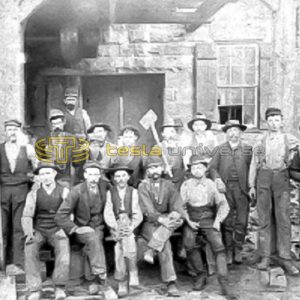
Nikola Tesla’s life did not immediately improve after leaving Edison. He had to go through a lot of struggles at first. His dream, making a name for himself in America, was far from becoming reality as he entered one of the darkest periods of his life.18 Tesla felt this period was a slap to the face, a genius, having to dig trenches just to survive.19 This period reveals the cost of being independent to Tesla. Being a genius did not immediately give him the life he hoped for in America. In the United States during the 1880’s everything was driven by profit. For an idea to make it, it needed investors and not many understood the vision Tesla offered. This struggle, though, did not stop Tesla from pushing for his dream. In his mind, his ambition remained: he was not going to settle for being a mere tool for men like Edison. 20
Nikola Tesla’s determination eventually brought him to some men who were willing to support his inventions. Tesla secured backing from investors who recognized that his electrical ideas had good value in them. The two years of trench digging and odd jobs was finally over for Tesla. This once poor immigrant who came to America with nothing but hopes and dreams finally had the means to accomplish them.21
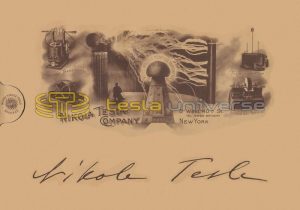
Now that Nikola Tesla had financial support, he started his first company, Tesla Electric Light and Manufacturing, and began to work on his ideas, which would later come to rival Edison’s DC systems. With this available, Tesla now had a podium where his inventions could be developed, patented, and brought for a wider public use.22 Throughout 1887 and 1888, Tesla was slowly getting more recognition. His alternating current work took on an institutional form in patents on the polyphase system, and in his lecture at the American institute of electrical engineers.23 Tesla had started a new phase in his life. No longer digging trenches to survive, but now building towards a future powered by his work. By early 1890s, Tesla was not just a former Edison employee. He had become a famous electrical engineer whose work started to gain attention.24 With the traction he was getting, this would set the stage for the famous conflict: the war of the currents. During that era, the battle between direct current and alternating current became a well known industrial debate. Edison would stubbornly defend his system, while Tesla’s AC ideas gained more publicity as more industries started adopting them. Ultimately, Tesla’s AC systems won by 1896, when the city of buffalo was lit by one of Tesla’s AC motors, even Edison’s General Electric had started to use the AC systems, because it proved to be a lot more efficient and cheaper than Edison’s DC systems.25
Although Tesla’s life was filled with struggles, he never lost hope that one day he would be given the opportunity to reach his goal. His break from Edison was not only the cause of his struggles, but it was also the very thing that led to him turning into the well known figure everyone recognized. He represented American ideals. In chasing his dream, he left all he knew behind in his country to make a name for himself. He left a huge impact that is reflected across the world today not just in engineering but in mathematics as well.
- Harry Goldman, “Nikola Tesla…Just Another Name?,” Science and Children 10, no. 4 (December 1972): 9–11; Edwin H. Armstrong, “Nikola Tesla, 1857–1943,” The Scientific Monthly 56, no. 4 (April 1943): 379. ↵
- Edwin H. Armstrong, “Nikola Tesla, 1857–1943,” The Scientific Monthly 56, no. 4 (April 1943): 379. ↵
- Marc J. Seifer, Wizard: The Life and Times of Nikola Tesla: Biography of a Genius (New York: Citadel, 2016), 10. ↵
- Marc J. Seifer, Wizard: The Life and Times of Nikola Tesla: Biography of a Genius (New York: Citadel, 2016), 16–17. ↵
- “Tesla, Nikola,” in Complete Dictionary of Scientific Biography, vol. 13 (Detroit: Charles Scribner’s Sons, 2008), Gale eBooks; “Nikola Tesla,” in Encyclopedia of World Biography, 2nd ed., vol. 15 (Detroit: Gale Research, 1998), Gale eBooks. ↵
- Margaret Cheney, Tesla: Man Out of Time (New York: Touchstone, 2001), 26-27. ↵
- Harry Goldman, “Nikola Tesla…Just Another Name?,” Science and Children 10, no. 4 (December 1972): 9; Margaret Cheney, Tesla: Man Out of Time (New York: Touchstone, 2001), 30. ↵
- Margaret Cheney, Tesla: Man Out of Time (New York: Touchstone, 2001), 31; “Tesla, Nikola,” in Complete Dictionary of Scientific Biography, vol. 13 (Detroit: Charles Scribner’s Sons, 2008), Gale eBooks. ↵
- Harry Goldman, “Nikola Tesla…Just Another Name?,” Science and Children 10, no. 4 (December 1972): 9. ↵
- Harry Goldman, “Nikola Tesla…Just Another Name?,” Science and Children 10, no. 4 (December 1972): 9; “Nikola Tesla,” in Encyclopedia of World Biography, 2nd ed., vol. 15 (Detroit: Gale Research, 1998), Gale eBooks. ↵
- Richard Munson, Tesla: Inventor of the Modern (New York: W. W. Norton & Company, 2018), 53. ↵
- Marc J. Seifer, Wizard: The Life and Times of Nikola Tesla: Biography of a Genius (New York: Citadel, 2016), 34-35. ↵
- “Tesla, Nikola,” in Complete Dictionary of Scientific Biography, vol. 13 (Detroit: Charles Scribner’s Sons, 2008), Gale eBooks; “Nikola Tesla,” in Encyclopedia of World Biography, 2nd ed., vol. 15 (Detroit: Gale Research, 1998), Gale eBooks. ↵
- Richard Munson, Tesla: Inventor of the Modern (New York: W. W. Norton & Company, 2018), 53–54. ↵
- Harry Goldman, “Nikola Tesla…Just Another Name?,” Science and Children 10, no. 4 (December 1972): 9–11. ↵
- Richard Munson, Tesla: Inventor of the Modern (New York: W. W. Norton & Company, 2018), 54-55; Edwin H. Armstrong, “Nikola Tesla, 1857–1943,” The Scientific Monthly 56, no. 4 (April 1943): 379. ↵
- Margaret Cheney, Tesla: Man Out of Time (New York: Touchstone, 2001), 36. ↵
- Harry Goldman, “Nikola Tesla…Just Another Name?,” Science and Children 10, no. 4 (December 1972): 9. ↵
- “Tesla, Nikola,” in Complete Dictionary of Scientific Biography, vol. 13 (Detroit: Charles Scribner’s Sons, 2008), Gale eBooks; “Nikola Tesla,” in Encyclopedia of World Biography, 2nd ed., vol. 15 (Detroit: Gale Research, 1998), Gale eBooks. ↵
- Marc J. Seifer, Wizard: The Life and Times of Nikola Tesla: Biography of a Genius (New York: Citadel, 2016), 41. ↵
- Marc J. Seifer, Wizard: The Life and Times of Nikola Tesla: Biography of a Genius (New York: Citadel, 2016), 42. ↵
- Harry Goldman, “Nikola Tesla…Just Another Name?,” Science and Children 10, no. 4 (December 1972): 9–10. ↵
- T. C. Martin, “Nikola Tesla: Receiving an Electric Current of Two Hundred Thousand Volts,” Austin Daily Statesman (Austin, TX), June 26, 1894. ↵
- Matthew Wills, “Thomas Edison and the War of the Currents,” JSTOR Daily, September 6, 2016, https://daily.jstor.org/thomas-edison-war-currents/. ↵
- “Tesla, Nikola,” in Complete Dictionary of Scientific Biography, vol. 13 (Detroit: Charles Scribner’s Sons, 2008), Gale eBooks; “Nikola Tesla,” in Encyclopedia of World Biography, 2nd ed., vol. 15 (Detroit: Gale Research, 1998), Gale eBooks. ↵
2 comments
Elizabeth Vazquez
Hello Armando,
Are you suggesting that Tesla inherited his intelligence from his mother, given that she also engaged in inventing solutions for the home? I was not aware that Tesla was an immigrant, although I was aware of his notable achievements. His resilience and determination are commendable; he had a clear mission and accomplished it despite facing skepticism and opposition from Edison. I appreciate the approach taken in your article, as it raises a question many people might be considering: Was Tesla the sole inventor of AC systems?
Emma Jimenez
I like how you frame Tesla not just as an inventor, but as someone constantly positioned between recognition and being overlooked. It makes his story feel more human instead of just listing inventions. I also think the way you describe his struggles after leaving Edison is effective because it shows that success didn’t come immediately, even for someone with clear genius. That adds realism to the story and makes his later achievements feel more earned.