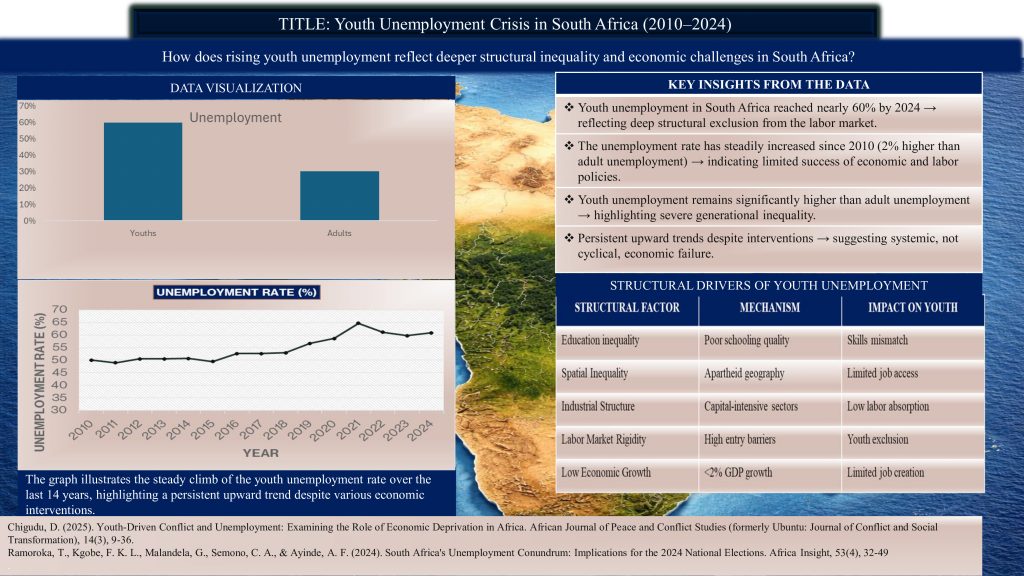

Unemployment in South Africa has been on the rise continuously from 2010 to 2024. This is especially true for young people who face structural inequalities as well as the legacy of past economic issues. Despite several government interventions and measures to stimulate job creation, skills development, and the economy, the infographic shows a general increase in unemployment amongst South Africa’s youth. Youth continue to face numerous barriers when seeking employment. The issues of poor education and slow economic growth have contributed to the lack of employment opportunities. Skill mismatch is also still prevalent.
Persistent increases in youth unemployment also highlight the problems faced by the South African economy more generally, including low levels of investment, structural changes such as automation that make many low-skilled jobs redundant, and the legacy of apartheid economics. Millions of young people continue to be locked out of productive economic activity.
It is important to note this trend when working toward policies that may better address this issue. The crisis can not only be handled with initiatives to create more jobs. But through institutional reform that will last long term solutions, opening pathways to better education, and promoting entrepreneurship. These numbers highlight the need for collaboration to change this momentum and develop a better economy for our youth.


6 comments
Rosa Inocencio
Hi Stephen, I really enjoyed reading your infographic, it was very informative and straight forward. I thought it was very shocking how bad unemployment is, and the fact that it’s not only affecting the youth, but the adults too, we could only imagine how bad it is today. I also liked how you included the contributing factors to it too, like the lack of education, and low levels of economic growth and so on, hopefully they are able to do something about it soon so that the unemployment levels become lower. Great article!
Alfonsina Aldama
Hi Stephen, I really liked how your infographic clearly shows the scale of the issue, especially the comparison between youth unemployment being close to 60% while adult unemployment is significantly lower. That contrast makes the inequality very visible. What stood out to me the most was your point that this is a structural, not cyclical problem. The way you connected factors like education inequality, spatial inequality, and low economic growth helps explain why the trend keeps increasing over time instead of improving. The line graph from 2010–2024 reinforces that this is a long-term pattern. Your infographic does a great job showing that this crisis goes beyond just job availability and reflects deeper systemic challenges.
Gary Gorrell
Good Morning Stephen,
I selected your infographic because Cape Town has a special place in my heart (vacationed there and loved it) and I was not aware of the youth unemployment crisis in South Africa. The visuals you used clearly portray the changing data in a very understandable way so great job in selecting the graphic depictions you used. It’s one thing to hear about the problem, but seeing the stats laid out like you did really drives the point home. The extra context you provided as to why youth unemployment is so high makes it easier to understand what you’re trying to say.
Your infographic makes me curious as to what’s being done to help youth unemployment in South Africa. The data has me interested, but I’m wondering if there’s a success story out there that’s worth briefly touching on here to show that real change is possible. Great job putting this together!
Valentina Gaona
Hi Stephen,
I found your infographic really interesting. This is a topic I do not have a lot of knowledge of, so reading it was easy to understand, and I got to learn more. Normally, we tend not to think about how our actions could affect other generations, and unemployment should be something to look at. Unemployment is not just an immediate economic issue—it can have long-term effects on individuals, families, and entire communities. When people are unemployed for extended periods, they may lose valuable skills, making it harder to re-enter the workforce later on. This can also create cycles of poverty that impact future generations, limiting access to education, healthcare, and opportunities for upward mobility.
talsaif
Hi Stephen,
Reading your infographic feels like watching an entire generation slowly being left behind, despite efforts to change the outcome. What stands out most is that this isn’t just a short-term spike in unemployment, it’s a persistent, structural trend that continues to worsen over time.
The way you connect youth unemployment to deeper issues like education gaps, slow economic growth, and the legacy of apartheid is especially powerful. It shows that this crisis isn’t just about jobs not being available, it’s about a system that isn’t fully equipped to integrate young people into the economy. The idea of a “skill mismatch” really stood out to me, because it highlights a disconnect between what the economy demands and what the workforce is prepared to offer.
Another important insight is how automation and structural changes are quietly reshaping the job market, making it even harder for low-skilled workers to find opportunities. It raises a bigger question: even if jobs are created, will they be accessible to the current workforce?
Overall, your work makes it clear that youth unemployment in South Africa isn’t just an economic issue, it’s a long-term development challenge that requires systemic change, not just temporary solutions.
ILA
Stephen, your infographic is a well-thought-out illustration of your research. The poverty trend in South Africa faces significant inequality. Economic exclusion and very little economic growth really limit the opportunity for South African youth. Structural changes such as inclusive education systems and institutional reform would have a much greater effect on the youth employment rate. Investing in the education of South Africa’s youth will allow for more skills development and pathway opportunities. Improving the youth unemployment rate is a collective issue that should be addressed from a top-down approach.