

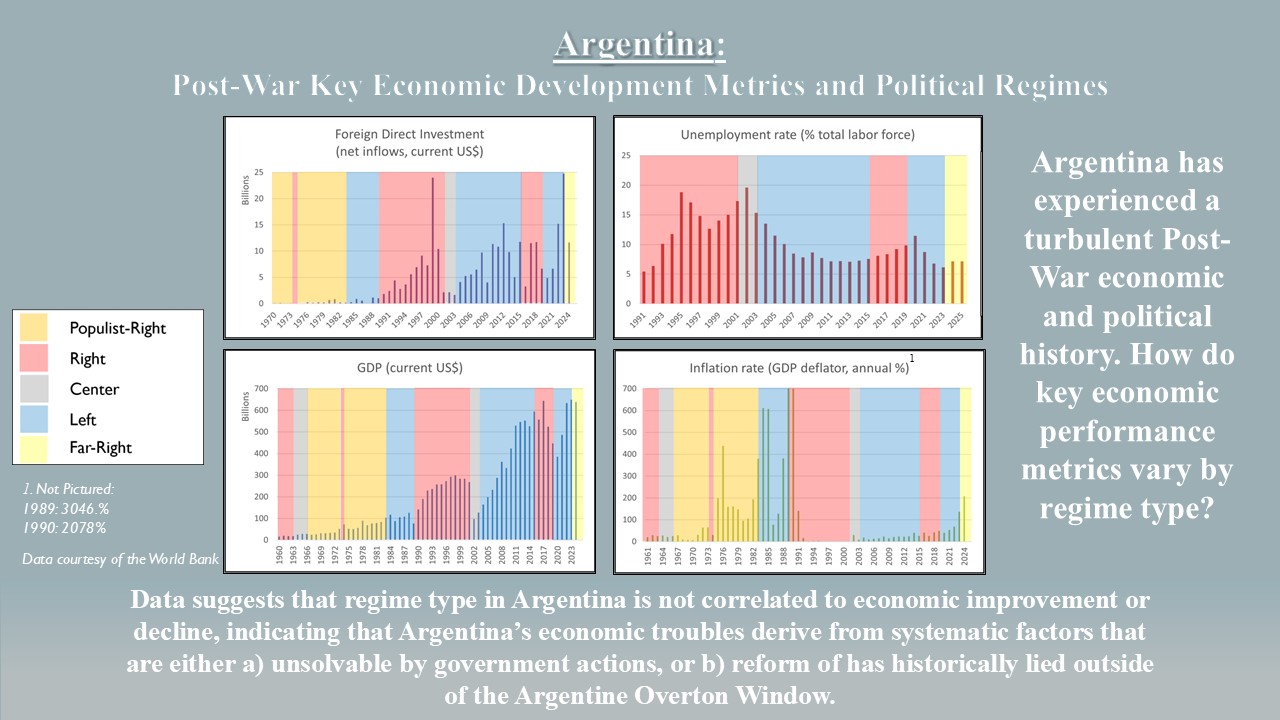
Argentina has experienced a tumultuous economic and political history since the Second World War. A key aspect of the current Milei regime is his denouncement of the previous regimes’ handling of the economy, specifically the policies of the incredibly influential Juan Peron. This graphic presents key metrics that help illustrate the state of the economy, maps them out across Argentina’s post-war history, and provides a layover of the political regime type during that period. These graphs give a quick look at how these numbers have changed based on the regime type. While there are many generalizations taken when classifying these regimes, this overlay will allow us to compare Argentine political economic history.
The results of this info graphic show that there is no real evidence that one regime type is the “good responsible” one and the other is not. What it does show is a variety of success and failure across different regimes. Indicating that there are either structural factors limiting Argentine economic growth, or that there are some policies that have historically transcended regime type in the country.
References:
World Bank. (2026). World Development Indicators: Argentina [Data set]. https://data.worldbank.org

7 comments
Alfonsina Aldama
Hi Bennett, You did a great job on this infographic! it’s really well put together and the way you organized the data across different political regimes makes it easy to follow. I especially liked how you compared multiple indicators like GDP, inflation, unemployment, and FDI over time, because it gives a more complete picture instead of focusing on just one metric. What stood out to me most is your conclusion that regime type doesn’t seem to directly determine economic performance. That’s a really interesting point, and it made me think about how much structural issues or recurring economic patterns might matter more than political shifts alone. At the same time, looking at some of the changes in growth and investment, it feels like certain periods still had meaningful differences, which adds another layer to your argument. Overall, I think you did a great job presenting a complex topic in a way that encourages deeper thinking rather than giving a simple answer.
Layla Rangel
Hi Bennett, I found this infographic on Argentina’s economic and political history since WWII to be very educational. I’m surprised that regime type in Argentina is not correlated to economic improvement or decline, especially since current president Javier Milei faces a lot of criticism on his economic policies especially including the rising poverty in Argentina. A clear connection to my article “Venezuela: Oil Politics Fuel the Struggle for Stability” is that both cases show how political leadership and regime type do not always directly determine economic outcomes in a simple way.
Martin Gonzalez
I find it interesting how much your graphs show the political shifts of Argentina and how regardless of where they stand within the capitalist structure their’s more to the economic change than just who’s in power at that moment. It’s both similar and different to my article where I look into Vietnam’s political shift which also connects with their economic change yet in their case they went through extreme political change in a short span than for the past few decades have remained with the same overall party.
Yuta Satake
Your infographic is very informative and insightful! I could have a deeper understanding of how different political regime affected the economy in Argentina. I found your argument that economic stagnation in Argentina could be caused by structural factors is insightful because my article focused on economic development in India and India has also experienced growth disturbance by traditional and cultural structures. Thank you for providing such valuable insights!
Shaikha Alodssary
Bennett
Your choice of a very relevant topic regarding the relationship between the economic status of Argentina and the political regime throughout the years. The post-war growth theme is very informative in terms of the background provided. In my opinion, you could have benefited from explaining the visualizations more thoroughly, particularly in terms of how each indicator was linked to changes in the political system. However, this did not affect the relevance of your topic.
Cody Granby
First, let me start by saying great job on your infographic. Your analysis of Argentina’s economy effectively illustrates that there is no clear correlation or causal relationship between regime type and economic improvement. However, your data do suggest that foreign direct investment (FDI) coincided with a significant increase in economic growth at the turn of the twenty-first century. Argentina’s GDP nearly doubled from approximately $300 billion to around $600 billion over the span of two decades. At the same time, unemployment declined sharply from roughly 20 percent to about 7 percent—a substantial 13-point drop in a relatively short period.
While this suggests that FDI may play an important role in promoting economic growth and modernization, it is likely only one part of a broader set of contributing factors. I am particularly curious about what types of economic policies or strategies Argentina implemented to attract this surge in FDI and whether these policies were sustainable over the long term.
Talal Alsaif
Excellent work on this publication. Your analysis of Argentinas post war economy and political changes was clear, insightful, and easy to follow. I especially liked how you connected the country’s economic performance with shifts in political regimes. The infographic was visually appealing and helped present complex information in a very accessible way. Well done.