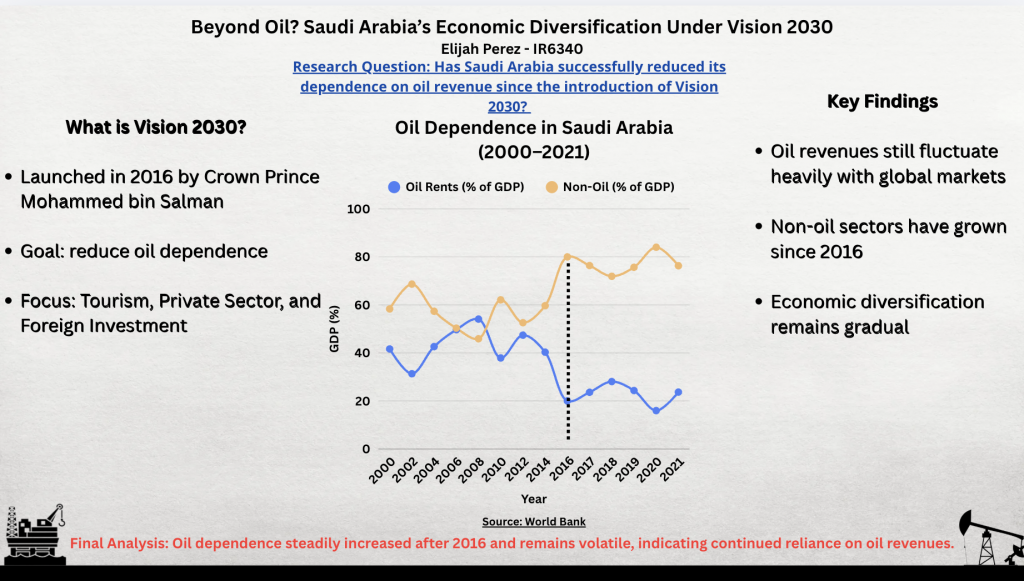

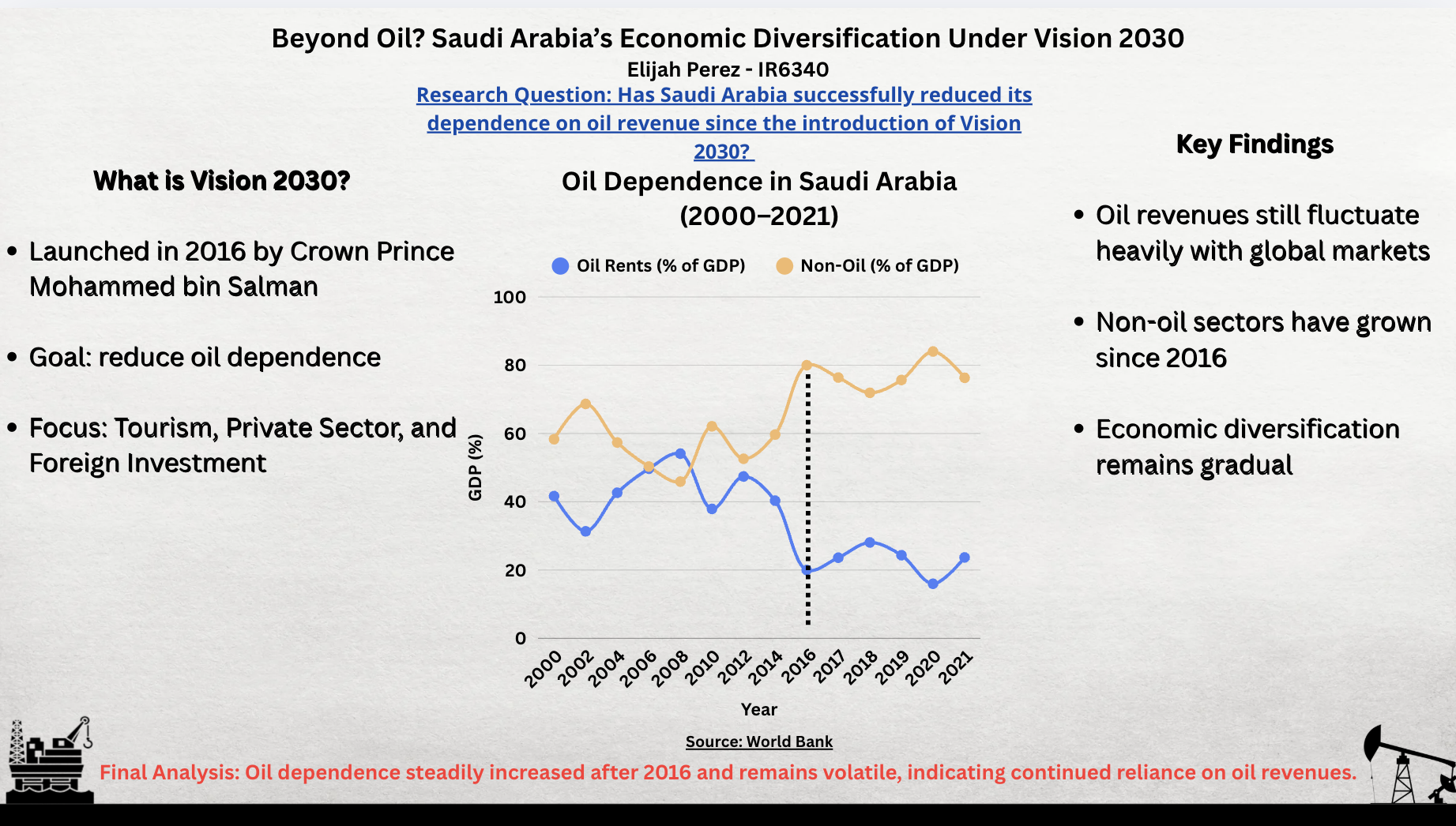
This infographic analyzes whether Saudi Arabia has reduced its dependence on oil revenue following the introduction of Vision 2030 in 2016. By using data from the World Bank on oil rents as a percentage of GDP, the analysis compares trends from 2000 to 2021 (latest available). Overall, the data shows that oil dependence declined after 2014–2016, coinciding with both the global oil price collapse and the launch of Vision 2030. Non-oil sectors have grown relatively, indicating a progressing shift toward economic diversification.
However, the findings also reveal that Saudi Arabia remains structurally dependent on oil. Oil rents continue to fluctuate in response to global market conditions, and these fluctuations still shape overall economic performance. While diversification efforts have been meaningful, they have not fundamentally transformed the structure of the economy.
This issue is important because continued reliance on oil exposes Saudi Arabia to economic volatility and external shocks. More broadly, the case highlights the challenges resource-dependent states face in achieving long-term diversification, even with significant policy reforms and financial investment.
Reference
World Bank – Oil rents (% of GDP), Saudi Arabia (2000–2021).


6 comments
Mía Perez
I like this article because it clearly shows the tension between Saudi Arabia’s Vision 2030 goals and its continued reliance on oil. I really enjoyed how you used the World Bank data to track changes over time, since it makes the argument feel grounded and convincing. It helped me understand that even with major reforms, diversification is a slow process and oil still shapes the economy in a powerful way. The focus on economic vulnerability really stood out to me.
Elizabeth Vazquez
Hello Elijah,
I would have appreciated more information and examples regarding how economic diversification is implemented within the context of non-oil sectors. Our perspectives align, as I have also highlighted Poland’s independence from Russian coal and gas imports. Additionally, I would have valued further details about the introduction of Vision 2030.
Yuta Satake
I was very engaged by your infographic and your analysis because it clearly shows how difficult it is to diversify an economy and alleviate overreliance on single economic sector. My article also focused on economic development in India and some regions in India has suffered from transition of economic development, so your analysis gives me a valuable implication about difficulties of structural change in economy.
Emilio Orona
Hey Elijah, this infographic does a great job at explaining the reduced reliance in oil due to the project launch of Vision 2030 in 2016. However, the analysis makes it clear that Saudi Arabia remains heavily tied to oil revenues. Even with growth in non-oil sectors, oil rents continue to fluctuate with global market conditions and still strongly influence overall economic performance. This connects to my article of Bosnia and Herzegovina in a broader structural sense, even though the contexts are very different. Both cases highlight how deeply embedded systems, whether oil dependence in Saudi Arabia or complex governance and economic fragmentation in Bosnia and Herzegovina.
Shaikha Alodssary
Hi Elijah
Your infographic offers an unbiased and comprehensive assessment of Vision 2030 for Saudi Arabia. The chart depicting the performance of the oil and non-oil industries is excellent at illustrating how the process of diversification is advancing. I found your incorporation of changes in global oil prices in explaining why reliance on oil remains to be a necessity very interesting. Your conclusions are in line with the information presented.
Haley Faucette
Hi Elijah! This is a great infographic, and has really helped me understand the reality of the “resource-curse” that states continue to face, even when they make an effort to diversify their economies. Your analysis of original data from World Bank is great as well. Thank you for your contributions!