Hello! I am a Forensics Biology and Bioinformatics double major, minoring in Environmental Science. I am graduating in 2027. I have a special interest in wildlife forensics and conservation. I also really love making art and birdwatching; my favorite bird is a long tailed grackle!!
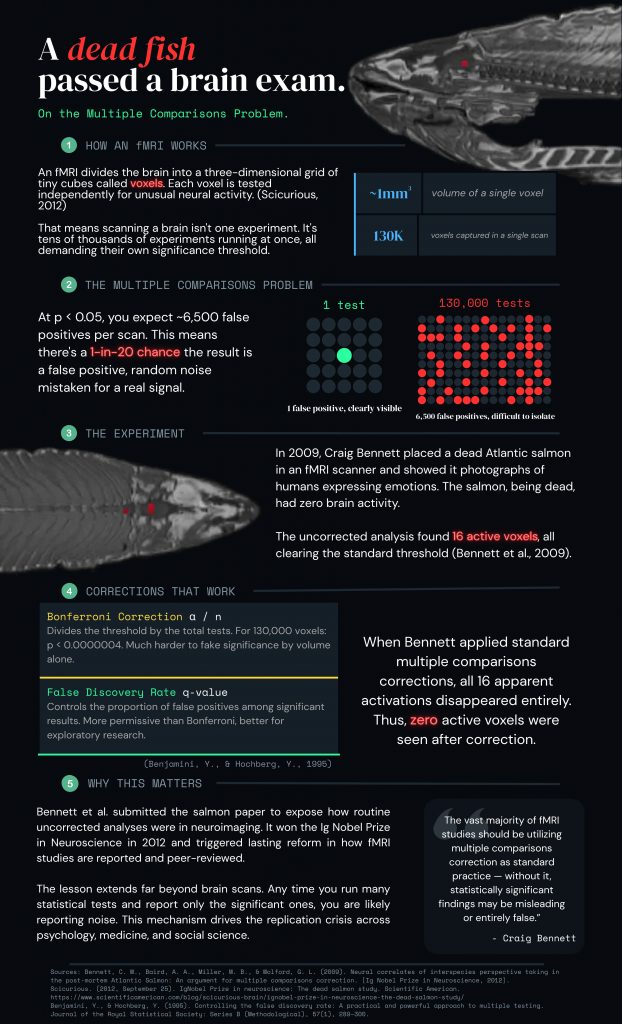
Hi Mary-Esther! For a moment I thought that the fish was actually somehow alive! Thank you for spreading awareness of how false positives can lead to the wrong conclusion. You managed to make an infographic about a hard-to-understand topic into a simple and easy to follow infographic, I had never heard of a voxel before and now I know that it the way fMRI divides the brain to scan for neural activity.
Hi Mary-Esther! What a title you have! It instantly inspired me with curiosity. Your infographic itself was really informative. I did not know anything about the world of neuroscience, but it makes sense that a “brain exam” is actually more than just one exam. And using a dead salmon to prove inconsistencies in these exams is definitely an intriguing way to bring light to an important issue. Good job!
Hello Mary-Esther! Your title immediately made me curious about how such a result was possible. Upon reading further, I understood your explanation that combining different statistical tests can be harmful and yield insignificant results if a researcher only reports the ones that support their specific case. This experiment is a perfect warning against data manipulation. Overall, your infographic was neatly organized, insightful, and very easy to follow!
What an interesting article! You explained the Bonferroni and False Discovery Rate so well and made it easy to understand with a real-life (or real-death in this case) example.

4 comments
Maurissio Gonzalez
Hi Mary-Esther! For a moment I thought that the fish was actually somehow alive! Thank you for spreading awareness of how false positives can lead to the wrong conclusion. You managed to make an infographic about a hard-to-understand topic into a simple and easy to follow infographic, I had never heard of a voxel before and now I know that it the way fMRI divides the brain to scan for neural activity.
Christian Molina
Hi Mary-Esther! What a title you have! It instantly inspired me with curiosity. Your infographic itself was really informative. I did not know anything about the world of neuroscience, but it makes sense that a “brain exam” is actually more than just one exam. And using a dead salmon to prove inconsistencies in these exams is definitely an intriguing way to bring light to an important issue. Good job!
Samantha Garcia Mora
Hello Mary-Esther! Your title immediately made me curious about how such a result was possible. Upon reading further, I understood your explanation that combining different statistical tests can be harmful and yield insignificant results if a researcher only reports the ones that support their specific case. This experiment is a perfect warning against data manipulation. Overall, your infographic was neatly organized, insightful, and very easy to follow!
Dr. Terry Jo Shackleford, Ph.D.
What an interesting article! You explained the Bonferroni and False Discovery Rate so well and made it easy to understand with a real-life (or real-death in this case) example.