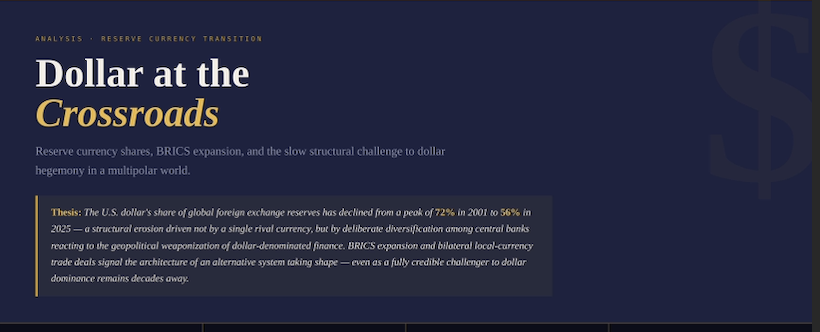

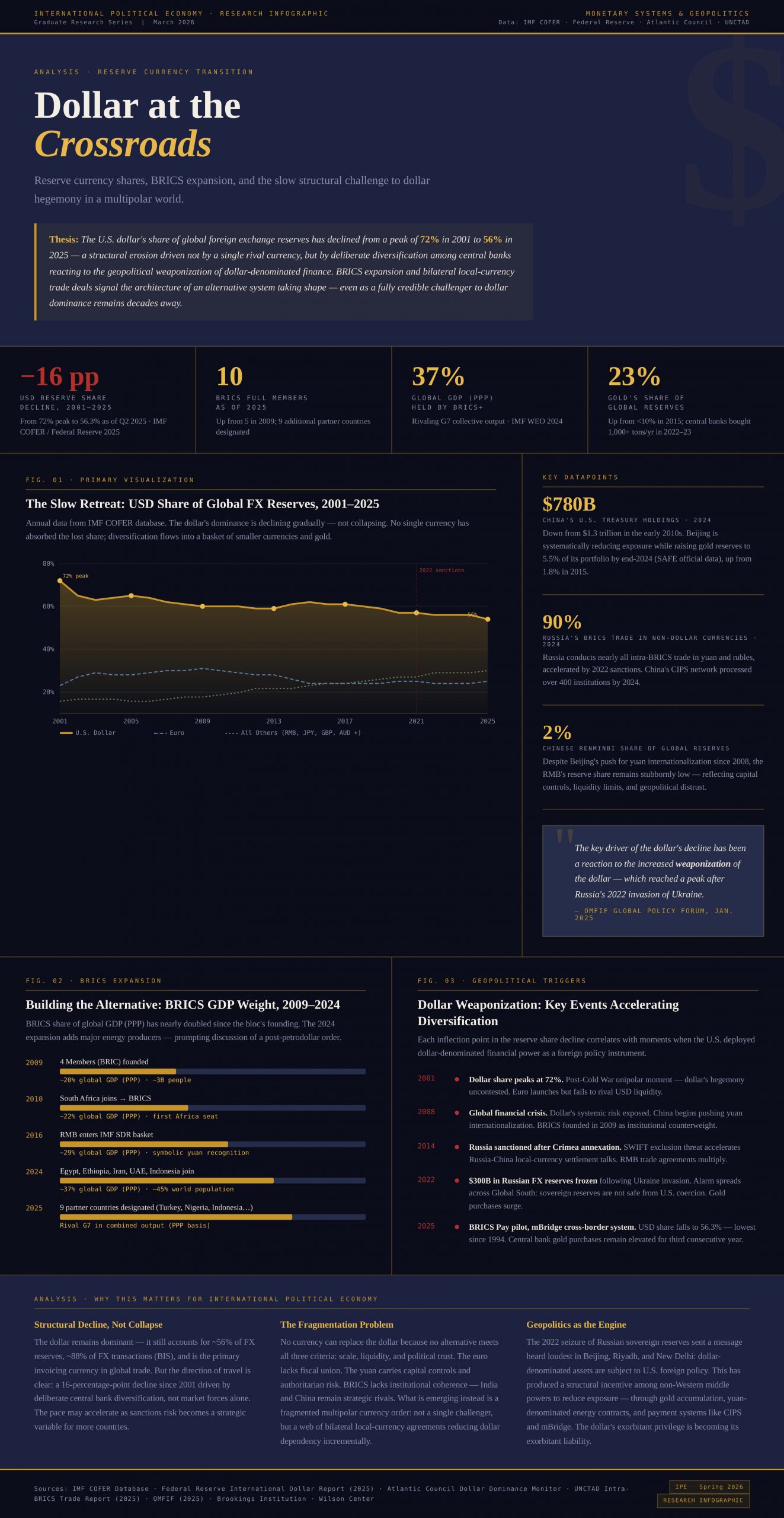
This work argues that the US dollar’s role as the world’s dominant reserve currency is in structural, though not terminal, decline. This information draws on IMF COFER data to show that the dollar’s share of global foreign exchange reserves has fallen from a peak of 72% in 2001 to 56% as of mid-2025, a 16-percentage-point erosion over two decades. Crucially, no single rival currency has absorbed that lost share; instead, central banks have diversified into a basket of smaller currencies and gold, whose share of global reserves has surged from under 10% to 23% since 2015. The BRICS expansion timeline contextualizes this trend: a coalition now representing 37% of global GDP has assembled around a shared interest in reducing dollar dependency. The geopolitical events timeline ties the data to its engine, particularly the 2022 freezing of Russian sovereign reserves, which gave non-Western governments concrete incentive to treat dollar exposure as strategic risk. Taken together, these patterns point not toward a single moment of dollar collapse, but toward the slow, deliberate construction of a parallel financial architecture designed to reduce coercive dependence on US-dominated monetary infrastructure.


2 comments
Eduarda Carvalho
What a great work, Michael! Your infographic is a compelling visual representation of a shift toward a more multipolar monetary order. It makes a complex issue much easier to understand. Key events accelerating diversification helps tell an enthralling story about the factors behind this outcome. I also found the section on the BRICS expansion particularly insightful, as it contextualizes how a coalition representing 37% of global GDP is actively working to reduce dependency on U.S.-centered financial system. In short, this is a data-driven analysis hard to contest. Well done!
Shannon Bowshier (Elms)
Hello!
Your infographic presents a really compelling and timely argument about the U.S. dollar’s position in the global economy. What stood out to me most is how you frame the dollar as being “at a crossroads,” which captures both its continued dominance and the growing pressures it faces from geopolitical and economic shifts. That framing makes the topic immediately engaging and helps the viewer understand why the issue matters beyond just economic theory. I also think your use of data is effective in illustrating these tensions. The visual elements help clarify complex dynamics, particularly how global confidence, trade relationships, and monetary policy interact. This aligns well with broader discussions in political economy about how financial systems are shaped not just by markets, but by power and institutional trust. In that sense, your project does a strong job connecting empirical trends to a larger conceptual argument. One suggestion I would offer is to make your main takeaway even more explicit visually, similar to how your title frames the issue, a clearly highlighted concluding statement could help reinforce your central argument for readers who are quickly scanning the infographic. Overall, though, this is a very strong project that clearly demonstrates both analytical depth and an effective use of data visualization.