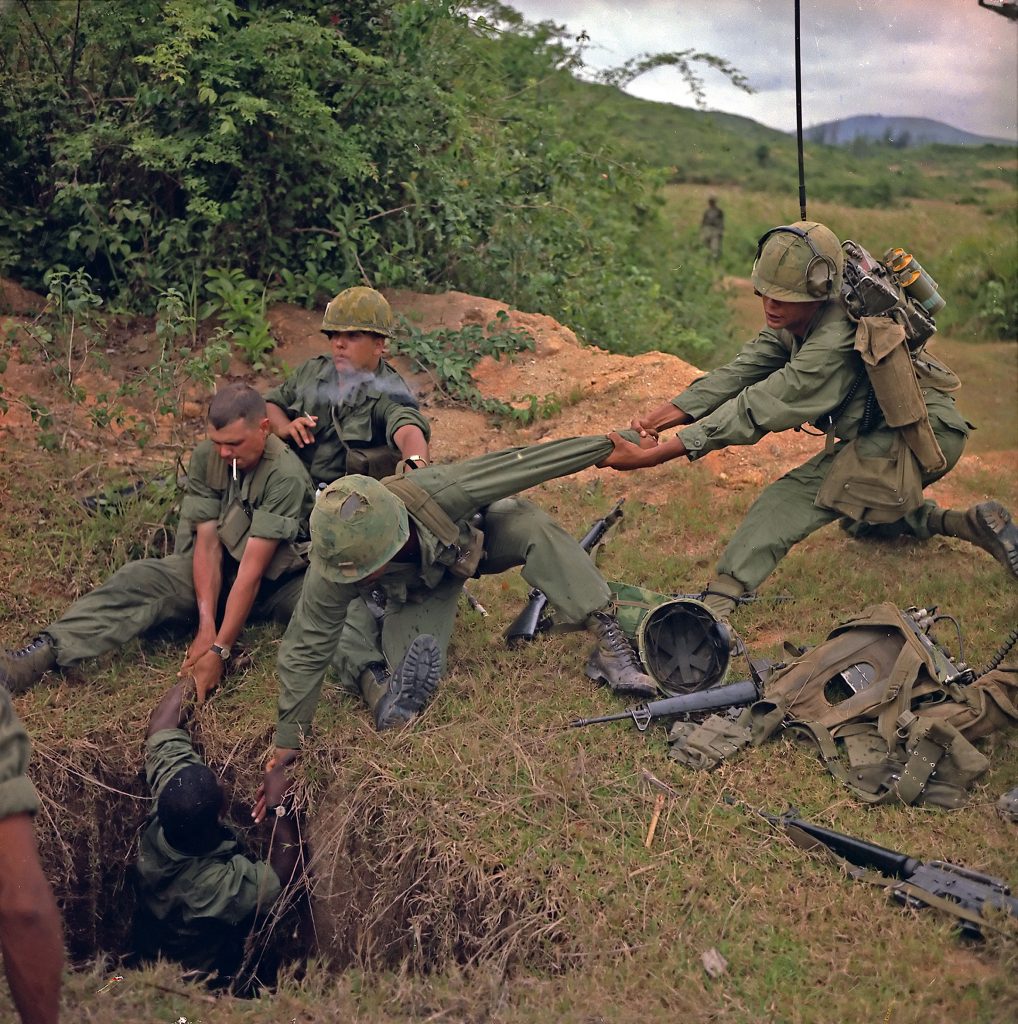

If you ever see a flashlight coming your way, you can fire away, but more than likely, you are already a dead man.1
January 7, 1966. The war in Vietnam was raging and the United States had only just begun sending regular combat units as opposed to advisers the year prior. President Lyndon Baines Johnson was steadily escalating the United States’ involvement in Vietnam in an effort to “combat communism.” Eight thousand men descend on a freshly bombed area, hoping to clean up the remnants of Viet Cong in a search and destroy operation. However, when they approached the bombed area, known as the Ho Bo woods, they found nothing but empty fortifications and some rice, evidence that there were once many more men there. The leaders of the Joint American-Australian force were stumped. Where could the Viet Cong have gone?2

They received their answer when one young American soldier sat down to rest, then began exclaiming that he had been stung or bitten on his nether regions. As he began to search for the offending creature, he discovered that what had “stung” him was a nail, protruding from a wooden hatch. This hatch covered a massive underground complex known as the Cu Chi tunnels, spanning some fourteen miles; and this was only one of many tunnel complexes in South and North Vietnam.3 The presence of these tunnels meant that future search and destroy operations would be failures as well, if the tunnels were not dealt with. These tunnels gave the Viet Cong a way to attack U.S. troops from behind, after they had passed overhead; then they could quickly slip back into their tunnels and seemingly vanish. The tunnels also allowed them to hide during bombing runs and as American tanks and helicopters flew by, effectively hiding them from the brunt of American military might. The tunnels could be destroyed using explosives, but these tunnels housed barracks, ammunition and food depots, hospitals, clinics, armories, and rooms with vital military intelligence. These things were often too deep in the tunnels to be destroyed by a blast at the mouth of the tunnel, as the Viet Cong designed their tunnels so that blasts could only destroy small segments. The tunnels were very well made, with sharp right angles every few meters to baffle the blast of an explosive charge, and they had breathing holes dug by taking rabbits and gophers to the bottom of a tunnel and letting them dig themselves back to the surface. After several attempts using tear gas, Acetylene gas, and explosives to flush out the tunnels failed, a new plan emerged. Someone would have to enter the tunnels.4
And thus, the “tunnel rats” were born. These were men, generally small in stature to better fit the small tunnels designed for the smaller Vietnamese physique, and without fear of tight spaces or total darkness, although these are things many tunnel rats would develop after their time in the underground complexes. Armed with nothing more than a flashlight, which was hardly ever used for fear it would alert Viet Cong to the Tunnel rat’s location, a handgun, and a combat knife, sometimes wearing a battery-powered headset, connected to a long cable to let them relay information back to their comrades waiting at the mouth of the tunnel, these men would be lowered into a tunnel, and begin their search.5 Originally made up of men from the famous “Big Red One” 1st Infantry Division present at the original discovery of the Cu Chi tunnels, “tunnel rats” became an unofficial description for someone who had volunteered for this job. This work was mentally and physically taxing, with many volunteers giving up the duty after a few runs, or in many cases, a close call with a Viet Cong soldier in the dark confines of a cave.6
Part of the reason it was such a loathed experience was due to how dangerous an ordeal exploring the tunnels was. If an American tunnel rat were to run into a Viet Cong soldier, the encounter would devolve into hand to hand combat, as firing one’s pistol was very dangerous in tunnels that were barely shoulder-width.7 Firing the large .45 caliber M1911A1 pistol one was issued would definitely lead to ruptured eardrums. This led many of these men to bring captured Vietnamese-used Russian pistols or guns brought from home that were of a smaller caliber–.22 and .38 caliber revolvers being particularly common–that could be more safely fired in the small confines of the tunnels.8

The dangers did not end there either, as the tunnels were frequently booby-trapped, sometimes even with poisonous or venomous snakes and insects, or they had dangerous pits filled with water or gas designed to keep these things away from their living areas of the tunnels. The tunnels were frequently incredibly hot and humid, cramped, sometimes as small as 2.6 feet tall by 2.5 feet wide, and full of unpleasant stagnant air, prompting many tunnel rats to don gas masks in an attempt to make breathing easier.9 Even exiting a tunnel was not safe, as a tunnel rat could travel some distance while underground, then emerge elsewhere, potentially startling a nearby American soldier, which could lead to him being shot. Many tunnel rats would bring smoke grenades with them to use to alert any nearby troops that a friendly would be emerging from a tunnel.10 Because of these hardships, tunnel rats soon gained a reputation as being very courageous, smart, and incredibly lucky to escape a tunnel without dying, and the tunnel rats themselves began to use the motto “Non gratum anus rotendum” or “not worth a rat’s ass.”11
Even with these difficulties, the majority of tunnel rats were very successful. The tunnel rats of the 1st Infantry Division, the only one with any kind of formal training, was especially successful. Consisting of a number of men formally trained to enter the tunnels, radio operators to communicate with them, a medic and a pair of former Viet Cong who could act as translators, the team, led by Sargent Robert Woods, killed 3 Viet Cong soldiers and captured 153 more in a tunnel in August of 1968, just to name one of their most impressive raids. Outside of the formally trained 1st Infantry Division, the volunteer tunnel rats of other companies were sometimes successful as well, securing vital military intelligence, an enemy hospital, or sometimes stores of weapons; these captures accounted for a large portion of seized Viet Cong weapons.12
The tunnel rats where born out of necessity. The United States military had little experience with non-conventional warfare, and needed to adapt quickly to the guerrilla warfare employed by the Viet Cong. During the Vietnam War, even the Australian armed forces had their own “tunnel rats” whom they called “ferrets,” and with the Soviet war in Afghanistan in the 1980s, many Soviet soldiers faced similar hardships in the tunnels of the Mujahideen. Even today, the United States Marine Corps faces similar issues in fighting the Taliban in the cave-like “Kyareses,” or irrigation tunnels of Afghanistan.13 The tunnel rats of Vietnam were one of the first adaptations that the U.S. military made to prepare itself for a new type of warfare, unlike the conventional wars the U.S. had fought in before. But as the number of US casualties from Vietnam rose, American public opinion shifted from support to dissatisfaction, ultimately leading to the United States pulling out of Vietnam, but not before the United States military had learned valuable lessons about guerrilla warfare.

- James Gillam, “Death dance in the dark: James Gillam’s most terrifying moments in Vietnam came in the pitch-black darkness of an enemy tunnel,” Vietnam, 2011., 52, Academic OneFile, EBSCOhost ↵
- Encyclopedia of the Vietnam War: A Political, Social, and Military History, 2011, s.v. “CRIMP Operation,” by Chris Tomas. ↵
- Encyclopedia of the Vietnam War: A Political, Social, and Military History, 2011, s.v. “CRIMP Operation,” by Chris Tomas. ↵
- Encyclopedia of the Vietnam War: A Political, Social, and Military History, 2011, s.v. “Cu Chi Tunnels,” by Richard D. Starnes; “South Viet Nam: The Tunnel Rats,” Time, March 4, 1966. ↵
- Encyclopedia of the Vietnam War: A Political, Social, and Military History, 2011, s.v. “Tunnel Rats,” by James T. Gillam. ↵
- Encyclopedia of the Vietnam War: A Political, Social, and Military History, 2011, s.v. “Tunnel Rats,” by James T. Gillam. ↵
- “I’m not alone down here!” Vietnam, September/October 2015, 42. ↵
- “South Viet Nam: The Tunnel Rats.” Time, March 4, 1966. ↵
- Encyclopedia of the Vietnam War: A Political, Social, and Military History, 2011, s.v. “Tunnels,” by Scott R. Demarco. ↵
- “I’m not alone down here!” Vietnam, September/October 2015, 42. ↵
- George C. Herring, “Vietnam Remembered,” The Journal of American History 73, no. 1 (1986): 152-64; Encyclopedia of the Vietnam War: A Political, Social, and Military History, 2011, s.v. “Tunnel Rats,” by James T. Gillam. ↵
- Encyclopedia of the Vietnam War: A Political, Social, and Military History, 2011, s.v. “Tunnel Rats,” by James T. Gillam. ↵
- Timothy Gusinov, “‘Kyareses’: Taliban’s Death Trap or Escape Route?” Military Intelligence Professional Bulletin 28, no. 2 (April 2002): 46. ↵
58 comments
Alise Balderas
This is an interesting type of warfare. What caught my attention the most was how the Vietcong created breathing holes by taking rabbits and gophers into the tunnels, knowing that they would dig their way out. The creativity and strategy behind that logic amazes me. What resonates with me is how the tunnels were described as being small, uncomfortable, hot, and dangerous, but some U.S soldiers still volunteered and sacrificed themselves for their country and their other soldiers. So many things could have gone wrong, but they still willingly went in, and the amazing thing is that most of them made it out. This article captures true heroism and bravery.
Ryann Cervantes
Very great and informative article. I always wondered just how much the Vietcong had done to win the war and creating these cave like systems serves as a lesson to how far someone is willing to go to win a war, and how creative we can be during times of war. I can’t imagine having to deal with that and I feel that might have lead to even more dissatisfaction with the war.
Manuel Aguilera
This is the first time I have had heard of such tunnels existing during the Vietnam War, I feel that it was pure luck that a soldier happened to just stumble upon this (or rather sit on it) causing another front to upon up in the face of war. Personally, there was no way that I could have done something like this (which could perhaps change under extreme circumstances) even though I am very small in stature. The thought of encountering an opponent seems very dangerous and does not leave either side with very many options. I also have a fear of cramped places. I digress, the article was well written and succeeded in doing what it was written for, informing.
Edward Cerna
This was an amazing article to read about and I find it amazing how the viet cong had constructed the tunnels about 14 miles long. The term “tunnel rats” was born when the United states couldn’t find a successful way to get rid of these tunnels. What they did to fix this was send men that were small in physique down there with nothing but a flash light, pistol, and a knife. War is scary, I can’t imagine how scary it must have been crawling in a tight dark tunnel that contain people that wanna kill you.
Mario Sosa
The term “tunnel rats” may have been familiar to me, but I never knew what they did exactly. I could never imagine myself ever doing a tunnel rat’s work. With such harsh conditions that the tunnel rats had to endure, I am surprised that this strategy was a success. I found it to be interesting how different varieties of tunnel rats would be used in future conflicts in places like Afghanistan. Overall this was a nicely constructed article, good job!
Richard Navarro
An amazing article, very interesting and grabbing at that. Tunnel rats were brave soldiers during the war in Vietnam. The descriptions in the text provide vivid and touching imagery, to whom I believe, reads it. I could only imagine how these soldiers felt during their excursion through these long – hot tunnels. Being in the Army, I can only relate about 1 percent of what these soldiers felt like. Being in the woods all hot and sweaty really does take a toll on the body. These brave men of the 1st Infantry Division crawled through such tight spaces while shirtless and under extreme pressure that they faced the possibility of coming into close combat with the enemy. You could only hope that those low grade flashlights the Army issues soldiers pulled through during their crawl through the Chu Chi Tunnels.
Faisal Alqarni
Hello Nelson, first of all the images you used were very alive and vivid that they just hooked me from the beginning. War is an evil thing I believe but the ingenuity it brings out of people is really impressive as shown by the Veit Kong. I like how this tunnels led to the formation for a whole new unit in the invading American forces and how this led to a respected and successful tunnel rat regiment to come out of this war. This tunnel rats were very brave I do not think I could go into such a hole not knowing what lay beneath there. The captured viet cong just make the efforts of this tunnel rats that more impressive. Very interesting article here.