

Sustaining Ethiopia’s Development
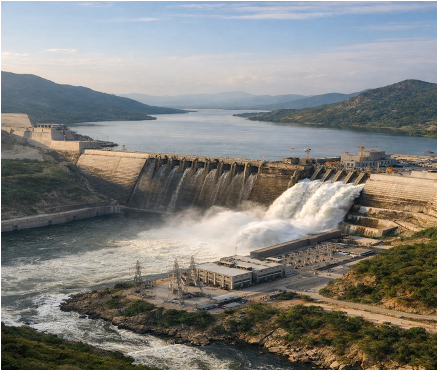
The Grand Ethiopian Renaissance Dam (GERD) on the Blue Nile represents a major development project for Ethiopia. This massive barrier on Africa’s longest river is reshaping the landscape and the nation’s future, carrying both promise and risk for both Ethiopia and its neighbors downstream. For Ethiopia, the dam brings enhances its infrastructure and will increases its hydroelectric power output. It will stimulate economic growth and strengthen energy security.
With an expected capacity of about 6,000 megawatts, the GERD will be the largest hydroelectric power plant in Africa, potentially doubling Ethiopia’s current electricity output.1 This will help thousands of Ethiopians get out of poverty through national development.
However, beyond statistics and policy debates, ordinary people in the neighboring countries downstream are feeling the impact of the dam. Farmers especially question whether the water will continue flowing, while communities in Ethiopia who see the dam as a long awaited opportunity for stability and progress from the dam withhold most of its water.
For Ethiopia, the dam is a major achievement. But for downstream nations along the Blue Nile, the consequences are far less positive. The dam has raised serious concerns from Egypt and Sudan, two countries who rely heavily on the water of the Nile for agriculture, drinking water, and for the industries that underpin its economic stability.
Egypt depends on the Nile for about 97% of its freshwater supply, making it one of the most water dependent countries in the world.2
Concerns raised include the reduction of the water flow, drought risk, and the lack of binding agreements, all of which have created political tensions in the region. From farms to factories, Ethiopia’s transformation reflects not only industrial change, but also a growing test of regional cooperation and trust.
Ethiopia at a Turning Point
Ethiopia constructed the Grand Ethiopian Renaissance Dam (GERD) in response to the challenges they faced: poverty, limited access to electricity, and dependance on an agrarian economy. More than 40% of Ethiopia’s population still lacks access to electricity, highlighting the urgency behind large scale energy projects like the GERD.3 The dam represents an effort to meet the needs of a rapidly growing population and the rising energy demand from its growing industries. The development of this large scale infrastructure project allowed Ethiopia to claim more control over the Blue Nile.4
While the dam symbolizes progress, it also marks a turning point where development intersects and challenges international responsibility. The dam did not fix all of Ethiopia’s problems, instead, it introduced new ones, including disputes over water, complaints about environmental damages, and the heightened need for collaboration with downstream countries.5
Now, political responsibility and regional stability are shifting Ethiopia’s transition towards a critical turning point.6 Ethiopia can no longer focus mainly on internal development because its actions have an impact on neighboring nations that depend on the same water that Ethiopia will de facto control with its dam.7 Every decision about the dam, from opening the gates and letting water out to completely cutting off the water supply will impact Sudan and Egypt and their rural agriculture.
Ethiopia’s transition started over the last two decades; it was most visible with the construction of the dam which began in 2011. The dam marked the shift in its development; it affected national progress but also became tied with international diplomacy. Ethiopia has struggled with poverty, limited access to electricity, and heavy dependence on agriculture, there has also been historical inequality in Nile’s water because of the colonial era agreements that excluded other nations like Sudan and Egypt. Will Ethiopia remain accountable for whatever happens to those communities along the river? Should they even care if it does not affect them? The moral line is yet to be drawn.
Rising Tensions Along the Nile
Ethiopia’s development clashes with the dependance of the downstream nations on the Nile. A primary-sector-driven economy, Ethiopian employment and GDP come from its agriculture and services sectors. Ethiopia continues facing a persistent and significant trade deficit, as the cost of its imported manufactured goods and fuels consistently outweighs the revenue it can generate from its exports. Ethiopia has achieved periods of robust GDP growth, but still must navigate the structural challenges associated with its status as a Least Developed Country (LDC) with low per-capita income.8 Without a binding, enforceable agreement, the operation of the Grand Ethiopian Renaissance Dam fuels regional conflict between Ethiopia, Sudan, and Egypt.9 Egypt is the one that faces the most repercussions from the dam, as they face the most severe reduction in water flow, they see this as a potential threat to national security.10 Sudan on the other hand can be benefited by the flow control of the water, but also faces long term uncertainty.
The Blue Nile and other tributaries form about 85% of the water that reaches Egypt. Downstream nations are worried because there is no biding agreement that protects them from the misuse of the dam, which will heavily affect them, Egypt relies almost entirely on the water of the Blue Nile. Sudan owns 3 dams that are either on
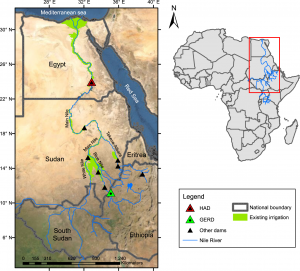
the Blue Nile or connected to it; Roseires Dam, Sennar Dam, Upper Atbara, all of the three countries operate under the 1959 Nile Water Agreement, which allocates 55.5 billion cubic meters to Egypt and 18,5 to Sudan, excluding Ethiopia entirely.
The unequal distribution is rooted in colonial era power dynamics that privileged downstream countries. This imbalanced was reinforced by 1929 Anglo-Egyptian Treaty and later by the 1959 Nile Waters Agreement, both of which excluded upstream nations like Ethiopia. Quite unimaginable because Ethiopia contributes the majority of the Nile’s flow through the Blue Nile. As a result Egypt and Sudan were granted nearly all of the river’s water.
These colonial legacies continue shaping modern tensions. For decades, Egypt has viewed the Nile as an acquired right, while Ethiopia and other upstream countries see the historic agreements as illegitimate and restrictive.11 What seemed to be a perfect project to bring economic growth and stability plus energy, has transformed into a diplomatic quagmire. No longer just a development project, now a battle where fear over water security and the need to assert national control have grown. A dichotomy between survival and progress.12
The Cost to Farmers and Cities
Farmers are the ones who fear the most about the dam being filled, especially in rural Egypt and Sudan, the dam became a mark of fear and uncertainty. Generations and generations of families have been dependent of the river; the families have begun to notice the level of river lowering they are being concerned with making the decision of planting less crops or risk losing all.
Many farmers are forced to choose between planting fewer crops or risking total loss. Crops that once thrived are now struggling. In Sudan, fertile soil cracks under prolonged dryness, while in Egypt, irrigation canals run thinner, sometimes barely reaching distant fields.13
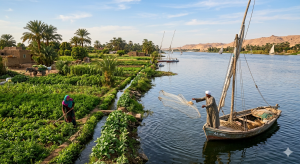
This is not just an environmental issue, this threatens income, food security, traditions, and the daily survival of the people. In Sudan, fertile soil is beginning to crack under the weight of prolonged dryness, splitting into jagged patterns as the sun beats down relentlessly. Crops that once stood tall (sorghum and wheat) now appear stunted and yellowing, their leaves curling inward as if trying to preserve the last traces of moisture. In Egypt, the situations is unfolding differently. Irrigation canals that once carried a constant, life giving stream now run thinner, some reduced to shallow trickles that barely reach the edges of distant fields. Farmers wandered further into their land, kicking up dust where the soil should be damp, digging their hands into the ground only to find it dry beneath the surface. Palm trees and vegetables crops that once thrived under predictable watering schedules now struggle to survive, their growth uneven and fragile.
Renewed Hope in Ethiopia
Ethiopians see the dam as a symbol of hope and progress, because for the communities inside of Ethiopia who have been struggling without the resources they need to survive or have a prosperous future, will not longer have to face those challenges that have plagued their life and their communities.14 An entire season’s income can disappear if the water does not arrive on time. Farmers not only worry about their crops, but about how they will feed their families. Elders speak of a river that used to be predictable, about how the river was a lifeline which shaped traditions and the daily life of the people around the Blue Nile. It is crazy how decisions made in another country will decide if your crops survive. The dam is not only a political issue, but it has also become in a daily struggle for survival.
To these communities, the GERD is not a threat, but a lifeline, a path toward a more stable and prosperous future. This contrast highlights the complexity of the issue. Progress for one nation can mean uncertainty for another.
Cooperation required!
Cooperation is still on the table; the transition is not yet set in stone.15 Ongoing negotiation between Egypt, Sudan and Ethiopia mean that cooperation between these nations is still a work in progress that has been slow and fragile because of the conflict the dam created.16 A potential solution can be found in the binding agreements, if stipulated clearly, the rules about filling and operating the dam, especially during the drought seasons, can create a better understanding in between the countries and find a middle ground, this way the downstream nations are protected and they feel seen and respected. If successful, this situation could transform from a source of division into an opportunity for collaboration and regional stability.
Will the Nile Dry Up?
The Grand Ethiopian Renaissance Dam represents more than infrastructure, it symbolizes a critical moment in Africa’s development. It highlights the tension between national progress and regional responsibility.
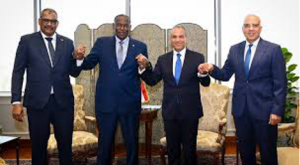
Temporary agreements and mediated talks have reduced tensions somewhat, but only reduced, not eliminated. These agreements do not worked especially when the trust level between countries is low. For a solution to work, the three nations have to be transparent with each other, meaning sharing the data, they need international mediation, bringing an outsider might not seem like a good idea to some, but that person will have a cold mind and it is someone who will focus on finding solutions not problems. Commitment, the three nations need to commit to a long term cooperation, instead of just a short term deal that focuses on the national interest at that moment. Conflicts might linger but with these steps the transition might help form new collaborations, provide more stability, and foster understanding between the nations, instead of division and hate.17
- “The Grand Ethiopian Renaissance Dam – Political and Legal Aspects,” European Institute for International Relations, January 29, 2026. ↵
- Sanaa El Banna, “What the Grand Ethiopian Renaissance Dam Means to Egypt,” Al Sharq Strategic Research, January 6, 2020. ↵
- Caila Glickman, “Development of the Grand Ethiopian Renaissance Dam,” Council on Foreign Relations, December 7, 2016. ↵
- JEPA Africa, “Rising Currents: How Ethiopia’s Renaissance Dam Is Shaping Africa’s Energy Landscape,” June 9, 2o25. ↵
- The Grand Ethiopian Renaissance Dam – Political and Legal aspects, European Institute for International Relations, January 29, 2026. ↵
- Caila Glickman, “Development of the Grand Ethiopian Renaissance Dam,” Council on Foreign Relations, December 7, 2016. ↵
- Sanaa El Banna, “What the Grand Ethiopian Renaissance Dam Means to Egypt,” Al Sharq Strategic Research, January 6, 2020. ↵
- United Nations Conference on Trade and Development (UNCTAD), “General Profile: Ethiopia,” UNCTADstat, accessed April 12, 2026, https://unctadstat.unctad.org/CountryProfile/GeneralProfile/en-GB/231/index.html. ↵
- Dispute over the Grand Ethiopian Renaissance Dam (GERD), Climate Diplomacy, Accessed January 31, 2026. ↵
- “Egypt Says Ethiopia’s Completed Power-Generating Dam Lacks a Legally Binding Agreement,” AP News, July 4, 2025. ↵
- Amna Almesafri, Sohaila Abdulsattar, Alia Alblooshi, Raed A,Al-Juboori, Nicholas Jephson, and Nidal Hilal, “Waters of Contention: The GERD and Its Impact on Nile Basin Cooperation and Conflict,” Water 16, no, 15 (2024): 2174. ↵
- Troubled Waters: Why is a Nile dam causing such tension? Euronews, November 11, 2025. ↵
- Dina Sakr and Mohamed Ezz, “Surging Nile Waters Inundate Egypt and Sudan, Revive Dispute over Ethiopian Mega-Dam,” Reuters, October 7, 2025. ↵
- Fuadyusuf, “The Grand Ethiopian Renaissance Dam: Ethiopia’s Renaissance on the Nile,” Waliifwalin, April 2025. ↵
- Dispute over the Grand Ethiopian Renaissance Dam (GERD), Climate Diplomacy, Accessed January 31, 2026. ↵
- Sanaa El Banna, “What the Grand Ethiopian Renaissance Dam Means to Egypt,” Al Sharq Strategic Research, January 6, 2020. ↵
- The Grand Ethiopian Renaissance Dam – Political and Legal aspects, European Institute for International Relations, January 29, 2026. ↵
18 comments
Valentín García
Adolfo, I found the scope of your article fascinating in the manner you explore the implications for the dam, and how it may affect Ethiopia, Sudan and Egypt. Your exploration of the GERD as both Ethiopia’s hope and a potential source of regional conflict is nuanced, expressly because it considers both the domestic and external implications for its construction. More fascinating is how Ethiopia views colonial-era treaties as illegitimate, to contrast with Sudan and Egypt’s fears for water security. What you discuss, in principal, are matters of national sovereignty and self-determination — subjects that are indeed novel for the scope of these articles our SP26 class was tasked with composing.
In a way, this tension between national sovereignty and shared resources felt especially relevant, as it parallels themes in my own article about Tainos in Cuba; how communities and nations fight to control their own destiny and resources after long periods of external control or erasure.
The stakes are high in situations like this, as seldom can they be brought to a productive impasse where equitable solutions can be discussed — sometimes there is no solution that can please all parties, alas, the implications in your article, given the circumstances, is indeed riveting. As you state in your article conclusion, however, transparency is the only value that will foster progress. Good work, Adolfo.
Mía Perez
I like this article because it clearly explains how the GERD is both a development opportunity and a source of tension at the same time. I really enjoyed how you pointed out the different perspectives of Ethiopia, Egypt, and Sudan, especially how the same river can mean progress for one country and fear for another. It helped me understand the real human impact behind the political conflict, not just the statistics or policies.
Rosa Inocencio
Hi Adolfo, I really enjoyed reading your article, it was very informative and straightforward. I liked how in detail you went about GERD and how you mentioned the good which is that its a source of development, but you also mentioned the bad, which is how it can also cause tension with downstream countries like Egypt and Sudan by putting water security at risk. Great Article!
Silvia Benavides
Hello Adolfo,
Your article does a very good job of keeping your audience engaged and keeps the flow of the topics that must be talked about in a concise way. Amazing job
Elizabeth Vazquez
Hey Adolfo,
The decision between life and death is a critical topic that should be central to political discussions on environmental stewardship, particularly concerning water resources. Given the projected scarcity of water in the coming years, this issue could potentially lead to significant conflict in the future. While the challenges faced by farmers are longstanding, having reliable access to water should, in principle, prevent resource scarcity from hindering their agricultural efforts. Would a story that portrays the struggle for water from the perspective of a local individual further engage your reader?
Kamilah Rodriguez
Hi Adolfo, your article does a great job unpacking how the GERD represents both national progress and regional strain. Your use of farmers experiences made the stakes feel real, not just political. The piece clearly shows how water, power, and diplomacy collide in ways that shape everyday lives. You also did a great job showing Ethiopia’s internal motivations, especially how energy poverty and uneven development push the country toward large‑scale infrastructure despite regional backlash.
Christian Molina
Hello, Adolfo! The handling of the dams in Ethiopia is something I have actually been keeping an eye on for a while. Even so, I’ve not yet been able to find what I think would be an acceptable solution yet. Countries need to look out for themselves, but they also need to care for each other. Optimistically, I hope they find a way to compromise with the nations downstream.
Maurissio Gonzalez
Hi Adolfo! I remember hearing about Ethiopia’s plan to construct a dam a few years ago and it having been met with backlash. I believe that it is a good decision for Ethiopia, as you addressed it would be very helpful for farmers. I am glad that cooperation between the nations is still on the table. Since one of the affected countries for the dam is Egypt, I wonder if this would have any repercussions to the country I did research on Tunisia, if Egypt ever needs help with water, Tunisia could potentially help.
Emilio Orona
Hey Adolfo, this article has a very interesting paradox in Ethiopia. You show us how GERD is both a symbol of national progress and a source of regional tension, revealing how development projects can reshape not only economies but also international relations. Ethiopia is reducing poverty through hydroelectric investment but at the same time depend on nations like Egypt and Sudan due to the downstream. This connects to my article of Bosnia and Herzegovina because infrastructure projects or peace agreements end up generating new layers of complexity that affect multiple actors beyond the original problem.
Yuta Satake
Hello Adolfo, I really enjoyed reading your article! Your article was very insightful and valuable because it showed how development of one nation could affect other nation’s development. I thought that your argument that international cooperation was essential around the Dam area to equally distribute resources has connection to my article that focused on economic development in India where there is a variety of ethnic groups within the nation.