
Acknowledgments:
I would like to thank Dr. Lori Boies for her guidance and encouragement in researching the different aspects bioinformatics has in public health and its positive effects in improving and advancing the world of medicine. I also would like to thank my friends and family for their support during this research process. I am thankful for this opportunity to present this research and its unique approach towards medicine and the community.

21 comments
Dillon Lopez
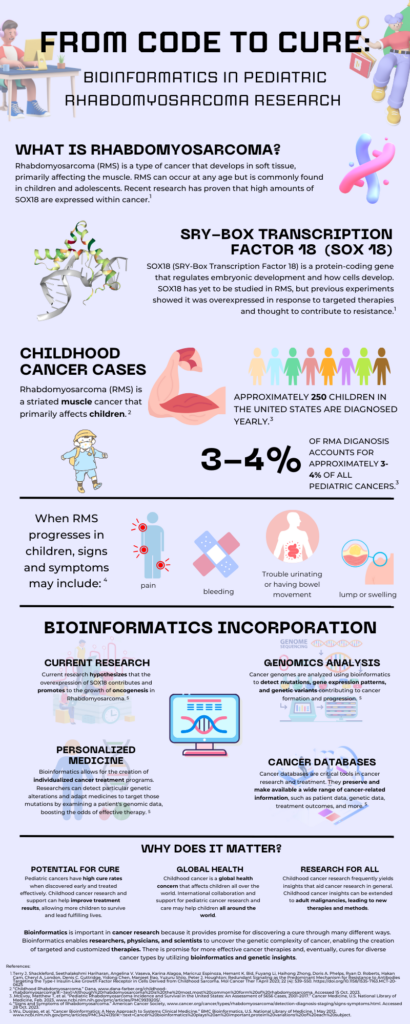
The way you broke down SOX18 and why it matters in rhabdomyosarcoma was super helpful, especially since pediatric cancers don’t always get much attention. The visuals also made the information more approachable. One thing you could improve is simplifying some of the bioinformatics text so people without a science background can follow along easier. Overall, this infographic does a great job showing why this kind of research actually
matters for real patients and their families.
Garrett Ticer
Hey Van! I really like how organized and creative this infographic is. It’s really easy to follow and honestly helped me learn a little bit about your topic in such a short time. It was very informational and fun to follow with all the images. I think you did a really nice job of bringing everything together and separating what needed to be separated for flow.
Joseph Ferrer
I thought this infographic did a good job explaining a serious topic in a clear and organized way. I liked how it broke down what rhabdomyosarcoma is and then showed how bioinformatics helps researchers study it. The visuals made the information easier to understand, especially for someone who is not very familiar with cancer research. I also appreciated the section explaining why this research matters for children. One small improvement could be using slightly less text in some sections, but overall, it was informative and easy to follow.
Angel Yandel Gonzalez
I found this infographic really interesting because it connects technology with helping kids who have cancer, which made the topic feel more meaningful and real. I appreciated how it explained rhabdomyosarcoma in a simple way and showed how bioinformatics can be used to study genes like SOX18. The visuals made the information easier to understand and less overwhelming. One suggestion I have is to add a short real-life example or patient story to make the emotional impact even stronger. Overall, this infographic clearly shows how science and technology can work together to improve lives, which I found inspiring.
Angel Yandel Gonzalez
Hello Van.
I found this infographic really interesting because it connects technology with helping kids who have cancer, which made the topic feel more meaningful and real. I appreciated how it explained rhabdomyosarcoma in a simple way and showed how bioinformatics can be used to study genes like SOX18. The visuals made the information easier to understand and less overwhelming. One suggestion I have is to add a short real-life example or patient story to make the emotional impact even stronger. Overall, this infographic clearly shows how science and technology can work together to improve lives, which I found inspiring.
agarcia428
Hi Van! I’ve heard about RMS, but never about what it really was, this presentation was neatly organized. I wonder if a cure will come up in the next few years, and what exactly it would be. Hearing about the bioinformatics involved was also an eye opener since I didn’t really know what they did, but it seems like tedious work, and I respect those that pursue it.
Aimee Diaz
I really appreciated this infographic because it clearly explains a complex and emotionally heavy topic in a way that feels accessible without oversimplifying it. The connection between bioinformatics and pediatric rhabdomyosarcoma research was especially meaningful, since it shows how data driven science can directly contribute to understanding rare childhood cancers. I found it powerful how the infographic linked gene expression, personalized medicine, and long term research impact, reinforcing that bioinformatics is not abstract but deeply connected to improving outcomes and advancing care for children and families affected by cancer.
Nicole Vanegas
This was a super informative infographic, yet really easy to follow along with. I really appreciate the way you broke down Rhabdomyosarcoma, bioinformatics, and the intersection of the two. As someone who knows very little about the computational world, I didn’t fully understand how impactful bioinformatics is in cancer therapeutics. I’m curious how it can be used outside of treating disease. Awesome infographic!
jrosas11
I can truly appreciate how this infographic makes a complex topic like bioinformatics and pediatric rhabdomyosarcoma research very clearly organized. As someone who is not very knowledgeable about how computational tools can improve health outcomes, seeing the connection between data analysis and research helped me gain a better understanding. The visuals and explanations help solidify scientific concepts that many people have never encountered before. My only suggestion would be to make the font size more consistent in all sections so that every part is equally easy to read, that would make it even more observer friendly, but overall really great work!
Samantha Nguyen
Hi Van! This poster was very insightful! I really love the visuals and little details like the icon where it develops on the body. I had no idea how much goes into rhabdomyscarcoma research. I am glad it can be treated if found earlier on, but I can’t even imagine how many untreated children walk around with this disease unaware of its serious effects. I am curious to know how you got into this research; it seems very interesting!