
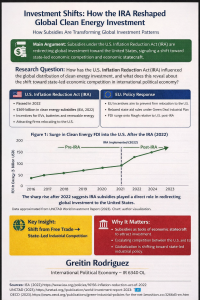
This project examines how subsidies under the U.S. Inflation Reduction Act (IRA) have reshaped global clean energy investment patterns. It argues that these subsidies are redirecting foreign direct investment toward the United States by creating strong financial incentives for firms in sectors such as electric vehicles, batteries, and renewable energy. As a result, companies are relocating operations to benefit from these policies, leading to a noticeable surge in clean energy investment in the U.S. after 2022. This shift highlights a broader transformation in the global economy, where countries are increasingly using state-led industrial policies and subsidies as tools of economic competition rather than relying solely on free market principles.


7 comments
Mía Perez
I like this article because it clearly explains how the Inflation Reduction Act is changing the global clean energy landscape. I really enjoyed how you pointed out the connection between government subsidies and companies relocating investment to the U.S. It helped me understand how policy can directly shape global economic competition, especially in industries like electric vehicles and renewable energy. The idea that countries are shifting toward state-led industrial strategies stood out to me as especially important and interesting.
David Tullius
Greitin,
Your infographic shows the clear effect that the IRA had on energy investment. It is in the best interest of the globe to transform our economies to clean energy, and that was not likely to happen – at least not any time soon – solely through private sector investment alone. It is encouraging that this trend is measurable so as to be argued in the future as the need for similar initiatives are sure to arise. I m looking forward to the main project. Great work!
Isabel Gerwig
Hey! This was a great infographic that explained how the Inflation Reduction Act has impacted clean energy investment. Before reading this, I did not know about this act, so I found it interesting how quickly it impacted the economy a year later, showing results. My article focuses on how Argentina is trying to eliminate its hyperinflation. So it was interesting to see the way the United States is trying to combat the issue. Great job on your infographic!
Eduarda Carvalho
This is such an interesting infographic, Greitin! It makes it easy to see how a domestic policy like the IRA can go far beyond U.S. borders. It is worth noting how an initiative meant to address a global challenge ended up increasing economic competition even among countries that usually work together. It made me wonder if there were other factors at play besides trade or security tensions, especially given the timing. I also couldn’t help but think of my paper on the effects of U.S. tariffs. It made me curious to see the repercussions of this other kind of policy on FDI into the U.S. Overall, your analysis offers an insightful perspective on how international political economy plays out in the real world. Excellent work!
Layla Rangel
Hello Greitin, your infographic was very educational on how the U.S IRA has reshaped global clean energy investment patterns. A useful connection to my article “Venezuela: Oil Politics Fuel the Struggle for Stability” is that both cases show how states use energy policy to shape economic stability and global position, but in very different ways. The U.S. IRA uses subsidies to attract clean energy investment but Venezuela is much more dependent on oil revenues and more exposed to price shocks and global energy transitions.
Emilio Orona
Hey Greitin, this is a very compelling economic framework infographic on subsidies promoting foreign direct investment. I like how the infographic shows that firms actions can be manipulated regarding production and incentives. What is especially significant is that the project frames this not just as a policy change, but as a broader shift in how the global economy operates. This suggests a return to more interventionist economic strategies at the national level. This connects to my Bosnia and Herzegovina article in the way of its political structure limits centralized economic coordination, it may also affect its ability to attract or direct large-scale green investment compared to major economies like the U.S.
Michael Wiles
Greitin,
You’ve made a focused and compelling case for why the Inflation Reduction Act deserves to be read as something more than domestic energy policy. By tracing how IRA subsidies created targeted financial incentives in various sectors of interest, your piece grounds an abstract structural argument in concrete, observable firm behavior: companies relocating operations to capture policy benefits. The EU policy response effectively illustrates that the IRA’s consequences rippled well beyond US borders, prompting competitive reactions that signal just how much the global investment landscape has shifted.
What you capture particularly well here is the underlying transformation in economic logic – the movement away from free market principles toward deliberate state-led industrial competition as the dominant mode of international economic engagement. This is a timely observation, articulated with clarity and confidence.