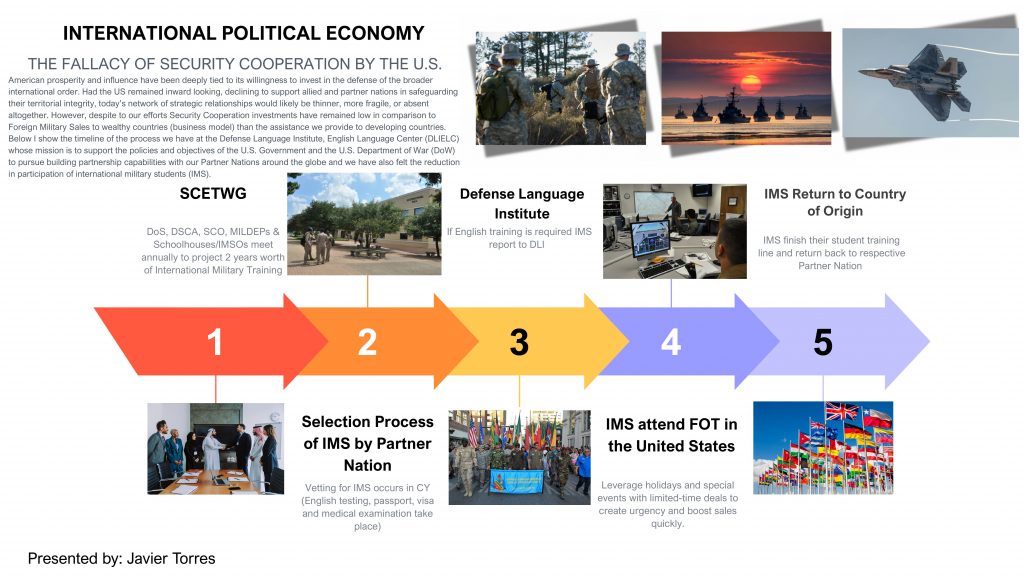

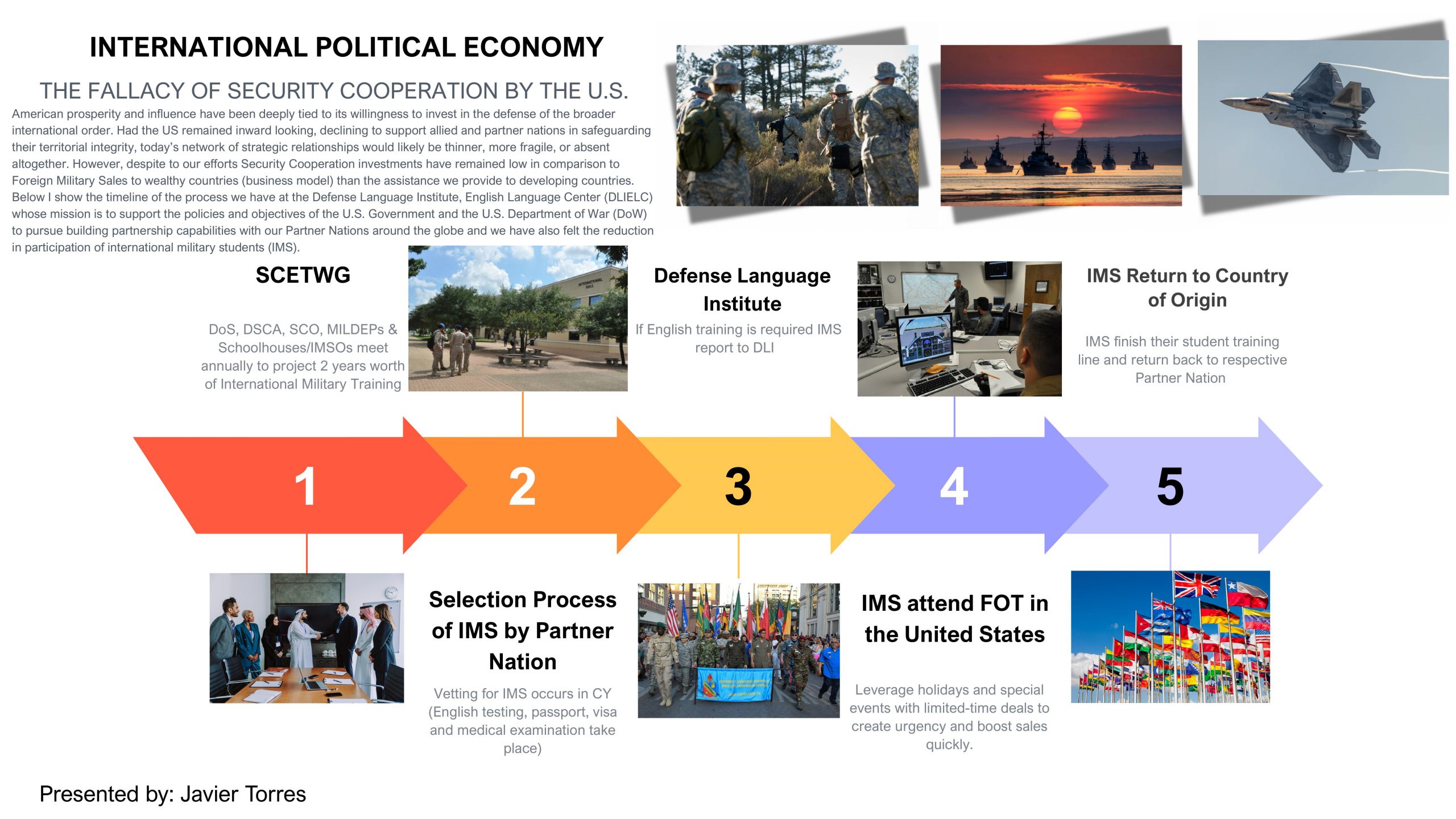
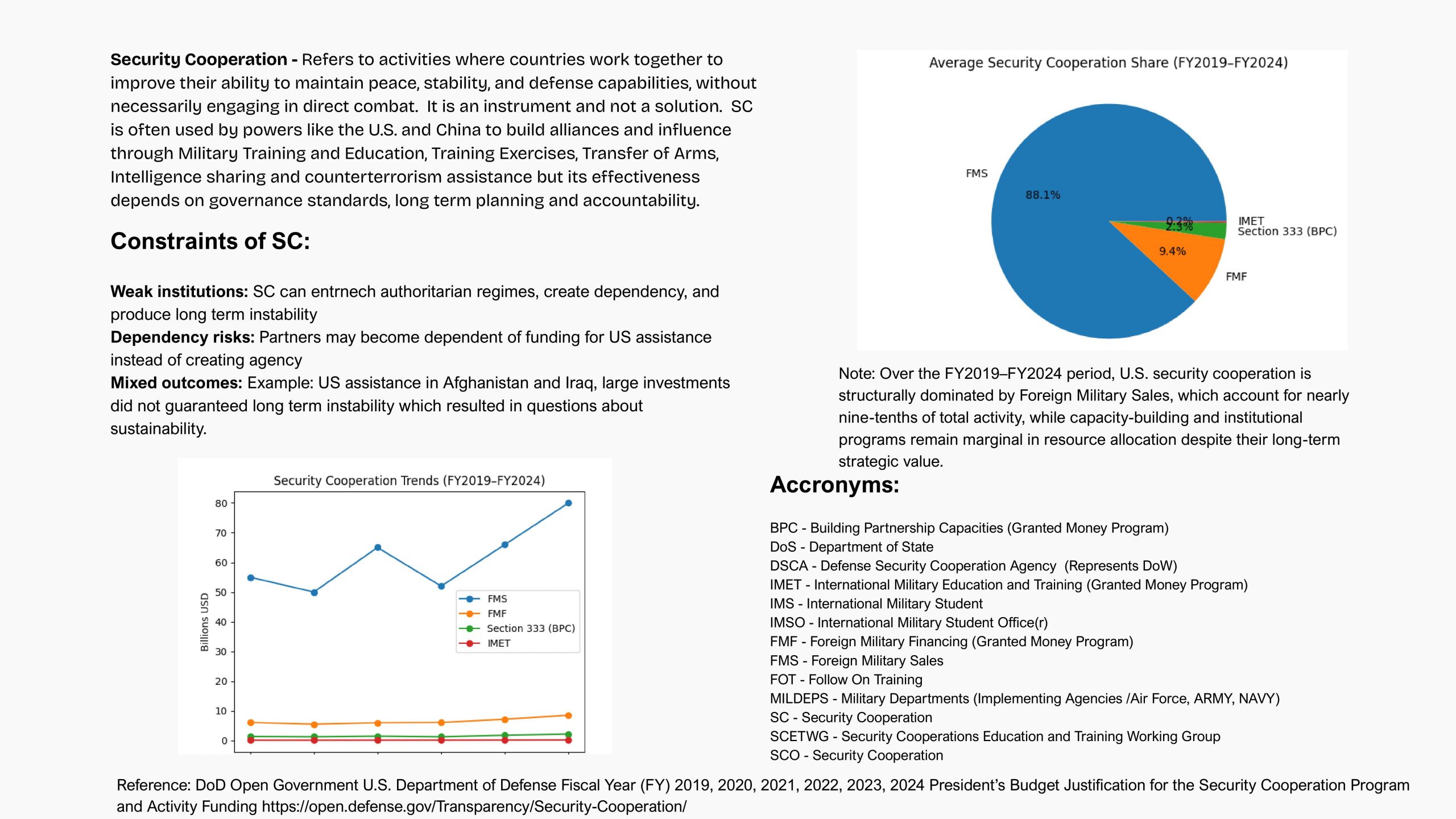
The growing narrative in Washington that Security Assistance (SA) and Security Cooperation (SC) have outlived their usefulness is less a reflection of reality than of frustration with uneven results. The problem isn’t the tool itself, it’s how it’s being used. Declaring security cooperation obsolete risks discarding one of the United States’ most cost-effective instruments of global influence at precisely the moment great-power competition is intensifying. The purpose of my research is to try to demonstrate that what makes Partner Nations to stop engaging with the United States are external factors such as competition with China especially with its investments in the West, lack of follow up with the Partner Nations, genuine interactions, corruption abroad and weak institutions in developing countries. Funding to support our international military training programs have also dwindled and more red tape has been institutionalized for their execution. I have firsthand experience and better access to the particulars that I can use to prove my argument along with the break down information per Combatant Command and Military Department at the Defense Language Institute (DLI), and area of responsibility.

3 comments
David Tullius
Javier,
Having dealt with the red tape of training with foreign militaries brought to the U.S specifically for that purpose, I know the pain. Every major school that I attended while on active duty contained officers from other nations, and it is fantastic investment in the overall safety of the country and the globe. I agree that we should be incentivizing these engagements in the face of adversity, not reducing them. Looking forward to your full paper!
Martin Gonzalez
I never knew how much went in regard to the connection between the US and other nations, especially with lesser developed states such as Vietnam or allies such as the EU. I go into Vietnam’s ever-growing tensions with China and how that’s affected their population’s outlook on them. While I didn’t get into the militaristic sides, the tensions brewing (along with the South China sea) has affected their willingness for military growth in case of conflict with China.
Emilio Orona
Hey Javier, I really liked that this infographic questions the usage and importance of Security Assistance and Security Cooperation. They are used as U.S foreign tools, but I like how you criticized the way they are implemented and not the tool itself. This connects meaningfully to my Bosnia and Herzegovina article, where post-conflict institutional complexity and external geopolitical pressures have historically influenced how international partnerships operate and are sustained. Just as your research highlights that outcomes in security cooperation depend heavily on external competition and internal governance capacity, Bosnia and Herzegovina illustrates how fragmented institutions and competing external influences can shape the effectiveness of international engagement and long-term stability efforts.