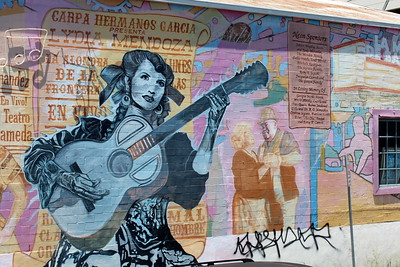

The moment she walked past the walls of one of the most influential Tejano radio stations in Texas, seventeen-year-old Lydia Mendoza knew that she was right where she was meant to be. She situated herself on a wooden stool, clutched her bajo sexto (12-string guitar), and waited for the signal to start playing. Throughout her young life, Lydia had defied the traditional role of women, survived racial oppression in American society, and worked through financial shortcomings. Her driving force was her music. Her passion, persistence, and self-assurance brought Lydia to this moment. She sang “Mal Hombre” (Cold-hearted Man), the iconic song that not only started her career, but inspired her to defy all of these challenges she faced as a young Mexican woman trying to preserve her identity. In preserving herself, she carved a space for women in a genre that continued to profit from their subordination. She never crumbled under the authority of men, even as a teen, and she fought to follow her creative aspirations on her own terms. She was Lydia Mendoza, who would become known as “La Alondra de la Frontera y La Cancionera de los Pobres” (the Meadowlark of the Border and the Songstress of the Poor). This is the story of the resilience of Lydia Mendoza and the moment that launched her to become the voice of the voiceless, changing the Tejano music industry forever.
Lydia Mendoza was born into a migrant working family in 1916 in Houston, Texas. Her father, Francisco Mendoza, worked as a railroad mechanic, which required him to move around the border area frequently. Her family was wholly dependent on the menial earnings of her father and followed him wherever his work took him.1 Throughout these movements, Lydia and her family experienced direct and indirect racism from society and from U.S. authorities. Lydia’s most stark experience of this racism and cruelty against Mexican immigrants occurred early on in her family’s travels, when Lydia was only four years old. Shortly after passing through the border into Texas, U.S. border patrol doused Mexican families with gasoline. The gasoline took over Lydia’s mouth, ears, and eyes, and caused her to become very ill.2 Lydia’s life would be defined within the confines of racial cruelty, oppression, and survival.
Constantly on the move and barred from the American school system, a formal education was never an option for the Mendoza children and especially not for the Mendoza girls. Lydia’s father did not see a point in his daughters receiving an education if they were just going to get married and move out. If this was the case, as was the case for so many women before them, it made more sense to have the girls help around the house and prepare them for this lifestyle. In defiance of her husband, Lydia’s mother Leonor took it upon herself to educate her children at home. Leonor was determined to provide her daughters with the structure and independence that her own father denied her. She taught her children to read and write, and the basic lessons of life. Her mother’s defiance was Lydia’s first example of female resilience. Seeing how her mother found a way to give her children some kind of education regardless of their unpredictable situations proved to Lydia that no matter what, there’s always a way to pave her own path.

Music had always been a part of Lydia’s upbringing too, and it offered her family a break from their day-to-day social and economic struggles. Lydia’s parents were both skilled guitarists and they often sang the corridos (Mexican ballads) that they had grown up with around their children. Corridos give insight into the Mexican experience and emotions, often telling stories of immigration, violence against Mexicans, love, and loss.3 Francisco and Leonor took these stories and their instruments wherever their family had to relocate to next. Lydia always admired her parents’ talents, and the songs they’d sing helped Lydia navigate through the everchanging world around her. However, one thing she wondered was why these songs were all about a man’s experiences? She knew that men weren’t the only ones crossing a border or experiencing racism, as she, as a young woman, was also living that every day. When was she going to hear the woman’s perspective? Did Mexican women even get played on the radio?
Learning to play an instrument was an ordeal for four-year-old Lydia. Lydia’s parents often had to keep their instruments away from young Lydia. Her father preferred she do chores like a lady, and her mother didn’t think she was old enough to handle the instrument properly. To disprove her parents’ assumptions, Lydia pieced together a wooden plank, six loose nails, and a few rubber bands to build her own make-shift guitar. If they weren’t going to give it to her, she’d make it happen.
“So I hooked up the rubber bands from one end of the board to the other. And, of course, with pressure they made a sound…which for me was the sound of a guitar. And it made me so happy to imagine—at that age—that I had a guitar. It was a guitar for me.” 4— Lydia Mendoza interview by Chris Strachwitz with James Nicolopulos, 1993.
Era yo una chiquilla todavía (I was just a young girl)
Cuando tú, casualmente me encontraste (when found me by chance)
Y a merced de tus artes de mundano (and at the mercy of your worldly charm)
De mi honra el perfume te llevaste (you took the essence of my innocence)
Lo dijiste conmigo lo que todos (and you did with me like everyone else)
Los que son como tú con las mujeres (the way other men like you are with women)
Por lo tanto no extrañes que yo ahora (so, don’t be surprised that now)
En tú cara te diga lo que eres (when I tell you to your face what you are)8
While Lydia was yet too young to be hurt by this type of romantic relationship, Lydia had been hurt by the words and actions of racism, the expectation to conform to her gender role, and always having to push through these barriers just to be happy. If she ever got the chance to perform it, she knew it would come from the heart. One day the grocery store ensemble invited Lydia to join them and sing.9 She was confident in her abilities to perform with the same heart and passion as the adults. Through her self-conviction, self-discipline, and straight up love for the culture of her community, Lydia showed that a ten-year-old could definitely keep up. Imagine what she could do as her skills and her voice matured.
Lydia’s fearlessness opened her parent’s eyes to her potential, which ultimately changed the course of her family’s lives. When Lydia was just twelve years old, her father took the lead in developing his children into a Tejano group, the “Cuarteto Carta Blanca,” (White Card Quartet) (c.1928). The Mendoza’s neighbors invited the group to perform at small gatherings and traditional celebrations. Lydia and her siblings built their confidence as performers, and it strengthened their bond as a family. Her parents realized that their children were good enough to pursue music full time as “migrant singers.” Francisco quit his job on the railroad and the Mendoza’s began traveling from town to town, performing on street corners and in restaurants for tip, hoping to make it big.10

Moving forward, music and performing held a new meaning to Lydia; it became a way to survive. Following their family’s new dream didn’t necessarily mean that life was going to be easier. If anything, the life of a traveling musician amplified their financial hardships and racial exclusion. The Mendoza’s had to travel unconventionally by hitch-hiking and train-hopping. Purchasing train tickets for the whole family was financially unfeasible. Even then, the family would not be permitted to ride on the train because of their race. Almost every time the family made it to a new town, the Mendoza’s immediately felt the racist scorn of white society. Lydia saw how the messages in each song spoke to the common struggles of her community, a largely migrant worker population. She realized that words could mend the aches in their lives and empower people to keep going. Lydia knew that these families were probably experiencing the same kind of hate and hardship as her family, so her music created brief moments of sanctuary and safety. Despite these roadblocks, her passion for music and belief in herself anchored her down to defy this hate and discrimination. Lydia was determined to learn the songs of her community, and eventually, tell her own stories.
In 1928, the Mendoza’s settled in Kingsville, Texas after a few months of touring in Texas. Francisco Mendoza came across an ad in La Prensa, a Spanish-language newspaper based in San Antonio, from the Okeh Record Company.11 The record company was calling for musical acts to be recorded, and they would pay for their work. Francisco begged a friend to let him borrow his car, and the Mendoza’s were off to San Antonio. Francisco signed the group to record twenty songs for $140.12 To the Mendoza’s, this was a huge paycheck to compensate for their rough journey; however, for Lydia, this opportunity proved to her that the challenges she faced would be worth it if it meant she could broadcast her voice.
Following this experience, the Mendoza’s traveled along the route of migrant workers coming from Texas to Michigan. As they entertained these communities, Lydia experienced a full circle moment. Like those ensembles she would watch every weekend in Monterrey, performing in these communities was much more than entertainment, but an escape from the racism, discrimination, and economic conditions they were navigating through in the United States. Traveling came to an abrupt halt in 1929 with the onset of the Great Depression. The economy collapsed and American society blamed migrant workers for their job loss. Migrant workers in the north were forced to relocate, and many, like the Mendoza family, trekked back south.13
The Mendoza’s found solace in the Mexican-American communities of San Antonio and decided to settle there in 1932, when Lydia was sixteen years old. Francisco and Leonor realized that they needed to focus more on actually creating a home for their family and finding a steady source of income. Lydia’s siblings’ interest in music had dwindled as her family found stable employment. But Lydia wasn’t going to let her family’s disinterest or financial situations dim the fire she felt for music. If they weren’t going to join her, she’d go out and do it herself. Almost every day for one year, Lydia packed her guitar, her tip box, and her courage to La Plaza del Zacate. In the early 1930s, La Plaza del Zacate, also known as the Haymarket Square, was the second largest outdoor market in the United States, dominated by Mexican vendors, salesmen, and entertainers earning any kind of money they could.14 Lydia stuck out like a sore thumb. While San Antonio was the perfect market for Tejano music, it was quite abnormal for a young girl to be out in public by herself, singing songs that were either written by men or too mature for a teenager to experience.

Male artists dominated the Tejano music industry, with the most popular songs being those that cast women as subversive, naïve characters.15 Male entrepreneurs also dominated the La Plaza del Zacate business, and initially dismissed Lydia’s performances. Lydia heard the sneers and the giggles, and saw men and women roll their eyes at a seventeen-year-old trying to perform mature, male content. Why was this young lady not accompanied by one of the men in her house? Why was she not behind a food stand like other women in the market? What made her think she could sing like a man? It was Lydia who decided she didn’t need a chaperone; Lydia decided that she could do more than make tortillas; Lydia knew she could very well keep up with any man. Whispers and rumors from random bystanders were nothing compared to the social and economic struggles she had faced in her young life.
One of these bystanders was Manuel J. Cortez, host of “La Voz Latina.” His radio show was a popular evening broadcast targeted to the Tejano community of south Texas.16 Manuel himself was a barrier breaker in Latino popular culture, trying to establish a music platform that served the minority population. One day in 1934, Cortez was eating dinner with his wife when he heard Lydia’s young, yet soulful voice. It was incredibly bold for a young woman to be singing out in the open, alone, and seemingly unbothered by the world around her. Lydia was in a trance when she played; when she performed, she cancelled all the literal and emotional noise around her. Her passion was evident to Cortez and he knew he had an opportunity to make a splash in the Tejano music industry with the gem that was Lydia Mendoza. Cortez approached Lydia and invited her to sing in a singing contest he was hosting. Her parents were apprehensive to let their daughter go on her own, but Lydia felt that this was her shot. Lydia entered the contest singing the song that she first saw herself in, the song that gave her a glimpse of hope that women could exist in Tejano traditions: “Mal Hombre.”
Lydia’s passion bled through every word of the song. To her, el “mal hombre” symbolized the male perspective that dominated every other Tejano song she had ever heard. El “mal hombre” represented the expectation that Mexican women should stay home and tend to their man. El “mal hombre” embodied all of the racism and discrimination she and her family had ever faced in the United States.
Poco tiempo después en el arroyo (Some time after, at my lowest)
Entre sombras mi vida defendía (I was defending my life within the shadows.)
Una noche con otra tú pasaste (You spent one night with another woman,)
Que al mirarme sentí que te decía: (when you saw me I felt like saying to you)
“¿Quién es esa mujer?” “¿Tú la conoces?” (Who’s that woman, do you know her?)
Y a la ves respondiste “una cualquiera” (and at the same time you responded, “a nobody”)
Al oír de tus labios el ultraje (Upon hearing the insult from your lips)
Demonstrabas también lo que tú eres (you were also showing your true colors)
Mal hombre (cold-hearted man)
Tan ruin es tu alma que no tiene nombre (your soul is so ruined; it has no name)
Eres un canalla. Eres un malvado (You are a bastard. You are a villain.)
Eres un mal hombre (You are a cold-hearted man.)17

The presence of Lydia Mendoza in Mexican pop culture was inspiring for the Mexican community for a number of reasons. To say that Lydia came from “humble beginnings” is only the tip of the iceberg. The Mendoza’s were a migrant family, living week to week, barely scraping by, and always under the thumb of racism.18 For this reason, Lydia Mendoza became known as “La Alondra de la Frontera” and the “Cancionera de los Pobres;” she sang about the Mexican-American reality. Most of all, Lydia experienced these hardships as a young woman, which created more hoops she had to jump through. Most notably, men had dominated the budding Tejano industry producing songs that reinforced women’s secondary place in Mexican society. Lydia flipped the industry on its head with the debut of a song that casted men as nasty antagonists. She would spend the rest of her career writing and popularizing female-driven narratives that empowered women to find their voice. When we think about women in Tejano music, who are the artists that immediately come to mind? We often think of the big names like Laura Canales, Selena Quintanilla, and Elida Reyna today. These women have achieved considerable success and celebrity status. Lydia Mendoza was the first woman to enter the Tejano music industry and pave the way for women to reach the fame and success equivalent to their male counterparts.
Mal Hombre” became synonymous with Lydia’s legacy as the first woman of Tejano music, and it became one of the first anthems of Latina empowerment for generations to come. One mal hombre, or ten mal hombres, cannot defy a woman who knows her strength.
- Agustín Gurza, “Strachwitz Frontera Collection Artist Biography: Lydia Mendoza, Meadowlark of the Borderlands,” Strachwitz Frontera Collection of Mexican and Mexican American Recordings, July 6, 2017, http://frontera.library.ucla.edu/artists/lydia-mendoza. ↵
- Lydia Mendoza, A Family Autobiography, ed. Chris Strachwitz and James Nicolopulos (Michigan: The University of Michigan Arte Público Press, 1993), 10. ↵
- James S. Griffith and Celestino Fernández, “Mexican Horse Races and Cultural Values: The Case of Los Corridos del Merino,” Western Folklore, 47, No. 2 (1988): 130. ↵
- Lydia Mendoza, A Family Autobiography, ed. Chris Strachwitz and James Nicolopulos (Michigan: The University of Michigan Arte Público Press, 1993), 12. ↵
- Mary Ann Fergus, “Lydia Mendoza, ‘Lark of the Border’ sings no more,” Houston Chronicle, September 23, 2001 updated August 15, 2011, https://www.chron.com/news/article/Lydia-Medoza-Lark-of-the-Border-sings-no-more-2023666.php. ↵
- Lydia Mendoza, A Family Autobiography, ed. Chris Strachwitz and James Nicolopulos (Michigan: The University of Michigan Arte Público Press, 1993),18. ↵
- Carlos B. Gill and Carlos Gil, “Lydia Mendoza: Houstonian and First Lady of Mexican American Song,” Houston History Magazine, Summer 1981, 254. ↵
- Lydia Mendoza, “Mal Hombre,” recorded 1934, Bluebird Records, record. ↵
- Carlos B. Gill and Carlos Gil, “Lydia Mendoza: Houstonian and First Lady of Mexican American Song,” Houston History Magazine, Summer 1981, 254. ↵
- Agustín Gurza, “Strachwitz Frontera Collection Artist Biography: Lydia Mendoza, Meadowlark of the Borderlands,” Strachwitz Frontera Collection of Mexican and Mexican American Recordings, July 6, 2017, http://frontera.library.ucla.edu/artists/lydia-mendoza. ↵
- “¡Solicitamos! Si usted sabe cantar, o si toca algún instrumento musical la Okeh Phonograph Corporation de New York City,” La Prensa (San Antonio, Texas), Feb. 26, 1928. ↵
- Mary Ann Fergus, “Lydia Mendoza, ‘Lark of the Border’ sings no more,” Houston Chronicle, September 23, 2001 updated August 15, 2011, https://www.chron.com/news/article/Lydia-Medoza-Lark-of-the-Border-sings-no-more-2023666.php ↵
- Erasmo Gamboa, The Great Depression, Deportations, and Recovery in Bracero Railroaders: The Forgotten World War II Story of Mexican Workers in the U.S. West (University of Washington Press, 2016) 31. ↵
- Carlos B. Gill and Carlos Gil, “Lydia Mendoza: Houstonian and First Lady of Mexican American Song,” Houston History Magazine, Summer 1981, 257. ↵
- Agustín Gurza, “Strachwitz Frontera Collection Artist Biography: Lydia Mendoza, Meadowlark of the Borderlands,” Strachwitz Frontera Collection of Mexican and Mexican American Recordings, July 6, 2017, http://frontera.library.ucla.edu/artists/lydia-mendoza. ↵
- Agustín Gurza, “Strachwitz Frontera Collection Artist Biography: Lydia Mendoza, Meadowlark of the Borderlands,” Strachwitz Frontera Collection of Mexican and Mexican American Recordings, July 6, 2017, http://frontera.library.ucla.edu/artists/lydia-mendoza. ↵
- Lydia Mendoza, “Mal Hombre,” recorded 1934, Bluebird Records, record. ↵
- Yolanda Broyles-Gonzalez, Lydia Mendoza’s Life in Music (New York: Oxford University Press, 2001), 182. ↵
41 comments
Yanelle Nicholson
This article is a great representation of Lydia Mendoza and the mark that she left. It is very fulfilling to see an empowering article written about a Latina woman who was able to defy such oppression. Music wasn’t only her passion, it was her means of survival. Lydia Mendoza is an icon that will never be forgotten especially for the Mexican community.
Rosa Deyo
This is such a lovely article! There is so little representation of Latinas in writing today, it’s really lovely that you decided to share this story. It’s so inspiring to see Lydia Mendoza chase her dreams and pursue music. I think the paragraph where you explain how she started learning music is especially intriguing, and really shows how dedicated Mendoza was to learning music even from such a young age.
Veronica Lopez
I personally loved this article! Throughout all this semester, I didn’t see an article written about a Mexican. Especially a Latina. I also loved her story, it’s one of many stories that hasn’t been told. I found it interesting how music and performing gave her a new meaning which was to survive. It reminded me of many Mexican families and how they had to immigrate from Mexico to the US in order to survive. By the way, congratulations on your award! You deserved it.
Amelie Rivas-Berlanga
I loved this article! It is incredible that she was able to overcome so many barriers and fight for her dreams at such a young age. As a Latina woman, this article really gave me a boost of confidence in continuing to strive for my goals. I love how you included a video! it expresses why her music was so controversial. I love how you decided to write about a woman that came before all the mainstream Latino/a artists, especially with both societal and traditional gender roles being so prominent during this time.
Erika Longoria
This article was not only very informative about Lydia Mendoza, but about many Latina women during the 1900s. Growing up, I heard about Lydia Mendoza, but never knew about her past or great influence on Tejano music. It is inspiring to learn that she had to go through all these different obstacles to become a musician and do what she loves.
Leon Martinez
I’d like to start off by saying, My jaw has hit the floor, I am very impressed by this article. Not only impressed but inspired to learn more about my ancestors that have fought so hard to make it in troubling times. Being a Latino I can’t imagine what my grandparents and great-grandparents went through as they grew up. For this young woman to follow her dreams, especially being so young, and to not listen to the ney sayers, she is the bravest I have ever had the pleasure to read about. Victoria Villasenor, Congrats on a job well done.
Dylan Miller
This article is an interesting read! As a child my grandma used to put her music on at parties, and I never knew what they were about, but now that I’m older, and because even now I still don’t know Spanish, this article is definitely helpful! I never knew that her songs were so important to Texas history! It’s great to learn about someone that contributed so much to Tejano culture, and had experiences so close to where I live!
Cecilia Schneider
To say this was a well written article is a complete understatement! The story you chose and how you went about about portraying this woman and her career was a joy to read! When I read this article it is difficult to picture Lydia without a bright smile on her face, which I know could not always be the case. To have gone through so much so consistently would break and wear down anyone, yet she did not budge. I am so glad you brought my attention to this musician! She is now my new favorite!
Luis Molina Lucio
I have heard of Lydia Mendoza and heard some of her songs but never learned about her past which this article really gave me the opportunity to do so. This article really describes and shows how the life of Latina women in the 1900s was and how Lydia Mendoza worked her way through societies obstacles to eventually influence the Tejano music. Lydia Mendoza was a woman who had inspiration from the negatives in her life and was able to embrace them to help her achieve her positive goals. I am glad I was able to learn more about Lydia Mendoza and how she came to coming up with her influential songs.
Haley Ticas
Thank you Victoria for introducing me to Lydia Mendoza. I had never heard of Lydia Mendoza prior to this article, however i am glad i was able to read this article and be introduced to someone new that influenced my culture and one of my favorite genres of music. It is great to read that her family supported her passions of sining and allowed her to pursue a music career in the Tejano music genre. Great job!