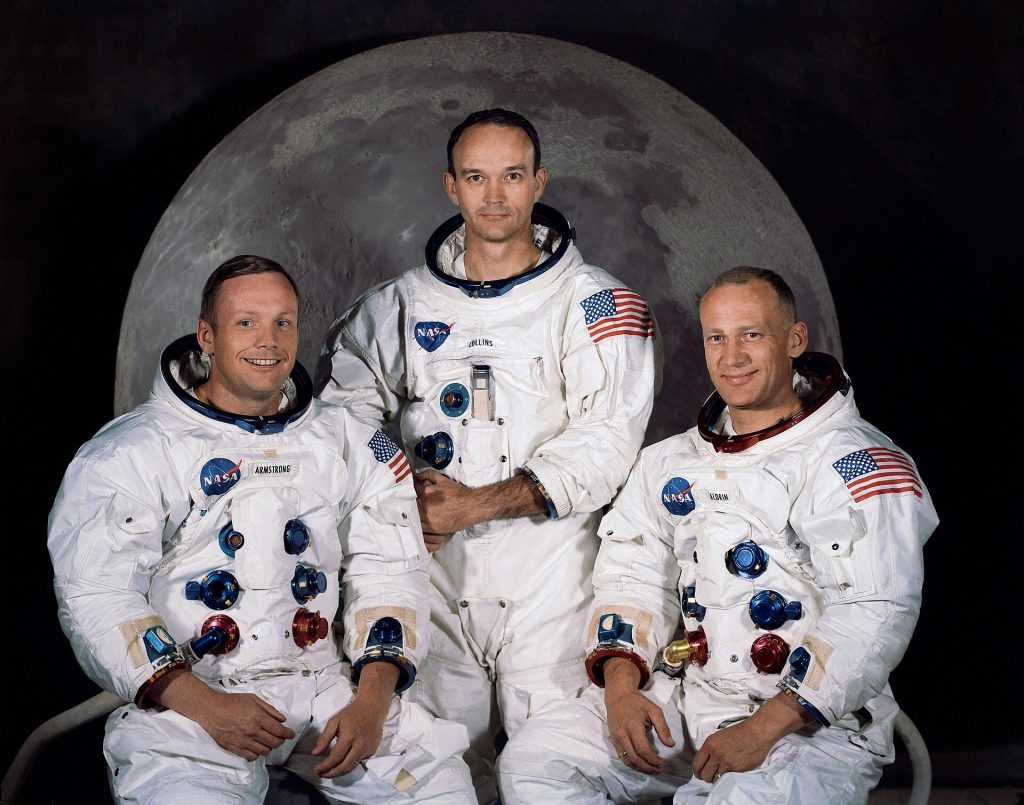

On July 16, 1969, a group of astronauts left earth to make history, by sending Neil Armstrong, Buzz Aldrin, and Michael Collins to land on the moon for the very first time. On July 20, they arrived at the moon. Neil Armstrong and Buzz Aldrin became the first men to ever step foot on the moon while millions of people were watching from their televisions at home. Not only was Apollo 11 successful, but it showed groundbreaking technology advancements and space travel by NASA. This paper will explain the ins and outs of landing on the moon, the night before, and everything that went wrong.
The lunar module Eagle started the trip with all looking nominal. At 9:32 a.m. EDT, the engines fired and Apollo 11 cleared the tower. About 12 minutes later, the crew was in Earth orbit. Then, after one and a half orbits, Apollo 11 got a “go” for what mission controllers called “Translunar Injection” – in other words, time to head for the moon. Three days later, the crew was in lunar orbit. A day after that, Armstrong and Aldrin climbed into the lunar module Eagle and begin the descent, while Collins orbited in the command module Columbia.1
Then, the guidance computer abruptly indicated a 1202 alarm. It was a foreign code in the context of real-flight — something that only appears in simulations. The room, which had been full of muting talk and shoutings, sank into deep silence. Nobody was instantly certain as to the meaning of the alarm, and doubt had begun to spread as much as anyone was inclined to acknowledge.2
“Program alarm,” announced Armstrong. “It’s a 1202.” The code was so obscure, almost no one knew what it meant. Should they abort? Should they land? “What is it?” he insisted. Scrambling back in Houston, a young engineer named Steve Bales produced the answer: The radar guidance system was pestering the computer with too many interruptions. No problem. “We’ve got you…” radioed Houston. “We’re Go on that alarm.”2
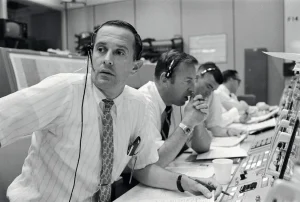
That ruling picked its way up the line. “You are Go for powered descent” mission control to the crew aboard the Eagle.4 The downward passage continued, but the margin of error had decreased. What previously was a daily landing was now something much more delicate due to “The bug-shaped Eagle was so fragile a child could poke a hole through its gold foil exterior. Jagged moonrocks could do much worse.”2
As the module fell down, “Neil Armstrong peeped through the window and observed a new threat the computer had not taken into consideration. The autopilot was directing them to a huge crater, the surface of which was covered with large boulders.”2 Landing on it would surely cause the spacecraft to tip or crash. The landing field at which they were training could not be seen.
“Armstrong had no time to wait to receive instructions so he made a very crucial decision, he took control of the spacecraft with his hands.”2 He was now flying the Eagle by hand, rather than programmed instructions, across the lunar surface in search of an unclouded stretch of ground. The Moon came rushing towards him. Next to him the ration of fuel was steadily shrinking.
In Houston, the tension had taken a new twist as the controllers started calling out fuel warnings. There were “60 seconds” of hover time. With every update the pressure was tightened. A silence nearly completely followed, interrupted by the clipped, measured voices pronouncing the countdown. No one was unaware of how low the margin would be. “Thirty seconds”: then it was the second warning that came awful fast.8 Had Armstrong been unable to land within the time limit the mission would have to be abandoned, or even more disastrously, the crew might have been killed. There was no unnecessary talking. Everybody turned their gaze on the information, on the loop of voices, on the destiny of the mission under process in reality.
The critical moment of the landing was influenced by the issue that was never clear of its problems, the guidance computer kept on flashing the 1202 alarm until the last moments of the descent. The trouble that at first seemed like one loud, frightening interruption was now a constant danger, and was a reminder to them that a thing run on wheels was not working smoothly. Each transmission of the code strengthened the indecision: the computer was overloaded, and yet it had to continue working as long as necessary to land.2
The weight of that previous choice still remained as Neil Armstrong steered the spacecraft downwards. The result of the choice was becoming real time and had been allowed to play out by Mission Control. Now the alarms were still to show, and the fuel was nearly exhausted, so there was no time now to lose. Armstrong desperately sought a good landing point, since there was barely room to do so. Now dust started to lift the surface and the Eagle was hovering just over the Moon, making Armstrong unable to see. The already overloaded computer could not be of much assistance at that point. He used his judgment and slowly brought the spaceship down, battling the visibility as well as the clock. Silence prevailed in the room at Houston, all the people knew how the mission was now balanced on seconds. Then it happened. The downward advance became more gradual, the movement more resistant, and a contact was achieved. Armstrong came through at last: “Houston, Tranquility Base here. The Eagle has landed.”1
As though the room needed to declare that the alarms, the doubt, and the danger had been really defeated, the tension held for a moment or so. Then some relief swept through the Mission Control. The system which had thrown the 1202 warning flash had just lasted long enough. And, in spite of the danger, in spite of the alarms, the landing was a success.2
Once the news was announced that the Eagle landed, “Immediately, they prepared to leave. This was NASA being cautious. No one had ever landed on the Moon before. What if a footpad started sinking into the moondust, or the Eagle sprung a leak? While Neil and Buzz made ready to blast off, Houston read the telemetry looking for signs of trouble. There were none, and three hours after touchdown, Houston gave the “okay.” The moonwalk was on!” 2
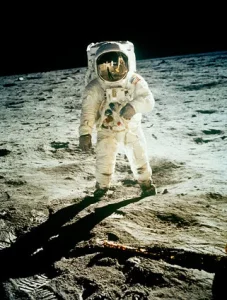
Back in the lunar module Armstrong and Buzz Aldrin had started the painstaking task of post-landing tests. All systems must have been ensured to be stable before anything else should be done. The Moon was silent and still outside, which, in comparison to the tumult descending, seemed vast and calm. What a few hours before had been an arena of peril was now of man first but once an arena of safety.2
Back home in Houston, the intensity of communication changed to confirmation as opposed to urgency. When Armstrong said, “Houston, Tranquility Base here. The Eagle has landed,” Mission Control erupted in celebration as the tension broke. “You got a bunch of guys about to turn blue, we’re breathing again.”1
During the following hours, the landing was forgotten and the next moment was focused. The crew got ready to do their historic moonwalk, and the new phase of support came to the mission control and left behind an American flag. But the gravity of the descent seems never to have quitted the room. It was a risky moment: computer alarms, low fuel, and decisions at the last moment, but it had ended with success. “Armstrong will later confirm that landing was his biggest concern, saying “the unknowns were rampant,” and “there were just a thousand things to worry about.”1
It was not only that the Eagle had safely landed but that it had landed there despite a flood of uncertainties at every moment that might have terminated the mission. The 1202 alarm, which used to be an indicator of imminent failure, now had become a component of a narrative of survival systems and human beings collaborating so long as to transform threat into success. “In a post-flight press conference, Armstrong calls the flight ‘a beginning of a new age,’ while Collins talks about future journeys to Mars.”1
- NASA, July 20, 1969: One Giant Leap for Mankind – NASA (Washington, D.C.: NASA, 2024), 1-2. ↵
- NASA, Wide Awake on the Sea of Tranquillity – NASA (Washington, D.C.: NASA, 2023), 1-2. ↵
- NASA, Wide Awake on the Sea of Tranquillity – NASA (Washington, D.C.: NASA, 2023), 1-2. ↵
- NASA, Wide Awake on the Sea of Tranquillity – NASA (Washington, D.C.: NASA, 2023), 1-2. ↵
- NASA, Wide Awake on the Sea of Tranquillity – NASA (Washington, D.C.: NASA, 2023), 1-2. ↵
- NASA, Wide Awake on the Sea of Tranquillity – NASA (Washington, D.C.: NASA, 2023), 1-2. ↵
- NASA, Wide Awake on the Sea of Tranquillity – NASA (Washington, D.C.: NASA, 2023), 1-2. ↵
- Alice Gorman, Apollo 11 at 50: How the Moon Landing Changed the World (Boston: The Christian Science Monitor, 2019), 2-3. ↵
- NASA, Wide Awake on the Sea of Tranquillity – NASA (Washington, D.C.: NASA, 2023), 1-2. ↵
- NASA, July 20, 1969: One Giant Leap for Mankind – NASA (Washington, D.C.: NASA, 2024), 1-2. ↵
- NASA, Wide Awake on the Sea of Tranquillity – NASA (Washington, D.C.: NASA, 2023), 1-2. ↵
- NASA, Wide Awake on the Sea of Tranquillity – NASA (Washington, D.C.: NASA, 2023), 1-2. ↵
- NASA, Wide Awake on the Sea of Tranquillity – NASA (Washington, D.C.: NASA, 2023), 1-2. ↵
- NASA, July 20, 1969: One Giant Leap for Mankind – NASA (Washington, D.C.: NASA, 2024), 1-2. ↵
- NASA, July 20, 1969: One Giant Leap for Mankind – NASA (Washington, D.C.: NASA, 2024), 1-2. ↵
- NASA, July 20, 1969: One Giant Leap for Mankind – NASA (Washington, D.C.: NASA, 2024), 1-2. ↵